
We didn't set out to move fast for the sake of it. We moved fast because the market was moving faster — and because what we saw in AI marketing needed to be fixed before it became permanent.
Three products. Four months. $3 million.
I want to be honest about what that number is, and what it isn't.
It isn't a marketing win. It isn't a lucky moment. And it definitely isn't proof that we built something the world needed just because we believed in it hard enough.
It's a signal — about how starved enterprise marketing is for AI that actually works, and how long that wait has been.
To understand why this happened, you have to understand what we were seeing in the market. And what we were seeing wasn't pretty.
The Lie That Built a Billion-Dollar Category
For the better part of five years, the AI marketing category was built on a broken promise.
Tools got faster, dashboards got prettier, and every incremental improvement got labeled AI — when what it really was, was automation. Rules-based logic. Nothing connecting the center.
The marketers living inside this reality knew it. They weren't short on data or tools — they had both. What they didn't have was any way to connect them. Most were managing six platforms manually, spending the majority of their time just preparing information, with barely any left to actually use it.
They were running campaigns on instinct, then pulling a Looker Studio report two weeks later to find out if the instinct was right. By then, the moment had already passed. That gap — between what AI promised and what it actually delivered — was something everyone in the industry felt but nobody had built a direct answer to.
We named it. Then we built against it.
Why We Moved Fast — and Why Speed Was the Strategy
The window to define a new category — to own the layer nobody else was claiming — doesn't stay open forever. We had a view on where things were going, and we made a decision that acting on it wasn't recklessness. It was the only response that made sense.
We built three products in roughly a year because each one answered a different part of the same problem, and waiting on any of them meant leaving that part of the market to someone else. I tell my team this a lot: if you see where things are going and you hesitate, you don't just miss the moment — you hand the category to whoever hesitated less.
That's not a philosophy we arrived at cleanly. It came from watching it happen to other people.
Prism: Built Because Insight Without Action Is Just Expensive
We started with the question that sits at the center of every marketing organization: why is it still so hard to know what to do next?
It wasn't a data problem. Most teams had more data than they could process. The issue was that none of it was connected — insights lived in silos, required an analyst to surface, and by the time something actionable emerged, the moment to act had usually passed. The majority of a marketer's working hours were going to preparation, not decisions.
Prism is the always-on intelligence layer that runs continuously against your live campaign data, surfaces what matters before it becomes a problem, and answers in plain English — not something you remember to check, but something that's already working when you get there.
More importantly, Prism doesn’t stop at insight. It can execute and optimize campaigns in an agentic way, taking actions directly across your marketing stack. That shift — from observing performance to actively improving it — marks a real leap forward in how AI supports marketers.
- Ask Prism what happened in the last 24 hours.
- Ask what happens if you increase the budget by 25%.
- Ask it to simulate three spending scenarios: aggressive, balanced, conservative.
The questions that used to require an analyst, a data pull, and three days of back-and-forth now take seconds. And because Prism is always running — not just when someone remembers to log in — it catches what falls through the cracks before it becomes expensive. Whether it’s fatiguing creative, a campaign pacing toward a budget cliff, or an audience segment underperforming before it drags the whole account down.
Prism’s integration with GA4 and paid channels brings campaign measurement into a single intelligent layer. By connecting Meta and Google Ads accounts directly with your GA4 property inside a Prism agent, marketers can analyze ad spend, platform performance, and actual on-site outcomes together. This allows Prism not only to compare platform-reported conversions with GA4 results, but also to continuously analyze the combined dataset and identify optimization opportunities. The result is a more reliable view of paid performance—one where insights emerge automatically from unified data rather than from manual reconciliation across multiple dashboards.
In its first six weeks, Prism processed over 100,000 prompts. More than 12,000 conversations turned directly into action plans.
Adroom: Built Because Creative Was the Biggest Lever Nobody Was Pulling
Creative drives roughly 70% of ad performance. That's not a new finding — it's been true long enough that most marketers can cite it from memory. What's strange is how little the industry had done about it. The creative process was still one of the slowest, most expensive parts of running a campaign. Weeks lost to photoshoots and agency turnarounds, and by the time assets were ready, the campaign window had often already shifted.
Adroom uses custom-trained brand models, not generic AI, to generate, personalize, and scale creative across every channel. It produces visuals, video, and copy that are on-brand from the first output. Bulk creation from product feeds. AI-enhanced editing. Built-in approval workflows that don't create new bottlenecks while eliminating old ones.
Across our customer base the creative turnaround is 87% faster, with a 28% average lift in ROAS — and the performance lift tracks directly back to the quality of what's coming out, not just the volume.
Pixis Visibility: Built Because the Execution Layer Was an Open Lane
The SEO + GEO market is a $5 billion ecosystem with over 100 tools. Research, scoring, auditing, rank tracking — all of it well covered. What nobody had built was a way to act on any of it without leaving the platform. Every tool stopped at the recommendation. What happened after — the content creation, the publishing, the measurement — was still 19 hours of manual work spread across platforms that didn't talk to each other.
Pixis Visibility bridges that very gap. It covers both sides of modern search.
On the SEO side: keyword gaps surfaced from your GSC data, scored by volume, difficulty, and CPC. Briefs generated. Drafts written, humanized, and published directly to your CMS. Every piece tracked for clicks, impressions, and ranking movement from the day it goes live.
On the GEO side: you define the prompts your customers are typing into ChatGPT, Perplexity, and Google AI Overviews. Visibility runs each one five times across all three — because generative engines don't give the same answer twice. You see where your brand stands, which competitors are being cited instead, and exactly what content gaps to close.
From opportunity detection through content creation through safe publishing to automated impact reporting, all in one connected pipeline. One platform that eliminates the fragmented workflow, closes the loop between publish event and outcome, and does it with brand-quality content that sounds human because it is.
It reached its milestone in 60 days. The fastest-growing product in the Pixis suite — in the most underserved category in a crowded market.
Three products, three market failures, three answers. And when you put them together, something larger than any single product emerges: a connected intelligence loop that runs continuously across creative, performance, and content.
What $3M in Four Months Is Actually Telling Us
When adoption moves this fast, it means one of two things: either the marketing was exceptional, or the pain was acute. In our case, I'm confident it's the second.
The marketers who adopt Pixis aren't chasing novelty. They are experienced practitioners who have been patient through years of AI hype, who know precisely what isn't working, and who recognize immediately — in the demo, in the first week of use — that this is categorically different from what they'd seen before.
They moved fast because waiting was costing them. Every week without a connected intelligence loop was another week of manual workflows, fragmented data, and creative bottlenecks. The cost of inaction was visible and it was real.
That's the larger market narrative underneath this number: the organizations that resolve the inconsistency, between AI that advises and AI that executes, will build compounding advantages over the next 18 months that will be genuinely difficult for slower movers to close.
$3M in four months isn't a company story. It's a market story. The product just happened to be ours.
The Numbers Behind the Movement
Across the Pixis’s Agentic Suite, now managing over $2.5 billion in ad spend globally:
34% average reduction in customer acquisition cost
28% average increase in return on ad spend
87% faster creative production turnaround
35% reduction in spend on audience testing
These numbers signify consistent patterns across hundreds of brands, produced by AI that learns from real campaign outcomes, not preset rules set at onboarding.
We're Just Getting Started
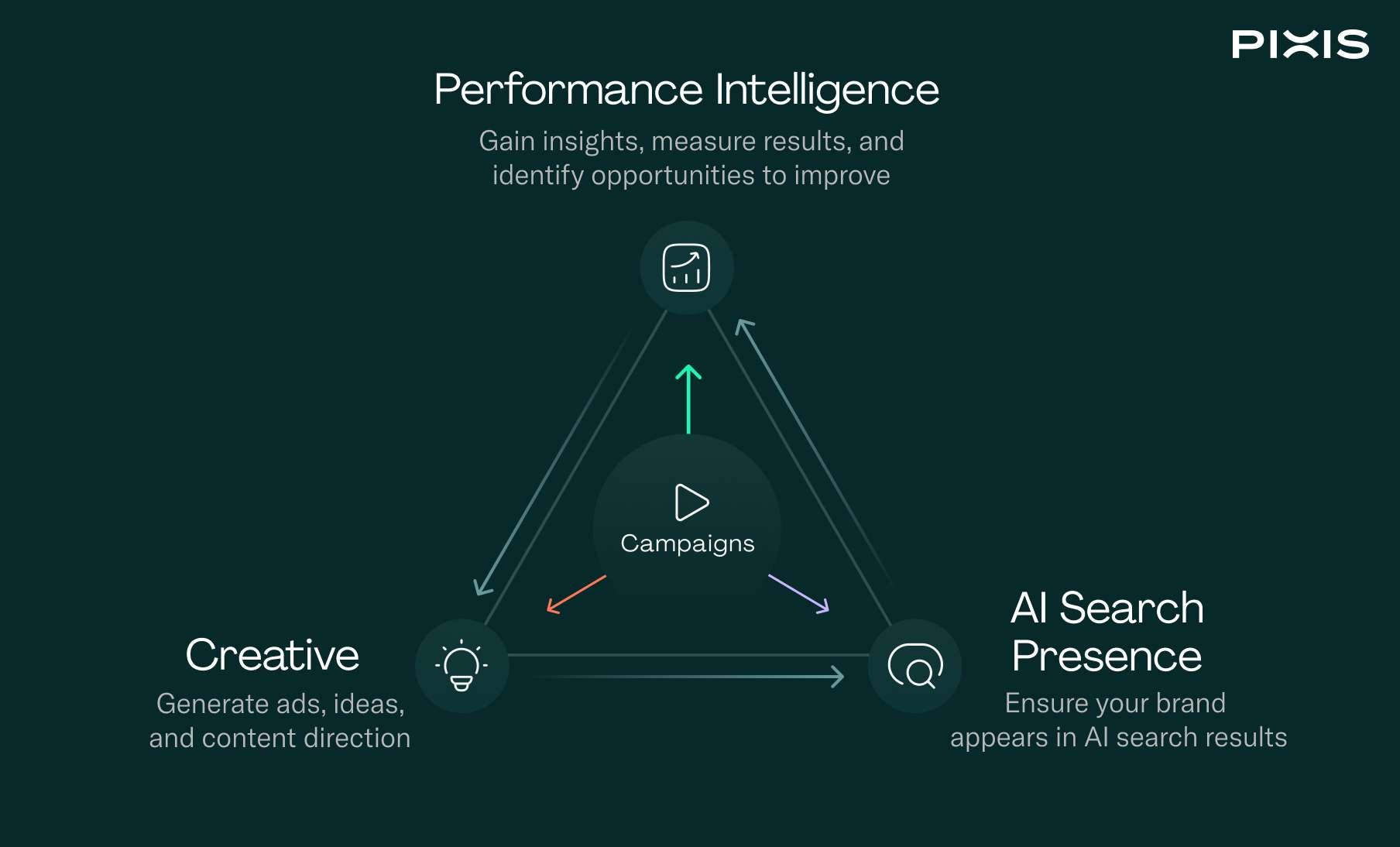
The roadmap ahead connects what we've already built into something greater than its parts. Creative insights from Adroom feeding directly into content strategy in Pixis Visibility. Performance signals from Prism shaping both. Full visibility into how your brand appears in AI search — and the ability to create, optimize, and publish content that competes for that ground, instantly.
The vision hasn't changed since we started building: a marketing organization where the loop from intelligence to creative to execution to measurement runs continuously, gets smarter with every campaign, and requires human judgment at the decisions that matter — not the workflows that don't.
The problem had been sitting there long enough. We decided to build into it.
Three products. Four months. $3 million. And a market that was clearly ready.