
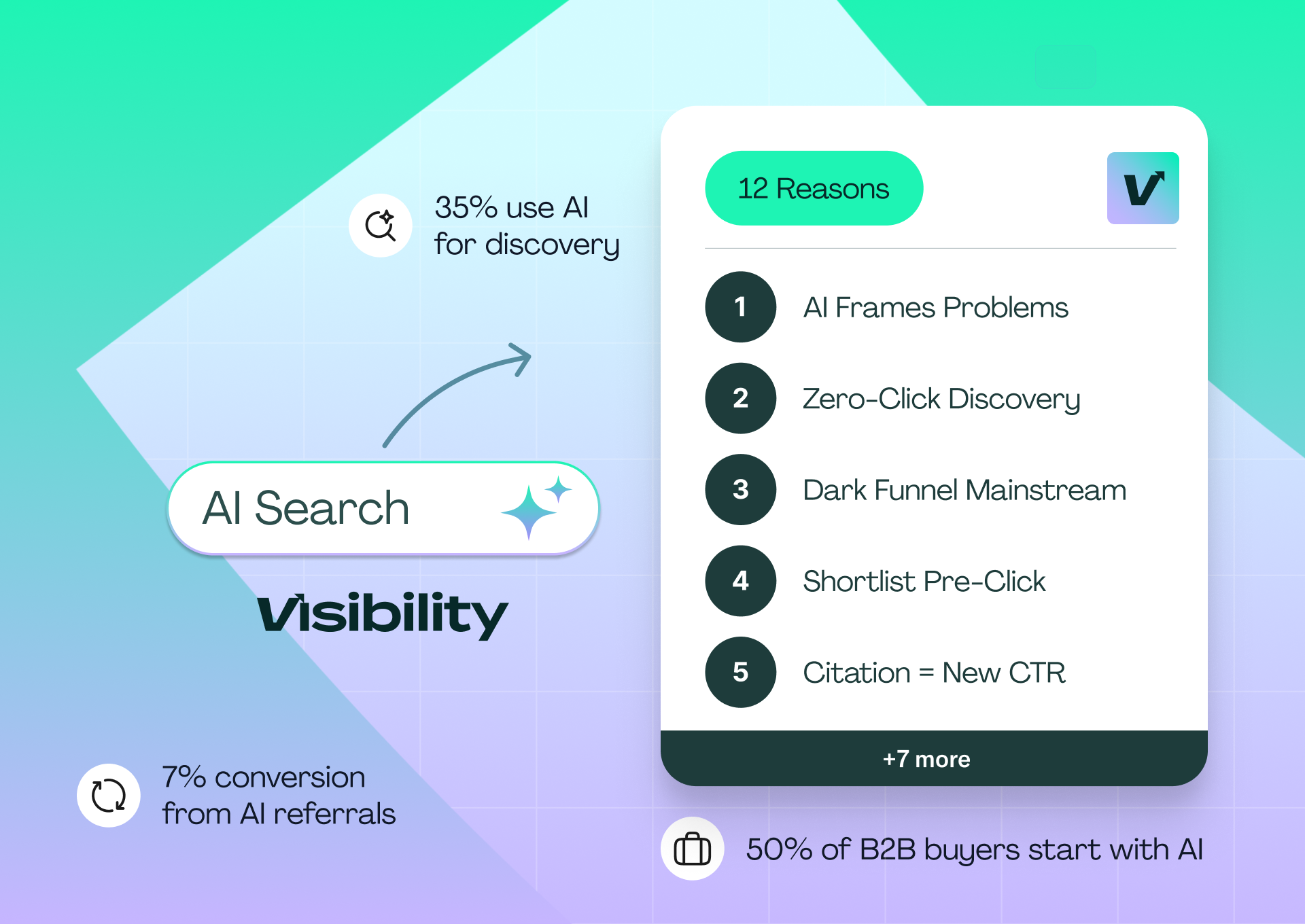
For a growing share of buyers, the shortlist is now set before they open a search bar. When someone asks an AI model to name the best tool in a category, the model frames the problem, names a handful of vendors, and describes each one, all inside an answer that can replace the results page entirely for that query. A brand left out of that answer is out of the consideration set before any website is visited, in a conversation that no analytics dashboard records. This is the structural change reshaping the top of the funnel, and the data behind it is not a projection: a US consumer panel found 35% now use AI tools at product discovery versus 13.6% who start with search. This guide covers 12 specific ways that shift reworks pre-click discovery and how to measure your presence within the answer.
Two-line summary: AI-mediated discovery increasingly shapes the buyer's shortlist before any click, in conversations traditional analytics cannot see. This covers twelve ways AI visibility reworks the top of the funnel and the metrics that actually track presence inside AI answers.
Key Takeaways
- Discovery is moving into AI answers: 35% of US consumers now start product discovery with AI tools versus 13.6% with search, so the shortlist can form before your site is visited.
- When an AI summary appears, users click a cited source about 1% of the time, so being named inside the answer matters more than ranking beneath it.
- AI shapes both whether your brand appears and how it is framed, and framing, not raw presence, is what moves buyer preference.
- Visibility tends to decline as buying intent rises, with pricing queries the most common blind spot, so measure discovery, evaluation, and pricing prompts separately.
- The metrics that matter are brand mention share, citation rate, entity recognition, and framing, not the rank-and-click metrics built for the old funnel.
Why the Top of the Funnel Is Changing
Marketing teams spent years optimizing for demand capture: chase the keyword, win the position, earn the click. That playbook assumed buyers search, see a list, and click through to evaluate. Generative answers break that loop by replacing the list with a synthesized narrative that frames the problem and names solutions inside the response, so the competition is no longer for a spot on a results page but for inclusion in a conversation.
The adoption data shows this is present-tense, not speculative. Across the buyer journey, AI leads in discovery by a wide margin (35% versus 13.6%), holds a smaller lead in evaluation (32.9% versus 15%), and narrows to near parity at purchase (24.3% versus 22.1%). The pattern is consistent: AI dominates the upper funnel where shortlists form, and traditional search increasingly closes the final transactional step. Traditional search has not stopped mattering; it still drives real demand, but it now runs alongside a parallel discovery layer that can shape the shortlist independently of your website.
The 12 Reasons
1. AI frames the problem before the buyer does
Before a buyer has fully defined their need, the model sets the criteria for what a good solution looks like. Ask for the best CRM for a mid-market SaaS company, and the answer frames the decision around specific attributes like integration depth, pricing transparency, and scalability. If your brand meets the criteria the model establishes, you enter the consideration set; otherwise, you are excluded before evaluation begins. Visibility here affects two things at once: whether you appear and the framing that shapes every recommendation that follows.
2. Zero-click discovery is the default
When an AI summary is present, users click a cited source within it only about 1% of the time, and click-through on any traditional result drops to 8% versus 15% without a summary. Most users are satisfied by the answer in the interface. That makes presence within the generated text the primary path to referral, rather than a byproduct of ranking for a keyword.
3. The dark funnel is now mainstream
A large share of research now begins in AI chat, which creates a discovery layer that traditional analytics cannot see. A lead that eventually reaches your site gives no signal that an AI assistant introduced your brand weeks earlier in a private conversation. That layer has to be measured directly, since it cannot be inferred from downstream traffic.
4. The shortlist forms before the click
AI answers typically name a handful of vendors, and the model curates that set from its training data, retrieval, and the current prompt before the buyer visits anyone. Once excluded from that shortlist, getting the buyer to your site is far harder, because they may never search for you by name. The job is no longer only to win a click; it is to secure a place on the pre-click list.
5. Citation rate is the new click-through rate
Click-through measured an action a user took. Citation rate measures an endorsement the model made: how often your brand is named as a trusted source in a generated answer. These are different signals, and being cited both drives downstream traffic and reinforces your position, since a model that has cited you is likelier to cite you again, which compounds against competitors it does not.
6. Entity consistency grounds how the model sees you
Models lean on structured data and entity signals to recognize and represent a brand across queries. When your name, category, attributes, and relationships are described consistently everywhere the model reads, it is more likely to classify you correctly and retrieve you for the right queries. A fragmented footprint invites misclassification or omission, though retrieval always stays somewhat variable.
7. Framing decides the recommendation
Being mentioned is not enough; how you are described sets your perceived value. Whether the model leads with your strengths or dwells on trade-offs, positions you as premium or budget, shapes the buyer's read before they reach your site. Favorable framing builds trust in advance; neutral or negative framing suppresses conversion before you can make your own case.
8. It creates demand rather than only capturing it
Traditional search is demand capture: it waits for intent and competes for it. AI visibility is closer to demand creation because a model answering a broad-category question can surface brands the buyer never searched for. Appearing in responses that frame emerging problems or whole categories generates fresh interest rather than only fighting over existing intent.
9. Query fan-out rewards depth
Models often run several background retrieval passes to produce a single answer, evaluating relevance across multiple sub-queries. Thin content gets discarded in that process; deep, topically authoritative resources survive it and become the building blocks of the synthesized answer, which raises the odds of being retrieved and represented accurately.
10. The funnel compresses
AI collapses discovery and evaluation into a single conversation, so a buyer can move from question to conclusion in minutes because the model has already synthesized the comparisons. That removes the room a slow nurture sequence used to rely on, and it means your value proposition has to be clear enough for the model to represent accurately in a sentence.
11. Category inclusion is the baseline
If your brand is absent from AI category answers, you lose consideration before any decision point, and that absence is an opening a competitor fills. Inclusion is not an advantage here; it is the price of participation, and recovering from exclusion is hard precisely because the buyer may never search for you directly.
12. AI referrals arrive further along
Visitors who come through an AI referral tend to arrive with context the model already gave them, which puts them deeper in evaluation than a typical search visitor and results in stronger conversions. Independent analysis has put the AI-referral conversion rate well above organic, roughly 11.4% versus 5.3% in one cross-site study, because the research and comparison happened inside the chat before the click. That makes AI referral one of the higher-intent sources available.
The Buyer Journey Now Fractures by Stage
The most useful pattern in recent research is that visibility declines as intent increases. An analysis of 212 AI visibility audits across the major engines found a consistent decline: brand visibility drops as buyers move closer to a purchase. At discovery, brands enjoy their widest presence, because buyers ask broad questions and models pull from a wide source pool. At evaluation, the queries narrow to features, pricing, and trade-offs, and the source pool tightens, so visibility begins to fall. By the pricing stage, it is the lowest of all, and the most common blind spot is pricing specifically, where a large share of audited brands show no presence at all.
The practical consequence is that a single top-level measurement can be misleading. A brand can look healthy on broad category prompts and be invisible exactly where buyers are closest to deciding. Measuring discovery, evaluation, and pricing prompts as separate stages is the only way to see where your narrative disappears. Pixis Visibility tracks share of voice across those stages and surfaces the specific prompts where competitors are cited instead of you, so the work targets the moments where absence costs the most, rather than guessing.
Measuring a Funnel That Lives Inside the Answer
Traditional SEO metrics are not obsolete, but they are incomplete for this layer. Rank and organic click-through still say something about search performance, and technical fundamentals like structured data and crawlability still matter. What they cannot tell you is whether you appear in AI answers, how you are described, or whether a competitor is named instead. That needs its own framework, built for generative output rather than blue-link streams.
Four metrics map to it. Brand mention share is how often you appear relative to competitors across a set of relevant prompts. Citation rate is how often you are named as a source, which signals authority and drives referral. Entity recognition is whether the model identifies you correctly and associates you with the right problem space. And framing is how the model describes you, favorably, neutrally, or against your positioning. The distinction between the last two and raw presence is the important one: a brand can be highly visible and poorly framed, mentioned often but described in terms that do not support it. Presence gets you into the answer; framing is what turns presence into preference, and early framing in a conversation tends to carry through to the final recommendation, so it is worth tracking whether your positioning holds as a conversation deepens or degrades. For the execution side of earning better framing, our guide on how to get cited by ChatGPT covers the content and authority signals that move it.