

The Brief Is the Bottleneck
Most creative testing programs fail before a single ad goes live. The failure point is not the creative itself — it is the brief. Vague hook direction. No brand voice guardrails. A variant matrix that is really just ten different ideas dressed up as a test. By the time the creative team has interpreted the brief, the 'variants' no longer isolate a single variable, the data is unreadable, and the team is back at zero for the next cycle.
This matters more now than it ever has. Creative drives 70% of campaign success, while media placement accounts for the remaining 30%, according to Google. A 2025 AppsFlyer report found that 70 to 80% of Meta ad performance comes down to creative quality — not budget, not targeting. With Meta's Andromeda algorithm now expanding the candidate pool to tens of thousands of ads per impression opportunity, the brief is the only production input you fully control.
What follows is the brief structure we built into Adroom — the fields, the logic behind each one, and the variant matrix that turns one proven concept into a replenishable rotation.
Why One Winning Ad Is Enough to Start
The instinct when building a creative testing program is to generate as many original concepts as possible. The data argues against it. In practice, only 1 to 3 out of every 10 creatives tested become genuine winners. That means the highest-ROI move is not producing ten new ideas — it is extracting maximum signal from the one idea that already works.
The approach that actually scales: isolate the highest-performing ad in your current rotation, identify the one element responsible for its performance — hook retention, CTA click-through, scroll-stop rate — and build a variant matrix that tests controlled changes against that control. Changing just one variable at a time is what makes the data readable and the next brief faster to write.
The 80/20 testing rule: 80% of spend on proven control creatives. 20% allocated to testing variants. This ratio keeps performance stable while continuously building a pipeline of challengers to promote.
On variant volume: The right number of variants to test simultaneously is 3 to 5 per test — enough variety to surface patterns, not so many that budget spreads too thin to reach statistical significance. Each variant needs a minimum of $100 to $150 in spend to produce a reliable read.
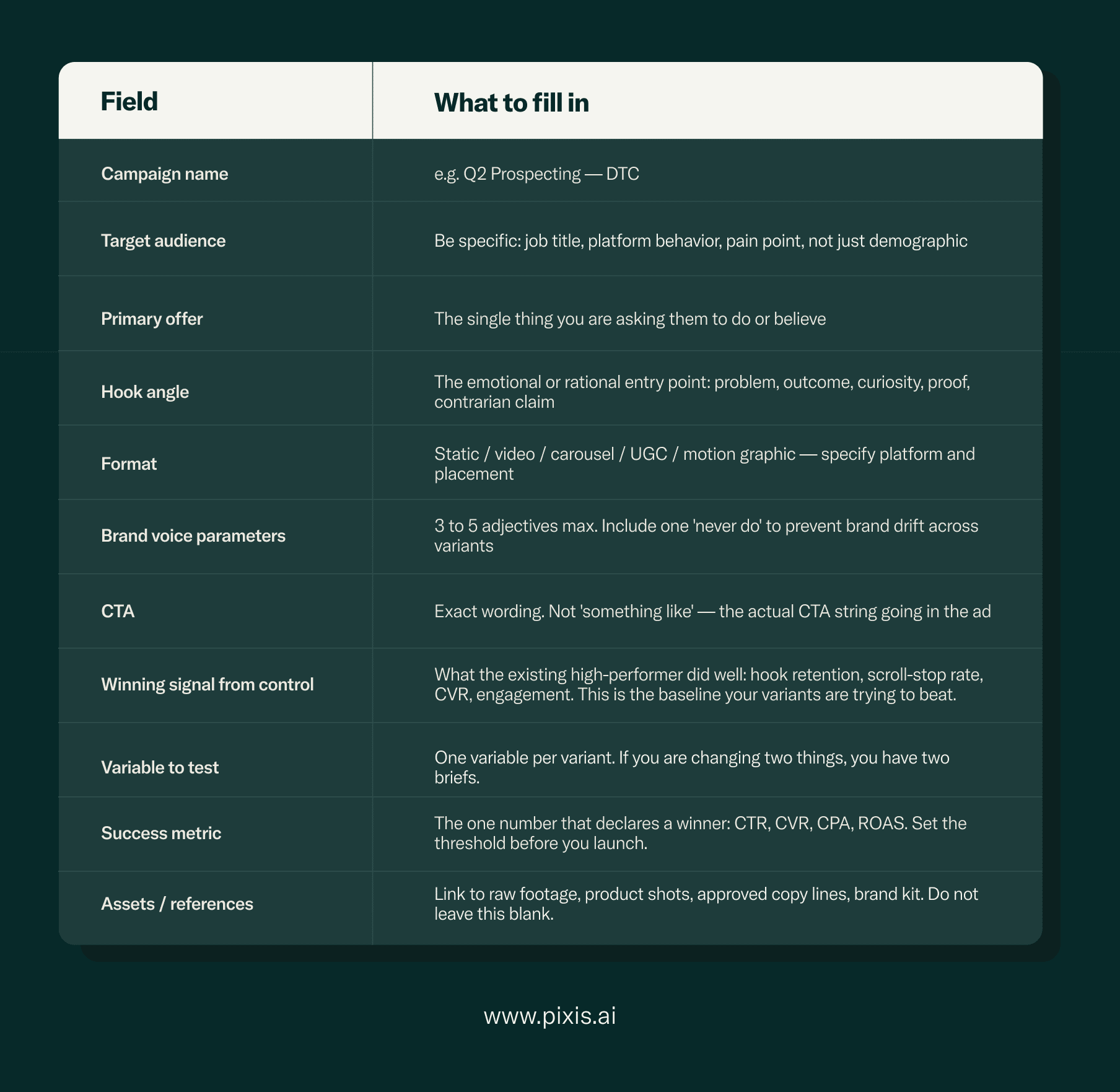
The Adroom Ad Creative Brief Template
Every field below is required. The brief does not leave the strategist's desk until every row is filled — including the winning signal from the control and the single variable being tested. Those two fields are the ones most often left blank, and they are the ones that make the difference between a test and a guess.
Hook Angle: The Field Most Briefs Get Wrong
The hook angle field is not a headline request. It is the emotional or rational entry point that earns the first three seconds — and those three seconds determine whether any other element of the ad matters.
There are five hook angles that consistently produce high-performing paid social creative. Each maps to a different psychological entry point and a different audience mindset.
- Problem-led. Opens by naming a specific, recognizable frustration. Best for audiences who are already in the problem and searching for a solution. Example: 'Still briefing creatives in a Google Doc?'
- Outcome-led. Opens with the result the audience wants, not the product that delivers it. Best for cold audiences who need to be sold on the destination before the vehicle. Example: 'What a 3x ROAS creative rotation actually looks like.'
- Curiosity-led. Opens with an incomplete statement or unexpected claim that creates a gap the viewer needs to close. Best for scroll-heavy placements like Reels and TikTok where pattern interruption is the first job.
- Proof-led. Opens with a specific result, customer quote, or data point. Best for warm audiences who know the category and need evidence, not education. Example: '47 variants. One brief. Here is what we learned.'
- Contrarian-led. Opens by challenging a common belief in the category. Best for differentiation in crowded markets where every competitor is saying roughly the same thing.
In the brief, name the angle and write one example sentence that demonstrates it. A hook field that just says 'strong hook' is a brief that has not been written yet.
UGC note: For UGC and creator-led formats, the hook angle brief should include the creator's natural entry point, not a scripted first line. Brief the angle and the emotional beat — let the creator find the authentic phrasing. UGC that sounds scripted loses the native-feed quality that makes it work.
Brand Voice Parameters: The Field That Prevents Creative Drift
Brand voice parameters exist for one reason: to keep variants recognizably connected to the same brand even as the hook, format, and CTA change. Without them, a rotation of ten variants becomes ten different brands running ads in the same account.
Three to five adjectives is the right scope — enough to give the creative team real direction, not so many that every word becomes a constraint. The more important addition is one 'never do' per brief: the specific move that takes a Pixis ad and makes it sound like everyone else.
Examples of useful never-dos:
- Never use feature-first language in the hook — lead with outcomes, not capabilities
- Never use exclamation points — they signal low-trust copy
- Never use passive voice in the CTA — it removes conviction at the moment it matters most
- Never use category jargon in the opening three seconds — earn context before using terminology
The voice parameters apply to every variant in the matrix. The variable being tested is one thing. The brand is not a variable.
The Variant Matrix: How to Build It
The variant matrix is the document that connects the brief to the test. It specifies, for each variant, exactly one thing that changes and everything else that stays fixed. If two fields change between variants, the matrix has a structural error — go back and split it into two separate tests.
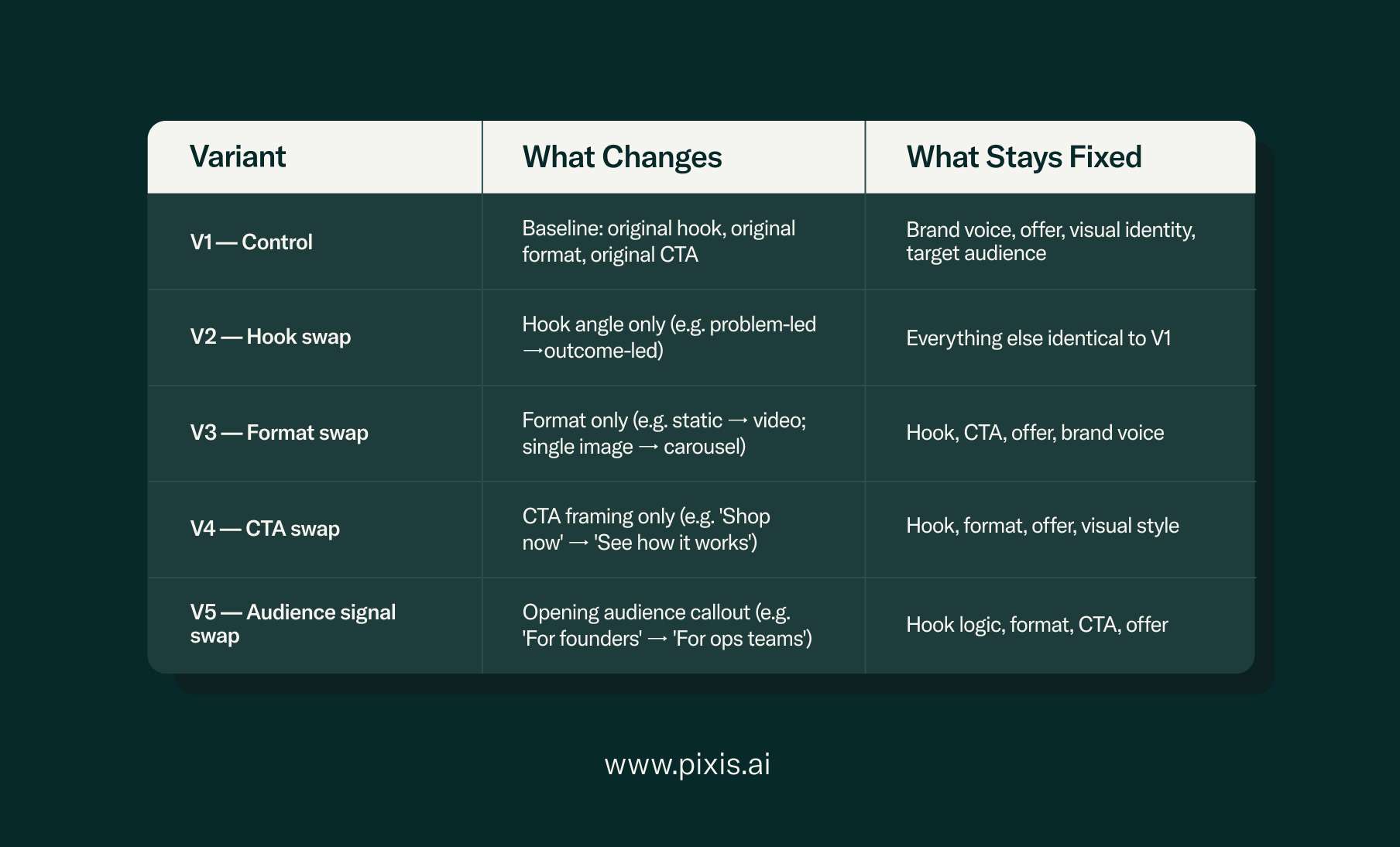
This matrix produces readable, actionable data because the difference between V1 and V2 is exactly one variable. When V3 outperforms V1, you know the format change is responsible. When V2 and V1 perform identically, you know the hook angle was not the performance driver — and you can stop briefing hook swaps and redirect effort to the variable that is.
On running time: Run each test for at least 7 to 14 days to clear the platform's learning phase and account for day-of-week variance. Top-performing accounts rotate in new ad variants every 7 to 10 days to stay ahead of creative fatigue — which means the brief cycle and the test cycle should run in parallel, not sequentially.
From Winner to Rotation: The Replenishment Logic
The purpose of the variant matrix is not just to find the next winning ad. It is to build a brief library — a set of tested, documented hypotheses that make the next brief faster to write than the last one.
Every time a variant wins, it answers a question about your audience: which hook angle they respond to, which format they engage with, which CTA framing converts. That answer goes back into the next brief as a constraint, not a starting point. The brief gets tighter. The test gets more precise. The rotation stays fresh without generating ten new concepts from scratch every cycle.
This is the system that separates brands with sustainable creative performance from those that burn through ideas. Brands that maintained ROAS growth in 2025 did so primarily through higher creative testing velocity — 10 to 20 new ad variations per week — not through increased budgets. Velocity is a function of brief quality, not creative volume.
The replenishment rule: For every winner promoted to the main rotation, brief two challengers immediately. One tests a variable adjacent to what made the winner work. One tests a variable the winner has not addressed yet.
How Adroom Makes This Repeatable
Adroom is Pixis's creative intelligence product. It ingests brief inputs — hook angle, format, voice parameters, variant logic — and generates production-ready creative variants at the speed the testing cadence actually requires.
The brief template above is the Adroom input structure. Every field maps directly to a generation parameter. When the brief is complete, the variant matrix is not a planning document — it is the production queue.
The result: a brief written once, a matrix that produces ten variants, and a rotation that replenishes itself on the data rather than on creative intuition.
Frequently Asked Questions About Ad Creative Brief Templates
What should an ad creative brief include?
A complete ad creative brief should include: campaign name, target audience with specific behavioral detail, primary offer, hook angle with an example sentence, format and placement specs, brand voice parameters with at least one 'never do,' exact CTA copy, the winning signal from the control creative, the single variable being tested in this brief, the success metric and threshold, and links to all approved assets. Every field is required — a brief with blank rows is not a brief.
How do you write a creative brief for paid social?
Start with the control — the highest-performing ad currently in rotation. Identify the one element that is most likely responsible for its performance: hook retention rate, CTR, CVR, or scroll-stop rate. Then write the brief around testing a single change against that baseline. The hook angle, format, CTA, and brand voice parameters define what the creative team delivers. The variable field defines what the data team reads.
How many ad variants should you test at once?
The recommended range is 3 to 5 creative variants per test. That number provides enough variation to surface patterns without spreading budget too thin to reach statistical significance. Each variant needs a minimum of $100 to $150 in spend to produce a reliable read, and each test should run for at least 7 to 14 days to clear the platform learning phase.
What is a variant matrix in creative testing?
A variant matrix is a structured document that specifies, for each test variant, exactly one element that changes and every other element that stays fixed. Its purpose is to make test data readable — when one variant outperforms the control, the matrix makes it unambiguous which variable was responsible. A matrix where two elements change between variants is not a test; it is two experiments that cannot be separated.
What is the difference between a creative brief and a creative strategy?
A creative strategy defines the long-term positioning, audience segmentation, and messaging architecture for a brand or campaign. A creative brief is the execution-level document for a specific ad or ad set — it translates strategy into production instructions. The brief template here is an execution tool. It assumes a creative strategy exists and operationalizes it for a specific test cycle.
How does Adroom use the brief template?
Adroom uses the brief template as its generation input structure. Hook angle, format, brand voice parameters, and variant logic map directly to Adroom's production parameters. When the brief is complete, Adroom generates the variant set — production-ready creative aligned to the brief, at the speed the testing cadence requires.
Ready to turn your next winning ad into a full rotation? Try Adroom and brief your first variant matrix today.