
You launch 50 ad variants, spend $10,000, and get back a spreadsheet with 300 rows of performance data. Now you're supposed to figure out which creative elements actually drove results—and you have about 20 minutes before your next meeting.
AI ad creative analysis automates how you examine ad performance data. It identifies which visual elements, copy choices, and layouts drive conversions.
This guide covers what AI creative analysis measures and why it beats manual testing. We explain the key metrics and a five-step workflow to turn insights into new ads fast.
What's AI ad creative analysis
AI ad creative analysis is the automated process of examining ad performance data to identify which creative elements drive results. It scans your ads—visuals, copy, and layout—and connects each element to actual conversion data, segment behavior, and platform context.
Here's how it works. The AI looks at colors, faces, text placement, motion, aspect ratio, headlines, CTAs, emotional tone, and value propositions. Then it maps each element to performance: which combinations lift CTR, which lower CPA, which drive conversions for specific audiences.
Traditional A/B testing isolates one variable at a time. You test button color this week, headline next week. AI analyzes multiple variables simultaneously, surfacing patterns you'd never spot manually. It's the difference between guessing and knowing exactly which combinations work for which audiences.
Why creative data beats gut instincts
Your gut tells you red buttons perform better because you saw it work once, a competitor uses red, or it simply feels urgent.
AI processes thousands of data points across creatives, placements, and audiences. It might discover that red buttons lift CTR for Gen Z on mobile during evening hours, while blue buttons perform better for desktop users in B2B contexts—driving higher lead quality at lower CPA.
AI discovers specific patterns. For example, red buttons lift CTR for Gen Z on mobile, while blue buttons perform better for B2B desktop users.
Your brain can't hold that many variables at once. AI can, and it updates its understanding as new data arrives. Human bias and limited pattern recognition miss subtle performance drivers. AI catches them.
Key metrics for AI-driven creative analysis
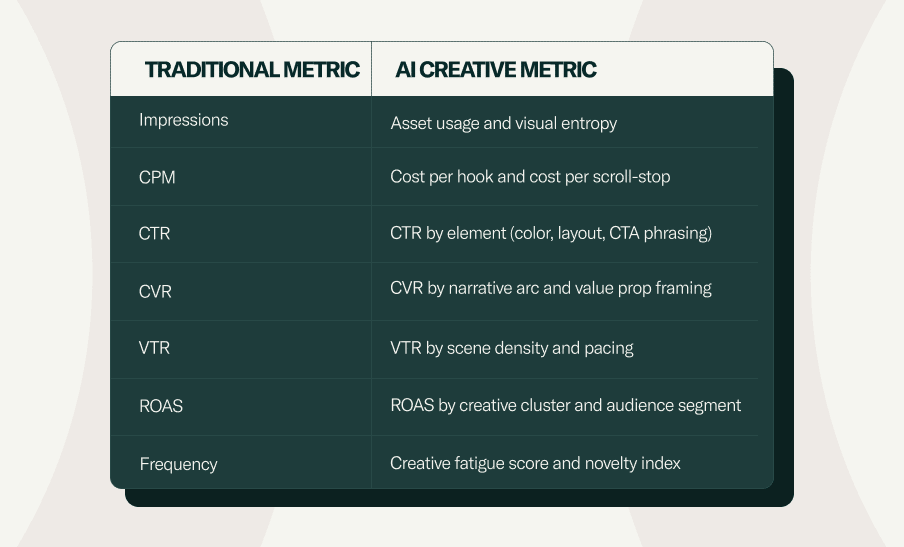
Standard campaign metrics—impressions, CPM, and CTR—tell you what happened. Creative-specific metrics tell you why it happened and what to do next.
Hook rate
Hook rate measures the percentage of viewers who watch past the first three seconds. AI identifies which visual and audio cues create strong hooks: quick cuts, bold openings, motion, early value props.
A high hook rate means your creative stopped the scroll. A low one means viewers kept moving, and your targeting doesn't matter yet.
Scroll-stop percentage
Scroll-stop percentage tracks how often users pause scrolling when they see your ad. AI analyzes composition, contrast, subject prominence, color temperature, and motion to pinpoint what triggers scroll-stops.
This metric matters most for static ads and carousels. If your ad doesn't stop the scroll, it doesn't get a chance to convert.
View-through rate
View-through rate shows the percentage of viewers who complete a video. AI evaluates narrative structure, scene pacing, caption timing, and payoff clarity.
You have a strong hook but lose viewers at the 10-second mark.
AI tells you why the drop happens. Your pacing slows, your value prop is late, or your CTA feels disconnected.
Click-through rate
View CTR through a creative lens. AI connects specific design elements—button size, color, copy, placement—to click behavior across audiences and placements.
Traditional reporting shows you CTR by campaign. Creative analysis shows you CTR by button color, CTA verb, and image composition.
Cost per desired action
Break down CPA by creative variations. AI pinpoints which combinations of imagery, copy, and offers produce the most cost-effective conversions, controlling for audience and bid variables.
Two ads have the same CTR, but one converts at half the cost. Creative analysis reveals whether the difference comes from the headline, the product angle, or the testimonial placement.
Predicted brand recall score
An AI-derived prediction of how memorable your ad will be. It assesses visual distinctiveness, message clarity, brand asset usage, and repetition to forecast recall lift.
Brand recall matters for awareness campaigns and long sales cycles. AI helps you balance performance with memorability.
Traditional metrics vs. AI creative metrics:
Five steps to move from insight to new ads
Here's a practical workflow to transform scattered data into clear creative actions. This process works whether you're analyzing 10 ads or 1,000.
Step 1: Gather all live creatives and results
Export every active and recent creative with performance data from the last 30–90 days, depending on your spend volume. Include audiences, placements, and budgets. Include ads that didn't work—they teach the AI what to avoid.
Comprehensive inputs improve AI accuracy and reduce confounding variables. The more data you feed in, the better the patterns.
Step 2: Auto-tag visual and text elements
Use AI to automatically identify and categorize components: color schemes, presence of faces, product angles, text overlays, logo placement, tone of voice, and CTA types. This creates a structured dataset for multivariate analysis.
Manual tagging takes hours and introduces inconsistency. AI tags thousands of ads in minutes using the same criteria every time.
Step 3: Spot patterns with multivariate filters
Apply filters across multiple variables to reveal patterns. For example, "UGC + warm lighting + price overlay + problem-solution structure" lifts CVR for lookalike audiences on Instagram Reels but not on YouTube Shorts.
You're not just looking at which ad won. You're identifying which combinations of elements win, for which audiences, on which platforms.
Step 4: Generate fresh variants in the AI ad creator
Turn insights into creative briefs for generation. Produce variations emphasizing winning elements—earlier reveal of social proof, bolder contrast, alternate CTA verbs—while holding constants to isolate learnings.
If AI tells you that face-forward UGC with captions outperforms studio shots, you generate five new face-forward UGC variants with different caption styles. Then you test those against each other.
Step 5: Launch and monitor in real time
Publish variants in controlled tests. Feed performance back into the system to update models, flag fatigue, and continuously optimize creative direction.
AI doesn't just analyze once. It learns from every new result, refining its understanding of what works and alerting you when a winning creative starts to decline.
How an AI ad creator speeds up testing
AI ad creators work alongside analysis to rapidly produce new variants aligned with data-backed patterns. You're not waiting for designers to mock up five versions of the same concept—you're generating them instantly.
- Background variations: AI generates multiple backdrop options (studio, lifestyle, textured gradients) tailored to platform and audience.
- Copy permutations: AI creates headline, body, and CTA variations aligned to tone, value props, and compliance guidelines.
- Layout adjustments: AI repositions elements (logo, product, CTA) based on historical performance heatmaps and platform safe zones.
The speed advantage compounds. Instead of testing one creative direction per week, you test three or four. You reach statistical significance faster, learn faster, and scale winners faster.
Try Prism today to see how AI-driven creative generation and analysis work together in one platform.
Human guardrails that keep AI on brand
AI accelerates production, but humans set the boundaries. Balance automation with oversight to protect brand integrity and compliance.
Brand voice prompts
Embed brand guidelines, tone, vocabulary, and dos/don'ts into system prompts. Include approved claims, style examples, and banned phrases to maintain consistency.
If your brand avoids hype language, tell the AI. If you always lead with the product benefit, not the feature, specify that upfront. The more context you provide, the less cleanup you do later.
Compliance checklists
Run legal and platform policy checks: disclosures, claims substantiation, accessibility, data usage, image rights. Maintain changelogs for auditability.
Regulated industries—finance, health, legal—carry higher risk. Build compliance checks into every generation step, not as an afterthought.
Final human review
Before going live, a human approves every asset for brand fit, cultural sensitivity, and context. This is especially important for high-stakes campaigns.
AI can't catch every nuance, and it doesn't understand your company's internal politics or recent PR issues.
Frequently asked questions about AI ad creative analysis
How long does AI ad creative analysis setup take for a typical ad account?
Most teams connect data sources and train the model on creative patterns within a few days. Initial insights typically surface in the first week. The system gets smarter as it ingests more performance data over time.
What creative volume do I need for reliable AI insights from ad analysis?
Aim for several dozen creative variations with sufficient spend per variation to achieve statistically meaningful signals across elements and segments. If you're running fewer than 20 active creatives, you'll still get insights, but they'll be less granular.
Does the AI store or share my brand assets externally during creative analysis?
Most platforms keep your data secure within their systems and do not share assets externally. Always review each provider's security architecture and privacy policy, especially if you're in a regulated industry or handling sensitive customer data.
From chaos to clarity with Pixis
AI turns complex, noisy creative performance data into clear, actionable guidance—what to make next, for whom, and why.
We at Pixis operationalize this by pairing analysis with generation. We make AI a strategic partner that amplifies human creativity.
You bring the strategy, the brand understanding, and the creative vision. We bring the speed, the pattern recognition, and the production capacity. Together, you move from gut-driven creative decisions to data-backed creative systems that scale.
Try Prism today to transform your creative workflow from data chaos to campaign clarity.