

The question of what to automate in paid media campaigns has a clean answer in theory: automate whatever is faster, more accurate, and more consistent when handled by a machine than by a person. In practice, enterprise teams run into a constraint that does not appear in the theory — platform incentive misalignment. Meta and Google both offer AI-driven automation tools, and both platforms have a financial interest in you spending more. That fact does not make their tools wrong, but it does mean that handing them unreviewed control over creative decisions, audience expansion, and campaign objectives carries a different risk profile than automating bid adjustments within parameters you set.
This article lays out a working framework for where automation produces reliable returns in enterprise paid media, where human judgment is irreplaceable, and how Prism's agentic execution model — which automates across Meta, Google, and TikTok while keeping campaign strategy and creative decisions inside your team's governance structure — fits into that framework. For the underlying mechanics of how Prism connects to ad platforms, the Prism integrations overview covers the technical setup, including the distinction between analysis-only and action-execution modes by platform.
Why Enterprise Teams Need a Governance Framework Before They Need Automation Tools
Gartner's 2026 strategic predictions include a projection that 'death by AI' legal claims will exceed 2,000 by end of year, driven by automated decision-making without adequate human oversight. For marketing teams, the legal exposure is lower than in healthcare or finance — but the brand exposure is not. A creative that runs across a sensitive news context, a lookalike audience that expands into a segment a brand has specifically excluded, a budget reallocation that cannibalizes a brand campaign to fund performance — these are failures that are visible to customers, regulators, and boards.
The PwC 2026 AI predictions report describes the governance failure mode precisely: agents rolled out without 'clearly-articulated steps for human initiative, review, and oversight.' For paid media specifically, that failure mode produces a distinct pattern — automation takes over decisions that humans thought they were still making, and the error is only visible after the damage is done.
The Deloitte 2026 enterprise AI implementation guide is direct on the governance requirement: 'organizations need to define where humans should remain in control, how automated decisions are audited, and which records of system behavior should be retained.' In paid media, that translates to three specific questions every enterprise team should answer before expanding automation:
- Which decisions, if automated incorrectly, produce recoverable errors? These are candidates for automation.
- Which decisions, if automated incorrectly, produce brand or compliance damage that cannot be undone by adjusting a bid? These require human sign-off.
- Which platform recommendations have an inherent conflict of interest because the platform profits from the outcome they're recommending? These require independent validation before execution.
The framework that follows answers all three questions with specific examples from Meta, Google, and TikTok campaign management.
What to Automate: Decisions Where Speed and Consistency Beat Human Judgment
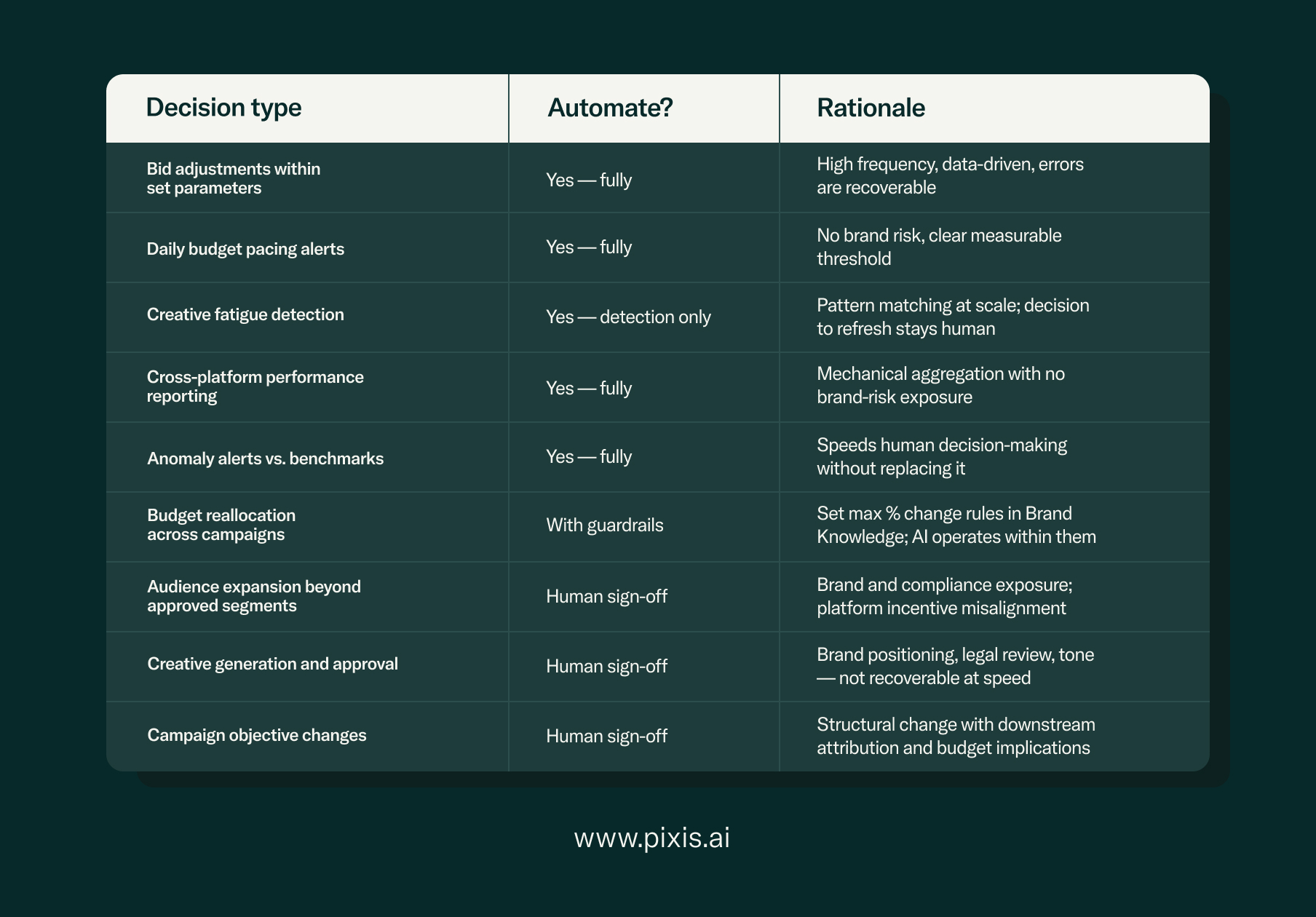
The decisions that belong in automated execution share a common property: they are high-frequency, data-driven, and operate within guardrails that a human has already set. Bid adjustments, budget pacing alerts, creative fatigue detection, and performance anomaly flagging all meet this criteria. The human sets the parameters; the machine operates within them continuously.
Bid adjustments and budget pacing
Real-time bid optimization is the canonical case for automation. The auction happens in milliseconds, performance signals change throughout the day, and no human analyst can monitor and respond at the speed the platform requires. Research confirms that automated bidding consistently outperforms manual bidding on cost efficiency for conversion-optimized campaigns, because the model has access to more signals than any human-set bid strategy can incorporate.
Prism automates bid adjustments and budget changes directly on Meta today — the only platform in its current integration stack with full action execution enabled. The mechanism matters: Prism requires a designated Primary Profile with Admin or Advertiser role permissions in Meta Business Manager before executing any action. Changes are logged in full. Every action taken within Prism is auditable, giving team leads complete visibility into what the system changed and when.
Performance anomaly detection and alerting
Automated alerts that fire when CPA exceeds a threshold, when spend pacing runs ahead of daily budget, or when CTR drops below a benchmark are universally appropriate for automation. The human still decides what to do — the machine just ensures the decision is made in time. Prism's scheduled workflows handle this by delivering a morning performance briefing that flags anomalies against the benchmarks configured in Brand Knowledge, without requiring manual log-in to each platform.
Creative fatigue detection
Identifying when a specific creative is declining in CTR and CVR relative to its historical performance is a pattern-matching problem that AI handles reliably and at scale. Prism's Meta Agent monitors frequency, CTR decay, and CVR trends continuously across ad sets, flagging creative fatigue before it erodes spend efficiency — a task that in manual workflows requires a practitioner to pull ad-level reports daily.
Cross-platform performance reporting
Unifying performance data across Meta, Google, TikTok, and DV360 into a single view is mechanical work that consumes hours of analyst time per week when done manually. Automating the data ingestion, normalization, and dashboard generation eliminates that cost entirely. Prism supports this through custom reports that surface performance data across all connected platforms in a single unified view, with consistent currency and timezone settings applied at the brand level.
Automation decision reference: what belongs in automated execution
What to Keep Human: Where the Errors Are Not Recoverable
The decisions that belong with humans share a different property: the cost of an incorrect automated action exceeds the efficiency gain from speed. Creative decisions affecting brand positioning, audience targeting that crosses compliance or sensitivity lines, and campaign objective changes that restructure how performance is measured — these are decisions where 'undo' does not fully restore the situation.
Creative decisions and brand sign-off
Meta's end-to-end AI automation model — Advantage+ in its most expansive form — can generate creative variants, run them, and scale the winners without human review of each asset before it reaches audiences. For performance-only advertisers with simple product categories and low brand sensitivity, this may be acceptable. For enterprise teams with legal review requirements, regulated product categories, or brand guidelines that require specific approvals before an asset runs publicly, it is not.
The distinction is not about trusting AI creative quality. It is about accountability. When a creative runs that violates a regulatory requirement or appears alongside brand-unsafe content, someone is accountable — and that accountability cannot be outsourced to an automated system. In Prism's model, creative generation and approval sit outside the action-execution layer entirely: Prism can identify creative fatigue and recommend refresh, but the creative itself goes through your existing approval workflow before it enters rotation.
Audience targeting and the platform incentive problem
This is the area where platform incentive misalignment is most consequential. When Google recommends enabling 'optimized targeting' to expand beyond your defined audience, or when Meta's Advantage+ audience feature expands reach beyond the parameters your team set, both platforms have a direct financial interest in the expansion: more reach means more spend, which means more revenue for the platform. The Meta Advantage+ compliance analysis published in April 2026 documents specific failure modes observed in automated targeting: demographic exclusions that the advertiser set being overridden, audience segments expanding into groups the brand had specifically avoided for compliance reasons.
Prism's position on this is structural rather than advisory. Action execution on audience targeting is not in the current capability set — Prism's automation operates on bids, budgets, and campaign status. Targeting decisions surface as recommendations with data justification, but they execute only after a human reviews and approves them. That is not a product limitation; it is a deliberate governance boundary.
Campaign objective changes
Changing a campaign objective — from traffic to conversions, from awareness to lead generation — is a structural decision that affects how the platform's algorithm optimizes, how performance is measured, and how budget flows through the account. These changes often look like optimization opportunities in automated systems because the data signals improve after the change. What the data does not capture is whether the change aligns with the broader campaign strategy and how it affects attribution across the full funnel. This decision belongs with the campaign strategist, not the automation layer.
The Platform Incentive Problem: Why Independent Governance Matters
Meta and Google both build automation tools that optimize for the metrics they can measure and monetize. Their recommended objectives are not wrong, but they are not neutral. An enterprise governance framework needs an independent layer that validates platform recommendations against your actual business goals before executing them — not as a check on dishonesty, but as a check on the structural difference between platform optimization targets and advertiser optimization targets.
Mark Zuckerberg's stated vision for Meta advertising — input a product image and a budget, and Meta's AI handles creative, targeting, and measurement entirely — is designed for small advertisers who lack the resources to do otherwise. As codedesign.org's analysis of the 2026 automation landscape notes, 'without clear frameworks and vigilant oversight, brands risk not only severe reputational damage but also significant regulatory penalties.' The enterprise context adds another layer: a single automated decision that runs non-compliant creative across a regulated category can create legal exposure that the platform's own dispute resolution process will not resolve.
The misalignment operates at the metric level as well. Meta optimizes for conversion events as reported within its attribution window. Google optimizes for conversion volume within its models. Both can show campaign success — improving ROAS or CPA — while the actual business outcome (revenue, customer lifetime value, margin contribution) is flat or declining. An independent intelligence layer that benchmarks platform-reported performance against your own business data is what Prism's Brand Knowledge configuration enables: KPI benchmarks like CPA £15 or ROAS 3.2x are set at the brand level and applied to every recommendation the system surfaces, so platform-reported improvements that do not clear your business bar do not get treated as wins.
By 2026, 40% of enterprise applications will include embedded AI agents. PwC's framework is explicit: agents work when humans retain 'initiative, review, and oversight' at defined checkpoints — not when automation runs without accountability boundaries.
How Prism Implements Human-in-the-Loop Governance at Scale
Prism's agentic execution model is built around a specific distinction: the system recommends and flags continuously, but it executes only within the parameters and permissions that your team has explicitly approved. Budget guardrails, Primary Profile designation, and Brand Knowledge configuration are not optional setup steps — they are the governance layer that makes autonomous execution safe at enterprise scale.
Brand Knowledge as governance infrastructure
Before Prism executes any action, it references the Brand Knowledge configuration your team has set up during onboarding. This includes KPI benchmarks (specific numerical targets for CPA, ROAS, and other primary metrics), budget rules (maximum percentage change thresholds for daily reallocations, weekly caps), brand positioning requirements (tone, compliance rules, messaging constraints), and campaign naming conventions. Every recommendation Prism surfaces is evaluated against these parameters before it becomes an executable action. A budget reallocation that would exceed the 20% daily change guardrail does not execute — it flags for human review.
Primary Profile and permission structure
Action execution on Meta requires Edit Access — specifically, Admin or Advertiser role in Meta Business Manager — and requires designation of a Primary Profile that determines which user account executes approved actions on the brand's behalf. This is not a convenience feature; it is an accountability mechanism. Every action executed through Prism is attributed to a specific authorized profile and logged in full, creating an audit trail that satisfies enterprise governance and compliance requirements. Read-only access limits Prism to analysis mode — recommendations surface but no actions execute.
Scheduled workflow design
Prism's scheduled workflows are designed to surface the right information to the right person at the right time, not to replace the human decision. The recommended starter workflow — a daily performance briefing delivered by email every morning — gives campaign managers benchmark-referenced insights and flagged action items before they open their platform dashboards. The decision of what to do sits with the human; the workflow ensures the decision is made with complete, current information rather than the partial view that comes from checking individual platform dashboards sequentially.
Analysis versus execution: the platform-level distinction
Prism's current action execution capability is intentionally sequenced. Meta Ads has full analysis and action execution now. Google Ads and TikTok Ads are analysis-only, with action execution coming in Q2 and Q3 2026 respectively. DV360 is in beta analysis-only. This sequencing is not an arbitrary release schedule — it reflects the need to validate action execution behavior and governance controls on each platform before expanding autonomous actions.
FAQs
What is human-in-the-loop campaign management?
Human-in-the-loop campaign management is a governance model where AI automation handles high-frequency, data-driven execution tasks — bid adjustments, performance monitoring, anomaly alerting — while humans retain decision authority over strategic, brand-sensitive, and compliance-relevant choices. The boundary between automated execution and human approval is set explicitly by the team, not determined by default by the platform.
What are the risks of fully autonomous AI ad campaign management for enterprise teams?
The primary risks fall into three categories. First, platform incentive misalignment: Meta and Google optimize for metrics they can monetize, which does not always align with advertiser business objectives. Second, brand and compliance exposure: automated creative and audience decisions that bypass approval workflows can produce outputs that violate brand guidelines, regulatory requirements, or sensitivity standards — errors that are not recoverable at the speed automation creates them. Third, accountability gaps: when an automated system makes a decision that produces a negative outcome, Deloitte's 2026 agentic AI governance framework is explicit that organizations need to define 'how automated decisions are audited, and which records of system behavior should be retained.'
What campaign management tasks should always require human approval?
Creative generation and final approval before an asset runs publicly. Audience targeting changes that expand beyond explicitly approved segments. Campaign objective changes that restructure how the platform optimizes and how performance is measured. Budget reallocations that exceed pre-set guardrails. Any action that a platform's own AI recommends in a context where the platform has a financial interest in the recommendation's outcome.
How does Prism differ from Meta Advantage+ or Google Performance Max automation?
Meta Advantage+ and Google Performance Max are platform-native automation tools that optimize for the metrics the platform can measure within its own ecosystem. Prism operates as an independent intelligence layer across platforms, benchmarking performance against your own KPIs rather than platform-reported metrics. Prism's action execution operates within the guardrails your team sets in Brand Knowledge — budget change limits, KPI thresholds, brand constraints — and requires explicit permission configuration before any action runs. It does not automatically expand audience targeting or generate creative without human approval.
What is a Primary Profile in Prism and why does it matter for governance?
A Primary Profile is the designated user account in Meta Business Manager that Prism uses to execute approved actions on a brand's behalf. It must have Admin or Advertiser role permissions. The designation creates an explicit accountability chain: every automated action is attributed to a specific authorized user, logged with a timestamp, and reviewable in Prism's audit trail. This matters for enterprise governance because it ensures that autonomous execution is traceable to a human who has accepted responsibility for the actions taken under their profile.
Key Takeaways
- Automate execution within defined parameters, not decision-making beyond them. Bid adjustments, performance alerts, creative fatigue detection, and unified reporting belong in automated execution. Creative decisions, audience expansion, and objective changes belong with humans.
- Platform incentive misalignment is structural, not adversarial. Meta and Google's automation tools optimize for platform-measurable metrics. An independent governance layer — Prism's Brand Knowledge, your own KPI benchmarks — is what ensures platform recommendations are evaluated against your actual business goals before execution.
- Governance infrastructure precedes automation expansion. Budget guardrails, Primary Profile designation, and KPI benchmarks configured in Brand Knowledge are the conditions that make autonomous execution safe. Expanding automation before this infrastructure is in place produces the risk scenarios that PwC, Deloitte, and Gartner's 2026 enterprise AI frameworks all flag.
- Prism's action execution is currently live on Meta, with Google Ads and TikTok action execution on the Q2–Q3 2026 roadmap. Analysis capabilities across Google, TikTok, DV360, and GA4 are available now. Every action is logged, attributed to a designated authorized profile, and reviewable in full.
- The audit trail is not optional. Enterprise AI governance requires that automated decisions are logged, attributable to a specific authority chain, and reviewable. Prism's complete audit trail for every action taken within the platform is the mechanism that makes agentic execution compatible with enterprise compliance requirements.
If you want to see how Prism's agentic execution model maps to your specific platform setup and governance requirements, book a demo.