
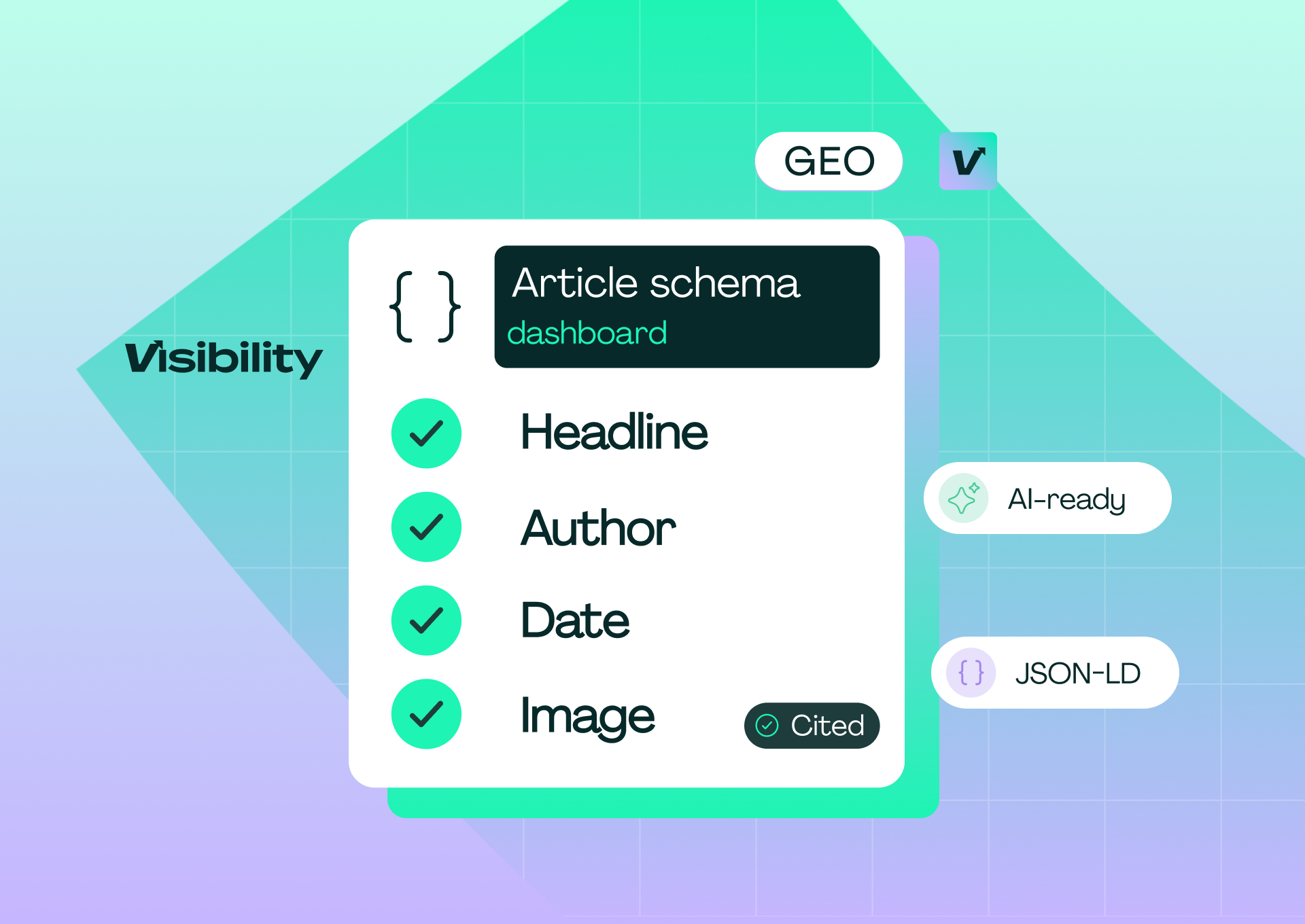
An article schema can make a page easier for machines to describe, but there is no reliable evidence that adding it will independently make ChatGPT, Google AI Overviews, or other answer engines cite the page more often.
That distinction matters. Structured data remains a useful technical infrastructure. It can identify an article, connect it to its author and publisher, and make a page eligible for supported Google rich results. But it should not be sold as a shortcut to AI citations.
This guide explains what the Article schema does, what current studies have found about its relationship with AI citations, and how to implement it correctly without making promises the evidence cannot support.
Key takeaways
- An article schema describes an article in a machine-readable format. It does not guarantee or independently produce AI citations.
- Google states that structured data is not required for AI Overviews or AI Mode and that there is no special schema markup for generative search.
- In an Ahrefs-controlled study, adding JSON-LD produced no meaningful citation increase in Google AI Mode or ChatGPT and a small relative decline in Google AI Overview citations.
- A separate Marshal study found no significant citation advantage for generic schema types such as Article and Organization. Its positive result was limited to Product and Review markup containing concrete attributes.
- Implement Article, Person, and Organization markup to describe real visible information accurately, not to manufacture authority signals.
- Put every important fact in the visible page content. Schema should support the page, not substitute for it.
What is Article schema?
Article is a Schema.org type used to identify content as an article. More specific types include BlogPosting for blog content and NewsArticle for journalism and news coverage.
The markup can describe information such as:
- The article headline
- Its publication and modification dates
- The author
- The publisher
- A representative image
- The canonical page
JSON-LD is generally the simplest format to manage because it keeps structured data in a script block rather than distributing attributes throughout the visible HTML. Google also recommends JSON-LD for supported search features.
The purpose of the markup is descriptive. It gives systems that consume Schema.org data an explicit representation of information that should already be present and accurate on the page.
Does Article schema increase AI citations?
The honest answer is that current evidence does not show that adding a generic Article schema independently increases citations.
Two types of evidence are commonly mixed together in discussions about schema and AI visibility:
- Correlational studies that find the schema more frequently on cited pages
- Controlled or adjusted studies that ask whether the schema itself caused the difference
The first can identify a pattern. The second is needed before marketers can claim that adding schema produces more citations.
What the Ahrefs controlled study found
Ahrefs analyzed six million URLs and initially found that pages cited by AI were almost three times as likely to contain JSON-LD as pages not cited by AI.
That finding did not prove that the schema caused the citations. Sites that implement structured data may also have stronger content, better technical maintenance, greater authority, and more links.
Ahrefs then tracked 1,885 pages that added JSON-LD between August 2025 and March 2026. It matched those pages with 4,000 controls and compared citations during the 30 days before and after the schema was added.
The study found:
- Google AI Overviews: a 4.6% relative decline in citations
- Google AI Mode: a 2.4% increase that was statistically indistinguishable from zero
- ChatGPT: a 2.2% increase that was statistically indistinguishable from zero
The responsible conclusion is not that schema harms AI visibility. The study had limitations, including a sample of pages that were already receiving substantial citations and the pooling of several schema types. It does show that marketers should not expect a generic JSON-LD implementation to create an immediate citation lift.
What the Marshal study found
Marshal examined 730 citations from ChatGPT and Gemini across 75 commercial queries. After adjusting for the composition of the comparison set, it found no statistically significant independent relationship between AI citation and:
- Schema presence
- Entity richness
- Schema-to-query alignment
Generic schema types such as Article, Organization, and BreadcrumbList did not show a citation advantage.
The study did find one narrower exception. Pages using the Product or Review schema, populated with concrete attributes such as price, ratings, and specifications, were cited more frequently than pages using generic schema types. The result cannot be generalized to the Article schema because the useful payload and page types were different.
What the AirOps correlation shows
AirOps compared more than 12,000 URLs cited by ChatGPT or ranking on page one of Google without a ChatGPT citation. It found rich schema on 61% of the ChatGPT-cited pages and 25% of the Google comparison pages.
This is useful observational evidence, but it does not isolate schema as the cause. The study compared two different groups of pages and intentionally excluded off-page factors such as backlinks and authority. Its result should therefore be described as a correlation, not a guaranteed 13% gain from adding three schema types.
Taken together, the research supports a restrained conclusion: schema is common on well-structured, technically maintained pages, but generic Article schema has not been shown to function as an independent AI citation lever.
What Google says about schema and generative search
Google's guidance is unusually direct. Its guide to generative AI features in Search states that structured data is not required for generative AI search and that there is no special Schema.org markup that website owners need to add.
Google continues to recommend structured data as part of an overall SEO strategy because supported markup can make a page eligible for rich results. The company also says that its established SEO practices remain relevant to AI Overviews and AI Mode.
This gives marketers a clear implementation principle:
Use structured data for the purpose it can verify: describing page content accurately and supporting established search features. Measure AI citation performance separately.
The distinction also aligns with our analysis of whether infographics improve AI visibility. Technical markup can support the search features it was designed for without becoming a standalone GEO tactic.
Why the Article schema is still worth implementing
The lack of a proven citation lift does not make the Article schema useless.
Correct markup can still improve the technical clarity and consistency of a website. It provides an explicit representation of authorship, publishing dates, images, and organizational relationships. It can also support Google search features where the page and markup meet the relevant requirements.
There are four defensible reasons to implement it.
1. It describes the article explicitly
Article markup identifies the page as an article and supplies properties that describe it. This reduces ambiguity for systems that consume Schema.org data, although it does not guarantee a particular ranking or citation outcome.
2. It connects the article to real entities
Stable @id references can connect an Article entity to the author and publisher entities declared on the site.
This relationship describes who wrote and published the content. It does not prove that the author has expertise or that the publisher is trustworthy. Those conclusions require visible evidence, including accurate biographies, original work, sourcing, and wider reputation.
3. It supports established search features
Google uses supported structured data to determine eligibility for certain rich-result treatments. Eligibility is not a guarantee that the feature will appear, and structured data does not determine ordinary rankings by itself.
4. It improves consistency at scale
A well-maintained template can keep author names, publisher details, canonical URLs, and publication dates consistent across a large content library. This is an operational and data-quality benefit even when no AI citation effect can be measured.
Article schema properties to include
The exact properties you use should reflect the page and the requirements of any search feature you intend to support. The following properties provide a useful foundation for an ordinary blog article.
@type
Use the most specific type that accurately describes the page. BlogPosting is generally appropriate for a blog article, while NewsArticle should be reserved for news content.
headline
Use the visible article title. The structured headline should remain consistent with the page rather than introducing a different claim or topic.
datePublished
Provide the article's genuine original publication date in ISO 8601 format.
dateModified
Update this property when the visible article has been materially revised. Do not change the date solely to simulate freshness.
author
Identify the real author. When the site has author pages, connect the article to a stable Person @id and a live biography URL.
publisher
Identify the organization or person responsible for publishing the article. Reuse a stable Organization @id across the site.
image
Reference a relevant, crawlable image that represents the article accurately.
description
Provide a concise, factual description consistent with the visible page.
mainEntityOfPage
Connect the article to the canonical page it describes. This can be expressed as a URL or a WebPage entity with its own @id.
A clean JSON-LD example
The following example uses placeholders intentionally. Replace every value with real information from the published page.
<script type="application/ld+json">
{
"@context": "https://schema.org",
"@graph": [
{
"@type": "BlogPosting",
"@id": "https://example.com/blog/article-slug/#article",
"headline": "Example article title",
"description": "A factual description of the article.",
"datePublished": "2026-09-07",
"dateModified": "2026-09-07",
"mainEntityOfPage": {
"@type": "WebPage",
"@id": "https://example.com/blog/article-slug/"
},
"image": {
"@type": "ImageObject",
"url": "https://example.com/images/article-image.jpg"
},
"author": {
"@id": "https://example.com/authors/author-name/#person"
},
"publisher": {
"@id": "https://example.com/#organization"
}
},
{
"@type": "Person",
"@id": "https://example.com/authors/author-name/#person",
"name": "Author Name",
"url": "https://example.com/authors/author-name/"
},
{
"@type": "Organization",
"@id": "https://example.com/#organization",
"name": "Example Publisher",
"url": "https://example.com/",
"logo": {
"@type": "ImageObject",
"url": "https://example.com/images/logo.png"
}
}
]
}
</script>
This structure declares the article, author, publisher, and page as connected entities. It does not imply that a search engine or AI platform will assign authority to them simply because the relationship has been declared.
How to implement the Article schema correctly
Step 1: Choose the accurate article type
Use BlogPosting, Article, or NewsArticle based on the content actually visible on the page. Avoid selecting a more specific type when the page does not meet that description.
Step 2: map every value to visible content
The headline, author, dates, description, and image should agree with the information users can see. Do not place claims in structured data that the page itself does not support.
Step 3: connect real author and publisher entities
Create stable @id values for the author and publisher. Use a real author biography page and consistent publisher details.
Use sameAs only when it points to a verified profile or external identity that genuinely represents the entity. Do not invent Wikidata entries or link unrelated profiles.
Step 4: connect the article to its canonical page
Use mainEntityOfPage to identify the page the article belongs to. Confirm that the URL matches the canonical version of the page.
Step 5: add the JSON-LD to the rendered HTML
Place the script in the page head or body. Confirm that crawlers receive it in the rendered document and that a CMS or plugin is not producing a conflicting duplicate.
Step 6: validate the implementation
Use two different tools because they answer different questions:
- Google Rich Results Test checks eligibility and issues for structured-data features supported by Google.
- Schema Markup Validator checks broader Schema.org syntax and vocabulary.
A passing result confirms that the markup meets the tool's technical checks. It does not guarantee a rich result, improved ranking, or an AI citation.
Should you add FAQPage or HowTo schema?
Add a schema type only when it accurately represents substantial visible content on the page.
FAQPage markup can describe a genuine page or section containing visible questions and answers. It should not be added merely because a marketer hopes the format will be extracted by an AI system.
Google restricted FAQ rich results in 2023, with regular eligibility largely limited to authoritative government and health websites. This changed the search-result benefit for many commercial publishers, although FAQPage remains part of Schema.org.
HowTo markup should be reserved for content that genuinely teaches a task through a sequence of steps. An ordinary article containing a few recommendations is not automatically a HowTo.
No reliable evidence establishes FAQPage or HowTo as a guaranteed AI citation lever. Clear, visible answers and instructions may still make a page more useful to readers and easier to quote, but that is a content-design principle rather than proof of a schema effect.
Common Article schema mistakes
Treating schema as invisible content
Do not place facts only in JSON-LD. Important information should appear in the visible article. Structured data must represent the page rather than supply a second, hidden version of it.
Inventing author or entity profiles
Do not add fictional authors, fake biography pages, placeholder social profiles, or invented Wikidata identifiers to a live page.
Updating dates without updating the article
The dateModified value should reflect a genuine material revision. Changing it without changing the visible content creates inaccurate markup.
Adding several schema types without a reason
More markup is not automatically better. Each declared entity and property should have a clear relationship to visible content.
Confusing validation with performance
A technically valid implementation may have no measurable effect on traffic, rankings, rich results, or citations. Validation is a quality-control step, not a performance result.
Measuring every schema type as one intervention
Article, Product, Review, Organization, and FAQPage describe different entities and carry different information. A result observed for attribute-rich Product markup should not be generalized to Article schema.
How to measure whether the schema made a difference
Do not treat a citation appearing after implementation as proof that the schema caused it. Content updates, recrawling, backlinks, authority, query demand, and changes within the AI platform may have occurred simultaneously.
A more disciplined measurement process is:
- Record the implementation date and the exact schema change.
- Track whether the page is recrawled and the markup remains valid.
- Monitor the same set of relevant prompts before and after the change.
- Record other page changes, including copy revisions, internal links, and new backlinks.
- Compare the result with similar pages that did not receive the change when possible.
- Repeat prompts across multiple sessions because AI answers can vary between runs.
- Report the result as directional unless the test controls alternative explanations.
Traditional rank tracking alone does not capture this behavior. An AI visibility workflow should monitor whether a brand or page is mentioned, whether it is cited as a source, which prompts the trigger to appear, and how the result changes over repeated observations.
For a broader measurement process, see our guide to auditing AI search visibility.
What to prioritize if your goal is AI visibility
The schema should sit inside a wider content and technical strategy rather than become the strategy itself.
Google recommends creating useful, original, people-first content for its generative search features. Its guidance places particular emphasis on material that adds genuine experience or a distinct point of view rather than repeating commodity information.
In practical terms, prioritize:
- Original information, analysis, or first-hand experience
- Direct answers to the questions your audience asks
- Clear evidence and links to primary sources
- Accurate author and publisher information
- Logical headings and readable page structure
- Important facts stated in visible text
- Crawlable pages with sound technical SEO
- Ongoing measurement across relevant AI platforms
A schema can describe this work. It cannot replace it.