
The answer is yes, but what schema is actually doing in 2026 is different from what it was doing two years ago. Google deprecated FAQ rich results on May 7, 2026, and a predictable overcorrection followed in the SEO industry: half the takes declared schema dead, the other half declared it more important than ever for AI. Neither is quite right.
Schema markup is not a SERP decoration tactic anymore. It is a machine-readability layer, and that function has become more relevant as AI search engines that depend on fast, accurate content classification have grown. SEO, GEO, and AEO now operate as three distinct disciplines, and schema has a role in all three, just not the same role in each. This guide covers what schema still does, what it no longer does, which types matter most for GEO, and what a schema audit should actually look for in 2026.
Key Takeaways
- Schema markup still matters for both traditional SEO and GEO, but its primary function has shifted from earning SERP visual enhancements to providing machine-readable context that helps search engines and AI retrieval systems classify and extract content accurately.
- Google deprecated FAQ rich results on May 7, 2026. FAQPage as a Schema.org type remains valid and can stay on pages. Google has stated the markup can be left in place and continues to use it for page understanding, though it will no longer produce visible rich result features in Google Search.
- For GEO, schema markup reduces the guesswork AI systems must do when parsing your content. Structured data helps establish entity identity, content freshness, and authorship signals that influence how reliably AI engines can cite your pages.
- The schema types with the most ongoing relevance for both SEO and GEO are Organization, Person, Article, sameAs, and dateModified. These establish entity trust and content context rather than chasing SERP features that may be deprecated.
- A schema audit should check for missing markup, invalid syntax, duplicate schema, and mismatches between structured data and visible page content. Pixis Visibility provides an end-to-end schema solution detecting and audits structured data, validating it against current standards, and continuously monitoring it alongside other technical health signals that affect AI crawlability.
- Technical SEO is the infrastructure layer for GEO. Schema that contradicts visible content, or pages with no schema where it would help, reduces the confidence AI engines have in a page as a citable source.
Why Schema Markup Remains Relevant for Traditional SEO
Traditional search engines use schema to understand the meaning behind content rather than just its keywords. This helps categorize pages, grasp entities and relationships, and display content in richer formats where those features are still available. The schema types that support these functions, Product, BreadcrumbList, Organization, Article, and Review among them, remain actively supported by Google and continue to produce rich result eligibility for the schema types that have not been deprecated.
Rich results that are still supported include Product listings with pricing and availability, Review snippets with star ratings, Breadcrumb navigation in SERPs, Article type signals for news and publishing contexts, and Event markup. These are not going away. The FAQ deprecation was part of a longer cleanup of schema features that were being abused to inflate SERP real estate without adding genuine user value. The underlying principle, use schema to help machines understand your content, has not changed.
The five most consistently useful schema types for traditional SEO remain:
- Article schema, which helps search engines identify content type and publishing context for news and blog posts.
- FAQPage schema, which is still a valid Schema.org type even though its SERP rich result feature has been deprecated, and which continues to help machines parse question-and-answer content structures.
- Product schema, which displays pricing and availability directly in search listings and remains fully supported.
- BreadcrumbList schema, which improves site navigation clarity and SERP context.
- Organization schema, which establishes brand identity, location, and authority signals.
The FAQ Rich Results Deprecation: What Actually Changed
Google deprecated FAQ rich results on May 7, 2026, ending the expandable Q&A dropdown feature that had appeared in search listings. The deprecation follows a three-year rollback: Google restricted FAQ rich results to government and health sites in August 2023, and the May 2026 update removed them for those sites too.
The timeline for the full removal runs across three dates. FAQ rich results stopped appearing in search on May 7, 2026. Search Console reporting, the rich result filter, and Rich Results Test support for FAQ are being removed in June 2026. Search Console API support for FAQ rich result data is being removed in August 2026.
What did not change: FAQPage is still a valid Schema.org type. Google has explicitly stated in its deprecation documentation that unused structured data does not cause problems for Search, and the markup can remain on pages. FAQPage schema continues to be crawlable by Bing, PerplexityBot, and AI retrieval crawlers indexing the open web. Google's own deprecation notice states it will continue to use FAQ structured data to better understand pages, even though it no longer displays the rich result.
The practical implication: stop adding FAQPage schema solely to chase SERP rich result features in Google. That use case is gone. FAQ schema that reflects genuine question-and-answer content on a page still serves a machine-readability function and can stay in place. Whether it specifically improves AI retrieval citation rates is an open question that Google has not definitively answered.
Schema Markup's Role in GEO and AI Search
Generative Engine Optimization focuses on visibility within AI-powered answer engines including ChatGPT, Perplexity, and Google AI Overviews. These systems do not just list links. They retrieve, synthesize, and cite sources when generating answers. Schema markup functions as a translation layer for these systems, providing immediate structured context that reduces the inference work required to understand what a page is about.
For GEO specifically, schema helps on three dimensions. Entity clarity: Organization and Person schema help AI models distinguish your brand from similarly named entities and connect your content to authoritative external profiles. Content freshness: dateModified and datePublished properties signal to AI retrieval systems whether content is current, which matters for topics where recency is a relevance signal. Authorship signals: Person schema with credentials and sameAs connections to recognised profiles establishes the expertise signals that AI models use to assess source credibility.
The shift is that schema is no longer primarily a SERP decoration tool. Its relevance for GEO comes from making content easier to parse, classify, and cite accurately. A page with well-implemented schema describing its entities, authorship, and content type gives an AI retrieval system faster, more confident access to the context it needs to cite that page reliably. A page without schema forces the AI to infer that context from unstructured text, which introduces noise and increases the risk of misidentification or omission.
Key Schema Types for SEO and GEO in 2026
The schema types with the most ongoing relevance across both traditional SEO and GEO are those that define entity identity, content context, and authorship rather than chasing specific SERP features that may be deprecated.
Organization establishes brand identity and authority. It connects your domain to your legal entity, physical address, social profiles, and official knowledge panel data. For GEO, this is one of the most important schema types because AI models need to confidently identify who is publishing a page before they will consistently cite it.
Person validates author expertise and credentials. For content where authorship matters to the reader and to the AI, attaching structured author data reduces the risk that AI systems misattribute content or skip citing it due to unclear provenance.
sameAs connects your brand and authors to official external profiles: Wikipedia, LinkedIn, Wikidata, social accounts. This is how you help AI systems resolve entity ambiguity when your brand shares a name or topic space with other entities.
Article and NewsArticle add content type context and freshness signals. These remain fully supported and help AI systems identify whether a page is a news item, editorial piece, or evergreen guide, which affects how the content is weighted for time-sensitive queries.
dateModified signals content freshness to AI retrieval systems. For evergreen content that is regularly updated, maintaining an accurate dateModified property is a low-cost, high-impact signal that the content reflects current information.
FAQPage remains a valid schema type and can be retained on pages where it accurately describes question-and-answer content. Its SERP rich result feature is deprecated. Its machine-readability function, helping AI systems parse Q&A structures on a page, is still intact, though its specific effect on AI citation rates is not yet definitively established.
What a Schema Audit Should Detect
A schema audit answers a specific question: is the structured data on your site accurate, complete, syntactically valid, and consistent with the visible content on each page?
The six things a thorough schema audit checks:
Missing markup on key pages. Pages that should have schema (product pages without Product schema, author pages without Person schema, articles without Article schema) leave machine-readability value on the table.
Invalid syntax. Malformed JSON-LD, incorrect property names, or missing required fields produce validation errors that prevent rich results eligibility and may reduce AI parser confidence.
Duplicate schema. Multiple conflicting schema blocks on the same page, often introduced through CMS plugins or template inheritance, create ambiguity that can override the intended structured data.
Mismatches between schema and visible content. If structured data claims information that is not present or is inconsistent with what a user sees on the page, both Google's validators and AI retrieval systems may reduce confidence in that page as a reliable source.
Outdated schema types. Using deprecated schema types or properties that are no longer recognised by major search engines reduces the effectiveness of the markup even if it is syntactically valid.
Citation readiness gaps. For GEO specifically, an audit should check whether entity-defining schema (Organization, Person, sameAs) is in place on the pages most likely to be cited by AI engines for relevant prompts.
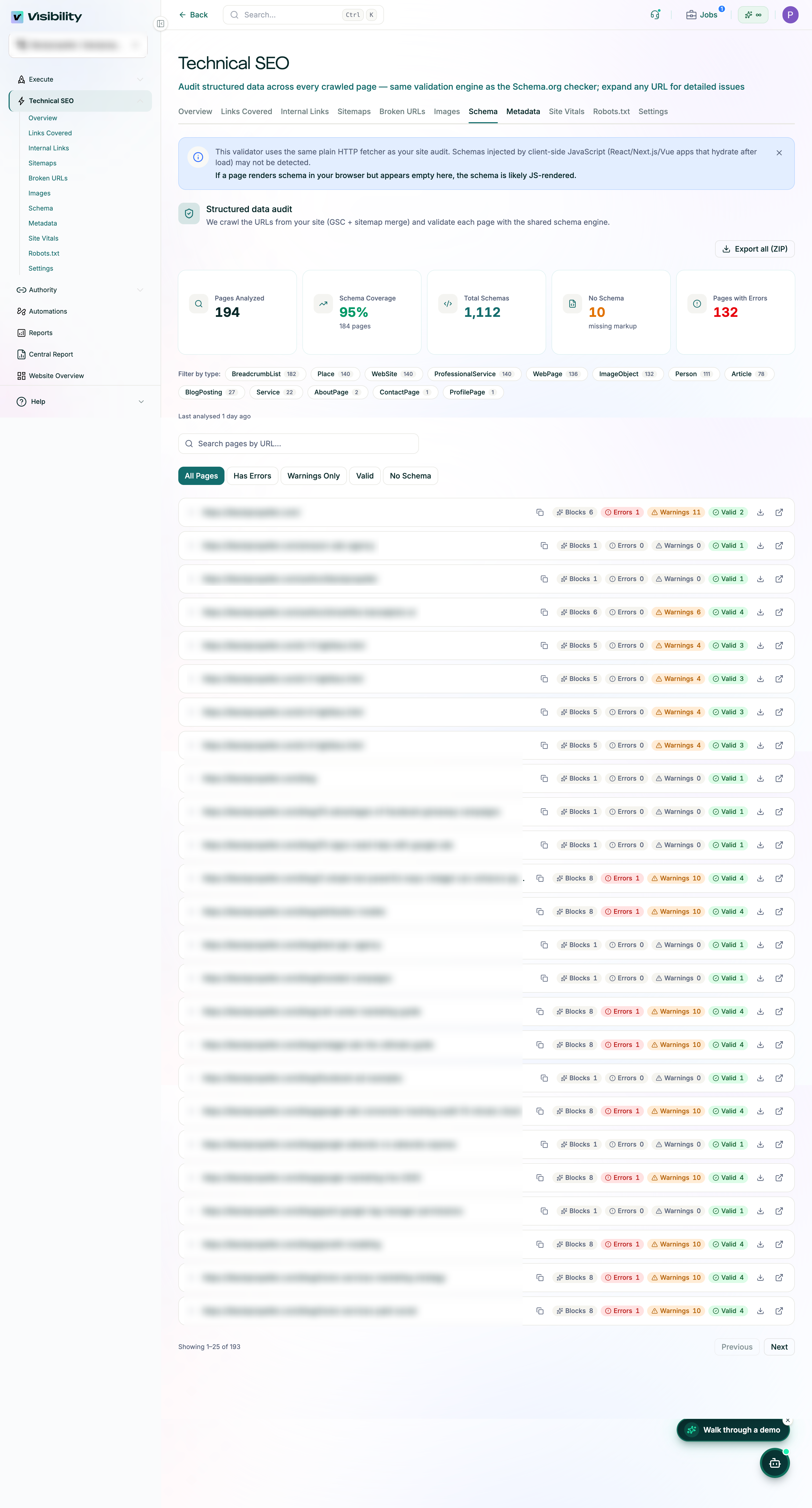
Running these six checks by hand across a growing site is where most schema programs break down. Pixis Visibility handles the schema audit lifecycle end to end: it crawls every page on your site (merging Google Search Console and sitemap URLs), validates each page's structured data with the same validation engine as the Schema.org checker, and reports schema coverage, total schemas, pages missing markup, and errors, warnings, and valid blocks down to the individual page and schema type (Organization, Article, FAQPage, BreadcrumbList, Product, and more). Because it re-audits on a schedule rather than as a one-off, regressions introduced by content updates, plugin changes, or CMS migrations surface the moment they appear rather than weeks later in lost rich results. This runs alongside the Technical SEO module's continuous monitoring of other dimensions of technical health, sitemaps, broken URLs, robots.txt, internal links, Core Web Vitals, and images, giving you one place to keep both your schema and the surrounding technical infrastructure AI-ready. Issues are surfaced with severity rankings and actionable recommendations. For schema specifically, this feeds into the broader technical health picture that determines whether AI crawlers can access, parse, and trust your pages reliably. Teams wanting a dedicated schema validation check alongside this should pair Pixis Visibility's continuous monitoring with Google's Rich Results Test for syntax validation (noting that FAQ rich result support in this tool is being removed in June 2026) and the Schema Markup Validator for broader Schema.org type validation.
The Interplay Between Visible Content and Schema for AI
Schema markup and visible content have to tell the same story. AI systems do not just read schema; they cross-reference it against the text, headings, and metadata on the page. If the structured data claims information that is missing or contradicted in the visible content, AI systems lose confidence in the page as a reliable citation source.
The most common misalignment issues are schema that claims an author that is not identified anywhere on the page, dateModified values that have not been updated after content revisions, Organization schema with contact information that differs from what is displayed on the page, and Product schema with prices or specifications that are out of sync with the visible product content.
The depth signals that drive AI citation include structural clarity, entity consistency, and verifiable substance. Schema contributes to all three when it is implemented correctly and maintained in sync with visible content. When it is not, it can actively reduce citation reliability rather than improving it.
The strongest results come from treating schema as maintenance rather than a one-time setup. After any significant content update, the structured data on that page should be reviewed for consistency. After a CMS migration or template change, schema inheritance patterns should be audited. Schema is not a set-and-forget layer.
Future Trends: Schema in a Post-2026 AI Search Landscape
The direction of schema is toward entity-based context rather than SERP visual enhancements. The FAQ deprecation fits a documented pattern at Google of retiring structured data features that were primarily serving as SERP decoration rather than genuinely aiding page understanding. The features being retired are the display elements, not the underlying data.
What is expanding: schema for content provenance and authorship signals as AI systems become more selective about source credibility. Schema for freshness signals as retrieval-augmented generation systems weight recency more heavily for time-sensitive queries. Schema types that help establish topical relationships between pages, which connects to how AI systems build context about a site's authority across a subject area.
The open question for practitioners is what role schema plays in AI retrieval specifically, as distinct from Google's traditional ranking systems. Google has confirmed that FAQ structured data will continue to be used for page understanding even without the rich result. How that understanding feeds into AI Overview source selection is not yet clearly documented. The conservative, durable strategy is to treat schema as a machine-readability investment rather than an AI citation shortcut: implement it accurately, keep it consistent with visible content, and focus on the types that define entity identity and content authority rather than the ones that were primarily chasing display features.