
Every few months, a new search development triggers the same conversation: SEO is dead. It happened when Google launched featured snippets. It happened with voice search. It happened with AI Overviews. Each time, organic search traffic turned out to be more resilient than the obituaries suggested, and the teams that abandoned their SEO foundations to chase the new thing paid for it.
Generative Engine Optimization is real, and it matters. Buyers are now starting their research inside ChatGPT, Perplexity, Gemini, and Google AI Overviews, and Semrush's 2026 AI search data shows visitors arriving from AI-generated answers converting at 4.4x the rate of traditional organic visitors. That makes AI citation a revenue question worth taking seriously. It does not make SEO obsolete.
The more accurate framing is that search now has two surfaces, and brands need to compete for both. SEO, GEO, and AEO now operate as three distinct disciplines with different optimisation targets, different metrics, and different content requirements. This guide covers where they diverge, what they still share, and why the teams doing both well are outperforming the ones who chose a side.
Key Takeaways
- GEO and SEO serve different outputs from the same content ecosystem. SEO earns clicks from traditional organic listings. GEO earns citations in AI-generated answers. A well-optimised page can do both, but the signals required for each are not identical.
- The SEO fundamentals that have always mattered, crawlability, indexability, helpful content, structured data, site architecture, and internal linking, still matter for GEO. AI engines cannot cite pages they cannot access and parse.
- The distinct GEO requirements are answer-first content structure, entity consistency across digital properties, factual density with verifiable sourcing, and AI crawler access. These are additions to an SEO foundation, not replacements for it.
- GEO success is measured differently from SEO. Citation rate, AI share of voice, brand mentions in generative answers, and AI-attributed referral traffic are the primary GEO metrics. Traditional rankings and organic traffic remain the primary SEO metrics.
- AI citation is already a commercially meaningful traffic channel. Visitors arriving from AI-generated answers convert at 4.4x the rate of traditional organic visitors per Semrush's 2026 data, and AI search traffic is projected to exceed traditional organic traffic by 2028.
Pixis Visibility tracks AI citation performance across four engines with 12-session variance reduction and connects those findings directly to content brief generation and publishing, closing the loop between GEO analysis and the content that acts on it.
Defining GEO and SEO: The Core Differences
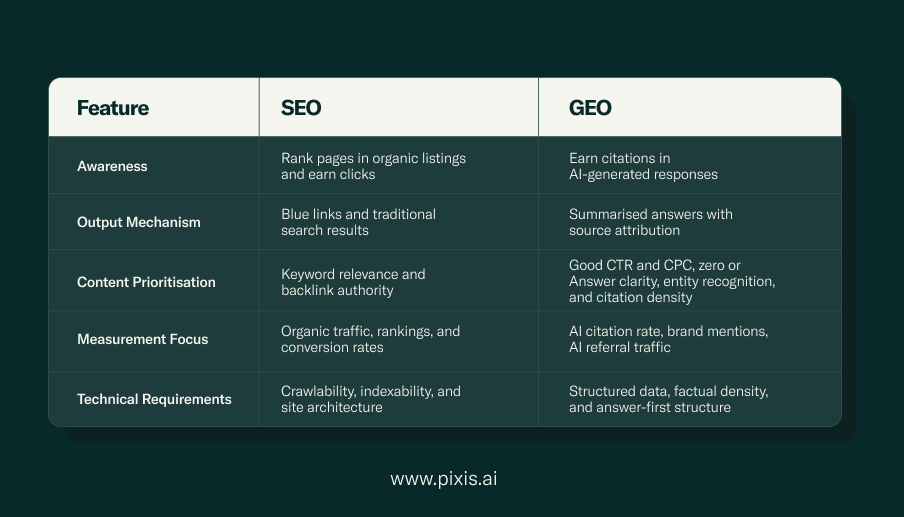
SEO is designed to win clicks from traditional organic listings through the classic pipeline of crawling, indexing, and ranking. GEO is designed to get content cited or summarised within AI-generated answers, a fundamentally different output that requires different content architecture.
As Pimberly's 2026 GEO vs SEO analysis frames it, SEO optimises for discovery, while GEO optimises for comprehension. Search engines find your page; AI engines extract meaning from it. Both need to work for your content to earn visibility across every surface where buyers now search.
The practical consequence is that content optimised only for keyword matching and backlink acquisition may rank well in Google but never appear in an AI-generated answer about the same topic. Conversely, content structured beautifully for AI citation but living on a technically broken or poorly-indexed site may never reach the AI engine's index at all. Both layers are necessary.
What Still Applies: Enduring SEO Fundamentals
AI systems do not pull answers out of thin air. They retrieve and synthesise content from the web's existing content ecosystem, which means the SEO infrastructure that organises that ecosystem still underpins GEO performance. If pages cannot be crawled or indexed, they are not available for AI citation regardless of how well their content is structured.
Google has confirmed that good SEO practices remain important for its AI features. The underlying logic is direct: AI Overviews are a feature of Google Search, and they draw on the same index and quality signals that power traditional results. A page that Google cannot access, trust, or understand is not a candidate for AI citation any more than it is a candidate for a top organic ranking.
The SEO fundamentals that transfer directly to GEO support:
Helpful, accurate, people-first content remains the foundation. AI engines are trained to avoid citing unreliable or thin content, and the signals they use to assess quality overlap significantly with Google's E-E-A-T framework. Content that demonstrates genuine expertise and answers questions with specific, verifiable information performs better in both environments.
Crawlability and indexability are the gatekeepers. If technical issues, blocked resources, or misconfigured robots.txt files prevent AI crawlers from accessing your content, your GEO efforts have no surface to build on. Technical SEO is not a prerequisite that becomes less important once GEO work begins. It is an ongoing requirement.
Structured data helps both search engines and AI systems understand content type, entity relationships, and page context with less inference required. Organisation, Article, Person, and sameAs schema in particular help establish the entity clarity that AI citation systems weight heavily.
Site architecture and internal linking establish topical authority signals that AI engines use alongside traditional ranking signals. A site with a well-organised content hierarchy and strong internal linking demonstrates broader subject-matter depth than a site with isolated pages on the same topic.
Page speed and Core Web Vitals affect whether AI crawlers successfully retrieve and process your content under their crawl budget constraints, particularly on large sites where slow or resource-heavy pages get deprioritised.
Key Differentiators for GEO: What Changes
Once the technical foundation is in place, GEO requires a distinct set of content practices that go beyond traditional SEO optimisation.
Answer-first content structure (BLUF: Bottom Line Up Front) rewards providing direct, concise answers near the top of a page before expanding on context or evidence. AI retrieval systems favour content that delivers the answer the prompt is asking for quickly and clearly, without requiring the model to infer it from surrounding text. This is a meaningful departure from the long-form SEO approach of building toward a conclusion.
Entity consistency requires that your brand, your products, and your key claims are described consistently across your own site and across third-party sources that reference you. AI models build a probabilistic picture of what your brand is and what it stands for based on everything they can find about it. Inconsistency across those sources creates ambiguity that reduces citation confidence.
Factual density and authoritative sourcing mean that vague claims and unsupported assertions are less likely to be cited than specific, verifiable statements supported by data or authoritative references. Linking out to credible sources strengthens rather than dilutes your own credibility in AI citation contexts, because it signals that your content is grounded in verifiable fact.
AI crawler access requires monitoring that the specific bots responsible for retrieval rather than training, including OAI-SearchBot, Claude-SearchBot, and PerplexityBot, can reach and index your content. Configuring robots.txt correctly for retrieval bots while maintaining appropriate controls over training bots is a distinct technical consideration that traditional SEO configurations often leave unaddressed.
Citation density means making clear, unambiguous claims backed by concise, verifiable support throughout the text. AI models look for content that answers a question directly and provides the evidence to trust that answer, not content that builds a persuasive narrative toward a conclusion.
How SEO and GEO Work Together
The disciplines reinforce each other because they draw on the same content quality signals, even when their optimisation targets differ. A well-structured page that comprehensively covers a topic will tend to earn both organic rankings and AI citations, because the factors that make content useful to a human reader (clarity, depth, accuracy, organisation) are also the factors that make it useful to an AI retrieval system.
Backlinks and topical authority still matter for GEO because AI engines draw on trust signals that the web's existing link graph helps establish. A brand consistently referenced by authoritative third-party sources is more likely to be cited in AI-generated answers, because those references provide the corroboration that AI systems look for before treating a claim as reliable.
The FAQ page is the clearest example of natural overlap. A page with genuine question-and-answer content, structured clearly with FAQPage schema, and living on a technically sound domain can rank in traditional search for the question terms, appear in AI Overviews, and be cited in Perplexity and ChatGPT answers for the same queries, all from a single piece of well-executed content.
How each AI engine cites content differently matters for teams trying to maximise coverage across multiple surfaces. ChatGPT draws heavily on Bing-indexed content and original data. Perplexity favours real-time semantic clarity. Gemini weights topical authority across formats. A unified strategy still serves all three better than three separate strategies, but understanding the nuances helps prioritise which content elements to emphasise.
Practical Optimisation: 90-Day Rollout and KPIs
Days 1 to 30: Audit and foundation
Conduct an AI visibility audit by prompting ChatGPT, Perplexity, Gemini, and Google AI Overviews with your core category keywords. Record which brands are cited, which sources are referenced, and where your brand is absent. Run a technical SEO audit to confirm crawlability, indexability, and structured data implementation across your highest-value pages. Identify the gap between where you are cited and where competitors are.
Days 31 to 60: Content upgrade
Prioritise the top 20% of pages by traffic or commercial intent. Add quotable statements, specific statistics, and verifiable claims to these pages. Restructure content to deliver direct answers near the top of each page before expanding on context. Implement or update structured data for Organisation, Article, and Person schema where missing. Ensure AI retrieval bot access is correctly configured in robots.txt.
Days 61 to 90: Publish and measure
Publish updates and monitor both traditional and GEO metrics. Track changes in AI citation rate, brand mentions in generative answers, AI share of voice across engines, and AI-attributed referral traffic. Compare against the baseline established in the first 30 days to identify which content changes produced measurable citation improvements.
KPIs for traditional SEO: Organic traffic, keyword rankings, click-through rate, conversion rate from organic.
KPIs for GEO: AI citation rate across tracked engines, brand mention frequency in AI answers, share of answer for key category prompts, AI-attributed referral sessions, sentiment of AI mentions.
Pixis Visibility's GEO Insights dashboard tracks AI Market Share, Average Position, Top 3 Presence, Model Coverage, and Competitor Matrix across ChatGPT, Perplexity, Gemini, and Claude. Running 12 sessions per prompt with variance reduction produces statistically reliable data rather than single-session approximations. Changes in these metrics following specific content publish events can be compared against the before/after SEO performance data in the same platform.
Generative AI Platforms and the Future of Search
The primary generative answer environments where GEO visibility matters in 2026 are Google AI Overviews, Gemini, Perplexity, ChatGPT Search, and Microsoft Copilot. Each surfaces sources differently, which is why understanding how each engine cites is more useful than treating them as a single undifferentiated channel.
Semrush's 2026 AI search data indicates that AI search traffic could exceed traditional search traffic by 2028, and that visitors arriving from AI-generated answers currently convert at 4.4x the rate of visitors from traditional organic search. These numbers reflect an early-adopter dynamic that is unlikely to hold at those ratios indefinitely, but they confirm that AI citation is already a commercially meaningful traffic channel rather than a speculative future concern.
The trajectory of search is toward a hybrid interface where traditional blue link results, AI-generated summaries, and conversational answers increasingly share the same page. Brands optimised only for the click will be invisible in the citation layer. Brands optimised only for the citation will be absent from the organic layer that often precedes it. The brands that build for both are the ones positioned to capture demand regardless of how the buyer searches.