
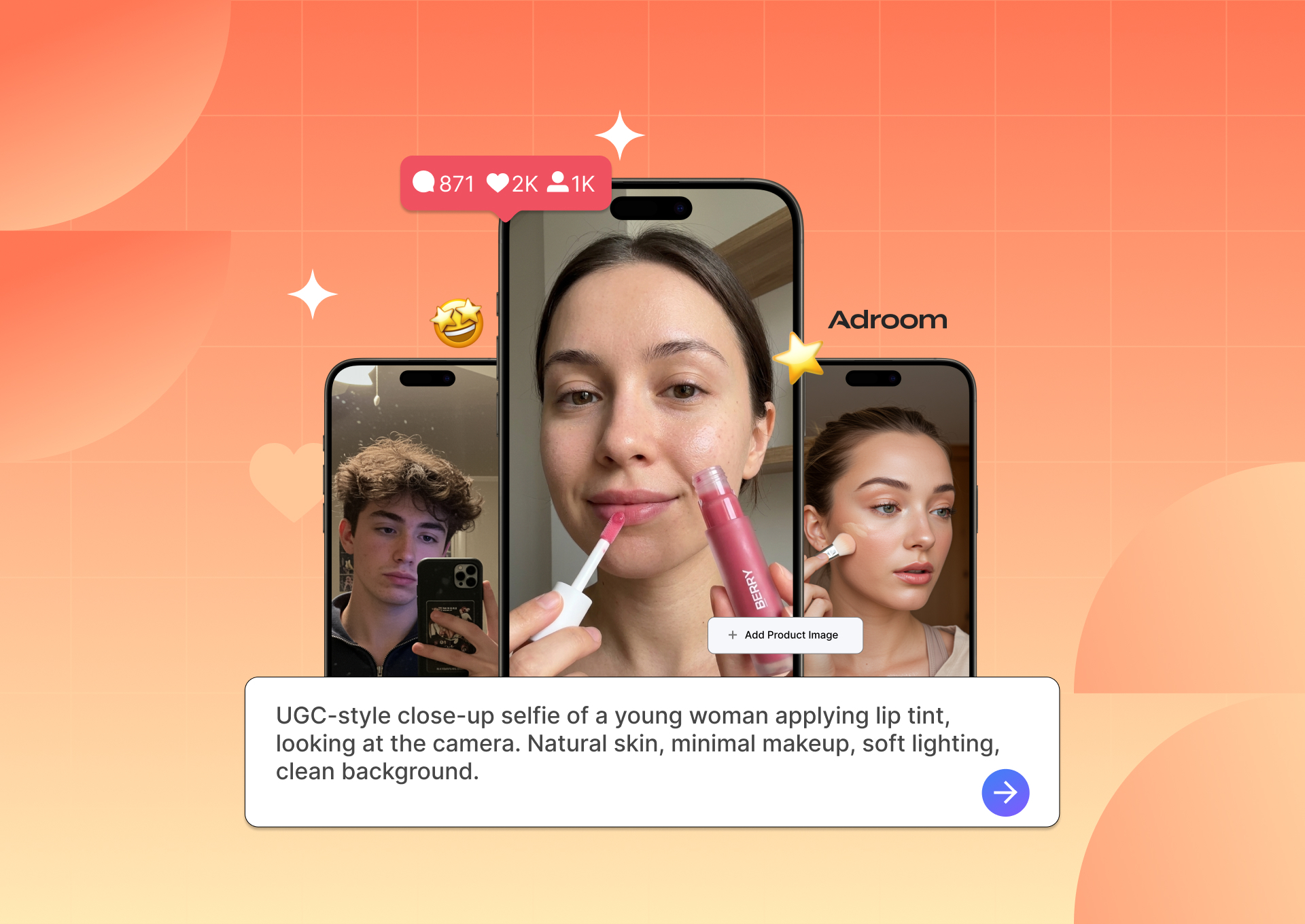
Your competitors are running 20 UGC variants. You're still waiting on a shoot.
That is a clear production model problem.
UGC-style ads — the kind that look like someone filmed them on their phone, talked directly to the camera, and actually meant it — are among the highest-performing formats on Meta and TikTok right now. Triple Whale's 2025 Meta benchmarks, drawn from nearly 35,000 brands, confirm that creative quality has an outsized impact on whether someone stops scrolling — and that CTR gains are increasingly driven by how well ad content resonates, not by targeting tweaks alone.
But getting UGC at scale has always meant one of three things: hiring creators, running an influencer programme, or hoping your customers make something worth reposting. All three have the same constraint — you're dependent on people you don't control, on timelines you can't compress.
AI UGC video generators change that. Not as a shortcut to the same outcome, but as an entirely different production model.
This guide covers how that model works, what it's good for, where it still falls short, and how to start producing creator-style video ads today — without a single influencer brief.
Why Creative Volume Now Determines Performance
The context has shifted. A 2025 AppsFlyer report cited across multiple performance marketing sources found that 70–80% of Meta ad performance is directly attributable to the strength of the creative itself — not budget, not audience targeting. You can have a perfectly configured campaign and still lose in the auction to a brand running better creative at a higher volume of variants.
The implication is uncomfortable: most SMBs are under-producing creative relative to what the algorithm needs to optimise. Meta's own 2025 guidance recommends testing 4–10 creative versions simultaneously and refreshing every 2–3 weeks to avoid fatigue. That cadence is simply not achievable with traditional creator-dependent workflows.
This is precisely the problem AI UGC production solves — not by replacing creative judgment, but by removing the production bottleneck that prevents teams from acting on it.
What Makes UGC-Style Ads Work
Before getting into the tooling, it's worth understanding what actually makes UGC-style ads effective — because 'it looks authentic' is too vague to act on.
The format works because of three structural features:
- Direct address: The presenter speaks to the viewer as though the camera is a conversation partner. No voiceover, no narrator — just eye contact and a point.
- First-person framing: The message is personal. 'I tried this,' 'I was sceptical,' 'here's what changed my mind.' Testimonial structure, even when scripted.
- Low-production signalling: Tight framing, natural light, ambient audio, minimal editing — all of it signals 'this is a real person, not a brand.'
None of these require a real human creator to execute. They require a well-written script and a delivery format that preserves those cues. Billo's internal 2025 creative testing confirms that drama-led scripts — presenting a relatable problem and resolving it with the product — consistently outperform generic ad formats on Meta. The structure is what converts, not the credential of the person delivering it.
The Real Cost of Creator-Dependent UGC
If you've run creator-sourced UGC campaigns, you know the rhythm: brief, negotiation, shoot, review, re-brief, final delivery, usage rights, repeat.
At low volume — two or three creatives per quarter — this is manageable. At the volume 2025 performance marketing requires, it breaks.
Consider what proper creative testing demands:
- Multiple hooks for the same script
- Different personas — sceptic, evangelist, expert, peer
- Platform variants: 9:16 for Reels and TikTok, 4:5 for Meta Feed, 1:1 for square placements
- Seasonal and offer-specific edits that can't wait two weeks
A single campaign can require 15 to 30 creative variants to test properly. Current UGC pricing benchmarks put the average rate for a single creator video at $150–$212, with mid-level creator rates running $150–$500 per deliverable. That's a significant production budget before a single ad has run — and before you know if the concept works.
The result is most teams under-test. They pick two or three creatives and run them until the performance falls off. That's not strategy — it's rationing.
What AI UGC Video Generators Actually Do
AI UGC video tools generate video ads featuring AI-powered avatars or synthetic presenters that deliver scripted content in a naturalistic, camera-direct style. The output looks like someone filmed themselves talking about your product.
Most platforms offer two broad capability tiers:
Turbo / Standard Mode
Faster generation, wider avatar variety, designed for rapid iteration. Best for high-volume hook testing where you need 8–15 variants quickly. Output quality holds well for mobile-first placements — particularly effective in formats where small screen size reduces the uncanny valley effect.
Advance / Talking Humans
Higher visual fidelity, more realistic expression and movement, better lip sync. Slower to generate, but output is difficult to distinguish from real creator content in most viewing environments. Best for proven ad sets where quality matters and budget is committed. AdRoom's UGC Video offers Turbo, Advance, and Talking Humans modes — the last being the most photorealistic option, suited for scaling the creative variants that have already won in testing.
The practical implication: Turbo is your testing layer. Talking Humans is your scaling layer. Run them sequentially, not interchangeably.
Step-by-Step: The AI UGC Production Workflow
Step 1: Write the Script First, Not Last
Most teams treat the script as a constraint around the creative. Flip that. The script is the product — everything else is execution.
A high-performing UGC script has three parts:
- Hook (0–3 seconds): A direct, specific opener that earns the next 15 seconds. 'I almost returned it' consistently outperforms 'Here's my honest review.' Specificity signals credibility.
- Body (3–25 seconds): First-person framing. One problem, one product connection, one proof point. Don't layer claims.
- CTA (final 3–5 seconds): Specific and low-friction. 'Link in bio,' 'Try it free,' 'See it for yourself.' Tell the viewer exactly what happens next.
Billo's 2025 research found that 'drama set-up' scripts — a relatable problem clearly named, then resolved with the product — are the most consistently high-performing structure on Meta. Write that structure, then generate avatar delivery around it.
Step 2: Select Avatar and Mode Deliberately
The avatar is not a stylistic choice — it's a targeting decision. Consider:
- Does the presenter's apparent age and demographic reflect your target buyer's peer group?
- Does the energy level — warm, direct, enthusiastic, authoritative — match the product category and the problem being solved?
- Does the framing match the placement? Tighter framing is more intimate for Reels; slightly wider works better for Feed.
For testing: run the same script across two or three avatar variants. Performance differences reveal how your audience's trust works, not just what message lands.
Step 3: Generate Multiple Hook Variants
The hook is where most creative tests are decided. Generate at least four hook variants per script — different emotional registers, different problem framings, different opening statements.
Run them as a structured test: same audience, same budget, same everything except the first three seconds. The data will eliminate options faster than any internal review.
Step 4: Resize for Platform Before You Launch
A video that performs on TikTok — fast hook, 9:16, direct — can underperform on Facebook Feed, where viewers are slightly more considered and often watching without sound. Don't re-edit manually. Use AI resizing to adapt each placement correctly. AdRoom's AI Resizing handles format adaptation automatically, keeping the presenter correctly framed across aspect ratio changes.
Step 5: Track at the Creative Level, Not the Campaign Level
The value of high-volume creative production is only realised if you're tracking performance at the creative level. Meta's Ads Reporting provides creative-level breakdowns that show which specific variant is driving which result. Without this, you can't iterate — you're just producing more of everything and hoping.
Where AI UGC Still Has Limits
Honesty matters here. AI UGC is a production model, not a magic creative layer.
- Real creators have audiences. If distribution through the creator's own following matters to your strategy, AI avatars don't solve that.
- Categories where visible product interaction is the proof — unboxing, tactile products, before-and-afters — still benefit from real human footage.
- Heavily regulated sectors (financial services, healthcare) may have additional restrictions on synthetic presenter content. Check platform policy before scaling.
The FTC's Disclosures 101 for Social Media Influencers is worth reviewing if your AI presenter script implies personal experience with a product — the endorsement disclosure principles apply regardless of whether a real person or an AI avatar is delivering the message.
For most SMB advertisers running direct-response campaigns on Meta and TikTok, none of these constraints apply to the majority of their ad inventory. AI UGC handles that inventory well.
The Business Case: Production Model Comparison
Traditional creator UGC pipeline for a 10-variant test:
- Creator briefing and negotiation: 3–5 days
- Shoot and delivery: 5–10 days
- Review and revision cycles: 3–5 days
- Total: 2–3 weeks minimum; $1,500–$5,000+ in creator fees
AI UGC pipeline for a 10-variant test:
- Script writing: 2–4 hours
- Avatar generation across variants: 1–2 hours
- Resizing and export: 30 minutes
- Total: under one working day; cost sits within your software subscription
The unlocked capacity isn't just time and money — it's creative learning velocity. Performance marketing practitioners running AI UGC workflows in 2025 report generating and optimising 125+ weekly creative variants — a volume that would be cost-prohibitive with creator-dependent production. The compounding effect over a quarter is significant: more variants tested means faster identification of winning creative, which means more efficient spend earlier.
FAQs
Can AI replace UGC creators for ads?
For performance-focused direct-response campaigns on Meta and TikTok, AI UGC tools can replicate the structural signals that make creator content effective — direct address, first-person framing, low-production aesthetics. Where AI doesn't replace a human creator is in audience distribution (creators bring their own following) and in content categories requiring visible real-world product use. For most SMB ad inventory, those exceptions don't apply.
How do I make UGC ads without hiring creators?
Use an AI UGC video generator. Write a script in first-person testimonial format, select an avatar that reflects your target audience's peer group, generate multiple hook variants, and export in the correct aspect ratios for your target platforms. The entire production cycle — from script to export — can be completed in under a day.
What's the best AI tool for UGC-style video ads?
Several standalone tools exist for AI avatar video generation. For teams running paid campaigns on Meta and TikTok who need UGC video generation integrated with ad resizing, variant management, and publishing workflows, a purpose-built performance creative platform like AdRoom reduces tool sprawl and keeps the production-to-launch workflow in one place.
Are AI avatar ads compliant with Meta and TikTok policies?
Both platforms currently permit AI-generated content in ads. Policy on synthetic media is evolving quickly — always verify directly against current platform guidelines before launching. If your AI avatar script implies personal product experience, also review the FTC's Endorsement Guides, updated in 2023, which apply to AI-delivered endorsements as well as human ones.
How many UGC variants should I be testing?
Meta's 2025 creative guidance recommends testing 4–10 creative versions simultaneously and refreshing every 2–3 weeks. For UGC specifically, start with at least four hook variants against a fixed body and CTA — let the hook data decide which concept to develop further. AI production is the only way most SMBs can reach that testing volume without a disproportionate creator spend.
Ready to see how we can help? Explore AdRoom: AI Creative Production for Performance Teams