

You're scaling ad spend and campaigns are multiplying across platforms. Somewhere between the dashboards and budget approvals, you've lost visibility into what drives results. AI promises to fix this by automating optimization, but handing over control to a black box that might overspend or misallocate budget feels riskier than the manual work you're trying to escape.
The tension isn't between automation and oversight—it's about building systems that let AI handle the repetitive optimization work while you maintain clear boundaries on spend, brand safety, and strategic direction. This guide walks through how to set guardrails, scale intelligently across channels, and track the metrics that matter when AI is making thousands of micro-decisions on your behalf.
Driving results with AI media buying while staying in control
AI media buying automates ad placement, bidding, and budget optimization across platforms like Meta, Google, and TikTok. Instead of manually adjusting bids or analyzing spreadsheets for hours, AI processes campaign data in real time and makes optimization decisions based on performance patterns.
Here's what changes: you stop executing repetitive tasks and start focusing on strategy, creative direction, and interpreting recommendations. The tension is real though. Automation promises efficiency, but you still own the budget and the brand. You can't hand over complete control to a system that might overspend, place ads in the wrong context, or optimize for metrics that don't align with your business goals.
The solution isn't choosing between automation and oversight. It's building guardrails that let AI scale your spend while you stay in the driver's seat. AI spots patterns humans miss by analyzing thousands of data points. It predicts which segments will convert. Then, it redistributes budget to high-performing placements faster than any manual process. But it only works when you define the boundaries, set clear success metrics, and maintain visibility into what the system is doing.
How AI Shifts From Rules to Real-Time Decisions
Traditional automation follows if-then logic. If cost per click exceeds $2, pause the ad. If ROAS drops below 3x, reduce the budget by 20%. These rules help, but they're rigid and reactive.
AI media buying operates differently. It learns from historical performance, identifies patterns across campaigns, and makes proactive adjustments based on what's likely to happen next.
Pattern recognition models
AI doesn't just track metrics. It connects behaviors across audience segments, ad formats, and time periods to identify what drives conversions.
Say users who engage with carousel ads on weekday mornings convert at twice the rate of single-image ads shown on weekends. The model recognizes that pattern and shifts budget accordingly. You'd eventually spot that trend manually, but AI finds it in days instead of weeks.
This capability extends beyond individual campaigns:
- AI detects creative fatigue before performance drops.
- It recognizes when a new audience segment starts responding.
- It identifies seasonal shifts in behavior that affect ad delivery.
The model constantly updates its understanding as new data flows in, which means optimization decisions improve over time.
Predictive budget allocation
AI forecasts which campaigns, ad sets, or audiences will deliver the best return and moves budget toward those opportunities before you see the performance dip elsewhere. If an ad set targeting parents of toddlers suddenly starts converting at a higher rate on Tuesday afternoons, the system increases spend during that window and pulls back from lower-performing segments. This happens automatically, without waiting for you to review yesterday's data and manually adjust.
The difference between prediction and reaction is speed. Manual reallocation happens after you've already spent budget on underperforming placements. Predictive allocation prevents that waste by anticipating performance shifts and adjusting in real time.
Cross-platform signal stitching
Most marketers run campaigns across Meta, Google, TikTok, and other platforms simultaneously. Each platform has its own dashboard, its own metrics, and its own optimization algorithm.
AI media buying tools connect these data streams to create a unified view of performance. If a user sees your Meta ad, clicks through to your site, then converts after seeing a Google search ad two days later, the AI understands that both touchpoints contributed to the outcome. This cross-platform visibility lets AI make smarter budget decisions. Instead of optimizing each platform in isolation, the system identifies which channels work best together and adjusts spend to maximize total return.
Guardrails That Protect Budget, Brand, and Data
Automation without boundaries creates risk. AI can optimize aggressively, but it doesn't inherently understand your cash flow constraints, brand safety requirements, or data privacy commitments. You set the rules that prevent the system from making decisions that conflict with your business priorities.
Hard spend caps and pacing alerts
Set maximum daily and weekly spend limits at the campaign, account, or portfolio level. If AI finds a high-performing opportunity, the cap prevents runaway costs. You control the investment pace to validate results before committing more budget.
Brand-safe inventory filters
AI places ads where performance data suggests they'll succeed. But performance alone doesn't account for context. You don't want your ads appearing next to controversial content, on low-quality websites, or in environments that conflict with your brand values.
Create exclusion lists for specific websites, content categories, or keywords. The AI respects these boundaries and only considers brand-safe inventory when making placement decisions.
Human-in-the-loop approval paths
Some decisions warrant human review before execution. Major budget increases, entry into new markets, or significant targeting changes can trigger approval workflows that pause automation until you sign off.
This doesn't slow down routine optimizations. It just adds a checkpoint for high-stakes decisions. Define thresholds that make sense for your business. You might allow AI to adjust budgets up to 30% automatically but require approval for anything larger. Or you might let the system test new ad creatives freely but require review before launching campaigns in a new geographic region.
The six-step roadmap to scale spend safely
Scaling AI media buying isn't about flipping a switch and hoping for the best. It's a phased process that starts with your highest-confidence audiences and gradually expands as the system proves itself.
1. Pinpoint high-signal audiences
Start with segments that already convert reliably. AI learns faster when it has quality data, and your best-performing audiences provide the clearest signal.
If parents aged 30–40 with household incomes above $75,000 consistently deliver a 4x ROAS, that's your starting point. Let AI optimize within that segment first before expanding to colder audiences. High-signal audiences also reduce risk. You're not testing AI on unproven segments where failure costs you budget and momentum.
2. Automate bid and budget testing
Once AI understands your core audiences, let it test different bid strategies and budget allocations within the guardrails you've set. The system might experiment with target ROAS bidding versus maximize conversions, or it might shift budget from morning to evening placements to improve efficiency.
These tests happen continuously, and the AI compounds what it learns into better decisions over time. You're not running manual A/B tests that take weeks to reach significance. The AI tests dozens of variables simultaneously and applies insights immediately.
3. Sync creative variants with signals
Connect creative performance data to audience insights so AI can match the right ad to the right person. If carousel ads outperform single images for first-time visitors but underperform for retargeting audiences, the system routes each creative to the segment where it works best.
You can also use AI to generate creative briefs based on what's working. Ads with bright colors, bold headlines, and product close-ups may outperform lifestyle imagery. The system documents this pattern. It then suggests producing more assets in the winning style.
4. Layer incrementality measurement
Last-click attribution overstates the impact of bottom-funnel ads and undervalues top-of-funnel awareness campaigns. Incrementality measurement isolates the true lift AI-driven campaigns generate by comparing results to a control group that didn't see your ads.
When AI optimizes for incremental lift instead of attributed conversions, it makes smarter budget decisions. It stops pouring money into retargeting audiences who were already planning to buy and starts investing in upper-funnel campaigns that actually expand your customer base.
5. Expand to new channels with lookalikes
Once AI has validated success on your primary platforms, use lookalike modeling to find similar audiences on new channels. If your Meta campaigns perform well with fitness enthusiasts aged 25–40, the AI identifies audiences with similar characteristics on TikTok, Google, or Pinterest and tests campaigns there.
Lookalike expansion also accelerates learning on new channels. Instead of starting from zero, the AI applies insights from existing campaigns to inform its initial decisions.
6. Set always-on anomaly detection
Automated alerts notify you when performance deviates from expected patterns. If your average cost per acquisition suddenly spikes by 40%, if click-through rates drop below historical norms, or if a campaign burns through its daily budget in two hours, you get an alert immediately.
Anomaly detection prevents small issues from becoming expensive problems. You're not reacting to poor performance days after it started. You're catching it in real time and deciding whether to adjust course or let the system continue.
Connecting AI Insights Directly to Creative Production
AI media buying doesn't stop at placement and bidding. The performance data the system collects informs creative strategy, speeds up production, and helps you test new concepts faster.
Dynamic briefs generated from performance data
AI analyzes which creative elements drive results and generates briefs for your design team. If ads featuring bright colors, bold headlines, and product close-ups outperform lifestyle imagery, the system documents that pattern and suggests producing more assets in the winning style.
Dynamic briefs also identify gaps. If you're missing high-performing creatives for a specific audience segment or product category, the AI flags the opportunity and recommends producing assets to fill it.
Rapid variant generation and scoring
Generative AI tools create multiple ad variations based on your brand guidelines and performance data. You provide a product image, a value proposition, and a call to action, and the system generates 10 different layouts, headlines, and copy combinations. Each variant gets scored based on predicted performance, so you can prioritize testing the concepts most likely to succeed.
This doesn't replace human creativity. It accelerates the production of testable assets so your team can focus on big ideas instead of repetitive execution.
Feedback loops for human refinement
AI provides data-driven recommendations, but you bring brand intuition, market knowledge, and creative judgment. When the system suggests a new creative direction, you evaluate whether it aligns with your brand positioning and long-term strategy.
If it does, you greenlight production. If it doesn't, you provide feedback that helps the AI refine future recommendations. This feedback loop improves over time. The more you guide the system, the better it understands your brand's unique voice and creative standards.
Choosing the Right AI for Media Buying vs. Generic LLMs
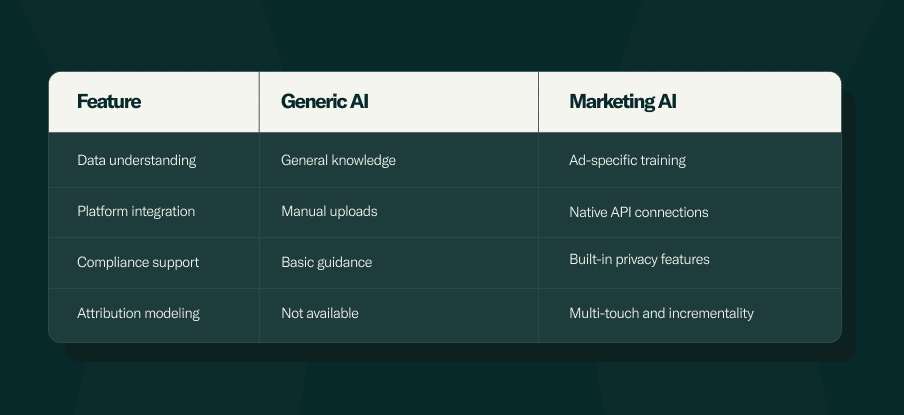
Not all AI tools are built for media buying. General-purpose LLMs like ChatGPT can answer questions and draft copy. But they lack the specialized training, integrations, and compliance features you need. These are essential to manage ad campaigns effectively.
Specialized ad data training sets
Marketing-specific AI models are trained on advertising data: campaign performance metrics, audience behaviors, creative effectiveness patterns, and platform-specific nuances. This training lets the system understand concepts like creative fatigue, incrementality, and cross-platform attribution without requiring you to explain them.
A general LLM might give you generic advice about "testing different ad formats," but a marketing AI knows which formats work best for your specific goals and audience. We at Pixis built our platform on models trained exclusively for performance marketing. That specialization means you get recommendations grounded in real advertising outcomes, not generic best practices.
Native integrations with ad platforms
Marketing AI tools connect directly to Meta, Google, TikTok, and other platforms via API. Performance data flows automatically into the system, and optimization decisions get executed without manual uploads or exports.
You're not copying numbers from one dashboard, pasting them into a spreadsheet, and then uploading that file to an AI tool. The integration happens seamlessly in the background. Generic LLMs require you to manually provide data, which introduces delays, errors, and extra work.
Compliance and attribution support
Marketing AI tools include built-in privacy compliance features that respect GDPR, CCPA, and platform-specific data policies. They also handle multi-touch attribution modeling, incrementality measurement, and other technical requirements that general AI tools don't address.
Future-Proof KPIs To Track As You Scale
When AI handles tactical decisions, your KPIs shift from inputs to outcomes. You stop obsessing over daily click-through rates and start tracking metrics that reflect business impact and system resilience.
Profit-weighted ROAS
Basic ROAS treats all revenue equally, but not all sales generate the same profit. A $100 purchase with a 60% margin contributes more to your bottom line than a $100 purchase with a 20% margin.
Profit-weighted ROAS accounts for these differences and ensures AI optimizes for actual profitability, not just top-line revenue. This metric matters more as you scale because it prevents the system from chasing high-revenue, low-margin sales that look good in reports but don't improve your business.
Signal loss resilience score
Third-party cookies are disappearing, and tracking limitations continue to tighten. Signal loss resilience measures how well your AI performs when data becomes less precise.
If your campaigns maintain strong performance even as attribution windows shorten or tracking degrades, you've built a resilient system. Track this metric by comparing performance during periods of high signal quality versus low signal quality. The smaller the gap, the more resilient your system.
Creative fatigue velocity
Every ad eventually loses effectiveness as audiences see it repeatedly. Creative fatigue velocity measures how quickly your ads decline from peak performance to diminishing returns.
Faster fatigue means you're burning through creative assets quickly and putting pressure on your production team. Slower fatigue means your ads have staying power and you can scale without constantly refreshing creatives. AI can help slow fatigue by rotating ads strategically, limiting frequency, and identifying which creative elements maintain interest longer.
FAQs About AI Media Buying
How do I set a daily spend cap without throttling AI media buying performance?
Set caps at your maximum comfortable spend level rather than target spend, allowing AI to scale up during high-performance periods while protecting against runaway costs.
What data do I need before switching on AI media buying?
You need at least 30 days of campaign performance data and clear conversion tracking to give AI sufficient signal for optimization decisions.
Can AI for media buying work with first-party data only?
Yes, AI can optimize using your customer data, website analytics, and campaign performance without relying on third-party cookies or external data sources.
How long before I see results after activating AI media buying?
Most AI systems show initial improvements within seven to 14 days, with significant optimization gains appearing after 30 days of learning.
Ready to Partner With AI For Media Buying Progress
Successful AI media buying comes down to pairing intelligent automation with clear boundaries. You define the guardrails, set the success metrics, and maintain oversight. The system handles the repetitive optimization work that used to consume your time.
The difference between AI that wastes your time and AI that multiplies your impact is specificity. You don't need perfect prompts or advanced technical knowledge. You need tools built specifically for marketers, trained on advertising data, and integrated with the platforms you already use.
Ready to see how AI can scale your media buying while keeping you in control? Try Pixis today.