

Most multichannel marketing campaigns waste 30–40% of their budget on duplicate reach, misattributed conversions, and creative that doesn't fit the channel. You're paying to show the same ad to the same person across three platforms, funding channels that look busy but don't convert, and wondering why scale feels expensive.
The difference between multichannel campaigns that drain budget and ones that drive growth comes down to three things: knowing which channels actually work together, automating the optimization you can't do manually, and adapting creative without starting from scratch every time. We'll walk through what multichannel marketing actually means, where the budget waste happens, how to scale without overspending, and which metrics prove your strategy is working.
What is a multichannel marketing strategy
A multichannel marketing strategy uses multiple platforms to reach customers where they already spend time. You're running campaigns on email, social media, your website, physical stores, and SMS. The goal is simple: meet people on their preferred channels instead of forcing them to come find you.
This approach gives customers choice in how they interact with your brand. A customer discovers you on Instagram, researches products on your website, and makes a purchase after receiving an email. Each touchpoint plays a role, and together they create a presence that feels natural rather than pushy.
Why multichannel campaigns waste budget and how to fix it
Most multichannel campaigns bleed money because teams launch everywhere at once without knowing where the waste happens. Three problems cause most of the damage.
First, channel overlap hits you hard. You're paying to reach the same person on Facebook, Instagram, and email simultaneously. That's three impressions when one would've worked, and you're competing against yourself for attention.
Second, attribution gaps mean you don't know which touchpoint actually drove the conversion. You keep funding channels that look busy but don't deliver results. Activity isn't the same as impact, but without clear attribution, they look identical in your dashboard.
Third, creative fatigue finishes the job. You use identical messaging across every channel because it's faster to copy-paste. But LinkedIn audiences expect different content than TikTok users, and treating them the same means lower engagement everywhere.
Here's how to stop the bleeding:
- Test channels in stages: Launch on one platform first, validate what works, then expand.
- Implement multi-touch attribution: Use tools that connect touchpoints into customer journeys so you see which combinations drive conversions.
- Adapt creative by channel: Keep your core message consistent but change format and tone to match each platform's context.
- Set frequency caps: Limit how often the same person sees your ads across channels to reduce overlap waste.
Advantages of multiple marketing channels for growth
Running campaigns across multiple channels expands your reach, increases engagement, and protects you from platform risk. Each advantage compounds when you execute well.
Expanded reach
Different audiences live on different platforms. Your Instagram followers might rarely check email, while your newsletter subscribers might not use social media daily. By showing up on multiple channels, you catch people in their natural habits rather than hoping they'll change behavior to find you.
Start with where your specific customers already are, not where you want to be.
Higher engagement rates
Customers who interact with your brand across multiple channels stay engaged longer and purchase more frequently. Someone who follows you on social media and receives your emails converts at a higher rate than someone who only sees one touchpoint.
The reason is straightforward. Multiple exposures build familiarity, and familiarity builds trust. When purchase decisions happen, you're top of mind because you've been consistently present.
Risk diversification
Algorithm changes, policy updates, and platform outages happen without warning. If your entire strategy lives on one channel, you're vulnerable to forces outside your control.
Multichannel strategies spread risk. When Facebook changes its algorithm, your email list and Google Ads campaigns keep running. When iOS privacy updates affect tracking, your owned channels still deliver.
Traits of a high-performance multichannel strategy
The best multichannel strategies share four characteristics: customer focus, creative consistency, real-time feedback, and automated optimization.
Customer-centric planning
Start with where your customers spend time, not where you want to be. Research their preferred communication methods and content formats before choosing channels.
Talk to customers, review engagement data, and test assumptions. Your data will show if your audience prefers SMS over push notifications, or if they engage with video on YouTube but ignore it on LinkedIn. Let behavior guide your channel selection.
Consistent cross-channel creative
Keep your brand voice recognizable across channels while adapting format and tone to each platform's context. Someone can identify your brand whether they see your ad on LinkedIn or in their inbox, even though the creative looks different.
Consistency doesn't mean identical. A professional tone works on LinkedIn; a more casual approach fits Instagram. The core message stays aligned while the delivery changes.
Real-time data feedback
Use systems that surface which channels drive results immediately, not days or weeks later. Make decisions based on current performance, not delayed reports that reflect outdated conditions.
Real-time feedback lets you spot problems early. If a channel's performance drops, you can investigate and adjust before wasting significant budget.
AI-led budget allocation
Automate daily shifts toward performing channels instead of waiting for monthly reviews. Let data guide investment decisions, not intuition or habit.
AI-powered budget optimization reacts faster than humans can. It identifies performance patterns, predicts outcomes, and moves spend to maximize results.
Steps to scale a multichannel campaign without overspend
Scaling multichannel campaigns requires a sequential approach that validates each step before adding complexity.
1. Start with one profitable channel
Master one channel's messaging, creative formats, and economics before expanding. You can't scale what you haven't proven, and trying to optimize multiple channels simultaneously splits your attention.
Pick the channel where your customers are most active and where you can measure results clearly. Run campaigns until you understand what works, why it works, and how much it costs to acquire a customer profitably.
2. Validate messaging fit on a second channel
Test your winning message from channel one on a complementary platform. Adapt the format but keep the core value proposition consistent.
If your Facebook carousel ads perform well, try adapting that message for Google Display or Instagram Stories. You're not starting from scratch—you're testing whether proven messaging translates to a new context.
3. Centralize reporting and attribution
Build a single dashboard showing customer journeys across touchpoints. Track which channel combinations drive conversions, not just which channels get last-click credit.
Without centralized reporting, you're managing channels in isolation. You might think email is underperforming when it's actually the critical touchpoint that moves people from awareness to purchase.
4. Automate budget shifts daily
Set rules to move spend from underperformers to winners automatically. Don't wait for monthly reviews to optimize—performance changes faster than that.
Automation removes delay and emotion from budget decisions. When a channel's CPA rises above your target, the system reduces spend immediately. When another channel exceeds goals, it scales automatically.
5. Refresh creative assets weekly
Rotate fresh versions of top performers to prevent fatigue. Maintain what works while iterating on details like headlines, images, or calls to action.
Creative fatigue kills performance gradually. By the time you notice declining results, you've already wasted budget.
Metrics that prove multichannel marketing campaigns are working
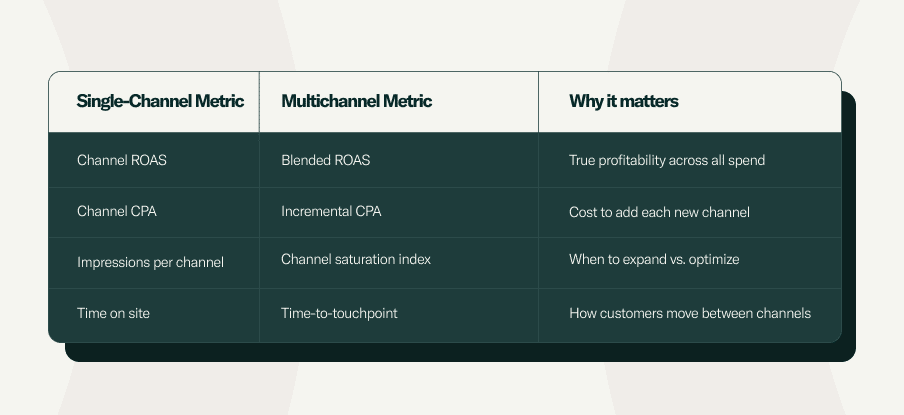
Traditional single-channel metrics miss the full picture. You can't evaluate multichannel success with isolated platform data. You have to measure how channels work together.
Blended ROAS
Blended ROAS shows return on ad spend across all channels combined, giving you true profitability. If your Facebook ROAS is four times but your Google ROAS is two times, blended ROAS tells you whether the overall strategy is profitable.
Customers rarely convert on the first touchpoint. They might see your Facebook ad, search your brand on Google, and purchase through email. Blended ROAS captures the full journey's efficiency.
Incremental CPA
Incremental CPA measures the additional cost to acquire customers when you add a new channel. This reveals diminishing returns early, before they become expensive problems.
If your first channel delivers $30 CPA and adding a second channel brings blended CPA to $35, you're paying $5 more per customer for expansion. This data shows whether the cost is worth the increased volume or if you're reaching the same audience twice.
Channel saturation index
Channel saturation index identifies the point where adding budget to a channel no longer improves results. This signals when to expand elsewhere instead of forcing more spend into a saturated channel.
Every channel has a ceiling. You can only reach so many qualified people on Instagram or Google before you start paying more for lower-quality traffic.
Time-to-touchpoint
Time-to-touchpoint tracks how long customers take to move between channels before converting. This guides retargeting windows and frequency settings.
If customers typically see your Facebook ad, then convert via email three days later, you know to set up a three-day nurture sequence. If they search your brand within hours of seeing an ad, you know to bid aggressively on branded search terms immediately after display campaigns run.
Tools and automations for streamlined multichannel management
Managing multiple channels manually doesn't scale. You can't react fast enough, optimize continuously, or maintain consistency across platforms without automation.
AI budget optimizers
AI budget optimizers automatically redistribute spend based on real-time cross-channel performance. They make decisions faster and more consistently than humans can, reacting to performance changes within hours instead of days.
The systems analyze patterns across channels, predict outcomes, and shift budget toward the highest-performing combinations. You set the goals and guardrails; the AI handles execution. We at Pixis built this capability into our platform because we saw marketers spending hours on budget management that AI could handle in minutes.
Creative versioning engines
Creative versioning engines adapt core creative for channel specs and audience segments automatically. Instead of manually resizing and reformatting assets for each platform, you upload once and the system generates optimized versions.
This speeds up campaign launches and keeps creative consistent across channels. You're not choosing between speed and quality—automation delivers both.
Unified attribution dashboards
Unified attribution dashboards connect touchpoints into single customer journeys, revealing true multichannel impact. You see which channel combinations drive conversions, not just which channels claim credit.
This visibility changes decision-making. Instead of funding channels based on last-click attribution, you invest based on actual contribution to the customer journey.
Try Prism today to see how AI-powered multichannel optimization works in practice.
Multichannel vs omnichannel vs cross-channel
People use the terms interchangeably, but they describe different approaches. Understanding the distinctions helps you set realistic goals and choose the right tools.
Multichannel means using multiple separate channels that don't necessarily connect. You run Facebook ads, send emails, and maintain a website, but each operates independently. Customers might interact with all three, but the channels don't share data or coordinate messaging.
Cross-channel means channels share data and coordinate messaging. Your email campaign references what someone saw in your Facebook ad. Your website personalizes content based on which channels someone engaged with previously.
Omnichannel means fully integrated experience where all channels operate as one system. A customer starts browsing on mobile, continues on desktop, and completes purchase in-store with full continuity. Every touchpoint knows the complete history and adapts accordingly.
Most brands operate in the multichannel or cross-channel range. True omnichannel requires significant infrastructure and integration.
Your next move: put insight into action with AI
Multichannel marketing transforms from reactive budget management to proactive optimization when you add AI to your process.
AI spots patterns you'd miss manually. It identifies which channel combinations drive conversions, predicts performance changes before they happen, and shifts budget continuously to maximize results. This isn't about replacing your judgment—it's about executing your strategy faster and more precisely than manual management allows.
Specialized marketing AI tools outperform general-purpose solutions for campaign management. Tools built specifically for marketers understand ad platforms, attribution models, and campaign structures. They don't require extensive prompt engineering or constant supervision because they're designed for this exact use case.
We at Pixis built our platform around this principle. Marketing teams don't have time to become AI experts—they have campaigns to run and goals to hit. Our AI handles the repetitive optimization work so you can focus on strategy, creative, and the decisions only you can make.
Try Prism today to automate your multichannel budget optimization.
FAQs about multichannel marketing strategies
How do I decide which new channel to test first?
Choose channels where your existing customers already spend time and engage actively. Review your current audience data to see which platforms they use most frequently. Start with platforms that complement your successful channel's audience behavior—if Facebook works well, Instagram or Messenger might be natural next steps since user behavior is similar.
What percentage of budget remains flexible across channels?
Keep about one-third of your budget flexible for reallocation based on performance. This gives you room to capitalize on winners without abandoning channels that can improve with optimization. Fixed budget allocations prevent you from scaling what works, while too much flexibility creates instability that makes performance analysis difficult.
When do I pause a channel that underperforms?
Pause when CPA exceeds your target beyond your profit margin and optimization shows no improvement over several weeks. Give channels enough time and budget to exit the learning phase—most platforms need at least 50 conversions to optimize effectively. If performance doesn't improve after testing multiple creative variations, redirect that budget to channels delivering results.
Can small teams run multichannel campaigns without an agency?
Yes, with AI tools that automate budget allocation, creative versioning, and performance tracking. Focus on mastering fewer channels rather than spreading thin across many. Start with two or three channels where your audience is most active, use automation to handle optimization, and expand only after you've proven profitability.