
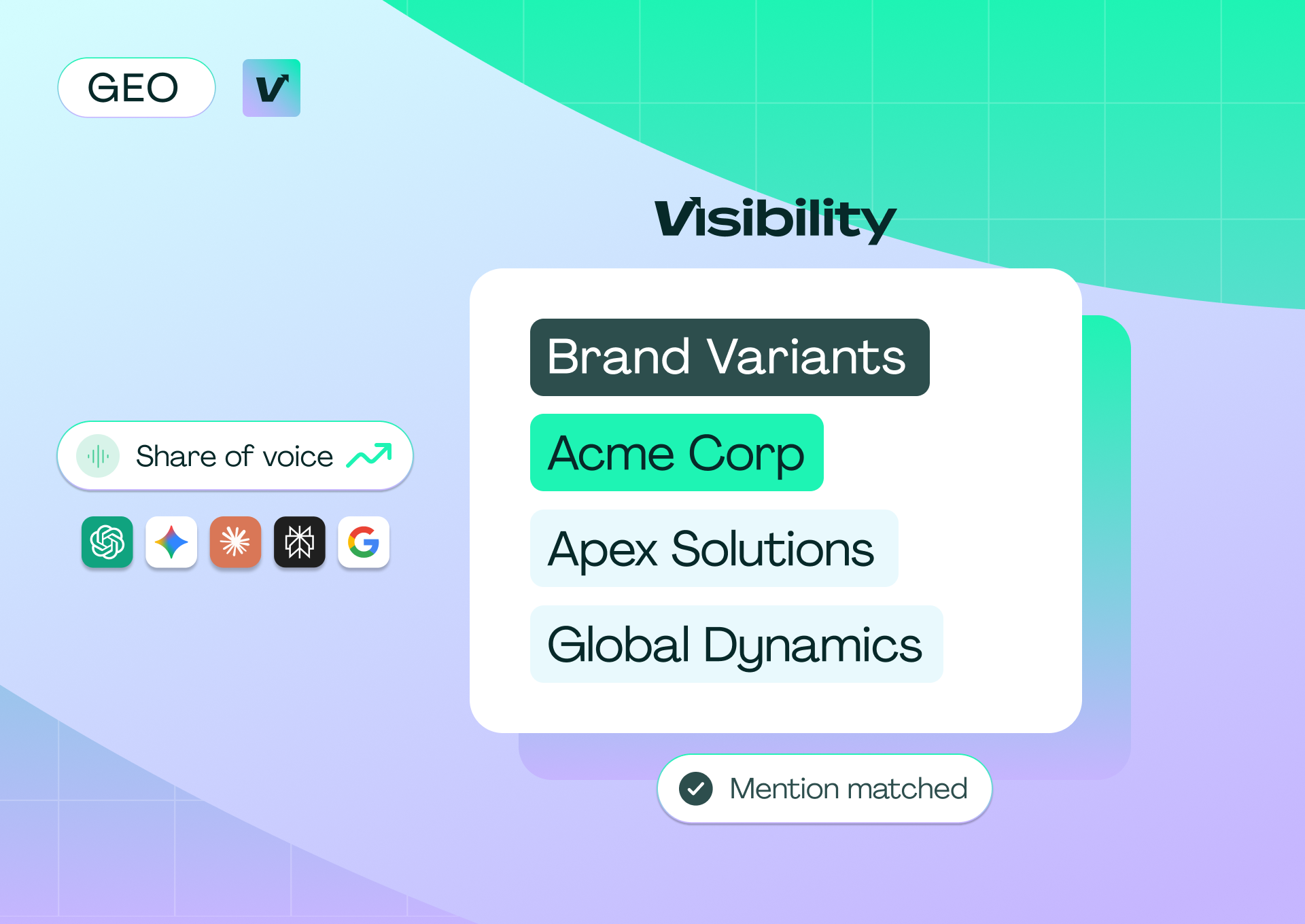
Your brand shows up in a ChatGPT answer as "Northgate", in a Perplexity answer as "NA", and in a Gemini answer by the name of its flagship product. Your tracker searched for "Northgate Analytics" and counted none of them.
This is one of the most common reasons AI visibility numbers look worse, or better, than they really are. Models refer to brands the way people do: by short names, acronyms, product names, old names and misspellings. A tracker that matches one exact string sees only part of that.
The opposite error is just as damaging. Map a short form that doubles as a common word, and every unrelated use of that word inflates your mention count and your share of voice.
The fix is a maintained variant list with clear disambiguation rules, checked against real answers. This guide covers how to build that list, how to handle names that collide with common words, how to verify the counts, and when to start a new baseline.
Key takeaways
- Track every form your brand takes in AI answers: legal name, short name, acronym, product and sub-brand names, common misspellings and former names.
- Short or common-word variants need disambiguation rules: match on word boundaries first, then review ambiguous answers with an exclude list or a second-pass check.
- Read a sample of actual AI answers by hand before you trust the counts, in both directions: missed mentions and false matches.
- Keep sub-brand and product mentions as separate entities that roll up to the parent, so one product does not distort the brand total.
- Every change to the variant list changes the measurement, so start a new baseline and record the date and reason.
- Pixis Visibility shows the actual AI answer for each tracked prompt, which is where you verify what was and was not counted.
Why one brand name is never enough
AI engines do not have a canonical spelling of your brand. They reproduce the forms that appear across the web content they learned from and the pages they retrieve. That means a single brand can surface in several shapes across engines, prompts and even repeated runs of the same prompt.
Two errors follow from this, and they push your numbers in opposite directions.
- Undercounting. Track only the legal name and every answer that uses a short form, acronym or product name goes uncounted. These are real brand references your data never sees.
- Overcounting. Map a generic term, such as a short acronym or a dictionary word, and the tracker counts mentions that have nothing to do with you.
Either error makes mention rate, share of voice and average position unreliable for decisions. For the wider tracking workflow these numbers feed into, see how to track your brand's visibility across ChatGPT, Perplexity and Gemini.
The variant list is only one input to measurement quality. Prompt coverage, engine sampling and answer parsing matter too. But it is the input most teams set once and never revisit.
Build and apply a brand variant list in five steps
The worked example below follows a fictional brand: legal name Northgate Analytics, with AI answers that also say Northgate, NA and Northgate Analytics Platform.
1. Build the variant list
Think of the list as an alias dictionary: every surface form maps to one canonical entity. Cover six categories:
- Legal or full name: Northgate Analytics
- Short name: Northgate
- Acronym or initialism: NA (flag for disambiguation)
- Product and sub-brand names: Northgate Analytics Platform
- Common misspellings: Northgate Analytix
- Former names: Northgate Data
Product names deserve special attention. A 2025 arXiv paper on brand entity linking notes that string matching can only retrieve brands that are explicitly mentioned, and that a product line name can point to a specific manufacturer without naming it. If an answer recommends your product by its own name, your list has to include that name.
For misspellings and short forms, start with your own search data. The queries people type into Google Search Console show the forms real buyers use, and models trained on human text tend to reproduce the same errors. Former names matter because older pages that still use them remain part of what models have seen.
2. Disambiguate common-word and short names
If a variant is also an ordinary word or a short string, it needs rules before it goes live. Entity resolution, the process of grouping surface forms under one canonical entity, depends on them.
A practical two-pass approach:
- First pass, deterministic. Match variants on word boundaries, so "NA" does not match inside "DNA" or "NATO".
- Second pass, review. Send ambiguous matches to a human reviewer or an AI judge with clear instructions, and keep an exclude list for known non-brand uses.
In the example, NA is too short to match reliably. It goes to the review pass, and the exclude list covers "not applicable" and "North America". Only map variants that are unambiguously yours; if a form is mostly used for something else, leave it out and accept a small undercount.
3. Audit a sample of answers by hand
Automated matching is only as good as the list behind it, so read real answers. Take a 20 to 30 prompt set and read several answers per prompt across the engines you track.
Check two things for each answer. Was every reference to your brand counted, whatever form it took? And was anything counted that was not your brand? Note every new variant you find and every false match, then update the list and the exclude rules.
4. Separate brand and product mentions
Treat each sub-brand or product as its own entity that rolls up to the parent brand. That way each one gets its own mention rate and share of voice, and you can see which products drive overall visibility.
Without this hierarchy, a single popular product can inflate the parent brand's numbers, or a product named in an answer can be missed entirely because the parent name never appears.
5. Re-baseline after every change
Adding or removing a variant changes what the count includes. Figures from before the change describe a different measurement than figures after it. Start a new measurement period, and record the date, the change and the reason.
What the worked example shows
Suppose Northgate's first measurement tracked only the legal name. After adding Northgate, NA with disambiguation, and the platform name, the same 30-prompt set produces very different numbers. The figures below are illustrative, not benchmarks.
- Mention rate: 12% with the legal name only, 28% with mapped variants (illustrative)
- Share of voice: 8% with the legal name only, 19% with mapped variants (illustrative)
The brand did not become more visible overnight. The measurement became more accurate. That is exactly why the change needs a new baseline rather than a line on a trend chart.
Where variant tracking goes wrong
Most errors trace back to three habits.
Ghost mentions from unmapped variants
When only the canonical name is tracked, answers that use a short name, acronym or product name disappear from the data. The brand looks less visible than it is, and teams can spend effort fixing a gap that does not exist.
Over-mapping generic terms
The reverse problem: a term so broad that it catches non-brand uses. Over-mapping inflates share of voice and makes competitor comparisons meaningless. The fix is the exclude list and the review pass from step 2.
Comparing across list versions
A trend line that spans a variant list change mixes two different measurements. A jump after you add variants is a measurement change, not a visibility gain. Keep a changelog next to your reports so anyone reading them can see where the baselines break.
Check the counts before you report them
Before you share numbers, run three checks.
- Recall check. Pull a fresh sample of answers and confirm that every brand mention, in any form, was counted.
- Precision check. In the same sample, confirm that non-brand uses of short or common-word variants were excluded. This is where over-mapping shows up.
- Direction check. Compare results before and after a list change. More mapped variants should raise the count; if it falls, or rises far more than the sample suggests, something in the rules is wrong.
Repeat the checks on every prompt set after each list change. For a quick manual version of the wider audit, see how to audit your AI search visibility in 15 minutes.
Keep in mind that AI answers vary from run to run. Search Engine Land, citing University of St. Gallen research, reports that consistency for the same prompt ranges from very low to very high. Read several answers per prompt before you conclude a variant is missing.
Where Pixis Visibility fits
The repeat work in this process is running the same prompts across engines and reading what comes back. Pixis Visibility tracks brand mentions, average position, citation rate, share of voice and top-3 presence across ChatGPT, Perplexity, Gemini and Claude, using prompt sets you build or auto-generate.
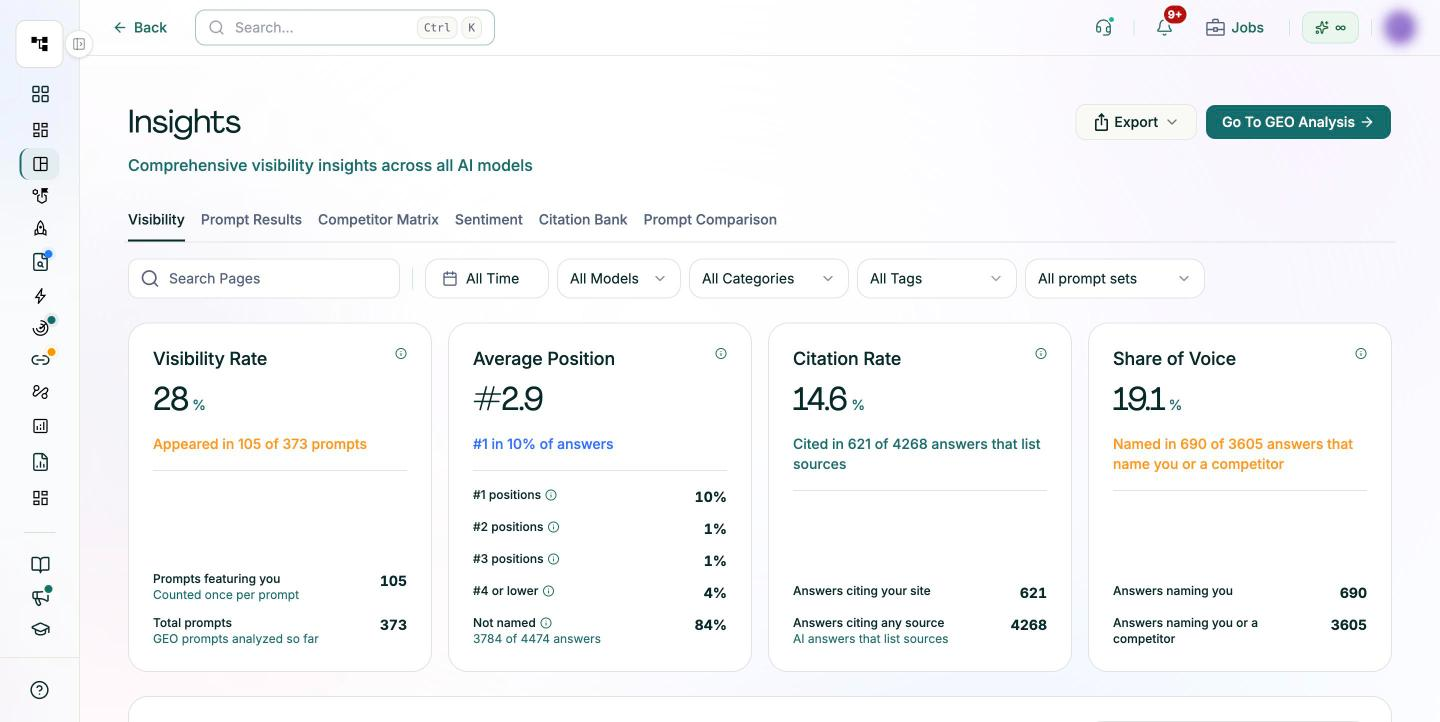
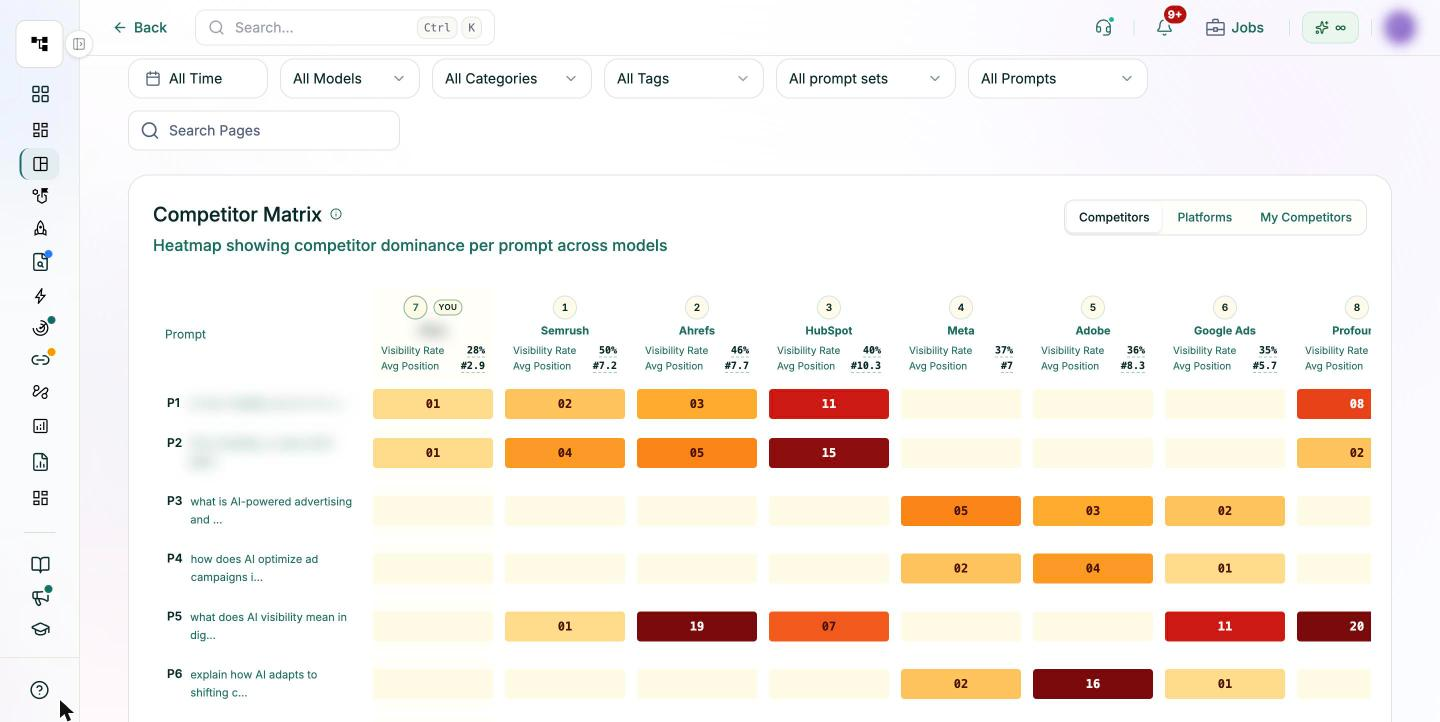
For variant tracking, the most useful part is that it shows the actual AI answer for each prompt. That is where you confirm which name forms the engines used, spot ghost mentions and catch false matches. The competitor matrix, with up to 20 tracked competitors, puts your share of voice next to theirs, which matters because competitors have the same variant problem.
GEO audits add a GEO score, share of voice by funnel stage and a maturity stage, and can be scheduled, compared over time and exported as PDF or PowerPoint. For how to read these metrics, see the AI visibility checker guide.
What stays with your team is the judgment: deciding which variants are yours, writing the exclude rules, and marking where each baseline starts.
Start with the answers you already have
Pick your 20 most important prompts and read the latest answers from each engine. Write down every form your brand takes and every false match you see. That list, sorted into the six categories, is your first variant list.
Then apply the rules, run the recall and precision checks, and record the date as your new baseline. Review unmapped mentions weekly for the first month, when new variants surface fastest, then monthly and after any launch or rebrand.
Get started with Pixis Visibility to read the actual AI answers behind your brand mentions and track share of voice across ChatGPT, Perplexity, Gemini and Claude.
FAQs
Which brand name variations should I track?
Track six categories: the legal or full name, short names, acronyms, product and sub-brand names, common misspellings and former names. Each category appears in AI answers for different reasons, so leaving one out creates a predictable undercount.
How do I handle a brand name that is also a common word?
Match on word boundaries first, then review ambiguous matches with an exclude list for known non-brand meanings. If a form is mostly used for something else, leave it out of the list and accept a small undercount rather than a large overcount.
How often should I update the variant list?
Review unmapped mentions weekly during the first month of tracking. After that, a monthly review is usually enough, plus a full re-audit after a product launch, rebrand or acquisition that changes how the brand is named.
Should prompt set changes also trigger a new baseline?
Yes. Changing the prompts changes what is being measured, just as changing the variant list does. Record the date and the change, and avoid comparing numbers across the break.