

A guest post marketplace shows you a publisher with a domain rating of 62, a price of $180 and a neat sample article. It looks like a good deal. Then you check the traffic and find a few hundred visitors a month, most of them from countries you do not sell to, and an archive full of posts linking to casinos and supplement shops.
Authority scores are easy to inflate and cheap to display, which is why they are the first number sellers put in front of you. A publisher worth paying for has real readers, an editorial standard, relevance to your topic and, increasingly, a presence in the sources AI engines cite.
The hard part is comparing those signals consistently across a dozen sites with different prices. A simple scorecard makes the decision repeatable and keeps a single impressive metric from carrying the whole choice.
This guide explains how to build that scorecard, vet authority and traffic together, check content quality and AI citations, judge price per link, and confirm a placement delivered.
Key takeaways
- Never judge a publisher on domain authority or domain rating alone. Cross-check it with independent organic traffic, traffic trend and the countries that traffic comes from.
- Read the publisher's last five to ten posts. Outbound links to unrelated businesses in most of them are the clearest sign of a link seller.
- Check which publications AI engines cite for your target prompts. A smaller site that is already cited can be worth more than a larger one that never appears.
- Treat price as the last filter, not the first, and mark every paid link with rel="sponsored" or rel="nofollow" as Google's spam policies require.
- Pixis Visibility shows the actual AI answers for your prompts, so you can see which publications are cited, and its Authority section runs PR, community and editorial placement campaigns on publications AI engines cite.
Build the vetting scorecard first
Set up the scorecard before you look at a single publisher, so every site is judged on the same criteria. Use one row per publisher and score it on six signals:
- Authority. Check DR or DA in Ahrefs, Semrush or Moz and compare it with your own site. Red flag: a high score with almost no organic traffic.
- Organic traffic. Get an independent estimate from a second SEO tool, with the 12-month trend. Red flag: a steep decline or a sudden spike.
- Audience location. Check traffic by country in your SEO tool. Red flag: most visitors outside your target markets.
- Content and links. Read the last five to ten posts in full. Red flag: outbound links to unrelated businesses in most posts.
- AI citations. Run your target prompts in ChatGPT, Perplexity, Gemini and Claude. Red flag: never cited for your topic.
- Price. Get the quoted price per placement, with content and attribute terms. Red flag: refuses rel="sponsored" or nofollow.
You also need a budget per placement and Google's spam policies open, so compliance is settled before you negotiate rather than after.
Step 1: Check authority and traffic together
Start with the authority metric, but read it as a comparison rather than a target. Domain Authority and Domain Rating are relative scores: a publisher is interesting when it is stronger than your site and relevant to your topic, not when it clears a universal number.
Then check organic traffic in a second tool. Two independent estimates that roughly agree are more trustworthy than one. A site with a DR of 60 and fewer than 1,000 monthly visitors deserves investigation before you go further. It may be a niche publication with a small loyal audience, or it may be a domain whose authority was built from bought links.
Look at the trend as well as the level. An illustrative comparison: a site with 20,000 monthly visits and steady growth is usually a better placement than one with 100,000 visits that has been falling for a year. Check where the traffic comes from, since visitors from your target markets matter more than raw volume.
Finally, check history. The Wayback Machine shows whether the site changed topics recently, and a backlink profile with sudden spikes or drops can point to bought links or an expired domain that was rebuilt.
Step 2: Read the content and the outbound links
Open the publisher's last five to ten posts and read them as a reader would. You are looking for evidence of an editorial process: original writing, a consistent topic, real authors, and posts that are indexed in Google (a quick site: search on a few URLs will tell you).
Then look at the outbound links. If most posts link out to several unrelated businesses, the site sells links to anyone who pays, and your link will sit in the same neighborhood. A publisher that publishes several guest posts a day across unrelated topics is a similar warning sign.
Relevance matters more than size here. A smaller publication that covers your topic in depth usually passes more useful signals, and reaches more relevant readers, than a large general site that will publish anything. For what makes content worth citing in the first place, see the depth signals that drive AI citations.
Step 3: Check whether AI engines cite the publisher
Write five to ten prompts your buyers would ask about your topic, and run them in ChatGPT, Perplexity, Gemini and Claude. Note which publications appear as cited sources in each answer.
A publisher that AI engines already cite for your topic offers something a high-DR site without that presence cannot: a chance that your content, or a mention of your brand, appears in the answers your buyers read. A cited source with a link is stronger evidence than a brand name mentioned in passing in the answer text.
Run each prompt more than once, and on more than one day. AI answers vary between runs, and a publisher that appears once may not appear again. Record how often each publication is cited across your prompt set, not just whether it appeared.
For a wider view of how different engines choose sources, see how ChatGPT, Perplexity and Gemini cite differently.
Step 4: Judge the price against what the placement delivers
Price comes last because it only makes sense once you know what you are buying. For a reference point, PressWhizz's link building pricing report, based on about 22,700 completed orders on its marketplace, found a median price of $112 per link and an average of $161. The same report found that organic traffic was a stronger driver of price than Domain Rating.
Use that as context, not a rule. Prices vary widely by niche, by whether content writing is included and by the publisher's audience. A placement priced well above the median can still be the better buy if the site has real readers in your market and is already cited by AI engines for your topic.
Before you agree a price, confirm three terms in writing:
- The link will carry rel="sponsored" (or rel="nofollow"). Google's spam policies treat paid links that pass ranking credit without these attributes as link spam.
- The link will sit in the article body, with the anchor text you agreed, not in a footer or author bio.
- What happens if the post is removed or not indexed within an agreed period.
A seller who refuses the attribute, or promises a dofollow link "that looks editorial", is asking you to take on the risk of a manual action.
Where publisher vetting goes wrong
Most bad placements come from three shortcuts.
- Trusting one metric. A high DR with no traffic, or high traffic from the wrong countries, looks fine until you check the second signal.
- Skipping relevance. A placement on a general news site that covers everything rarely helps as much as a smaller, focused publication.
- Ignoring AI visibility. Buying only for traditional link value misses whether the publisher actually shapes the answers your buyers read.
Confirm the placement delivered
After the post goes live, check it within a week:
- The link is live and correct. Right URL, agreed anchor text, in the body of the article, with rel="sponsored" or rel="nofollow" applied.
- The page is indexed. Search for the exact URL or a distinctive sentence. If it is not indexed after two weeks, ask the publisher to fix it or replace the placement.
- AI citations are tracked. Rerun your prompt set after a few weeks and note whether the publication, your brand or both appear more often.
To see whether AI engines send any visitors through the placement, set up AI referral tracking in GA4. Review all of this against the measurement period you set before the campaign, so one good week does not decide the next budget.
Where Pixis Visibility fits
The slowest part of this process is Step 3: running the same prompts across four AI engines, repeatedly, and recording which publications they cite.
Pixis Visibility runs prompt sets you build or auto-generate across ChatGPT, Perplexity, Gemini and Claude, and shows the actual AI answer for each prompt. That lets you see which publications are cited for your topic and track your own brand's mentions, citation rate and share of voice before and after a placement. Competitor benchmarking compares your domain with competitors on domain authority, organic traffic, backlinks and referring domains, which helps set realistic expectations for a link campaign.
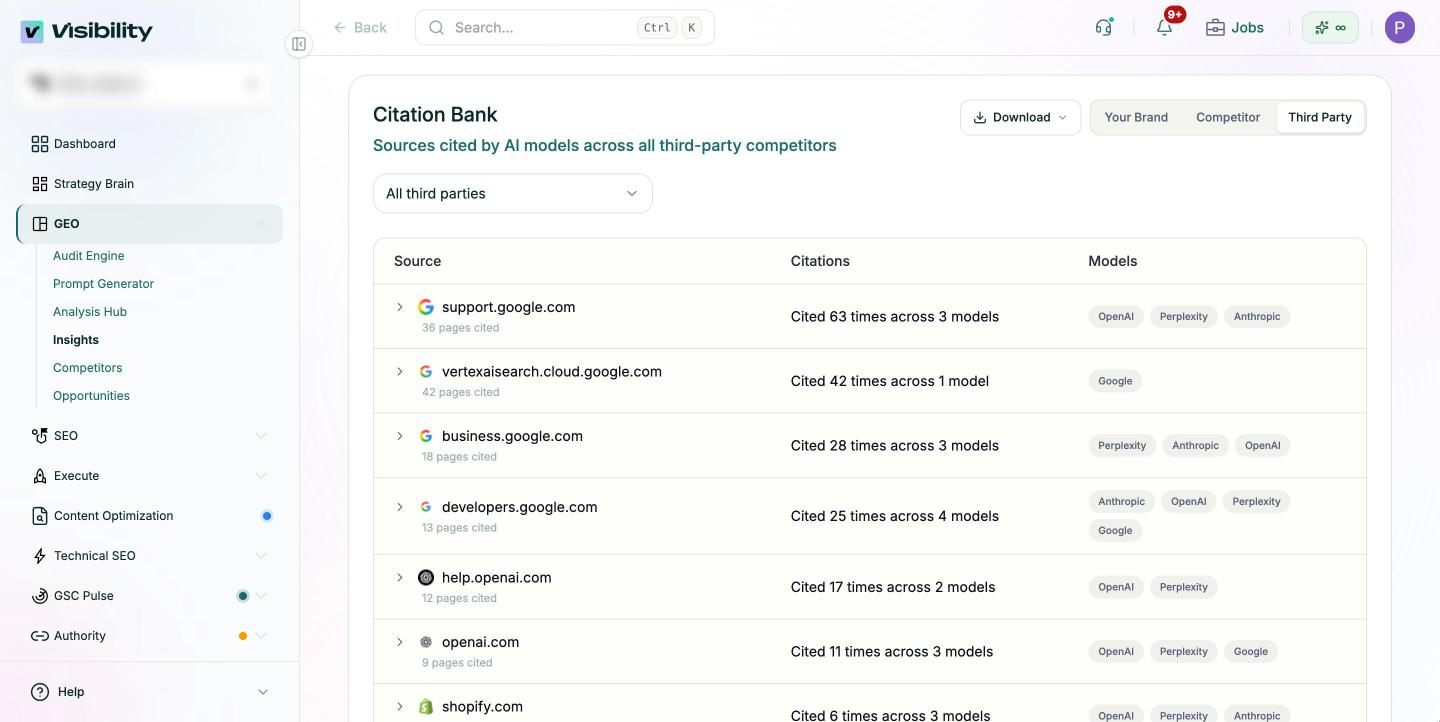
If you would rather not source placements yourself, the Authority section in Pixis Visibility runs brand PR, community promotion and editorial link campaigns, with placements on publications AI engines cite.
The scorecard judgment stays with you: reading a publisher's content, weighing relevance against price, and deciding which risks you are willing to take.
Build a shortlist you can reuse
Start with ten candidate publishers in your niche and run them all through the scorecard in one sitting. Most will drop out at Step 1 or Step 2. The three to five that survive become your vetted list for the next quarter.
Keep the scorecard after each campaign and update it with results. Over time it becomes a record of which publishers delivered readers, citations and rankings, and which only delivered a link.
Get started with Pixis Visibility to see which publications AI engines cite for your topic before you pay for a placement.
FAQs
What domain authority should a guest post publisher have?
There is no universal threshold. Compare the publisher's DR or DA with your own site and its competitors, then let traffic, audience location and topical relevance decide. A relevant DR 35 site with real readers is often a better placement than a DR 60 site with none.
Is buying guest post links against Google's policies?
Paying for links that pass ranking credit is against Google's spam policies. Paid placements are acceptable when the link is marked rel="sponsored" or rel="nofollow", which tells Google not to count it as an editorial vote.
Is a nofollow or sponsored link worth paying for?
It can be. A marked link still sends referral traffic, puts your brand in front of a relevant audience and can put your content on a publication that AI engines already cite. Judge it on those outcomes rather than on ranking credit alone.