
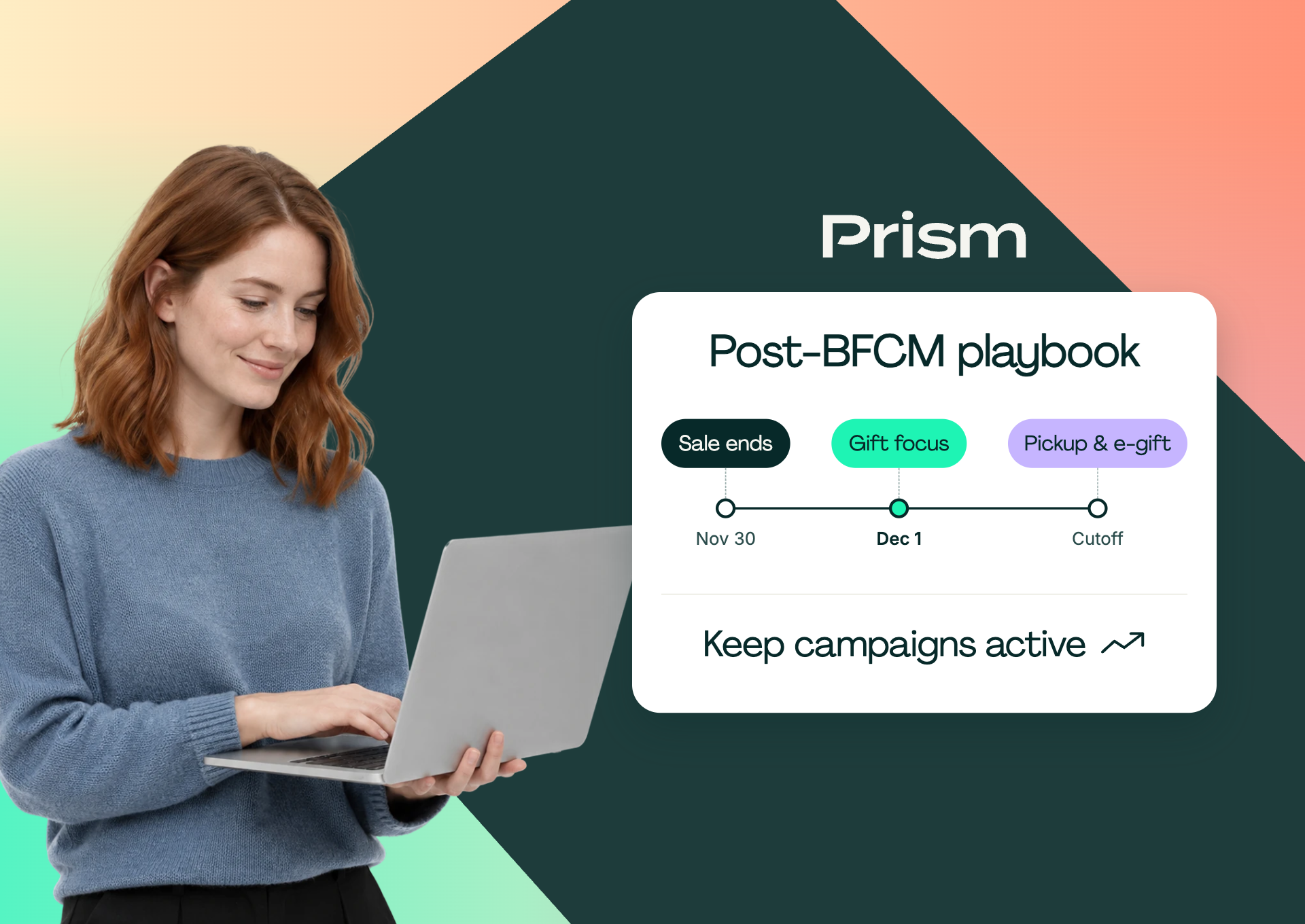
The Black Friday ad is still generating clicks on December 1. The discount has ended, two popular sizes are unavailable, and the customer who bought on Saturday is seeing the same acquisition message again. The campaign is active, but the commercial situation behind it has changed.
That is the problem performance marketers have to solve after BFCM. Shutting everything down can interrupt demand that is still worth capturing. Leaving everything running can spend December's budget on November's promises.
A useful post-BFCM campaign strategy carries forward what still works while rebuilding the parts that depended on the sale. Budgets need current margins, audiences need current purchase information, and creative needs a reason to buy beyond an expired discount. As delivery windows narrow, the campaign also needs to change what it offers and where it can serve it.
For the 2026 calendar, prepare this transition before the November 26–30 shopping period begins. Then use December 1 as an operational reset, rather than waiting for the first week's weekly report to reveal what was left behind.
Key takeaways
- Recalculate allowable acquisition cost for December's actual products, discounts, shipping costs, and contribution requirements before extending BFCM budgets.
- Keep successful campaigns where their setup remains useful, but remove expired offers and verify inventory, destinations, and temporary settings.
- Give recent buyers, unconverted visitors, and new prospects different treatment. A large BFCM audience does not automatically justify a large retargeting budget.
- Refresh the buying argument around recipients, product suitability, and delivery confidence, while retaining creative elements that still perform.
- Plan each delivery deadline as a campaign transition, with approved replacement messages and an owner responsible for switching them.
Start December with a campaign decision, not a blanket budget cut
Before the sale starts, give each campaign a proposed December status: continue, revise, or end. Confirm those decisions when current results and operating conditions are available.
Continue a campaign when its products remain available, its message is accurate, and its expected acquisition cost fits the next phase's economics. An evergreen demonstration ad may need no seasonal redesign if it is still persuasive and commercially viable.
Revise a campaign when the underlying demand remains useful, but the offer, product selection, destination, or audience treatment must change. A giftable product that sold well over BFCM might belong in December, even though the percentage-off headline does not.
End activity whose entire purpose has expired. That includes sale-specific destinations with no suitable replacement, promotions the business has withdrawn, and products that cannot be fulfilled within the promise being advertised.
Inspect the full customer journey before signing off. Check ad copy, video overlays, promotional assets, product feeds, discount codes, landing pages, checkout pricing, and automated messages. An updated primary headline does little good if the video still says “ends Monday” or the cart rejects the code.
Record the decision at campaign level, with the replacement offer, effective time, owner, and rollback condition. This extends the closeout process in the BFCM paid media planning guide into a usable December operating plan.
Rebuild the budget around what an order is worth now
There is no dependable percentage by which every account should cut spend after Cyber Monday. The right starting point is the contribution available from the next order, alongside the demand and fulfillment capacity available to earn it.
Calculate net order revenue after discounts and expected refunds, using a consistent treatment of taxes. Subtract product cost, payment fees, fulfillment, shipping subsidy, and other variable order costs. The amount left must cover advertising and the contribution the business needs to retain.
Consider a hypothetical retailer whose December gift set produces $90 in net revenue. Product and variable operating costs total $48, leaving $42 before advertising. If the business requires $15 of contribution after advertising, the allowable acquisition cost is $27.
A BFCM campaign reporting a $31 CPA would need closer examination before receiving December funding under those conditions. Its sale-period revenue, basket composition, and costs may have been different. Even a more attractive revenue-based ROAS can conceal a weaker contribution if expedited shipping or a low-margin bundle changes the order economics.
Use these calculations to establish a working acquisition target by meaningful product group or offer. Where customer lifetime value supports a higher acquisition cost, make the recovery period and evidence explicit. A forecast of future repeat purchases should not silently become permission to spend cash the business needs this month.
Give the December budget a committed portion and a conditional portion
Authorize enough funding to maintain campaigns that meet the current commercial requirements. Hold additional money for opportunities that qualify as the month develops, such as an in-stock gift set with acceptable acquisition cost or a pickup offer that remains viable after shipping closes.
For example, a hypothetical $40,000 authorization might commit $28,000 to the initial plan and retain $12,000 for later decisions. These amounts illustrate the process, rather than a recommended split. Releasing any reserve should require a named opportunity, sufficiently mature performance, available inventory, and a revised forecast for total spend.
Do not spend the reserve merely because the calendar is running out. Equally, do not assume it must be saved for the last week, when the products or delivery options that justify it may no longer exist.
When comparing performance, account for conversion delay. Google's conversion lag reporting helps advertisers inspect how long conversions take to be counted. A recent December window and a mature BFCM window are not directly comparable without that context. Investigate operational problems immediately, while allowing purchase performance the observation time appropriate to the account.
Reorganize audiences around what happened during BFCM
BFCM produces several kinds of audience information: people who bought, people who considered buying, and people who engaged without showing much purchase intent. December planning becomes more useful when those groups receive different treatment.
Recent buyers need a reason for another purchase
Where supported and appropriate, exclude recent purchasers from acquisition campaigns promoting the product they just bought. Verify that purchase events and customer lists are updating, and check the actual controls of each campaign type. An intended exclusion is only useful if the campaign applies it as expected.
That does not mean excluding every customer from every December campaign. A customer who bought a durable appliance last week has little reason to buy the identical appliance again. Someone who bought one gift may still need gifts for other people. Consumables, accessories, and complementary products each have different timing and relevance.
Use purchase date, product, and plausible next need to decide what paid follow-up deserves funding. Coordinate with email and other owned channels so paid media adds a useful message rather than repeatedly buying access to customers already receiving the same offer. Use customer data according to the permissions and platform requirements that apply to it.
A practical buyer brief is specific: “Show the compatible accessory to customers who purchased the base product, once the purchase data has updated, and exclude accessory purchasers.” That gives the team something it can implement and verify.
Unconverted visitors need a current answer
Review product viewers and cart abandoners against the offer they actually saw. A visitor who abandoned a discounted cart may return to a higher December price. The follow-up should make the current value clear rather than imply the old price remains available.
For a giftable product, that could mean showing the packaging, explaining recipient suitability, or clarifying returns and delivery. For a technical purchase, a demonstration or compatibility explanation may be more useful than another sale reminder.
Keep audiences large enough to operate sensibly. Creating separate campaigns for every recency window, engagement type, and product can leave a modest account with many segments and too little evidence in each. Use the few distinctions that change the message or economics, and consolidate where they do not.
Retargeting funding should follow the size and value of the reachable opportunity. If delivery becomes repetitive and additional spend is producing fewer worthwhile purchases, reconsider the budget and message. A large pool accumulated during the sale is not proof that all of it remains likely to buy.
Prospecting still needs December funding
An account that devotes all December spending to BFCM visitors can narrow its opportunity too early. Continue reaching new prospects where the current product, offer, and acquisition cost support it.
Keep prospecting and customer demand visible in reporting where reliable distinctions are available. Strong branded search or retargeting results can make an account look healthy while acquisition weakens. Avoid adding platform-attributed purchases together and calling the sum unique customers; reconcile with store-level orders and customer records where possible.
Refresh the reason to buy before refreshing every asset
The strongest BFCM creative may have worked because of the discount, the demonstration, the creator, or the product itself. December planning should identify which part can travel into the next phase.
Keep a useful demonstration or testimonial and replace the expired offer. Change the opening argument when the buying context has changed. A November message about securing a deal can become a December explanation of who the product suits, what comes in the box, or how easily it can be given as a gift.
For each priority product, prepare three connected messages:
- Selection: Help the shopper decide whether this is the right gift, with recipient needs, use cases, comparisons, or an appropriate price point.
- Confidence: Resolve the questions that delay purchase, including sizing, compatibility, packaging, returns, and substantiated delivery expectations.
- Timing: Explain the real order deadline or available fulfillment option once timing becomes decisive.
For a coffee gift set, the selection ad might show why a beginner can use it. The confidence ad could demonstrate the contents and packaging. The timing version could state the approved order cutoff for a defined delivery region. Those assets answer different questions while retaining a recognizable product story.
Brief the landing page alongside the ad. A “gift for a beginner” message should lead to information that helps a beginner choose, rather than a generic collection page that makes the shopper start again.
Diagnose fatigue before commissioning a full replacement batch
When results weaken, look at delivery, engagement, purchase behavior, offer changes, and site conditions together. Rising frequency alone does not establish creative fatigue. Falling click-through rate across repeatedly exposed audiences is a different problem from stable engagement followed by a drop in checkout completion.
Use the diagnosis to choose the next creative change. Test a new opening if attention is weakening. Improve the explanation if people click but cannot determine whether the product suits them. Fix the commercial or operational problem if shipping cost, stock, or an expired offer is blocking purchase.
The broader production process belongs in a repeatable creative fatigue management system. For December, the immediate job is to deliver the next relevant buying argument before the current one becomes inaccurate or unhelpful.
Make delivery deadlines part of campaign planning
A delivery cutoff changes which demand the business can serve. It should therefore have the same operational attention as a promotion launch.
Get approved deadlines from fulfillment by product, destination, and service level. Include warehouse handling capacity, order cutoff times, and carrier transit assumptions. Google's estimated delivery guidance explains how handling time, transit time, and order cutoff affect the delivery estimate shown in Shopping experiences.
Then work backward from each deadline. Approve replacement copy, destination pages, product selections, and campaign changes before the cutoff arrives. Assign an owner and a backup, including for evenings and weekends.
Before standard delivery closes, advertise an arrival promise only where operations can support it. When that service closes, remove the claim across ads and destinations. If expedited shipping remains available, recalculate acquisition economics with its actual subsidy and clearly explain any additional customer charge.
After physical delivery is no longer suitable, shift eligible activity toward genuine alternatives such as local pickup or digital gift cards. Check store hours, pickup stock, digital delivery requirements, and redemption terms before promoting them. If the business has no viable alternative, reduce or end the relevant gift campaign instead of carrying an impossible promise into the next week.
Do not transfer the full physical-product budget automatically into gift cards. Demand, measurement, and accounting differ. Agree how gift card sales and later redemptions will be recorded so the same economic value is not treated as two independent sales wins.
Turn December into a sequence of approved transitions
A manageable plan has a few clear phases, each with entry conditions and an exit decision.
On December 1, close the BFCM offer. Verify prices and destinations, remove expired claims, review temporary settings, and confirm which campaigns will continue. Reconcile immediate execution issues while keeping commercial results provisional where attribution and returns are still developing.
During the early December period, rebuild the gift proposition. Fund products with viable economics and availability, update purchaser treatment, and introduce recipient-led and confidence-building creative. Review whether actual demand supports the initial commitment or a release of reserve funding.
As delivery deadlines approach, narrow promises to what can be fulfilled. Change product and geographic eligibility where needed, confirm remaining inventory, and launch approved deadline messages. The dates should come from the business, rather than a universal holiday calendar.
After shipping closes, activate only viable alternatives. Move to pickup, digital products, or other supported offers where they fit. Stop paying for seasonal demand the business cannot fulfill.
After the holiday, establish a new commercial brief. Self-purchase, replenishment, accessories, and clearance may be appropriate, but each needs its own inventory and margin decision. Review return and cancellation information as it matures before declaring the full season profitable.
Check platform settings as part of those transitions. Google states that seasonality adjustments are intended for major expected conversion-rate changes during short events, ideally one to seven days, and that Smart Bidding already handles seasonal events. Treating all of December as one extended BFCM adjustment would miss that distinction. Review what was configured and its end time before adding further interventions.
Use Prism to make the review repeatable
The recurring December review should connect campaign performance to the current offer and operating constraints. A useful analysis needs the latest approved targets, relevant campaign scope, and clear dates, alongside the platform data.
Prism's Scheduled Workflows run sequences of prompts against a selected ad account using a selected agent. Each execution creates a conversation containing the analysis, which the team can continue investigating. This can reduce repeated preparation for a review while preserving space for follow-up questions.
Start with a narrowly defined brief:
Review the specified December campaigns against the approved CPA targets and budget authorization. Identify material changes in spend, purchases, and acquisition cost using comparable reporting windows. Distinguish recent results that may still be affected by conversion delay. Use the supplied offer calendar, inventory update, and delivery deadlines to identify campaigns requiring review. State the source and date of each operational input, flag anything unavailable, and separate recommendations from executed changes.
Provide operational information explicitly if it is not available through the connected sources. A campaign analysis cannot establish whether a warehouse can dispatch tomorrow, and a scheduled report should not imply otherwise. Confirm account access, source freshness, and supported workflow configuration before relying on the review.
Use the output to make a short decision record: what changes, why, who owns it, and when it will be verified. Keep budget authorization and execution responsibility explicit. If a product becomes unavailable or a delivery promise fails, assign the correction immediately rather than waiting for the next recurring analysis.
With Pixis Prism, teams can bring recurring performance analysis into the December review process. The value comes from connecting that analysis to a current commercial plan, so a campaign keeps earning its place as the holiday changes around it.