

Most marketing teams operate across multiple channels—email, social, paid ads, their website. The question isn't whether to use multiple channels, but how those channels work together.
Multichannel uses separate, independent channels to reach customers, while omnichannel integrates all channels to create a single, seamless customer experience. The key difference is that multichannel is channel-focused, whereas omnichannel is customer-centric, prioritizing a unified journey across all platforms.
We'll walk through what each approach actually means, when each makes sense, and how to execute either strategy effectively with AI.
What is multichannel marketing
Multichannel marketing means you're showing up on multiple platforms—email, social media, paid ads, your website, maybe physical stores. Each channel runs independently with its own campaigns, messaging, and goals. The focus stays on the channels themselves, not how customers move between them.
Think of it like running several different stores under the same brand name. Each location has its own inventory, pricing, and policies. They all carry your products, but they don't share information.
Here's what that looks like in practice:
- Your email team sends newsletters with no connection to what people see on Instagram.
- Facebook ads and Google campaigns run separately, even when targeting the same person.
- Social posts promote different offers than what appears on your website.
The primary advantage is speed. You can launch new channels without waiting for complex integrations. Your email team optimizes open rates, your paid team scales what converts, and your social team experiments freely.
The downside shows up in customer experience. Someone sees one price in your email, a different offer on Facebook, and conflicting messaging on your website—all in the same day. That creates confusion and erodes trust.
What is omnichannel marketing
Omnichannel marketing connects all your channels so they work as one system. Every touchpoint—your app, website, store, or ad—shares data and maintains consistent messaging. The focus shifts from individual platforms to the complete customer journey.
Instead of separate stores, imagine one store with multiple entrances. Customers see the same inventory, get the same prices, and pick up right where they left off regardless of which door they use.
Here's what integration actually means:
- Unified messaging: Your spring sale looks the same on Instagram, Google, and email with consistent creative and timing.
- Connected data: You know when someone browses on mobile, abandons their cart on desktop, and opens your email the next morning.
- Seamless transitions: Customers check inventory on your app, buy online, and pick up in-store without re-entering payment information.
The advantage is smoother customer experience. People don't think in channels. They just want to buy from you in whatever way feels most convenient at that moment.
The main challenge is implementation, which takes longer and costs more upfront. You need systems that talk to each other and teams that collaborate across silos. This requires a willingness to prioritize customer experience over channel-specific metrics.
Multichannel vs omnichannel marketing key differences
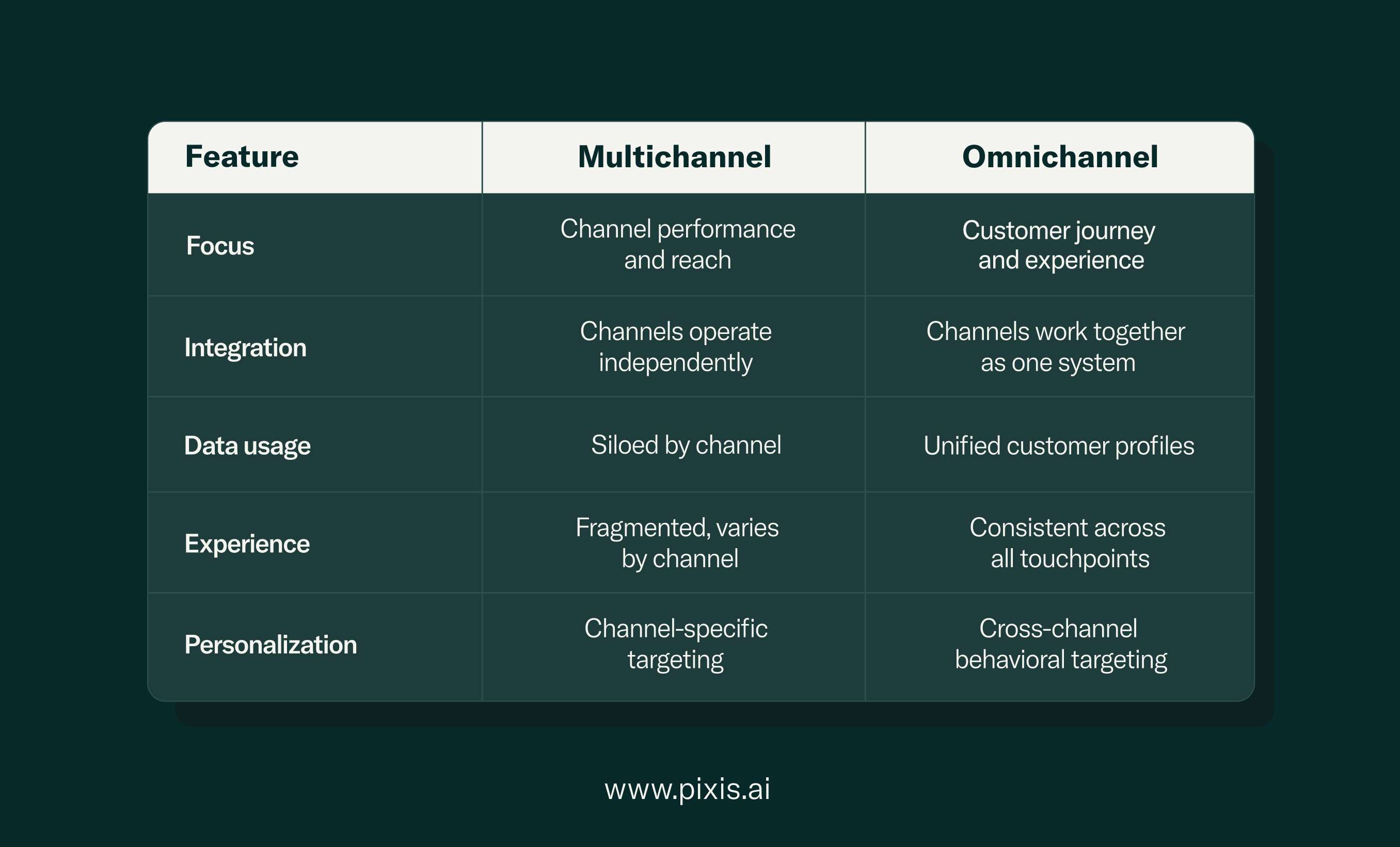
The core difference comes down to focus. Multichannel optimizes each platform for its own performance. Omnichannel optimizes the entire journey across all platforms.
1. Messaging consistency
Multichannel lets each channel develop its own voice and offers. Your email team might run a 20% off promotion while your social team pushes free shipping. Both work toward the same business goals, just not in coordination.
Omnichannel maintains unified messaging everywhere. When you run a spring sale, every touchpoint reflects that campaign with the same creative, offers, and timing. Customers see one coherent story instead of competing messages.
2. Data and personalization depth
Multichannel collects data separately for each channel. Your email platform knows open rates, your ad platform tracks clicks, but neither sees the full picture. Personalization happens within each silo based on limited information.
Omnichannel builds complete customer profiles by connecting data across all touchpoints. You can see that someone browsed winter coats on mobile, opened your email on desktop, and visited your store last week. That complete view enables showing ads for the exact product they tried on in-store.
3. Channel coordination effort
Multichannel requires less coordination between teams. Your paid team optimizes for conversions, your email team for engagement, and your social team for awareness. Each group moves independently toward separate KPIs.
Omnichannel demands cross-functional collaboration. Teams share goals, coordinate campaign timing, and align on messaging. The coordination overhead is higher, but it prevents customers from receiving conflicting messages or getting over-targeted across platforms.
4. Customer experience impact
Multichannel creates fragmented journeys. A customer might see a product for $50 in an ad, find it listed at $55 on your website, and discover in-store it's actually $48 with a promotion that wasn't advertised online.
Omnichannel delivers seamless experiences. That same customer sees consistent pricing everywhere, checks in-store inventory from your app, and receives ads based on their complete browsing history—not just activity on one platform.
Omnichannel vs multichannel examples from real brands
Real examples make the difference clearer. Let's look at three brands doing omnichannel well.
Apple store pickup journey
You browse iPhones on Apple's website and see real-time inventory at your local store. You buy online using your Apple ID, choose in-store pickup, and get a notification when it's ready. When you arrive, the store associate already has your order pulled and can see your purchase history.
Nike membership ecosystem
Nike's app connects to its website, stores, and SNKRS releases. Your preferences, purchase history, and workout data sync everywhere. When you favorite a shoe in the app, you see ads for it on Instagram.
Walmart online and in-store sync
You can check if a product is in stock at your local Walmart through the app, order it online, and pick it up the same day. Returns work both ways, so you can buy online and return in-store. Prices match between online and physical locations.
Pros and cons of each model
Both approaches have legitimate use cases. The right choice depends on your resources, team readiness, and what customers expect from you.
Multichannel strengths
- Faster implementation: Launch new channels without waiting for system overhauls or data integration.
- Lower initial costs: Skip investments in unified platforms, data warehouses, or extensive team restructuring.
- Channel specialization: Each team optimizes for their platform's unique strengths without compromise.
Multichannel limitations
- Inconsistent experiences: Customers encounter different messaging, pricing, or inventory information depending on which channel they use.
- Data silos: Missing the complete customer view limits personalization and makes attribution nearly impossible.
- Wasted opportunities: You can't retarget website visitors with social ads based on their browsing behavior.
Omnichannel strengths
- Seamless customer experience: Consistent journeys across all touchpoints build trust and reduce friction.
- Better personalization: Complete customer data enables relevant messaging based on behavior across all channels.
- Higher customer lifetime value: Integrated approaches typically drive stronger relationships and repeat purchases.
Omnichannel limitations
- Complex implementation: Requires significant system integration, data infrastructure, and process changes.
- Higher upfront investment: Technology, training, and organizational alignment demand substantial resources.
- Organizational alignment: Teams accustomed to channel-specific goals resist sharing data and collaborating on unified metrics.
When to choose multichannel vs omnichannel
Your current situation matters more than theoretical best practices. Here's how to assess where you actually are.
Signs you’re ready for omnichannel
You're already operating across several touchpoints and have baseline performance data. You collect first-party data and have the technical capability to unify it. Leadership and teams are willing to share goals, data, and collaborate across traditional silos.
Scenarios where multichannel is enough
Simple offerings with short consideration cycles don't require complex journey orchestration. Small teams benefit more from mastering individual channels before attempting integration. Experimental approaches work better with independent channels until you understand what resonates in a new market.
The transition from multichannel to omnichannel is a spectrum, not a binary choice. You can start by connecting your two highest-traffic channels and expand from there.
How AI closes the gap between insight and action
The biggest barrier to omnichannel success isn't strategy. It's execution speed. Humans can't analyze cross-channel data, adjust targeting, shift budgets, and refresh creative fast enough to keep up with changing customer behavior.
Real-time audience refinement
AI analyzes behavior across all channels simultaneously and adjusts targeting instantly. When someone browses winter coats on your website, clicks a Facebook ad, but doesn't convert, AI automatically adds them to retargeting audiences across Google, Instagram, and email within minutes.
Multichannel approaches require manual audience building for each platform. By the time you export data, create segments, and upload audiences, customer intent has often shifted.
Automated creative versioning
AI generates channel-specific creative while maintaining brand consistency. The same product appears in different formats—a carousel ad on Instagram, a single image on Google Display, and a text-based email—all created automatically from one set of assets and guidelines.
Manual multichannel creative management means your team builds separate assets for each channel, often with inconsistent messaging or outdated product information by launch time.
Dynamic bid and budget shifts
AI moves spend between channels based on real-time performance patterns. When your target audience is more active on TikTok this week, budget flows there automatically. If Instagram engagement drops, spend shifts to better-performing channels without manual intervention.
Human-managed multichannel budgets get set weekly or monthly and rarely adjust mid-flight, even when performance signals clearly indicate better opportunities elsewhere.
See how Prism helps marketing teams move faster
Steps to move from multichannel to omnichannel
Transitioning doesn't happen overnight. Start with high-impact connections and expand gradually.
1. Unify first-party data
Connect customer data from your website, CRM, email platform, and ecommerce system first. Create a single customer view that shows all interactions regardless of channel. You don't need perfect data—just good enough to identify repeat customers and track their primary touchpoints.
2. Map key journeys
Identify your three most important customer paths. For most brands, that's new customer acquisition, repeat purchase, and cart abandonment. Document every touchpoint in each journey and look for disconnects where data doesn't flow or messaging conflicts.
3. Connect paid and owned channels
Link your advertising platforms to your owned channels. Set up website event tracking that feeds into ad platforms for retargeting. Connect your email platform to ad audiences so you can suppress existing customers or create lookalike audiences from high-value subscribers.
4. Test and iterate with AI
Use AI to identify optimization opportunities you'd miss manually. AI spots patterns like "customers who browse on mobile and receive an email within two hours convert 40% more often" and automatically creates workflows to capitalize on those patterns.
We at Pixis built our platform specifically for this kind of cross-channel optimization. Prism analyzes performance across all your channels, suggests budget shifts, and generates creative variations while maintaining your brand guidelines and strategic priorities.
Finding your best channel mix with AI-powered Pixis
Whether you choose multichannel or omnichannel, execution matters more than strategy. We help marketing teams execute either approach effectively through AI-powered optimization.
Our platform handles audience targeting across channels, generates creative variations that maintain brand consistency, and manages budget allocation based on real-time performance signals. You focus on strategy and creative direction while AI handles the repetitive optimization work that traditionally requires hours of manual analysis.
Prism, our marketing AI, connects to your existing ad platforms and analyzes performance across all channels simultaneously. It identifies opportunities, suggests optimizations, and can implement changes automatically based on rules you set.
Frequently asked questions about omnichannel and multichannel
What is the difference between cross-channel and omnichannel marketing?
Cross-channel connects specific touchpoints for targeted campaigns—like retargeting website visitors with Facebook ads. Omnichannel integrates all channels for a unified customer experience across every interaction. Cross-channel is tactical, omnichannel is strategic.
Does omnichannel marketing always cost more than multichannel?
Initial setup costs are higher due to integration requirements and system investments. However, omnichannel often delivers better ROI through improved customer lifetime value, higher conversion rates, and more efficient ad spend. The payback period typically ranges from six to 18 months.
Can small marketing teams successfully run an omnichannel strategy?
Small teams can start with omnichannel principles by focusing on their most important channels and using AI tools to automate integration tasks. Begin by connecting two or three channels rather than attempting full integration across every touchpoint. Expand as you prove value and gain resources.
How does privacy regulation affect omnichannel data collection?
Privacy laws like GDPR and CCPA require explicit consent for data sharing across channels. First-party data collection becomes essential—you need customers to willingly share information and create accounts. Transparent privacy policies and clear value exchange make omnichannel possible in a privacy-conscious environment.