
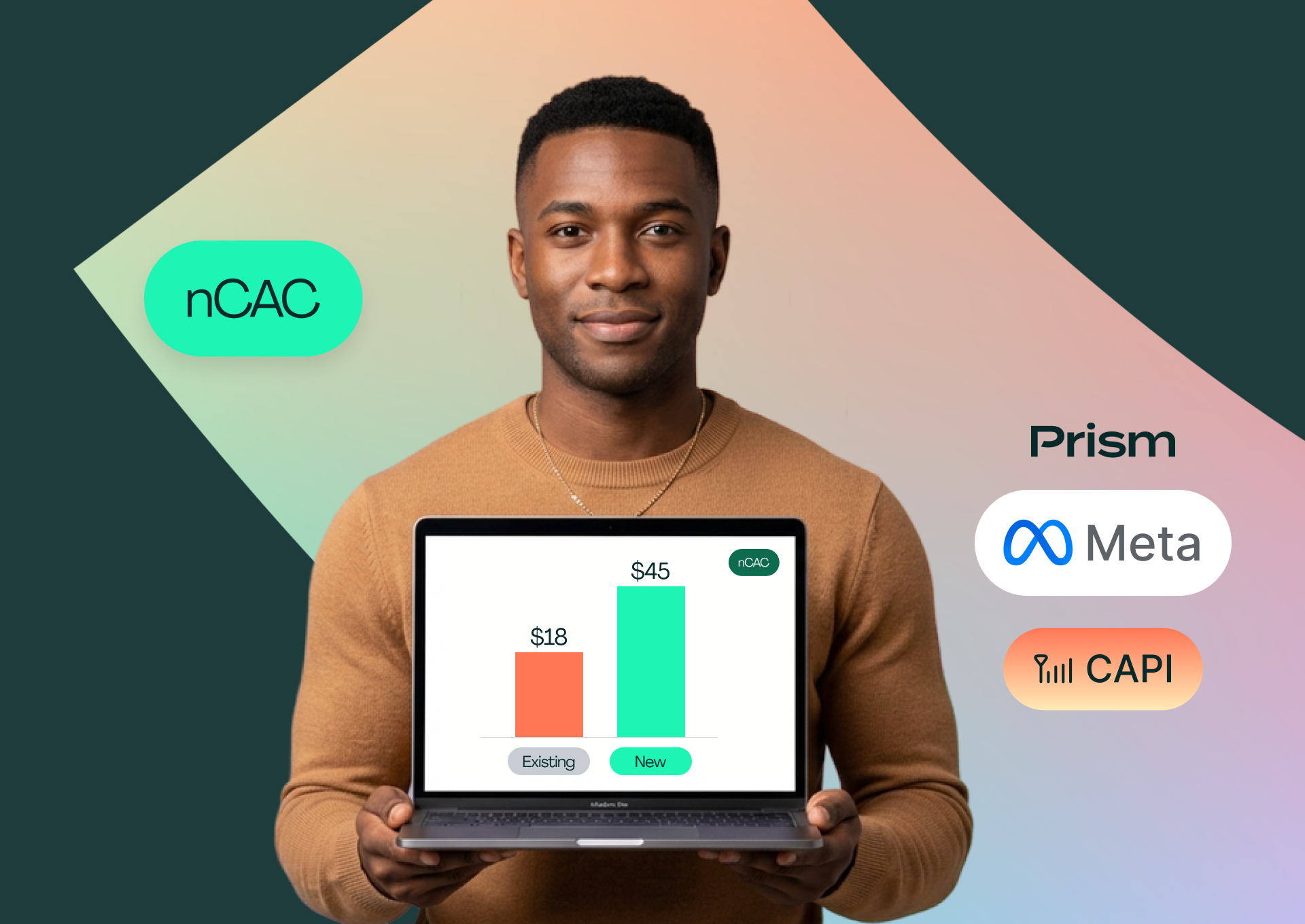
A prospecting campaign reports a strong return on ad spend, and the instinct is to scale it. But a large share of those conversions can be existing customers who would have bought anyway, reached because they are the cheapest people in the account to convert. The dashboard looks healthy while actual new-customer growth barely moves. This is the gap between blended performance and real acquisition, and closing it starts with measuring the one number blended reporting hides: what it actually costs to acquire a first-time buyer. This guide covers how to define and track new-customer acquisition cost on Meta, how to keep existing buyers out of prospecting cleanly, and how to verify the growth is genuinely incremental.
Two-line summary: Blended reporting lets existing buyers inflate prospecting metrics, so campaigns look efficient while real acquisition stalls. This covers how to measure true new-customer acquisition cost on Meta, exclude existing buyers correctly, and confirm the growth is incremental.
Key Takeaways
- Blended CAC averages cheap repeat buyers with expensive new prospects, which flatters efficiency and hides the true cost of growth. New-customer acquisition cost isolates the number that matters for expansion.
- Left unconstrained, Meta's algorithm gravitates toward existing customers because they convert cheapest, then reports those conversions as new acquisitions. This is the breakdown effect.
- Meta's Customer Lifecycle Strategy setting can exclude existing customers natively when you choose to acquire new customers only, which is cleaner than maintaining manual exclusion lists, but it depends on the quality of the customer data you feed it and was still rolling out in early 2026.
- The Conversions API improves signal quality server-side, which is what makes both the exclusion logic and the measurement trustworthy.
- A low nCAC only means growth if it is incremental, so pair it with new-customer ROAS and validate with holdout testing rather than trusting platform attribution.
What New-Customer Acquisition Cost Actually Measures
New-customer acquisition cost, or nCAC, is the ad spend required to bring in a first-time buyer, counting only genuinely new customers. It differs from blended CAC, which averages every conversion together, mixing the hard-won new prospect with the loyal repeat purchaser. That blending dilutes the true cost of growth and produces a comfortable-looking number that can hide a stalling acquisition engine.
The distinction matters most when expansion is the goal. A low blended CAC can look like efficient scaling while the reality is that the budget is subsidizing demand that would have converted through email or a direct visit anyway. Knowing your true nCAC changes the decisions you can make: if you know what a new customer is worth over their lifetime, you can set acquisition targets and bid with confidence rather than guessing. Without it, you risk pausing campaigns that are actually finding valuable new users, because their honest upfront cost looks high against a polluted blended average.
- nCAC isolates first-time purchase events from all other conversions in the account.
- Blended CAC mixes new prospects and existing buyers into one average that flatters efficiency.
- Meta reporting defaults to total conversions unless configured otherwise.
- True nCAC reveals the real efficiency of top-of-funnel prospecting.
Why Meta Reports Existing Buyers as New Customers
Meta's algorithm optimizes for conversions at the lowest cost, and it does not, by default, distinguish a first-time buyer from a fifth-time one. Without a constraint, it targets whoever is likeliest to convert, which means existing customers: they already trust the brand, know the product, and have their payment details saved, so they convert cheaply. When they do, the system records the conversion as an acquisition, and your reported new-customer efficiency looks better than the business reality.
This is the breakdown effect, and it compounds. The more existing customers convert through a prospecting campaign, the more the algorithm learns to find people like them, which usually means more existing customers. Prospecting budget quietly becomes expensive retargeting, the dashboard ROAS stays high, and net-new growth flattens. The algorithm is doing exactly what it was asked, get the most conversions for the least money, so the fix is not to fight the algorithm but to change what you ask it for, and to stop accepting default reporting at face value.
Meta's Customer Lifecycle Strategy Setting
Meta offers a native answer to this, and it is worth describing accurately because the details matter and the feature is still rolling out. The Customer Lifecycle Strategy setting appears at the ad-set level for manual Sales campaigns, where the default is to reach new and existing customers and you can instead choose to acquire new customers only. When you select that option, Meta applies its own data and specialized exclusion treatments to focus delivery on people who have not purchased from you, rather than requiring you to build and maintain the exclusion audiences yourself. Jon Loomer's breakdown of the setting is a reliable reference for how it behaves. As of early 2026 it was in a limited rollout, so availability in a given account varies.
The advantage over the old approach is real: it reduces the friction and failure points of manually uploading and refreshing exclusion audiences per ad set, and it pushes the algorithm to find net-new buyers instead of taking the easy conversions. Meta also notes the tradeoff plainly, that choosing new-customers-only can raise your cost per result, since the algorithm is working from a smaller pool. But it is not a solved problem on its own, because it can only exclude customers it can identify. If the customer data defining your existing base is stale, fragmented, or incompletely matched, the setting cannot do its job, a buyer whose account it cannot resolve will still be treated as a fresh prospect. So the native setting reduces the manual work, but it raises the importance of the data feeding it, which is the next piece.
Signal Quality: First-Party Data and the Conversions API
The exclusion logic and the measurement both rest on how well Meta can identify who your customers are, and browser-side tracking has become a shaky foundation for that. Privacy changes and browser restrictions mean the pixel alone now misses a meaningful share of events, and every missed purchase is both a measurement gap and a customer the exclusion logic cannot see.
The Conversions API addresses this by sending purchase events server-to-server, from your backend directly to Meta, rather than depending on the browser. That improves match rates and, specifically for this work, lets Meta identify existing buyers more reliably across devices and sessions, which is what makes the exclusion trustworthy. Better signal quality is not a general nicety here; it is the mechanism that keeps existing customers out of prospecting and keeps your nCAC measurement honest. A server-side connection paired with clean, current first-party data is the technical floor beneath everything else in this piece.
Measuring True New-Customer ROAS and Incrementality
nCAC tells you the cost of acquisition; it does not tell you the quality of what you acquired. New-customer ROAS is its complement, measuring the revenue those first-time buyers generate, and the two together describe the profitability of prospecting in a way either alone cannot.
Neither, though, answers the harder question: would these customers have arrived without the ads? That is what incrementality testing exists to check, and it is the guard against attributing organic sales to paid campaigns. A holdout test, where a portion of your audience is deliberately withheld from ads, or a geographic lift test, where you compare treated and untreated markets, gives you a defensible read on whether the campaign is producing net-new customers or claiming credit for conversions that would have happened anyway. Platform attribution consistently leans generous, so a strict nCAC target and a healthy new-customer ROAS are only meaningful once incrementality confirms the growth is real. The discipline of separating what a campaign caused from what merely coincided with it is the same causal-attribution problem that applies across SEO and paid media. The combination, honest cost, honest revenue, and validated incrementality, is what lets you scale on evidence rather than on a flattering dashboard.
Creative for Pure Prospecting
Creative aimed at first-time buyers has a different job from creative aimed at returning ones, and mixing them wastes both the budget and the signal. A returning customer needs a reminder and a product shot; a cold prospect needs to understand what the product is, what problem it solves, and why they should trust you over whatever they use now.
That points to specific choices. Lead with the value proposition early, in the first few seconds of a video, since a cold viewer has not decided to pay attention yet. Use genuine social proof, reviews and user-generated content, to overcome the trust gap a new buyer starts with. A first-purchase incentive, a welcome offer or a risk-reversal guarantee, can lower the friction of a first transaction. And avoid catalog or reminder-style creative that assumes familiarity, since it reads as noise to someone meeting the brand for the first time. The through-line is that prospecting creative has to earn attention and build trust from zero, which retargeting creative never has to do.
- Lead with product education and the core benefit, early and clearly.
- Use authentic social proof from real customers rather than polished studio assets alone.
- Offer a first-purchase incentive or guarantee to reduce first-time friction.
- Keep reminder-style catalog creative out of cold prospecting.
Scaling, Full-Loaded Costs, and the Wider Mix
Advantage+ Sales campaigns can scale acquisition through automation, and the existing-customer budget cap is the lever that keeps them focused on new buyers rather than drifting into retargeting. As with the manual setting, that automation depends on clean data to behave, so the signal work above is a prerequisite, not an afterthought.
Two things keep scaling honest. First, calculate a fully-loaded nCAC that includes shipping, fulfilment, and agency or platform costs, not just media spend, because a bid target set against media-only cost quietly erodes margin. Comparing that fully-loaded figure against customer lifetime value is what tells you how hard you can afford to bid. Second, hold nCAC targets consistent across channels, since Meta, Google, and TikTok show different behaviors and costs, and optimizing each in isolation can hide the fact that one channel is buying cheap low-value customers while another buys expensive loyal ones. The decision that matters is where an incremental dollar produces the most efficient net-new growth across the whole mix, which is a question no single platform's dashboard can answer.
This is the work Pixis Prism is built for. Prism runs agentically across Meta, Google, and TikTok, and its Campaign Portfolio gives a cross-account view that surfaces where prospecting is drifting toward existing buyers rather than requiring manual spreadsheet reconciliation, while Brand Knowledge holds the account context that makes those reads accurate against how your account actually behaves. It keeps the comparison of new-versus-existing signal continuous rather than a monthly audit, the same discipline that catches ad-spend anomalies before they burn budget applied to acquisition quality specifically. The measurement and governance sit in Prism; the ad creative those campaigns run still comes from AdRoom, which keeps creation and distribution in their respective tools. As a real-world reference point, Pixis has published how the Brazilian fintech Nomad reduced CAC by 28% using Pixis AI to sharpen audience targeting and real-time budget optimization on Meta, the same class of problem this guide describes.