

There is a question every content and brand team should be able to answer in 2026: when an AI engine mentions your brand, does it get the important things right? Visibility is one part of the assessment. The description a buyer reads also needs to be accurate, include relevant differentiators, and place you in the right category. Appearing in an AI answer and being described correctly in one are two different wins, and the second is the one this piece is about.
That distance, between what is true and substantiated about your brand and what an AI engine actually says about it, is what I mean by the AI narrative gap. It matters because the AI answer is increasingly the first description a buyer sees. When someone asks ChatGPT, Gemini, or Perplexity about your category, the reply is often assembled from public sources the system can draw on: your pages, your reviews, press coverage, competitor content, and the occasional forum thread, though how much any given answer pulls from live sources versus the model's existing training varies by engine and query. If that assembly gets your positioning wrong or leaves out the thing that makes you worth choosing, the buyer forms an impression from it before reaching anything you actually wrote.
This piece is about how to define that gap precisely, measure it reliably, and close the parts of it you can.
Key takeaways
- The narrative gap worth managing is about factual accuracy, relevant differentiators, and category positioning. Tone matters, but it is secondary; a neutral, accurate summary is not a failure.
- Benchmark AI answers against verified facts and substantiated positioning, not just your own marketing copy, which can itself be outdated or overstated.
- How an engine builds an answer depends on the system, the query, the sources available, and whether it retrieved live web results. There is no single universal formula.
- Measurement beats intuition. A structured audit with a verified reference sheet, classified error types, and repeated runs turns "AI gets us wrong" into a specific, fixable list.
- Use AI to run the continuous monitoring; keep people directing and reviewing the work and owning the positioning itself.
Defining the gap precisely
"AI gets my brand wrong" hides at least four different problems, and they are not equally urgent:
- A factual error: the answer states something untrue about your product, pricing, availability, or capabilities.
- A missing differentiator: the answer is accurate but omits a substantiated strength that should inform the buyer's shortlist.
- Outdated positioning: the answer describes a version of your brand that was true once and is not now.
- Misleading category or audience positioning: the answer places you in the wrong category or for the wrong buyer, describing an enterprise platform as a budget tool, say, even when the individual feature statements are correct.
Those four are worth real effort. A fifth kind of difference, a purely stylistic one where the answer is accurate, complete, and correctly positioned but simply does not sound like your brand voice, is usually not worth chasing: a concise, neutral summary doing its job is not a failure.
It is also worth resisting a related instinct, that a competitor appearing in an answer means your brand should have appeared instead. Sometimes the competitor is a reasonable answer to that query. The useful question is not "why them," but "is what's said about us accurate and correctly positioned."
One caveat on omissions: judge them relative to the prompt, since a short answer cannot be expected to list every differentiator, and only a differentiator genuinely relevant to the question counts as a real omission.
One more discipline matters here. Comparing AI answers only against your owned content sets the wrong benchmark, because your own messaging can be stale or aspirational. Benchmark against what is genuinely verified and substantiated about your brand. That way the audit corrects real errors rather than just enforcing your latest campaign language.
Two adjacent practices frame the work. Generative Engine Optimization (GEO) is about helping AI systems find, understand, and reference your brand; Answer Engine Optimization (AEO) is about structuring content so answer engines can extract it cleanly. This article is narrower than either: it is about the accuracy of the description once you already appear. For the broader "how do we get cited at all" work, our GEO execution guide for performance marketers covers the citation side, and the AI trust ecosystem covers the entity clarity and third-party corroboration that make a brand legible to engines in the first place.
Why this belongs on a content team's desk
The commercial stakes show up in the consideration set. When a buyer asks an engine to compare vendors, the summary shapes the shortlist, and an inaccurate or incomplete description of you shapes it against you. That is a positioning and content problem surfacing through a new channel, which is why I think it sits with content and brand rather than only in a technical backlog.
The reason this belongs on the priority list is that AI-mediated discovery is becoming mainstream. Capgemini's What Matters to Today's Consumer 2025 report, a survey of 12,000 consumers across 12 countries in late 2024, found that 58% of respondents reported using generative AI tools as their go-to for product and service recommendations in place of traditional search engines. That is consumer shopping research rather than a measure of B2B software buyers specifically, but the direction is hard to ignore: AI-generated recommendations can influence how shoppers discover and assess products. That makes the accuracy of those recommendations a practical concern for brands.
Consider what an inaccurate description can do to a single buyer's assessment. If an engine tells a buyer your platform lacks a capability it actually has, and names a competitor for that capability, the buyer may drop you from the shortlist before ever visiting your site, on the strength of a claim that simply is not true. That is the shape of the risk. What an audit can tell you is how often and in what ways these errors occur; it cannot, on its own, tell you what they cost in pipeline, and it is worth keeping those two questions separate.
How AI builds an answer
It helps to understand roughly how these answers get made. An engine assembles a description by drawing on sources it has access to and synthesizing them into a summary. Crucially, that process is not uniform: it depends on the system, the specific query, which sources are available, and whether the answer was generated with live web retrieval or from the model's existing parameters without a fresh search. An answer that retrieved current pages behaves differently from one that did not, and the same prompt can produce different results on different runs. There is no single selection formula that decides what surfaces.
Within that variability, a few tendencies are common enough to plan around, each with a practical check:
- Omission. Attributes that appear rarely or unclearly in the available sources may not make it into a short answer. Check whether your substantiated differentiators show up, or only your product names. A content or structure gap is one possible cause to investigate here, though prompt phrasing, answer length, and retrieval access can also explain an omission.
- Category defaulting. When brand-specific detail is thin, an answer can lean on category-level generalities. Check whether the description reads like a generic category summary with your name inserted.
- Staleness. Answers can carry positioning you have since retired, especially when generated without fresh retrieval. Search your AI answers for legacy messaging.
- Inconsistent sourcing. When your details conflict across sources, answers can come back inconsistent or outdated from one run to the next. Conflicting public information is worth reconciling for that reason.
If an answer reads like the category with your logo on it, that is a signal to investigate your source material, but treat it as one hypothesis among several rather than a proven content failure.
Measuring the gap: a protocol you can actually run
The move that helps most is to convert a vague "AI keeps getting us wrong" into a structured audit, because monthly repetition alone does not solve the fact that these answers vary run to run. A workable protocol has a few parts.
Start with a verified reference sheet before you look at a single AI answer. Write down, with substantiation, your category, your audience, your actual capabilities, and the differentiators you can genuinely support. This is your benchmark, and building it first stops the audit from simply rewarding your newest copy.
Then build a prompt set in three groups, because they surface different failures: branded prompts ("What is [brand]?", "What are [brand]'s strengths and limitations?"), comparison prompts ("How does [brand] compare to [competitor]?"), and unbranded category prompts ("What are the best tools for [category]?"), where the question is whether you appear at all and how you are characterized when you do.
Run the set across ChatGPT, Gemini, Perplexity, and Claude, and run each prompt several times under comparable conditions. A single response can still contain a real, actionable error worth fixing; what it cannot tell you is how consistently that error recurs, which is what repetition establishes. For every response, log the engine, the date, the model and search mode where visible, the full response, and any cited URLs. Use fresh conversations and keep language, location, and personalization settings consistent where possible.
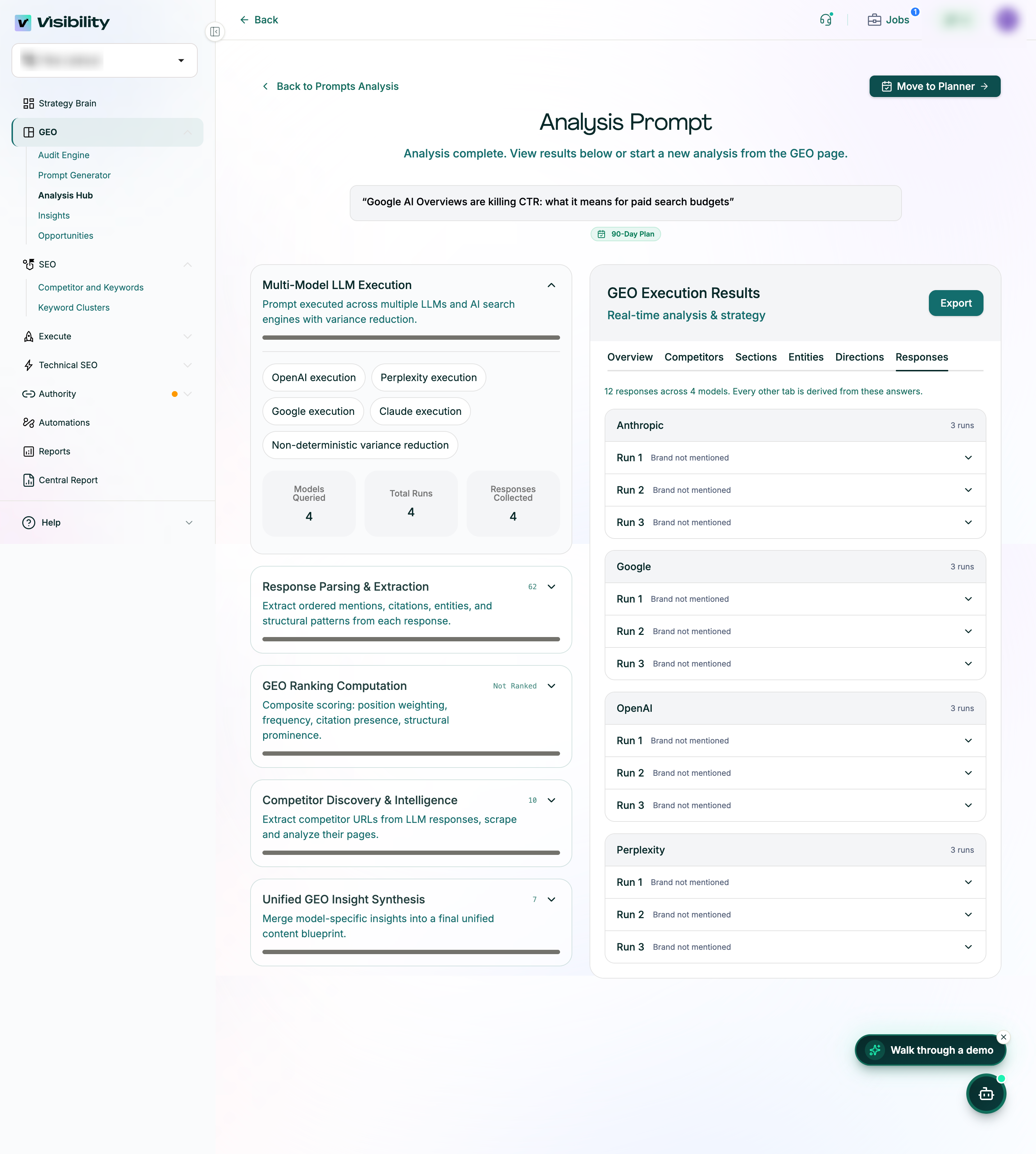
Then classify what you find rather than lumping it together: incorrect facts, outdated facts, relevant omissions, and misleading category or audience positioning are different problems that may require different responses, and separating them is most of the value; purely stylistic differences are worth logging apart from these, since they rarely need action.
Track three measures separately, reporting the raw counts and percentages for each engine:
- Factual error rate: Among responses describing your brand, the percentage containing at least one verified factual error. Divide responses with an error about your brand by all responses describing it, then multiply by 100.
- Relevant-differentiator inclusion rate: Among responses describing your brand where a specified differentiator is relevant, the percentage that accurately mention it. Divide eligible responses accurately mentioning the differentiator by all eligible responses, then multiply by 100. Set the relevance criteria before reviewing results.
- Brand-appearance rate: The percentage of tested responses that mention your brand. Report this separately for branded, comparison, and unbranded prompts, since including the brand in a question changes what this measure tells you.
Keep testing conditions and the prompt set consistent when comparing periods. If there are no eligible responses for a measure, report it as not applicable rather than zero. These measures describe your tested prompt set, not every possible AI answer or buyer experience.
Here is a hypothetical worked example to show the loop end to end (illustrative, not a specific customer):
- Observed error. Across repeated ChatGPT and Perplexity runs, a project-management brand is consistently described as "lacking native time tracking," and a competitor is named for that feature.
- Supporting evidence. The brand shipped native time tracking eight months ago. Checking the cited sources, the pages cited include outdated review-site descriptions and a comparison article that predates the release. (Citations are useful evidence, though they do not reveal every influence on an answer.)
- Source correction. The team updates its own feature page and pricing page to state the capability plainly, pitches the review sites to refresh their entries, and publishes a current comparison page with substantiated detail.
- Later reassessment. Re-running the same prompt set over the following weeks, the team watches whether the "no time tracking" claim fades and tracks which engines update first.
A change in answers after you edit content is suggestive, not proof your edit caused it, since these systems and their sources can change independently. Watch whether the improvement holds across runs and engines before crediting the fix. And the audit measures representation, not revenue.
What actually closes the gap
The durable fixes are unglamorous, which is usual for content work. The through-line is giving every engine the same substantiated, well-structured material to find wherever it looks.
Start with the operational backbone: keep your business description, product names, proof points, and partner relationships consistent and current across your owned site, third-party profiles, press releases, and review platforms. Consistent details give systems clearer information to work with. Conflicting details can contribute to inconsistent answers. Add structured data and clear entity definitions to make the relevant business details explicit in machine-readable form, matching what is visible on the page. Note that Google says no special schema is required for its AI features, so treat structured data as clarity for machines rather than a citation lever.
Get your positioning down operationally before you produce content, documenting not just what your brand says but what it does not, with examples, and use that as the guardrail for both writers and AI tools. Source authority does real work too, though how much is engine-specific rather than uniform, since engines retrieve and weight sources differently. For Google's surfaces specifically, its guidance on AI features says foundational SEO helps content qualify, and its content guidance recommends valuable, non-commodity content with a first-hand point of view while cautioning that many circulating GEO "hacks" do not reflect how its systems work. So the genuinely useful, well-structured pages you would build anyway are also a strong investment here. The real strategy is simpler and harder than a hack: publish material that could only come from you.
Where the people stay, and where Pixis fits
The division of labor I would argue for is this: let AI run the continuous, repetitive monitoring, watching how you are represented across engines and surfacing where the representation is shifting, while people direct and review that work, judge what is actually an error, and own the positioning itself. AI-assisted content is genuinely useful; the judgment about what is true, what differentiates you, and how you want to be known is the part that stays human, because it is exactly what an automated summary cannot supply on its own.
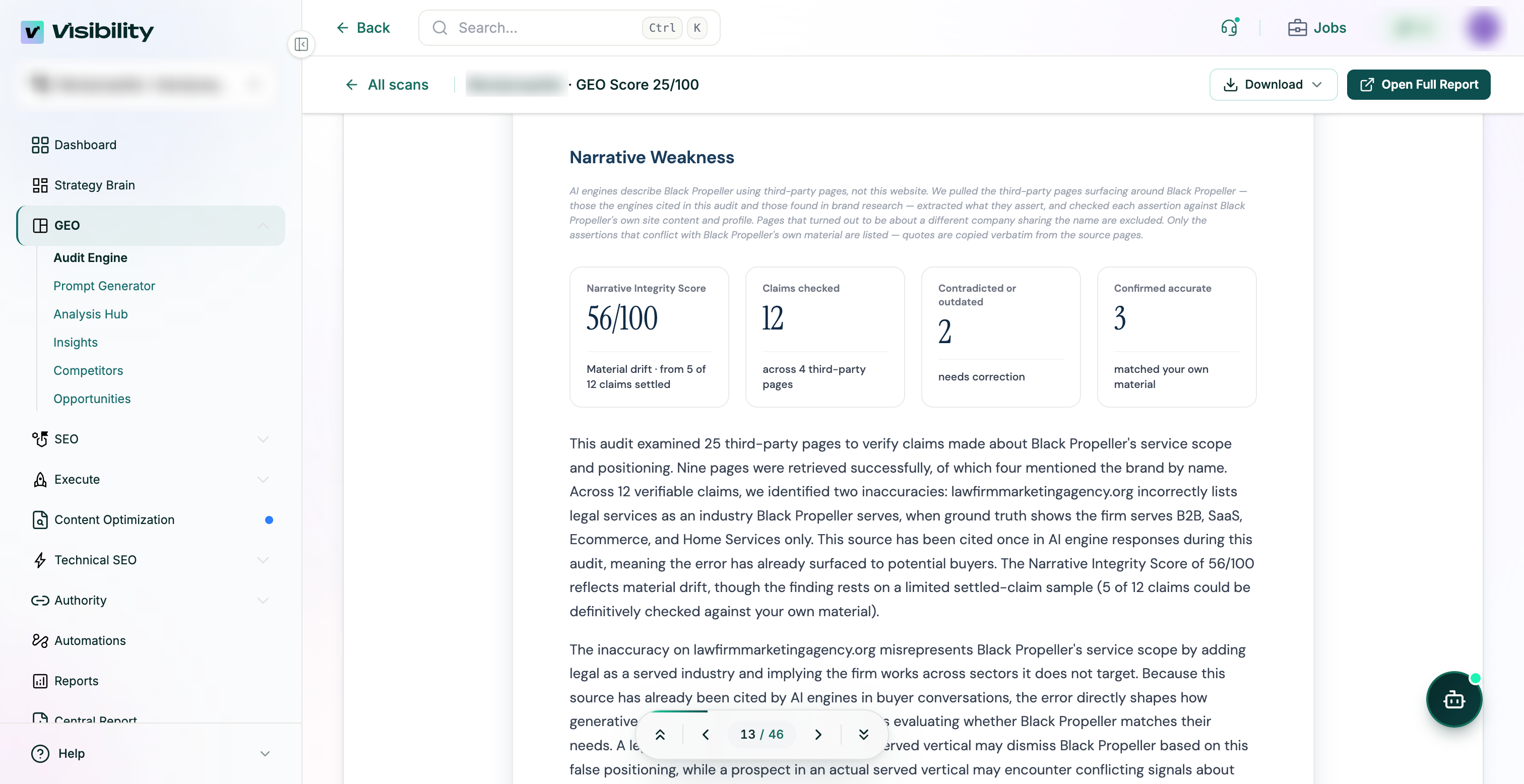
This is the principle behind Pixis Visibility. It tracks how AI engines describe your brand across ChatGPT, Perplexity, Gemini, Claude, and Google AI Overviews, follows how that representation and its sentiment shift over time, monitors competitor mentions, and supports custom prompt tracking. Your team can track those observations over time and assess them against its verified reference sheet. That review produces a specific list of what to fix. Deciding what counts as an error and which content to change remains the team's responsibility. The platform supplies the evidence, and your team keeps the judgment.
Owning the work, not the fantasy of control
You cannot fully control what a probabilistic system says about you, and I would be suspicious of anyone who promises you can. What you can do is make the accurate, substantiated version of your brand the easiest thing for an engine to find, keep it consistent everywhere, and measure whether it is landing. That is stewardship rather than control, and unlike control, it is actually achievable.
The narrative gap is not a future problem; it can arise whenever an engine describes your brand. The question is not whether AI will describe you, because it can. It is whether the description gets the important things right, and whether you have the evidence to know when it does not. Start with Pixis Visibility to see how the engines describe you today, or book a demo for a live read across the major AI engines it covers.
FAQs
What is the AI narrative gap, and why does it matter?
It is the distance between what is true and substantiated about your brand and what AI engines actually say about it, in the accuracy, completeness, and positioning of their descriptions. It matters because an AI summary is increasingly the first description a buyer encounters, and it may draw on retrieved sources, information learned during training, and conversation context, any of which can be incomplete, outdated, or inconsistent.
How do I measure it for my brand?
Build a verified reference sheet of what is genuinely true about your category, capabilities, and differentiators. Then run branded, comparison, and unbranded prompts across ChatGPT, Gemini, Perplexity, and Claude, several times each, logging the engine, date, search mode, response, and any cited URLs. Classify what you find into incorrect facts, outdated facts, relevant omissions, and misleading category or audience positioning, since they may require different responses, and treat purely stylistic differences separately.
What is GEO, and how does this differ from it?
Generative Engine Optimization is the broad practice of shaping content and structure so AI represents your brand well, including whether you get cited at all. This article is narrower: it is about the accuracy of the description once you already appear, which is a distinct problem from visibility.
Why does an AI description differ from my brand copy?
Engines synthesize from many sources and favor concise extraction, and they may or may not retrieve live pages when they answer. That can strip nuance and surface outdated or inconsistent detail even when individual facts are correct, which is why consistent, substantiated source material across your surfaces matters so much.
What is the single best first step for a small team?
Build the verified reference sheet and run the first audit. It is inexpensive and manageable as a first exercise (the time depends on how many prompts, engines, and repeat runs you include), and it converts a vague worry into a specific, classified list of what to fix and where. Everything downstream is easier once you can see the gap.