
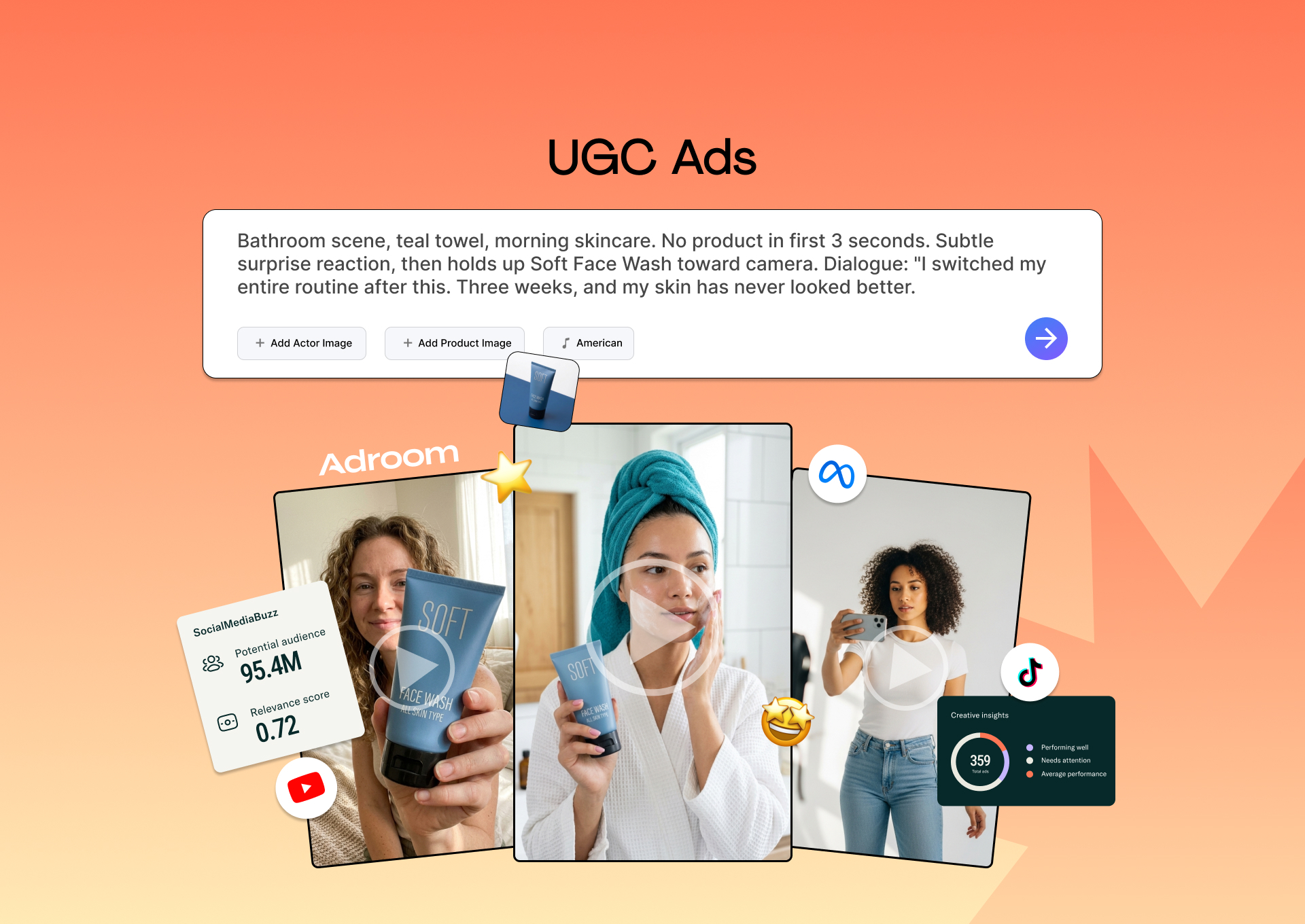
User-generated content is still one of the highest-performing creative formats in paid social. But the version of UGC that most DTC brands and performance teams are still running — ring-lit testimonials, scripted problem-solution hooks, faux-enthusiastic demos — is fatiguing fast. The formats haven't changed. The audiences have.
There's a specific moment every performance marketer recognizes. Your UGC creative that was crushing it three weeks ago has flatlined. CTR is down. CPMs are climbing. You brief a new round of content, wait ten days for delivery, and by the time it launches the audience has already moved on to something else.
That cycle used to take months. In 2026, it takes weeks. Sometimes less.
The good news is that UGC itself isn't the problem. The data is unambiguous: according to Emplifi's Q3 2025 Social Media Benchmarks report, social posts featuring UGC drove 10.38x higher conversion rates compared to non-UGC posts. UGC video ads show 35% higher watch-through rates than polished brand ads. Campaigns incorporating UGC alongside brand content achieve 28% higher engagement than brand-only approaches.
The problem isn't UGC. The problem is format fatigue — and the inability to test fast enough to stay ahead of it.
This article breaks down which UGC hook formats are converting in 2026, which ones audiences have learned to scroll past, and how performance teams can build a creative testing system that doesn't require a full brief cycle every time you need to refresh.
Why Your UGC Feels Stale (Even When It's New)
When UGC first emerged as a performance format around 2019, it worked because it felt genuinely different. Shaky handheld footage. Unscripted takes. Real people with real opinions. Compared to the polished studio creative that dominated feeds at the time, it was jarring in the best way.
That contrast no longer exists.
Every DTC brand runs UGC now. Every performance team has briefed creators on the same problem-solution arc. Every testimonial opens with some version of "I was skeptical at first, but..." Audiences didn't stop trusting UGC — they started pattern-matching it. And once a format is recognizable as an ad, the scroll resistance kicks in.
AppsFlyer's 2025 Creative Optimization Report, which analyzed 1.1 million creative variations across $2.4 billion in ad spend, captured this gap precisely. Tutorials and app review formats generated 45% higher installs per thousand impressions and 17% better day-seven retention compared to testimonials — yet testimonials still captured the majority of budgets. Teams are funding yesterday's playbook while the data points somewhere else.
The insight buried in that finding: users don't have creator fatigue. They have format fatigue. The issue isn't that a real person is talking to camera. The issue is that they're saying exactly what every other real person says, in exactly the same structure, with exactly the same emotional arc.
Format fatigue is faster than most teams account for — and it's the primary reason a UGC creative can underperform not because the hook was weak, but because the audience has seen the hook enough times to recognize it as an ad. If you're seeing declining CTR without obvious targeting changes, creative fatigue is usually the culprit. We covered the mechanics of this in detail in How High-Performance Teams Beat Creative Fatigue Without Expanding Studio Headcount.
The Hook Is the Variable That Matters Most
Before getting into which formats are working and which aren't, it's worth establishing what the hook actually is and why it deserves more strategic attention than most teams give it.
The hook is the first one to three seconds of a video ad. It's the only variable that determines whether someone keeps watching or keeps scrolling. Everything else — the product demo, the testimonial, the CTA — is irrelevant if the hook doesn't land. A strong hook rate in 2026 is considered above 30% (meaning more than 30% of impressions watch past the three-second mark). Top-performing creatives hit 40 to 50%.
Most teams treat the hook as part of the brief. It's usually one line — the opening line of the script. The creator delivers it once, the editor keeps it, and the ad goes live. If it works, great. If it doesn't, the whole creative gets scrapped and the cycle starts again.
The smarter approach is to decouple the hook from the body of the ad entirely. Brief the body once. Test ten to twenty hook variations against it. The production cost is marginal. The data you get back tells you exactly what your audience responds to — information you can apply across every future brief.
This is the shift that separates creative teams running a sustainable testing system from ones that are perpetually in brief-to-delivery limbo.
What's Working in 2026: Hook Formats That Are Converting
The Hot Take / Contrarian Open
This format opens with a statement that contradicts a common assumption in your category. Not a fake controversy — a genuine reframe. "Most skincare routines are making your skin worse." "The reason your ads aren't converting has nothing to do with targeting." It mimics the cadence of high-value podcast commentary, which means it feels like something worth stopping for rather than something to scroll past. It works particularly well for products that require education or behavior change.
The Scenario Hook
Instead of opening with a claim, this format opens mid-scene. The viewer is dropped into a recognizable moment — someone standing in a changing room, someone at their desk at 11pm, someone doing a grocery shop. The product isn't introduced immediately. The situation is. This borrows from the way organic content on TikTok and Reels operates: story-first, product-second. Testing data from brands across DTC categories during BFCM 2025 shows scenario-based hooks consistently outperforming direct testimonial opens on ROAS, even when the underlying script was identical.
The Reaction Hook
A format built around a genuine reaction — unboxing, first use, unexpected result — rather than a prepared statement. The key word is genuine. Over-produced reaction content reads as scripted immediately. What converts is the pause before the reaction, the micro-expression, the moment of actual surprise. This format travels well across categories and is relatively low-cost to produce in volume since it requires minimal scripting.
The Third-Person Social Proof Hook
Rather than the creator speaking about their own experience, they speak about someone else's. "My sister has been using this for three months and I finally caved." "My whole friend group is obsessed with this." This format borrows trust rather than claiming it directly, which lowers the skepticism threshold audiences have built up against first-person testimonials. It also feels less scripted because the creator is relaying something rather than performing something.
The Direct Diagnostic
This format opens by naming a specific symptom the viewer is experiencing. Not a category problem — a specific, granular one. "If your retention drops off at day three, this is probably why." "If you've tried three moisturizers this year and none of them have worked, read this." The specificity is what makes it work. A general pain point is easy to scroll past. A pain point that sounds like it was written about you specifically is not.
What's Fatiguing: Formats That Have Run Their Course
The Ring-Light Testimonial
The format that built UGC as a performance channel is now its biggest liability. Clean lighting, direct address to camera, scripted problem-solution narrative. Audiences have learned to pattern-match this format as an ad within the first half-second. It's not that the content is bad — it's that the visual and structural codes of the traditional testimonial format signal "advertisement" before the message has a chance to land.
The Forced Enthusiasm Demo
Creator holds product. Creator expresses amazement. Creator lists features. Creator says some variation of "game changer" or "I can't live without this." The problem isn't enthusiasm — it's performed enthusiasm. Audiences in 2026 are exceptionally good at detecting scripted emotional beats. When the energy in a video feels manufactured rather than earned, trust evaporates. The specific phrases that have been retired by overuse: "this changed my life," "I was skeptical but," "you need to try this," "obsessed."
The Talking Head Value List
A creator lists reasons to buy the product. Usually three to five. Usually delivered in a rapid-fire format. This format assumes the viewer is already interested enough to sit through a list — which they're not. Value lists belong in the body of an ad, not the hook. Opening with a list signals that what follows is a commercial, not a conversation.
The Vague Before/After
Before-and-after content works when the transformation is specific and visible. It doesn't work when the before is generic ("I was tired all the time") and the after is vague ("I feel so much better"). Audiences have been burned by vague transformation promises often enough that they've become skeptical of the format by default. The fix isn't abandoning before/after — it's making both the before and the after specific enough to be verifiable.
The Creative Volume Problem: Why Teams Can't Keep Up
The data on testing volume is consistent and uncomfortable for most DTC and performance teams. For brands spending over $5,000 per month on paid social, testing five to ten new creative variations per week is the recommended baseline. Most teams are nowhere near that.
The gap isn't usually strategic — most teams understand they should be testing more. The gap is operational. Briefing a creator, waiting for content, reviewing, requesting revisions, editing, launching, waiting for data: the standard UGC workflow takes two to three weeks from concept to live test. By the time results are in, the next round needs to have already started.
This is where the traditional brief-heavy model breaks down. It was designed for a world where creative had a longer shelf life. It wasn't designed for a world where a hook format can fatigue in ten days. The downstream effect shows up in your ROAS — and the connection between creative iteration speed and revenue efficiency is something we unpacked in Why More Ads Don't Improve ROAS. More volume without more variation doesn't move the number. What moves it is better creative signal.
The teams pulling ahead are the ones that have separated hook testing from full-brief production. They maintain a library of proven bodies — ad structures that have already demonstrated they convert — and rotate hooks against them continuously. New hooks cost a fraction of a new full creative. They generate data faster. And they compound: the hooks that win across multiple body formats become directional intelligence for every future brief.
How to Build a Hook Library That Doesn't Go Stale
A hook library is exactly what it sounds like: a documented, organized collection of hook formats, opening lines, and visual approaches that a team tests, scores, and iterates from. The difference between a hook library and a swipe file is that a library is living — it gets updated based on performance data, not just inspiration.
Start with categorization, not collection
Most swipe files are just folders of ads teams liked. A hook library needs taxonomy. Categorize by psychological mechanism: curiosity gap, social proof, contrarian claim, scenario drop-in, diagnostic question, pattern interrupt. When you know why a hook works, you can generate variants. When you only know that it worked, you're stuck waiting for the next thing to copy.
Score everything, retire fast
Every hook gets a three-second hold rate when it runs. Track it. Set a threshold — anything below 25% gets retired. Anything above 35% gets variant-tested. The goal is to kill losing hooks faster than the budget spent on them becomes significant, and to scale winning hooks before the audience has seen them enough times to pattern-match them.
Generate variants before you need them
The worst time to brief new hooks is after your current ones have fatigued. By that point you're already behind. Build variant generation into your regular cadence: every hook that performs gets five variants briefed within the week of its first strong result. Different emotional angle, different opening word, different visual approach — same core mechanism. You're not reinventing. You're extending.
Pull from outside your category
The strongest hook formats usually don't come from within a category. They come from adjacent ones. A DTC supplement brand studying how fintech ads open. A skincare brand borrowing from the cadence of fitness content. When you only study your direct competitors, your hooks start to sound like your direct competitors. The freshest creative intelligence comes from outside the bubble.
Where Adroom Fits: Testing Angles Without a Full Brief Cycle
The briefing bottleneck is structural, not a team capability problem. The issue is that most creative workflows were designed around full productions: one brief, one batch of content, one round of revisions. That model made sense when a creative could run for three months. It doesn't make sense when you need five new hooks in a week.
Adroom's variant engine is built for exactly this gap. Rather than requiring a full brief cycle every time a creative needs refreshing, Adroom lets performance teams generate hook variants directly from existing top-performing assets — different angles, different opening lines, different visual approaches — without going back to square one on production. It's a direct answer to the brief cycle bottleneck that most creative teams are working around rather than solving.
For performance teams managing creative at scale, the practical impact is significant. A creative that would have taken two weeks to brief, produce, and launch can be variant-tested in a fraction of the time. Which means teams can run more tests, get data faster, and make better decisions about which angles to invest in before sinking production budget into a full creative round.
The result isn't just faster creative. It's a tighter feedback loop between what the data says is working and what goes into the next brief — which connects directly to how performance reviews should be structured. If your review cadence isn't designed to surface creative signals fast enough to act on them, the system breaks down before Adroom or any other tool can help. That's the argument we made in Why Your Performance Marketing Reviews Keep Failing.
The Platform Dimension: Hooks Aren't Universal
One of the most common mistakes performance teams make is treating hook format as platform-agnostic. A hook that stops the scroll on TikTok doesn't necessarily work the same way on Meta. The audience behavior, the content cadence, and the creative norms are different enough that a direct port rarely performs at the same level.
On TikTok, native behavior is defined by entertainment and discovery. Hooks that mimic organic TikTok content — reactive, spontaneous, trend-adjacent — tend to outperform hooks that feel deliberately constructed. The visual rhythm matters as much as the copy. TikTok CTR benchmarks for UGC-style content sit between 1.0% and 2.0% for top performers.
On Meta, the audience is more varied and the scroll behavior is slower. Hooks that open with a specific, recognizable pain point tend to convert better than hooks that open with entertainment. The first frame is doing more work than on TikTok — it's not just stopping the scroll, it's qualifying the viewer. Meta CTR benchmarks for UGC-style content sit between 0.5% and 1.5%.
Reels sits between these two. It rewards native visual style more than Meta Feed but has more tolerance for direct-response copy than TikTok. The implication for hook libraries: you need platform-specific variants, not just format variants. A hook that works on TikTok should be rewritten for Meta — same mechanism, different execution. For platform-level performance benchmarks across Meta and Google, the Pixis 2025 Benchmark Report — drawn from over $1.8B in analyzed ad spend — is the most useful reference point we have for understanding what strong performance actually looks like by channel.
Measuring Hook Performance: The Metrics That Matter
Not all metrics tell you the same thing about a hook, and optimizing for the wrong one leads to bad creative decisions.
Three-second hold rate is the primary hook metric. It tells you whether the opening captured attention. A hold rate above 30% is strong. Below 20% and the hook is actively losing the audience before your message has a chance to land.
Watch-through rate tells you whether the body of the ad is delivering on what the hook promised. A high hold rate with a low watch-through rate usually means the hook created a curiosity gap the ad didn't fill — a disconnect between expectation and content.
Thumb-stop ratio (impressions that result in any watch time) is useful for comparing hooks across different audience segments. It normalizes for audience size and gives you a cleaner read on creative quality independent of targeting variables.
Cost per result is the downstream metric that validates everything upstream. A hook can have excellent hold and watch-through rates and still not move the business metric if the audience it's attracting isn't the right one, or if the offer isn't right. Hook performance metrics tell you about creative quality. Cost per result tells you about commercial impact. The moment ROAS starts drifting is usually when teams realize they've been watching the wrong signals — which is exactly why real-time monitoring matters as much as the creative itself. Real-Time Budget Optimization: How Teams Prevent ROAS Drift Before It Shows Up in the Weekly Report covers how to catch those signals before they become expensive.
The Library Is the Strategy
The brands pulling away from the pack in UGC performance in 2026 aren't the ones with the best individual creative. They're the ones with the best creative testing infrastructure.
A single great UGC ad is a data point. A hook library built from hundreds of tested variations, scored by real performance data, continuously refreshed before fatigue sets in — that's a competitive advantage that compounds.
The shift from format-thinking to mechanism-thinking is where it starts. Stop asking "what format is working right now" and start asking "what psychological trigger is making audiences stop, and how many ways can we activate that trigger before they learn to recognize it."
The answer to that question is never a single hook. It's a library. And the library is never finished.
Frequently Asked Questions
What are UGC ads in 2026?
UGC ads in 2026 are video or image ads built from content that looks and feels like it was created by a real customer or creator rather than a brand. The format is designed to blend into organic social feeds on platforms like TikTok, Meta, and Instagram Reels. In 2026, UGC ads increasingly refer to performance-first creative that prioritizes authentic hooks and native visual style over polished production — including both human-created and AI-assisted content that maintains a genuine feel.
What UGC hook ideas are converting in 2026?
The hook formats with the strongest conversion data in 2026 include contrarian or hot take openers (statements that challenge a common category assumption), scenario drop-ins (opening mid-scene in a recognizable situation), third-person social proof hooks (the creator relaying someone else's experience rather than their own), and direct diagnostic openers that name a specific symptom the viewer is experiencing. These formats outperform traditional testimonial opens because they delay the "this is an ad" recognition long enough for the message to land.
Why is UGC ad fatigue accelerating?
UGC ad fatigue is accelerating because the volume of UGC-style creative across paid social has increased dramatically while the range of formats in use has remained narrow. Most teams are briefing within the same structural conventions — problem, solution, testimonial, CTA — which means audiences have learned to pattern-match the format before the message has a chance to land. Fatigue isn't about UGC as a category. It's about format repetition within that category. The solution is continuous hook testing and format rotation rather than waiting for performance to drop before briefing new creative.
How often should DTC brands refresh their UGC creative?
For DTC brands spending more than $5,000 per month on paid social, testing five to ten new creative variations per week is the recommended baseline. At a minimum, hook variants should be tested before a full creative is declared fatigued — which typically means having new hooks ready within ten days of a creative going live, not waiting until performance drops. The practical approach is to decouple hook production from full creative production: brief hooks as modular assets that can be tested against proven body structures.
What is a UGC hook library and why does it matter?
A UGC hook library is an organized, scored collection of hook formats, opening lines, and visual approaches that a team tests and iterates from over time. Unlike a swipe file (which is typically just a collection of ads that looked interesting), a hook library is organized by psychological mechanism — curiosity gap, social proof, contrarian claim, pattern interrupt — and updated based on actual performance data. It matters because it transforms hook development from a reactive process (briefing new hooks after fatigue hits) into a proactive system (maintaining a tested pipeline of angles before you need them).
What makes a UGC ad perform better than branded content?
UGC ads outperform branded content primarily because they reduce the "this is an ad" recognition response that triggers scroll behavior. Emplifi's Q3 2025 data found UGC-style content driving 10.38x higher conversion rates than non-UGC posts. The underlying mechanism is trust: content that looks like it came from a real person carries more credibility than content that looks like it came from a brand — even when audiences know the former was paid for. The performance advantage holds as long as the UGC format remains genuinely distinct from branded creative. When UGC becomes formulaic, the trust advantage erodes.
Key Takeaways: UGC Ads in 2026
UGC still outperforms branded content at scale — Emplifi's Q3 2025 data shows 10.38x higher conversion rates for UGC-style posts. The channel works. The formats within it are what need refreshing.
Format fatigue is outpacing brief cycles. The traditional testimonial, ring-lit demo, and talking-head value list have been overexposed. Audiences pattern-match them as ads within the first half-second.
Hooks are the primary testing variable. Decoupling hooks from the body of the ad and testing ten to twenty variants per core creative is more efficient than briefing new full creatives for every refresh cycle.
The formats converting in 2026 share a common logic: they delay the "this is an ad" recognition by leading with entertainment, education, or a specific diagnostic before the product enters the frame.
Platform-specific variants matter. A hook that performs on TikTok needs to be rewritten for Meta, not directly ported. The audience behavior and creative norms are different enough to warrant platform-specific treatment.
A hook library built from continuous testing is a compounding asset. Teams with a scored, categorized library of proven hook mechanisms make better brief decisions, move faster, and stay ahead of fatigue rather than reacting to it.