

Most marketing teams waste budget on AI tools that promise automation but deliver busywork. These platforms often can't integrate with your stack. They generate off-brand creative that needs heavy editing or require so much setup that you would have been faster doing it manually.
We tested 20 AI marketing platforms hands-on—running campaigns, generating creative, and measuring real performance impact—to find the ones that actually deliver. Here's what works, what doesn't, and how to choose the right platform for your team's specific needs.
What is an AI powered marketing platform
An AI powered marketing platform uses artificial intelligence to automate, personalize, and optimize your marketing across channels like social, search, display, email, and ecommerce. Think of it as software that handles the repetitive stuff: building audiences, setting budgets, scheduling posts, running tests, generating creative variants, and surfacing performance insights.
The automation goes beyond simple if-then rules. AI models learn from your data to predict which audiences will convert, which creatives will resonate, and which budget splits will maximize return. They adapt in real time as campaigns run, shifting spend toward winning combinations and pausing underperformers before you waste budget.
Here's what AI marketing platforms typically handle:
- Automate repetitive tasks: Schedule posts, build audience segments, set bid strategies, generate reports, and rotate creative variants without manual work.
- Personalize content at scale: Tailor ad copy, email messaging, landing page headlines, and product recommendations to individual customer segments based on behavior.
- Provide data-driven insights: Analyze campaign performance across channels, surface trends, predict outcomes, and recommend next actions like bid adjustments or audience expansion.
- Generate marketing content: Produce ad creatives, social captions, email copy, product descriptions, and image or video variants using generative AI.
For example, you might upload a product feed and brand guidelines, and the platform generates 50 ad variants optimized for different audience segments. Or it might analyze your Meta and Google campaigns together, spot that iOS users convert better on video ads, and automatically shift budget accordingly.
The goal is simple: free your team from low-value work so you can focus on strategy, creative direction, and the decisions only humans can make well.
Why Marketers Need AI Marketing Software Now
Modern marketing suffers from three bottlenecks: manual workload, optimization complexity, and creative production constraints. AI platforms directly address each.
Speed matters more than ever, as consumer attention shifts fast and campaign windows close quickly. Manually building audiences, trafficking ads, and generating reports eats hours that could go toward testing new channels or refining messaging. AI offloads repetitive tasks, letting you launch campaigns in minutes instead of days.
Optimization has gotten too complex for manual management. You're juggling bid strategies across Meta, Google, TikTok, and Amazon, each with different algorithms and performance signals. Add in attribution challenges, iOS privacy changes, and fluctuating CPMs, and it's nearly impossible to optimize at the pace algorithms demand. AI continuously adjusts bids, budgets, and targeting based on real-time signals, capturing opportunities you'd miss manually.
Creative is the new battleground, but production is slow. Winning campaigns now require dozens of variants to test hooks, formats, and messaging across segments. Traditional creative workflows can't keep up. AI-powered platforms generate on-brand variants at scale, test them automatically, and surface winners—turning creative iteration from a monthly project into a daily habit.
If you're still managing campaigns manually, you're competing against teams using AI. These teams test 10 times more creative, optimize 24/7, and act on insights the moment they surface.
How We Ranked The 20 AI Marketing Platforms
We tested AI marketing platforms hands-on over several months, combining direct usage, customer feedback, and performance analysis.
Evaluation criteria
We scored each platform across five dimensions:
- Ease of use: Onboarding time, UI clarity, workflow efficiency, documentation quality, and support responsiveness.
- AI capabilities: Model sophistication, automation depth, generative quality, and built-in guardrails for brand safety.
- Integration options: Connectors to ad platforms, ecommerce systems, CRMs, analytics tools, data warehouses, and CDPs.
- Performance impact: Measurable uplift on key metrics like ROAS, CPA, CTR, and LTV, plus reliability at scale.
- Pricing value: Transparency, scalability, total cost of ownership, and whether pricing aligns with the value delivered.
Data sources and testing period
We created live campaigns where possible, generated creative assets, and ran controlled pilots to measure performance impact. For platforms we couldn't test directly, we conducted deep product demos with specialists and validated feature depth against roadmaps. We surveyed users across industries and analyzed public reviews to capture real-world outcomes beyond vendor claims.
Our observation window spanned multiple weeks to capture the full cycle: setup, daily usage, optimization loops, and long-term reliability.
Scoring formula
We used a weighted scoring model that balanced usability, AI depth, integration breadth, impact, and value. Each category received a weight reflecting its importance to typical marketing teams.
We prioritized real performance signals—did ROAS improve, did creative production accelerate, did teams save time—over marketing claims or feature lists.
The Winners At A Glance
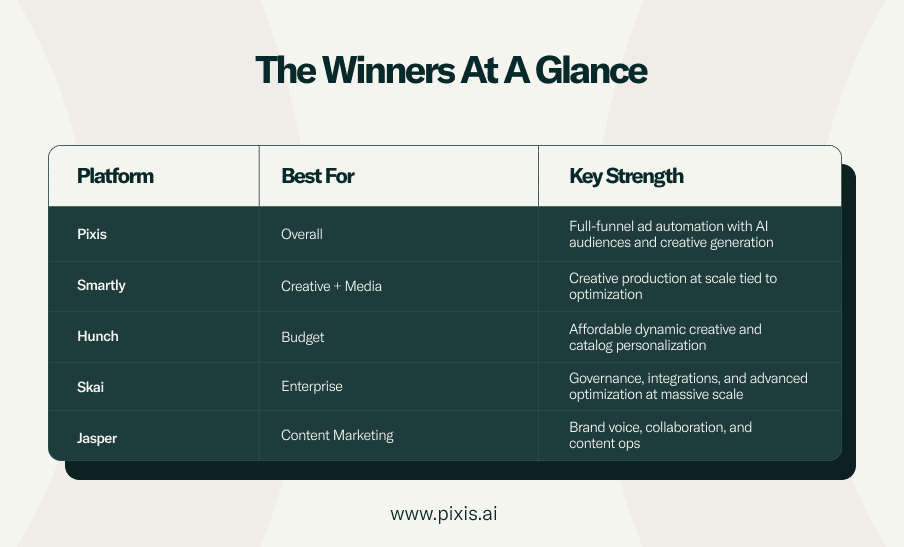
Here's the quick reference for best fit by use case:
1. Best overall AI marketing platform
Our platform wins for versatility and measurable results across targeting, creative, and optimization. We at Pixis built the platform specifically for consumer brands running paid social and display who need faster testing cycles and performance lift.
The platform automates audience expansion, dynamically adjusts budgets and bids, and generates creative variants—images, video, and copy—that stay on-brand. You get end-to-end campaign automation with clear impact reporting that ties AI actions directly to metric improvements.
Two. Best for creative and media in one
Smartly excels at combining creative automation with media buying to streamline cross-channel execution. Performance and brand teams use it to scale creatives across Meta, TikTok, Snap, and other platforms without manual resizing or reformatting.
Dynamic templates and feed-based ads let you generate thousands of variants. Real-time creative optimization ties directly to spend decisions. If a creative starts underperforming, the platform shifts budget automatically.
3. Best budget option
Hunch offers strong dynamic creative and feed-based personalization at a price point friendly to smaller teams. It's data-driven creative personalization with predictive templates that adapt to audience signals. Lean teams get affordable access to feed management, audience-level personalization, and rapid creative versioning without enterprise-level contracts.
4. Best for large enterprise
Skai is built for complex organizations needing governance, customizable workflows, and robust integrations. It handles enterprise-scale campaign management across search, social, retail media, and more with a unified data model. Features like scenario planning, budget forecasting, and robust APIs make it the go-to for large marketing teams managing massive budgets across multiple brands and regions.
5. Best for content marketing AI
Jasper is the top choice for brand-consistent content creation, collaboration, and multi-channel distribution. Content, lifecycle, and social teams use it to produce high volumes of on-brand copy and assets efficiently. Brand memory, multi-user approvals, campaign templates, and distribution integrations keep teams aligned and productive without sacrificing quality or voice.
Full Reviews Of The Top AI Marketing Platforms
Here's what you need to know about each platform's strengths, ideal use cases, and standout features.
Pixis
Pixis focuses on advertising automation for consumer brands. The platform combines AI-powered audience targeting, budget and bid optimization, and creative generation into one workflow.
Ideal use cases: Consumer brands running paid social and display campaigns who want to accelerate testing velocity and improve ROAS without adding headcount.
Standout features:
- AI audiences: Continuously discover new high-intent segments.
- Adaptive optimization: Respond to performance signals instantly.
- Creative iteration: Generate on-brand image, video, and copy variants.
- Impact reporting: Transparent tracking that ties AI actions to metric improvements.
Try Pixis today to see how AI-powered advertising automation can lift your campaign performance.
Smartly
Smartly combines creative automation and media optimization in one platform. Teams use it to manage campaigns across Meta, TikTok, Snap, Pinterest, and other channels.
Ideal use cases: Performance and brand teams scaling creative production across multiple channels while maintaining quality and brand consistency.
Standout features: Dynamic templates that generate variants from product feeds, real-time creative optimization that shifts spend based on performance, and feed-based ads that personalize at scale.
Jasper
Jasper is a content creation platform with strong brand voice controls and collaboration features. Marketing teams use it to produce copy for ads, emails, social posts, and landing pages.
Ideal use cases: Content, lifecycle, and social teams producing high volumes of on-brand copy and assets across channels.
Standout features: Brand memory that maintains voice consistency, multi-user approvals, campaign templates, and integrations with distribution tools.
TripleWhale
TripleWhale is an ecommerce analytics platform built for Shopify brands. It consolidates performance data across ad platforms, provides attribution insights, and surfaces actionable recommendations.
Ideal use cases: Shopify brands seeking clear performance tracking, attribution clarity, and decision support without heavy technical setup.
Standout features: Post-purchase surveys that capture attribution data, LTV cohorts, ad platform reconciliation, and creative insights that tie assets to revenue.
Skai
Skai is an enterprise campaign management platform that spans search, social, retail media, and app advertising. Large organizations use it to manage complex workflows at scale.
Ideal use cases: Large marketing teams managing massive budgets across multiple brands, regions, and channels with strict compliance requirements.
Standout features: Unified data model, scenario planning, budget forecasting, customizable workflows, and robust APIs for custom integrations.
Hunch
Hunch specializes in data-driven creative personalization with predictive templates that adapt to audience signals. It's designed for teams that need dynamic creative without enterprise budgets.
Ideal use cases: Lean teams needing cost-effective creative automation and feed management for ecommerce or catalog-heavy campaigns.
Standout features: Feed management, audience-level personalization, rapid creative versioning, and predictive templates.
11 more platform reviews
- Persado: Language AI for performance copy; best for high-volume conversion optimization where small copy changes drive meaningful lift.
- Movable Ink: Content personalization in emails and mobile; great for lifecycle marketing teams personalizing at the moment of open.
- Braze: Customer engagement platform with strong orchestration and testing across channels; ideal for lifecycle and retention teams.
- Klaviyo: Ecommerce lifecycle marketing with accessible AI for email and SMS personalization; popular with Shopify brands.
- Mutiny: Web personalization that improves on-site conversion with low-code experiments; fits teams optimizing landing pages.
- Pathmatics: Competitive ad intelligence for market mapping and benchmarking; useful for strategy and planning teams.
- Celtra: Creative automation for enterprise with global brand consistency at scale; fits large organizations with complex compliance needs.
- Adobe Sensei: AI-enhanced enterprise marketing suite with deep integration potential; best for Adobe-committed organizations.
- Albert: Autonomous media buying experimentation that runs hands-off testing cycles; fits teams wanting to delegate optimization entirely.
- Optimizely: Digital experience platform with experimentation and content recommendations; strong for teams running frequent A/B tests.
- Writer: Enterprise generative AI with compliance and terminology controls; ideal for content ops in regulated industries.
Choosing The Right Artificial Intelligence Marketing Platform For You
Use this framework to map your needs to the right tool and avoid costly misfits.
Match features to goals
Start by identifying your primary challenge. For example, you might want to reduce acquisition costs on paid social, produce 100 on-brand creatives monthly, or consolidate performance data into a single source of truth.
Map your challenge to capabilities:
- Acquisition and optimization: Pixis, Smartly, Skai, Albert.
- Creative at scale: Smartly, Celtra, Icon.
- Content and lifecycle: Jasper, Klaviyo, Braze, Writer.
- Analytics and attribution: TripleWhale, Polar Analytics.
- Personalization and CRO: Mutiny, Movable Ink, Persado.
Don't try to solve every problem at once. Pick the one bottleneck costing you the most time or money and optimize for it first.
Check integration requirements
Confirm the platform connects to your existing stack: ad platforms like Meta, Google, TikTok, and Amazon; ecommerce systems like Shopify and BigCommerce; CRMs like Salesforce and HubSpot; analytics tools like GA4; data warehouses like Snowflake; and CDPs.
Watch for integration pain points: brittle custom APIs, manual data mapping, delayed syncs, and limited user permissions. Ask vendors for integration documentation and check whether they offer pre-built connectors or require custom development.
Evaluate pricing models
Common pricing models include per-seat licenses, usage-based credits for generations or impressions, tiered feature bundles, and enterprise contracts with custom terms.
Look for transparent overage policies, clear limits on generations or automation, whether SSO and SOC 2 compliance are included or cost extra, and predictable scaling costs as your usage grows.
Getting Started With AI Marketing Solutions In Under 30 Days
Hit quick wins with a focused rollout plan.
Pick a high impact use case
Choose one recurring, high-value task where AI can deliver measurable improvement fast. Examples include automating top-of-funnel ad creative variants, recovering abandoned carts with personalized email or SMS, or deploying on-site personalization for a hero product.
Avoid one-off projects or tasks that require extensive custom setup. You want a use case that compounds value over time.
Establish baseline metrics
Document current performance before you launch the pilot. Capture CPA, ROAS, CTR, CVR, production hours per asset, and cycle times for the workflow you're automating. Without a baseline, you can't prove impact, and you'll struggle to justify scaling.
Launch a controlled pilot
Limit scope to one or two channels, a defined budget, and a small set of KPIs. Use A/B holdouts to quantify lift and prevent noisy conclusions. Run the pilot for at least two to three optimization cycles so the AI has time to learn and adapt. Don't expand until you've confirmed consistent gains over multiple weeks.
Iterate weekly with the AI feedback loop
Review performance, update prompts or audience definitions, shift budget toward winners, and lock in successful configurations. Expand scope only after you've validated that the AI consistently improves outcomes without manual intervention. The goal is to build confidence in the system before you scale it across more campaigns or channels.
Your Next Move Try Pixis Today
For consumer brands, we provide comprehensive advertising automation and AI-powered creative generation that accelerates testing and improves performance. Our platform handles audience targeting, budget and bid optimization, and creative iteration so your team can focus on strategy and big ideas.
Start your pilot here to see how AI-driven advertising automation can lift your ROAS and free up time for the work only you can do.
Frequently Asked Questions About AI Powered Marketing Platforms
Does an AI marketing platform replace my marketing agency?
No. AI platforms complement agencies rather than replace them. The platform handles automation, scale, and optimization, while your agency focuses on strategy, creative concepting, and cross-channel coordination. The best outcomes pair both: the agency brings strategic thinking and big ideas, and the platform executes and optimizes at scale.
How do AI marketing platforms handle data privacy compliance?
Reputable platforms offer GDPR and CCPA tooling, consent management integrations, data retention controls, and often maintain SOC 2 certification. Confirm vendor compliance documentation and align with your legal team's requirements before you commit. Ask about data storage locations, subprocessor agreements, and whether the platform uses your data to train models.
Can I use multiple AI advertising tools without creating workflow conflicts?
Yes, with clear integration planning and role definitions. Start with one primary platform, document data flows and responsibilities, and layer complementary tools only after you've established stable processes. Avoid overlapping capabilities like two creative generation tools that create redundant work or conflicting outputs.