
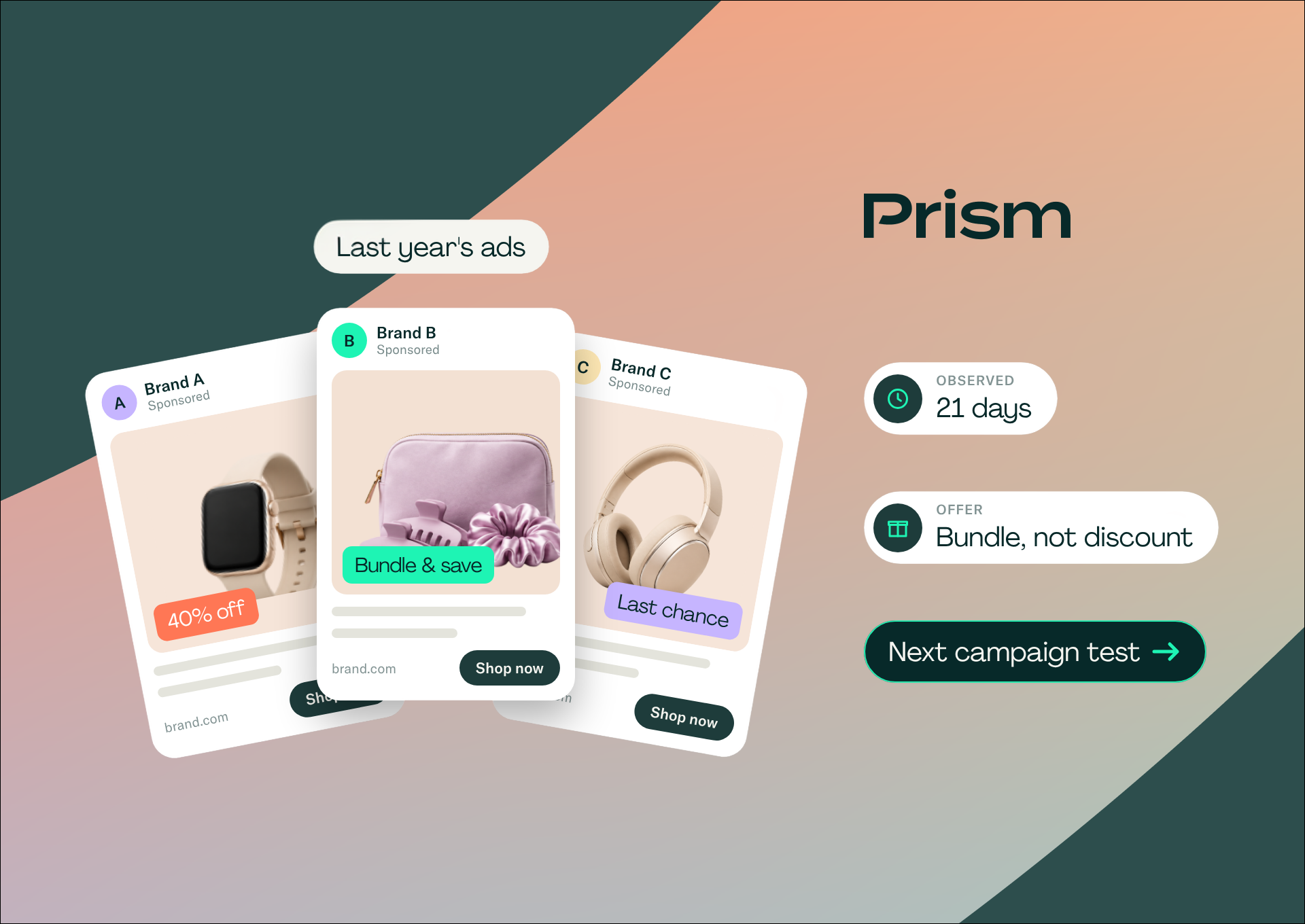
Last year's competitor ads can help answer some of the hardest questions in a Black Friday brief: whether to lead with the offer or the product, how early to introduce the promotion, and which creative ideas deserve several executions.
Furniture brand Recess has used that approach in practice. In a 2024 customer interview published by MagicBrief, its team described studying other brands' angles, hooks, and formats, including the previous year's ads, to prepare Black Friday creative across funnel stages.
The useful part is what happens between finding an ad and approving a campaign. A competitor's video that appears to have lasted three weeks deserves a closer look, but its dates cannot tell you whether it was profitable. A two-day ad might have completed a successful flash sale exactly as intended.
A stronger retrospective reconstructs the sale: how offers changed, which buying arguments recurred, and how brands adapted those arguments across formats. It then turns those observations into tests supported by your own customer evidence and commercial limits. Here is how to make that process useful for your next BFCM plan.
Key takeaways
- Reconstruct the sale in phases instead of ranking a folder of isolated ads. Early access, the main event, and the final deadline serve different buying moments.
- Establish what historical data is actually available before promising a review of last year's ads. Library retention and public fields vary by platform and market.
- Use longer observed presence to prioritize inspection. It does not establish continuous delivery, high spending, or profitability.
- Compare complete offers, including exclusions, thresholds, shipping, and bundle contents. Headline discount percentages can conceal very different propositions.
- Turn observations into bounded tests with your own economics, proof, creative, and success criteria attached.
Start with the decision you need to make
Before opening an ad library, identify a planning question. “What did competitors run?” is too broad to determine which evidence matters.
A useful question might be whether your BFCM offer needs a bundle alongside a percentage discount. Another could concern whether product demonstrations remain useful when the sale message becomes more urgent. You might want to know whether comparable brands introduced gifting arguments before Thanksgiving or saved them for December.
Choose a small competitor set around that question. Include direct substitutes your buyers genuinely compare, and add an adjacent brand only when it helps investigate the same buying behavior. A category leader with different margins, distribution, or brand demand may be instructive without being a suitable model for your spending plan.
Specify the product category, country, language, and historical window. For a 2026 plan looking back at 2025, Thanksgiving fell on November 27, Black Friday on November 28, and Cyber Monday on December 1. Compare activity relative to those events rather than treating the same calendar dates as equivalent in both years.
The general collection and tagging process is covered in Pixis's guide to running a competitor ad analysis. Here, the assignment is narrower: establish what changed across the previous sale and decide what merits a test now.
Establish what you can actually recover from last year
A retrospective depends on the archive you have, not the archive you wish existed. Check historical access before making claims about a competitor's full campaign.
For Meta, distinguish active-ad discovery from historical coverage. The Meta Ad Library includes currently running ads, with additional archives for particular categories and regions. Its published coverage includes ads delivered in the EU during the past year, while political and issue-ad retention follows different rules. Do not assume ordinary commercial ads from every market remain available after they stop running. At the edge of a rolling archive window, last year's early-sale activity may already be unavailable.
For Google, search the relevant advertiser and period. Google's Ads Transparency Center guidance describes searching by advertiser or website and filtering by date and targeted location. Verify the advertiser identity and inspect what the selected search actually returns. A result set is evidence of available ads, not a complete view of competitor spending or performance.
For TikTok, recognize the sample. TikTok describes Top Ads as a collection of high-performing creatives authorized by advertisers. It is useful for examining execution, but it is not a complete competitor archive. A missing example does not establish that a brand avoided the platform or format.
Bring in your team's dated captures from the previous year where available. Retained creative references and contemporaneous research notes can preserve observations that public tools no longer expose. A third-party archive may also help, but inspect its earliest capture, market coverage, duplicate handling, and definition of first and last seen before using its dates.
Label each example as directly verified in a public source, supported by a dated historical capture, or insufficiently verified. If the archive is thin, say so and narrow the conclusion. “We recovered four ads from this phase” is defensible. “They only ran four ads” requires evidence you probably do not have.
Build a sale sequence rather than a list of launch dates
Arrange recovered material into the buying phases it addresses: preparation or early access, the main Black Friday offer, the weekend, Cyber Monday, and the immediate holiday transition. Use the competitor's actual offer timing where the evidence supports it.
For each phase, ask what changed in the proposition. Did the brand move from joining a list to shopping a live offer? Did a gift-with-purchase replace the discount? Did the product stay the same while the message shifted from suitability to deadline? Did a new landing page support a different basket or recipient?
Keep ad and destination evidence separate. A landing page visited today may have changed since last year. Unless you have a historical capture, it can explain the current journey but cannot establish the previous offer's terms.
Use a consistent record for each recoverable example:
Evidence reference: Source URL or retained reference, ad ID where available, and capture date.
Scope: Advertiser identity, country, language, platform, and product.
Timing: Source-displayed dates and your own observation dates, identified separately.
Sale phase: Early access, main event, weekend, Cyber Monday, or post-sale.
Offer: Visible promise, qualifications, threshold, expiry, and any missing terms.
Creative: Opening hook, supporting proof, CTA, format, and duration where available.
Destination evidence: Historical, current only, or unavailable.
Interpretation: What this might suggest.
Next decision: What your team should investigate or test.
Group near-identical executions into concept families while preserving their separate records. The same demonstration in three ratios is one underlying idea with three executions, rather than three independent endorsements of that idea. Equally, an image using the same product but a different offer may belong to a separate commercial test.
Use longevity to choose what to inspect, not what to copy
“Ran longest” needs a definition before it becomes a ranking.
A platform-displayed start date, an archive's first-seen date, and the date your analyst first captured an ad describe different things. Two observations a week apart show presence at those observations. They do not prove uninterrupted delivery between them, and the first capture may be later than the actual launch.
Record those distinctions in the analysis. If an ad is visible on November 20 and November 27, describe it as observed on both dates. If the source exposes a longer activity period, preserve the field label and its meaning. Do not fill missing periods with assumed delivery.
Then compare examples within an appropriate phase. A two-day Cyber Monday offer is not inherently weaker than a month-long evergreen demonstration. A UK campaign and a US campaign may have different offers and historical visibility. Combining them into a single longevity leaderboard obscures those differences.
Longer observed presence becomes interesting when it connects with another finding. Perhaps the same product demonstration appears repeatedly while its price card changes. That supports investigating whether the demonstration could serve as a reusable base concept. It does not establish the competitor's reason for retaining it.
Inspect shorter-lived executions too. They may reveal a genuine deadline, a limited-stock product, or a phase-specific proposition. A retrospective that saves only apparent survivors loses the very changes it is meant to explain.
Read the offer as a basket decision
The largest visible percentage is rarely enough to compare two offers. Separate the headline promise from what a shopper must do to receive it.
Look for the eligible products, minimum spend, bundle contents, code requirements, exclusions, delivery charge, and expiry. Mark anything you cannot verify. An “up to 40% off” headline and a fixed 20% discount across an eligible range can create different customer experiences; the headline alone cannot tell you which is better value.
A hypothetical comparison makes the problem clearer. One competitor advertises 20% off a $100 item, producing an $80 item price before shipping and taxes. Another offers a $90 bundle containing the item and an accessory. The bundle costs the shopper more in total. Whether it is attractive depends on the accessory's relevance, the actual included items, and the rest of the buying conditions.
The practical question is whether a bundle could answer a need your own buyers have. Check your accessory attachment rate, customer questions, stock, and costs before briefing it.
Suppose your proposed bundle produces $90 of net revenue after the promotion and expected refunds. Product and variable operating costs total $52, leaving $38 before advertising. If the business requires $14 of contribution after advertising, it can allow $24 for acquisition under those assumptions.
That calculation does not predict campaign performance. It establishes the boundary within which the offer can be tested. Use the BFCM paid media planning guide for the wider commercial plan rather than taking a rival's discount as permission to match it.
Read hooks and formats together
Code the opening argument in plain language: price, product in use, recipient suitability, a specific problem, customer proof, or a real deadline. Then inspect how the rest of the asset supports it.
A product-in-use opening may make a function immediately clear. A price-led image can make a simple offer easy to read. A carousel may help explain a set of included items. These are possible roles to investigate, not proof of the competitor's campaign objective or audience setup.
For video, watch the full asset after inspecting the opening. Note when the product, brand, proof, offer, and CTA become understandable. A striking hook that depends on a later explanation may require a different test from one that makes the proposition clear immediately.
Pixis's competitor ad creative intelligence guide covers broader message interpretation. For the BFCM retrospective, focus on how the argument changes with the sale phase. Does the same product proof survive while the offer changes? Does deadline copy replace the explanation, or sit alongside it?
Also distinguish the visible asset from campaign structure. A vertical video does not identify the exact placements that delivered it. Public creative records do not expose the competitor's private targeting, bidding strategy, or incrementality. Keep those fields unknown unless the source genuinely provides them.
What published company examples actually demonstrate
Recess: use historical research to prepare the creative plan
The Recess interview describes a broader change from scattered references and reactive inspiration to more coordinated research, briefing, and testing. Its Black Friday example is particularly relevant: reviewing prior-year ads helped the team prepare creative in advance and connect executions across the funnel.
MagicBrief's case-study headline reports 233% month-over-month growth, but the article does not isolate the contribution of historical competitor research or present that figure as a Black Friday-specific lift. The practical evidence is the workflow: research became an input to planning and faster creative testing. The growth figure should not become a forecast for a brand adopting the same method.
River Island: connect competitive information to a campaign decision
An older Adthena case study about River Island describes using competitor information before and during Black Friday to guide paid-search copy, bidding, and budget redistribution. Adthena reports an 82% increase in sales over the previous year.
This is a related example rather than an exact match for the historical-creative approach. It concerns competitive intelligence used to adjust live paid-search activity, and the case study does not establish the incremental effect of each intervention. Its relevance is the connection between research and action: the information helped the team decide what to change while the event was underway.
Together, these vendor-published accounts support using competitive research as part of a campaign process. They do not establish that an ad's age predicts its return. To apply the lesson, the next step is to show exactly how an observed pattern becomes a decision your own team can evaluate.
A worked retrospective: three observations, three different decisions
Consider a hypothetical homeware brand reviewing saved 2025 captures from three direct competitors. The team has uneven coverage, so it describes only the observations it can support.
Competitor A repeatedly paired a product demonstration with changing offer cards. The same demonstration family appears in saved early-access, Black Friday, and Cyber Monday observations. The CTA and sale message change, while the central product explanation remains recognizable.
The useful hypothesis is that one strong explanation could support several approved offer versions. The brand briefs its own demonstration with replaceable offer sections and distinct expiry checks. It does not copy the rival's script or assume the competitor proved the concept profitable.
Competitor B used a completion bundle instead of leading with its deepest discount. Historical captures show the main item alongside accessories, with messaging about having everything needed to use it. The available examples are not sufficient to establish campaign results.
The brand checks its own customer questions and finds uncertainty about required accessories. That independent evidence justifies reviewing a bundle. Finance and merchandising verify the contents, availability, and allowable acquisition cost before the creative test is approved.
Competitor C's deadline message appeared only near the end of the event. A saved Cyber Monday capture contains an expiry claim absent from the earlier records. The historical landing page is unavailable, so the team cannot confirm whether the commercial terms changed too.
The brand prepares a truthful closing message for its own approved deadline. It tests that execution against its current product-proof message during the same eligible period, where account volume and setup support a useful comparison. It avoids treating the competitor's timing as a forecast of when its own sales will peak.
The retrospective produces a modular demonstration, a commercially reviewed bundle, and a phase-specific closing message. Each has a reason to exist beyond resembling another brand's ad.
Turn each finding into a test decision
Keep an evidence trail from the recovered ad to the proposed action. Separate what was visible from what you think it means, then define the result that would make the test worth continuing.
A useful test brief contains:
- Observation: The specific pattern and the historical records supporting it.
- Hypothesis: Why that pattern might address a need among your customers.
- Independent support: Your own purchase data, questions, research, or prior creative results.
- Treatment and comparison: What will change and what will remain comparable.
- Commercial boundary: Approved offer, inventory, allowable acquisition cost, and test spending.
- Evaluation plan: The reporting window, conversion-delay allowance, owner, and next decision.
When possible, isolate the change you want to understand. If you change the offer, hook, audience, and landing page at once, you are testing a package. That may be commercially sensible, but it limits what you can conclude about any one element.
Do not let click-through rate alone choose the winner of a purchase campaign. Evaluate purchase outcomes against the agreed economics, with data maturity and sample limitations acknowledged. A competitor-inspired concept earns more investment through your results.
Use Prism to structure the research and expose missing evidence
Prism's Competitor Ads Agent supports research using public ad-library data and search intelligence across Meta and Google. Its documented capabilities include collecting available ads, identifying messaging patterns, and comparing visible timing and creative information. Historical coverage and exposed fields remain dependent on the source and market.
For this task, ask it to distinguish historical records from current observations and keep evidence references attached to its summaries. Do not request a ranking of “most profitable competitor ads” when profit is not observable.
A focused prompt could read:
Review the available 2025 BFCM ad history for these competitor domains in our specified country and language. Separate early access, Black Friday, weekend, Cyber Monday, and post-sale observations. Identify offer changes, recurring concept families, hooks, and formats. For each finding, cite the available ad reference and state which dates come from the source versus our supplied captures. Flag archive gaps and duplicates. Do not infer continuous delivery, spend, CPA, ROAS, or private targeting. Return three hypotheses we can assess against our own customer evidence, inventory, and offer economics.
Review the underlying examples before using the output in a brief. Automated grouping can mistake similar products for the same concept, omit an offer qualification, or join observations that belong to different markets. Where a historical source is unavailable, the answer should retain that gap.
The final deliverable should be short enough for the campaign team to use: a phase-by-phase account of the observed changes, a few source-backed examples, and the selected tests with owners attached. Explore Pixis Prism to bring structured competitor research into that planning workflow.
The best outcome of a retrospective is a clearer brief: a defensible offer, a specific buying argument, and a test the team knows how to evaluate. That is how last year's competitor ads become useful to your next campaign.