
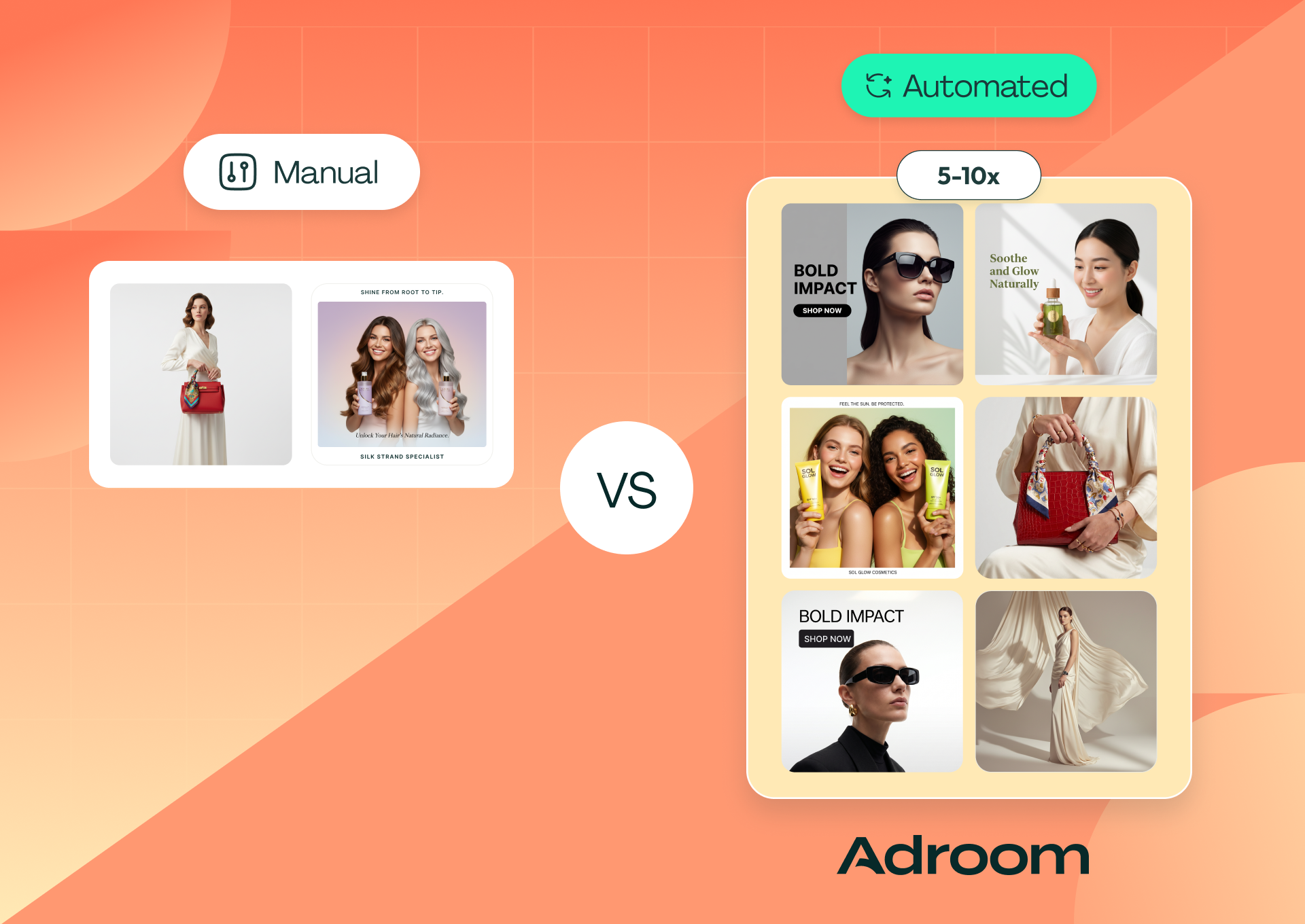
41% of marketers still take three to four weeks to get a single campaign from finished asset to live launch. Only 3.6% can do it in under a week. Those numbers, from Smartly’s 2026 Digital Advertising Trends Report, describe the real bottleneck in performance marketing right now, and it is not targeting or bidding. Those moved into the algorithm and got fast. It is a creative production, which stayed manual while everything around it accelerated. The gap between how fast you can buy media and how slowly you can feed it is where performance leaks, and closing it is what creative automation is for.
Here is why that gap matters more than it used to. A real cross-platform campaign spans a square for feed, a vertical for Stories and Reels, more ratios for other placements, and all of that multiplied by every variant, every language, and every other channel you run. One approved concept turns into a long production list, and not one item on it is design work. It is the same idea, reformatted until it fits everywhere it needs to go. Meta alone serves ads across a whole family of placements spanning Facebook, Instagram, Messenger, Threads, and the Audience Network, and the exact list keeps shifting.
That reformatting work is invisible until you add it up, and then it turns out to be most of the time your team spends. This is my case for automating it: what creative automation actually does, why manual production became the thing holding performance back, and where it fits alongside the personalization you are probably already running.
What I mean by creative automation
When I say creative automation, I mean software that automates the production, variation, and distribution of ad creative at scale. It is not the marketing automation you use for email, CRM, and journeys. This is upstream of all that. It is the part that turns one approved concept into the volume and variety that platforms require, without a person exporting each version by hand.
It is also not the same as dynamic creative optimization, and I want to be precise because the two are often blurred. Automation builds the supply of assets. DCO manages the demand, personalizing what gets served in real time. You need both, and they are genuinely different jobs. I wrote a whole piece on how DCO should work if you want the downstream half of the story. This one is about the supply.
In practice, it looks like this. Your designers build master templates with flexible zones for imagery, copy, and CTAs. The system generates variations of those templates, and a human still reviews for accuracy, compliance, and brand fit before anything goes live. That last part is not a footnote. Automation earns you volume; it does not excuse you from judgment.
Why production became the bottleneck
Here is the shift that changed everything. When the platforms took over targeting and bidding, they did not just automate some busywork. They moved the whole competitive frontier. If everyone runs on the same targeting infrastructure, the thing that separates you is what you feed it, and most teams are feeding it slowly.
There is research that puts an uncomfortable number on this. EMARKETER surveyed 111 US marketing and agency professionals in February 2026, each managing more than $5 million in annual media spend, and published the findings that April. 89.2% said creative is important for optimizing performance. Only 3.6% said creative performance is well understood and actively optimized today. That gap, between what we all know matters and what we actually operationalize, is the whole problem in one statistic.
The volume math explains why the gap is hard to close. A smart set of two to three ratios covers most delivery, but a real cross-platform campaign still spans placements, languages, and audience segments, quickly multiplying the asset count. If you want the fuller picture of where platform automation is heading, my colleague’s guide to Meta’s fully automated ads is worth reading alongside this.
And the creative you make does not last as long as it used to. Motion’s 2026 Creative Benchmarks, built from 578,750 creatives across 6,015 advertiser accounts and roughly $1.3 billion in spend, found that about half of creatives are turned off before they reach 28 days, only around 5% become genuine winners, and roughly 6% of ads drive the majority of spend in a given account. Sit with that for a second. You produce constantly, most of it is retired inside a month, and a small fraction has to carry the account. As a working cadence, many practitioners refresh every 7 to 14 days, though that is a rule of thumb rather than a fixed law. Either way, you cannot win that game by hand.
So what do teams do instead? They wait. In that same EMARKETER research, more than half of marketers said creative insights reach them slower than media signals do, and 41.4% do not get creative feedback until two to four weeks after launch. That is not a discipline problem. It is a tooling problem. When your workflow cannot move faster, reacting late is the only option left.
What you actually get back
The first thing you get is your team’s time. When variations are generated from templates instead of being done by hand, your designers stop reformatting and go back to designing. You stop being the bottleneck in your own campaigns, and you start feeding the platforms the volume they need to learn.
The second thing is speed to market. When 41% of teams still need three to four weeks to launch, shaving that to days is a real competitive edge. You can move on a trend or a season before your competitors have finished briefing theirs, and the earlier your creative is live, the more the algorithm learns from it.
The third thing, and the one I care most about, is personalization that does not cost you a rebuild every time. Locked brand elements hold the template together while messaging, imagery, and offers flex by segment. I saw the ceiling that was removed when we worked with Swiggy. In six weeks, our technology identified more than 100,000 distinct personas and automated the production of 60,000 custom creatives to match them, and installs rose 270% while cost per install and cost per first transaction both fell 41%. That creative engine is the direct ancestor of AdRoom. And this is the part I want to land: no team produces 60,000 relevant creatives by hand. That number is only reachable when production is automated.
And then there is what you learn. When 53.2% of marketers say creative insights lag their media signals, the fix is not more dashboards. It is production-wired directly to feedback, so you can see which hook, format, or angle actually moved and make the next batch smarter. That is the loop manual work keeps breaking.
How the workflow actually runs
Templating is the foundation. Your designers define the locked zones that protect the brand and the open zones that vary. Everything downstream depends on getting that structure right, because it's what lets you scale without losing yourself.
Feeds bring in the live data. Product catalogs, pricing, and inventory: when they are connected and healthy, your creative reflects what is true right now rather than what was true when someone last exported an asset. The health of those feeds is on you to monitor, so build that check into your cadence.
Variation generation is where discipline matters most. It is tempting to read all of this as permission to flood the platforms with variants, and I would push back on that hard. The goal is not volume for its own sake. It is a deliberate spread: different hooks, value propositions, visual treatments, and messaging for different audiences, so the algorithm has something meaningful to compare. Then you read the signals and let them tell you which dimension is carrying the performance. When only about 5% of variants win, aimless volume just buries your winners in noise.
Generative AI is what makes this reachable without tripling your headcount. It produces on-brand starting points and variations on demand, and, again, a human reviews before launch. I am not interested in replacing creative judgment. I am interested in giving it more surface area to work on.
Multi-channel resizing handles the reformatting. One concept resizes across feed, Stories, Reels, short-form video, and display, and the repetitive part mostly disappears. One thing I want to keep clean here: this is the creation-and-resizing stage. Serving and distribution are separate steps. Automating how assets are made is not the same as automating how they are delivered, and conflating the two is how teams end up disappointed by tools that only ever promised one half.
If you are going to start
Do not boil the ocean. Pick one high-volume campaign, the one where your team is most obviously drowning, and automate that. Measure three things: how much more you produced, how much faster you produced it, and what it did to performance. Then scale from evidence, not from enthusiasm.
A few things are worth getting right early. Build your templates with real guardrails, locked brand zones, and open content zones, so governance is structural rather than a review bottleneck. Wire in your product and performance data so variations are driven by signal, not by guessing. Put your creative and media teams on the same platform, because the feedback loop dies the moment it has to cross a silo. And check that whatever you adopt handles localization without forcing a rebuild for every market, so one asset family can travel.
Where I think this goes next
Generative AI is starting to move from producing variations of a template to producing original concepts. That changes what a designer is for. Less execution, more direction and curation. I think that is a good trade, and I think the people who see it that way will do better than the people who feel threatened by it.
The bigger shift is convergence. Creative generation and campaign optimization are drifting toward one workflow instead of two stacks, and cross-channel learning means a winning angle on one surface will inform the next. The direction of travel is clear enough that I am comfortable saying it plainly: as the platforms keep asking for more volume and variety, teams still producing manually will fall behind on refresh speed, on how much they can test, and on how fast they learn. Not because their people are worse. Because their pipeline is slower.