
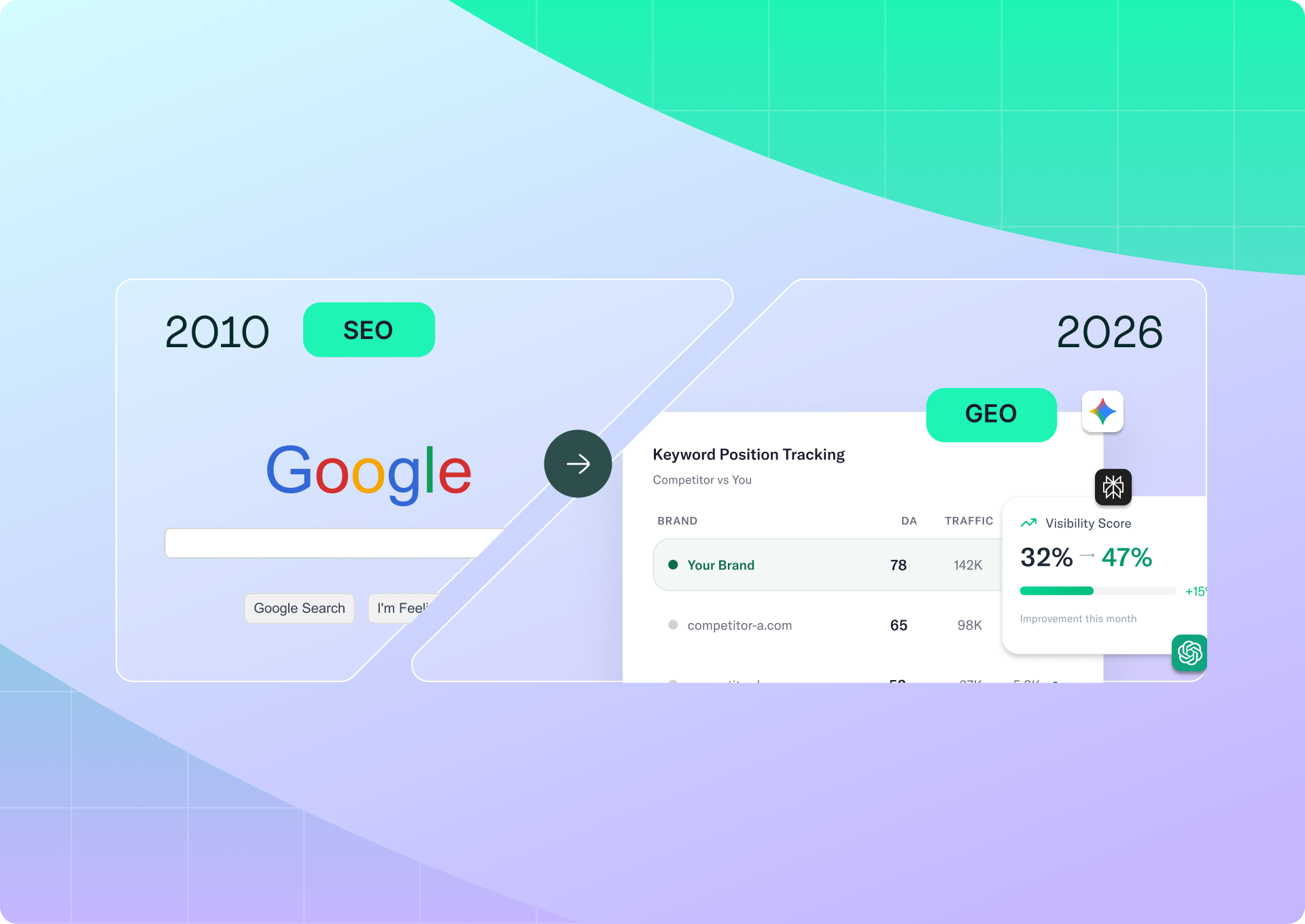
I did not live through the 2010 SEO scramble. I came into this work after it, when the playbook it produced was already the gospel everyone handed me on day one. Keyword density. Exact-match anchors. Build the backlinks. Most of my early career was spent learning those rules, applying them, and then slowly watching the ground move under them as Google changed what it rewarded. That experience, learning a discipline at the exact moment it stopped being stable, is the reason GEO in 2026 feels so familiar to me.
The parallel I want to draw is not that the tactics rhyme. They do not. Keywords and backlinks are not the same as canonical prompts and citations. The parallel is in the timing. A new layer of discovery is forming, the rules governing it are not settled, and the people paying attention now are taking positions that get harder to claim later. If you have ever inherited a mature playbook and wished you had been in the room when it was still being figured out, GEO is your second chance at that room.
I will be honest about what I am sure of and what I am not. The behavioral shift is measurable: roughly 60% of Google searches now end without a click, and Semrush's 2026 AI search data shows visitors from AI answers converting at 4.4x the rate of traditional organic visitors. That conversion figure almost certainly reflects an early-adopter effect that will compress as AI search becomes normal, so I would not build a forecast on it. What I would build on is the pattern underneath it, which I recognise from having learned the last version of this story slightly too late to shape it.
Key Takeaways
- The useful parallel between GEO in 2026 and SEO in 2010 is timing, not tactics. Both are real disciplines whose best practices are still forming, which is what creates the window.
- If you learned SEO as a settled playbook, GEO is the chance to work a discipline while its rules are still soft enough to influence.
- The job moved one layer up: from optimising for a ranking algorithm to optimising for a retrieval-and-synthesis model. The instinct transfers; the unit of work changes.
- GEO does not replace your SEO. AI engines pull from the web's existing index, so your crawlability and content quality are still the floor everything else stands on.
- You measure it differently. Citation rate, share of voice in AI answers, and answer inclusion are your new signals, not rankings and raw clicks.
- Pixis Visibility tracks citation performance across ChatGPT, Perplexity, Gemini, and Claude with 12 sessions per prompt, then feeds that into brief generation, so the analysis and the content that acts on it live in one place.
What I Learned About SEO, and When
The version of SEO I was taught was already a generation removed from its wild early days. By the time it reached me it had hardened into rules: target the exact phrase, structure the page around it, earn enough links and you would rank. I learned those rules well because I had to. They were how the work got done and how performance got judged.
What no one quite prepared me for was how unstable that ground actually was. I would apply a tactic that worked, and a few months later an algorithm update would quietly retire it. The lesson I took from that period was not any specific technique. It was a meta-lesson: a playbook is a snapshot of what an algorithm rewarded at one moment, and the moment passes. The people who had done best, I noticed, were not the ones who memorised the playbook hardest. They were the ones who had been working the discipline while it was still forming, who understood the why underneath the rules and could adapt when the rules shifted.
I missed that window for SEO by a few years. I am not going to miss it for GEO.
What Actually Changed by 2026
Here is the shift in plain terms. When you optimised for traditional search, you were writing for a ranking algorithm that decided which page deserved the click. When you optimise for GEO, you are writing for a retrieval model that decides which content to extract, trust, and cite inside an answer the user reads instead of clicking through.
The practical consequence is unforgiving. If an engine cannot pull a clean answer from your page, it pulls from whoever made the answer easier to find. Research analysing 3 million ChatGPT responses found that 44.2% of all citations come from the first 30% of a page, the pattern researchers call the "ski ramp." Everything I learned about burying the lede and building toward a satisfying conclusion works against you here. The model is not reading for payoff. It is reading for the answer, and it is reading the top of the page first.
The Old Playbook, One Layer Up
The clearest way I can show you the parallel is to take the moves I was trained on and tell you what each one became. The job did not disappear. It moved up a level.
I was taught to research keywords, the exact phrases buyers typed. The 2026 equivalent is the canonical prompt, the actual question someone asks an AI system. A keyword is "marketing attribution software." A canonical prompt is "how do I prove my paid media is actually driving revenue." One is a search term, the other a conversation, and the research shifts from phrases to questions. The instinct, finding out what people actually ask, is exactly the one I learned. The form of the answer is what changed.
I was taught that backlinks were authority. You earned standing through the volume and quality of links pointing at your page. The 2026 equivalent is the mention graph, the web of references to your brand, much of it unlinked. Being named consistently alongside the topics you want to own is what teaches a model to trust you. Roughly 82% of links cited by AI come from earned media, which means the external-corroboration instinct behind link building survived. It just stopped requiring a hyperlink.
I learnt on-page optimisation: title tags, headers, keyword placement, structuring a page so a crawler could read it. The 2026 version is structuring a page so a model can lift a clean answer out of it. Pages with H2 headings phrased as questions are cited 38% more often than unstructured prose, and answer capsules near the top yield a 40% higher citation rate, per Semrush's 2025 State of AI Search data. The header-hierarchy obsession I inherited turns out to have been good training for this. Same instinct, different reader.
And the prize moved. I was taught to chase position one, because position one captured the click. Now the prize is inclusion in the answer itself, because the click increasingly never happens. The brand cited inside the response wins the moment the top blue link used to win.
If you came up the way I did, none of this should feel alien. You already have the instincts. You are just pointing them at a model instead of an algorithm. For a fuller map of how the disciplines divide today, our piece on how SEO, GEO, and AEO each target a different layer of the same problem lays it out.
Where Authority Comes From Now
The biggest mental adjustment for me was where authority lives. In the SEO I learned, authority attached to a page and the links pointing at it. In 2026 it attaches to a recognised entity, the clearly named brand or product a model can identify and verify across the web.
That makes a boring task suddenly important: describing yourself the same way everywhere. Your brand on your site, your LinkedIn, your Crunchbase, your Wikidata entry, your directory listings. Inconsistency across those creates friction that lowers a model's confidence in citing you. The 2010 chore of cleaning up broken backlinks has a 2026 equivalent, and it is making sure a machine that checks five sources about you gets the same answer five times.
The older trust signals have not vanished, but they are now read through machine readability. If a model cannot verify your claim against another source, your domain authority will not save the page. The content that gets reused is the concrete kind: clear definitions, structured sections, claims with verifiable support, placed where a model looks first. For the deeper version of how engines decide who to trust, our breakdown of the AI trust ecosystem and what earns a citation goes further than I can here.
What I Would Do If I Were You
If you are sitting where I was, holding an SEO playbook and watching GEO form, here is where I would put my attention. Not a comprehensive program, just the moves I think compound.
Start by rebuilding your most important pages around clear entities and direct answers, so a model can quote you without working for it. Write the answer first, then the context. It will feel wrong if you were trained to build toward a conclusion. Do it anyway.
Audit how consistently you describe yourself across the web and fix the contradictions before you do anything fancier. This is unglamorous and it is the highest-leverage thing on the list.
Favour concrete over persuasive. Specific data points and verifiable claims get extracted; marketing language gets skipped. Every place you can replace an adjective with a number, do it.
Learn the actual questions your buyers ask AI tools, in their words, and build to those rather than to keyword stems. If you want the step-by-step version of this, our GEO execution guide that runs from canonical prompts to published, tracked content is the workflow I would point you to.
How to Measure Whether It Is Working
The metrics I was raised on, rankings and clicks, do not tell you whether you are showing up inside an answer. So you need a different dashboard. The signals worth tracking are how often you are cited in AI answers, your share of voice against competitors on the prompts that matter, whether your specific content blocks get selected, how consistently a model recognises you as a distinct entity, the sentiment of how you are described, and the range of prompts where you appear at all.
One thing that took me a while to internalise: AI responses are non-deterministic. Ask the same prompt twice, from two locations, on two days, and you can get two different answers. That means a single check tells you almost nothing. You need repeated sampling to get a stable read, which is exactly why single-query spot checks mislead people. This is the part I would not try to do by hand.
Why This Does Not Mean Abandoning SEO
I want to be careful here, because I have watched people make the opposite mistake. Every time search changes, someone declares SEO dead and abandons the fundamentals to chase the new thing. They tend to regret it.
GEO does not replace your SEO. It raises the bar on it. AI engines retrieve from the same web index your SEO work organises. A page a crawler cannot reach is a page a model cannot cite. The clearest proof that these are one system, not two, is the humble FAQ page: genuine question-and-answer content with proper schema, on a technically sound domain, can rank in traditional search, appear in AI Overviews, and get cited in Perplexity and ChatGPT, all from one well-built asset. Treat SEO as the floor and GEO as the layer you build on it, and you do not have to choose.
What I Am Watching Next
I will not pretend to know how this settles. AI search will get more personalised and more answer-driven, and the brands investing in structured, entity-clear content now will be better positioned as the interfaces mature. The risk I am watching is over-dependence on any single engine, because they cite using different logic and that logic keeps diverging. The defensible move is authority that holds up no matter which interface gains share, which means I am less interested in gaming one platform than in being legible to all of them.
What I keep coming back to is the thing my SEO education taught me almost too late. The advantage does not go to whoever memorises the current rules hardest. It goes to whoever works the discipline while the rules are still soft. That was true in 2010 and I missed it. It is true for GEO right now and I am not planning to miss it twice.
FAQ
Is GEO replacing SEO in 2026?
No, and I would be wary of anyone who tells you it is. GEO is a layer that sits on top of SEO, not a substitute for it. AI engines retrieve from the web's existing index, so crawlability, indexability, and content quality stay prerequisites for getting cited. The strongest position is treating them as one connected system.
What is the biggest difference between SEO and GEO?
The output. SEO earns you a click from an organic listing. GEO earns you a citation inside an AI answer. That one shift changes how you structure content, with the answer first instead of last, what signals matter most, entity clarity and factual density over keyword density, and how you measure success.
I only know traditional SEO. How hard is the transition?
Easier than it looks, in my experience. The instincts transfer almost directly: keyword research becomes prompt research, link building becomes mention building, on-page structure becomes extraction structure. What you are really learning is a new reader, a model instead of an algorithm, and a habit of writing the answer up front.
How do I know if my brand is even visible in AI search?
Track whether you show up in AI answers, how often you are cited, and whether the information stays accurate across platforms. If you are consistently missing on your core topics, the usual culprits are unclear structure, weak authority signals, or inconsistent entity information across the web.
What should I track for GEO instead of rankings?
Citation frequency, share of voice in AI answers, answer inclusion rate, entity recognition consistency, response sentiment, and prompt coverage. These tell you whether you are surfacing in answers, which is the thing traditional analytics simply cannot see.
Closing
The honest version of my own story is that I learned SEO as a finished product and only later understood it had been a moving target the whole time. That is why GEO reads to me less like a threat and more like a familiar shape arriving early. The mechanics are new. The situation is one I recognise: a discipline forming faster than the consensus around it, rewarding the people who engage before the rules harden.
If you work in this with me, that is the invitation I would extend. Treat GEO as the room you get to be in this time. I am building toward that with Pixis Visibility, which tracks citation performance across ChatGPT, Perplexity, Gemini, and Claude and connects it to the content that acts on it, so the analysis and the execution are not two separate jobs.