
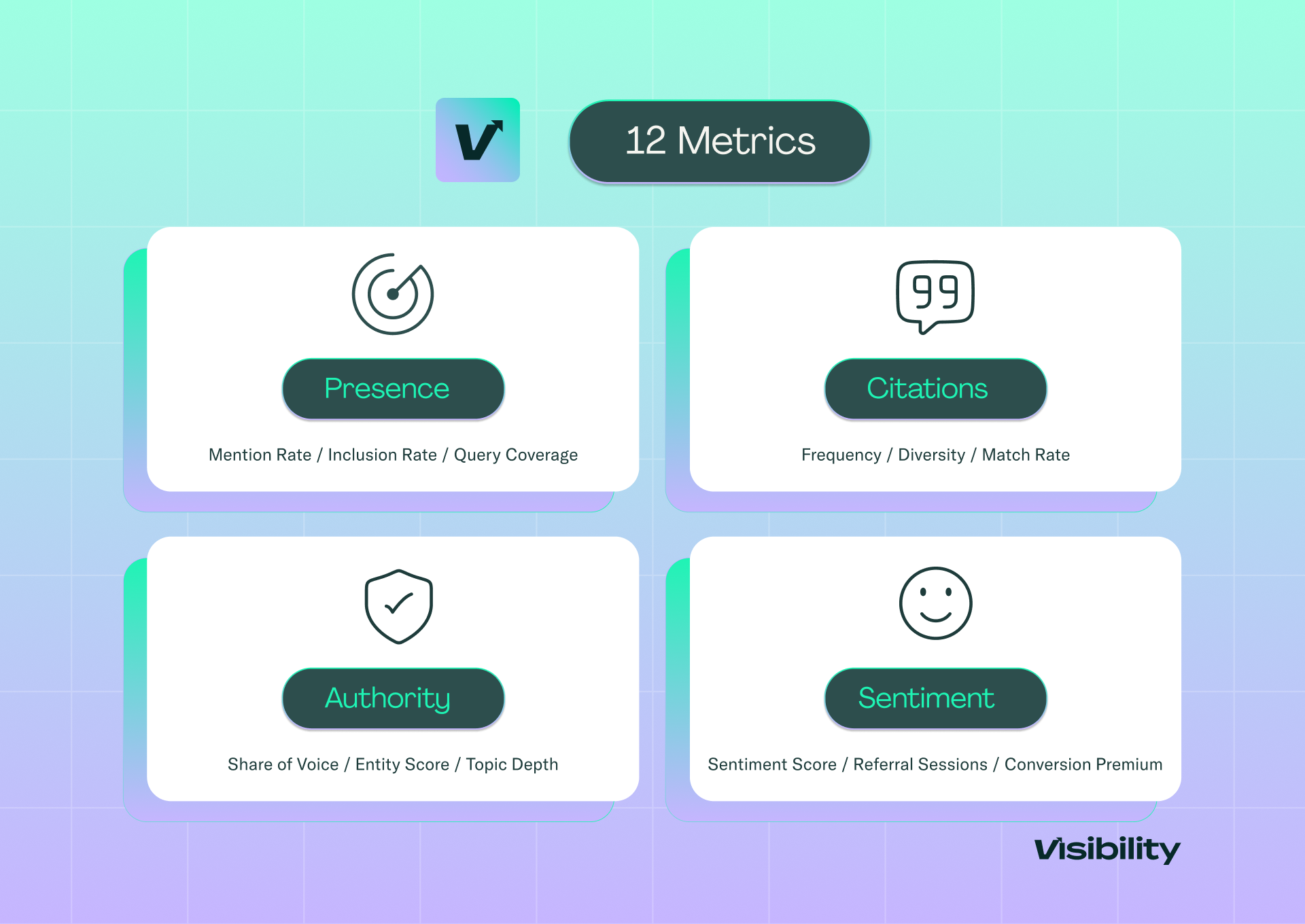
Organic traffic and keyword rankings describe a version of search that is shrinking. As buyers get their answers inside AI-generated responses rather than from a list of links, the question that matters shifts from "where do we rank" to "does the model mention us, cite us, and describe us accurately." A brand can hold steady traffic numbers and be entirely absent from the AI answers its highest-intent buyers now read first. Measuring that absence, and its opposite, requires a different set of metrics than traditional analytics provide. This guide covers the twelve worth tracking, organized into four pillars, with what each one tells you and how to read it.
Two-line summary: AI visibility measures how often and how prominently a brand appears inside generated answers, which traditional traffic metrics cannot see. This covers twelve metrics across presence, citations, authority, and sentiment, plus how to measure and report them.
Key Takeaways
- AI visibility tracks how often and how prominently your brand appears inside generated answers, a different thing from ranking on a results page.
- The twelve metrics fall into four pillars, presence, citations, authority, and sentiment, and no single metric describes performance on its own.
- A casual mention and a formal citation are not the same signal, and separating them matters for understanding whether a model treats you as a source or just a name.
- Measurement rests on a fixed, repeatable prompt set tested across engines on a regular cadence, since the answers change with the prompt and over time.
- AI-referred traffic tends to convert well above organic, but the size of that advantage varies widely by category, so treat it as a range rather than a fixed multiple.
Why Traditional Metrics Fall Short
AI visibility measures how often your brand appears, gets cited, or is recommended inside generated answers across engines like Google AI Overviews, ChatGPT, Gemini, and Perplexity. Traditional SEO metrics count clicks and impressions, which tell you how many people saw a link. They cannot tell you whether the model chose your brand as the answer, and in a zero-click environment, being the answer is worth more than being a link the user never reaches.
The reason this matters structurally is that AI tools summarize rather than list. If your brand is absent from the training data and the real-time retrieval context, it does not appear in the synthesized answer at all, and no amount of historical traffic changes that. The scale of the shift is well documented: by early 2026, roughly 68% of US Google searches ended without a click, and Pew Research's behavioral study of nearly 69,000 real queries found that when an AI Overview appears, users click a cited source inside it only about 1% of the time. Being named in the answer, not linked beneath it, is what carries influence now. This produces a specific and easy-to-miss failure mode: strong legacy traffic alongside near-zero presence in the answers your highest-intent buyers now see. You cannot improve a channel you are not measuring, so the first step is simply seeing where you appear and where you have disappeared.
The pillars below organize the work. Presence asks whether the model knows you exist. Citations ask whether it relies on you as a source. Authority asks whether it treats you as an expert in your category. Sentiment asks how it describes you. Together they replace impression counts with answer-level influence, and each pillar catches something the others miss.
The 12 Metrics, by Pillar
Presence: does the model surface you at all
- Brand mention rate tracks how often your brand name appears in AI answers, with or without a link. It is the baseline read on whether the model recognizes you as a relevant player in your category.
- Generative search inclusion rate is the percentage of relevant industry prompts where your brand makes it into the final answer. Tested against a fixed set of high-priority buyer questions, it shows whether your efforts are reaching the topics that drive revenue.
- Conversational query coverage measures the breadth of question types and follow-up threads where your brand provides the answer. Wide coverage signals the model trusts your content across use cases, from educational queries to specific technical ones.
Citations: does the model rely on you as a source
- Citation frequency reveals how often engines link back to your specific pages inside their responses. High frequency indicates the model draws on your data or product information for factual grounding, which is a stronger signal than a passing mention.
- Citation diversity evaluates the range of domains and content types supporting your mentions. When the model pulls from your blogs, case studies, and product pages rather than one source, your footprint is more resilient to any single page losing favor.
- Source-to-answer match rate measures whether the information the model attributes to you matches what your page actually says. Tracking it catches misrepresentation, where a model states your pricing or features incorrectly, which is a distinct and urgent problem from simply not being cited.
Authority: does the model treat you as an expert
- AI share of voice compares your mention volume against competitors for a controlled set of prompts, giving a competitive benchmark for who is dominating the answer in your category and who is losing ground.
- Entity authority score reflects how strongly the model associates your brand with core category topics. A strong association makes you likelier to be the default recommendation rather than one option among several.
- Topic authority depth tracks the range of sub-topics where the model recognizes your expertise. Expanding it requires detailed, accurate content that demonstrates depth beyond surface-level marketing claims.
Sentiment: how the model describes you
- Sentiment score evaluates the tone, positive, neutral, or negative, the model uses when describing your brand, products, or leadership. Since models synthesize opinion from across the web, tracking sentiment catches a negative narrative before it hardens into how the model routinely characterizes you.
Business impact: does any of it convert
- AI referral sessions track traffic and engagement from users who reach your site after an AI interaction, connecting algorithmic mentions to actual visits.
- AI conversion premium measures the gap between how AI-referred traffic converts versus traditional organic. This is where the visibility work has to reconcile against revenue, and the gap is usually meaningful, though its size varies widely, which the next section covers honestly.
Measuring It Without Fooling Yourself
The attribution challenge here is real: the most important AI interaction often happens before any click, so last-click reporting misses most of the story. A workable measurement stack combines general analytics with purpose-built tracking, because neither covers the ground alone.
GA4 can identify sessions originating from AI tools when the referral data is available, though the default attribution is imperfect and often files AI-influenced visits under direct or organic. Pairing it with Google Search Console shows your impression share for queries where AI Overviews appear. But analytics alone cannot read the text of a generated answer, which is where a dedicated AI visibility platform, one that runs prompts across engines and logs how your brand appears, becomes necessary rather than optional.
The core discipline is a fixed prompt set. Build a library of 10 to 30 high-value buyer questions, run them across the major engines on a regular cadence, and log for each whether your brand appears, how it is described, and whether that description is accurate. That consistency is what lets you separate a real trend from the run-to-run variance these systems produce, and it establishes the baseline every other metric is measured against. Report the results to stakeholders as trends over time rather than raw data dumps, focusing on the business-impact metrics leadership actually acts on. Our walkthrough on auditing your AI search visibility in fifteen minutes covers a lightweight version of this loop you can run without a paid tool.
Track Each Engine Separately
The engines are not interchangeable, and a single blended visibility score hides the gaps that matter. Each one surfaces answers differently, weights sources differently, and cites at different rates, so strong visibility on one does not imply presence on another. Google AI Overviews, Gemini, ChatGPT, Perplexity, Claude, and Copilot each warrant separate tracking, because a tool your buyers use heavily could be one where you are nearly absent.
The practical consequence is that your prompt library should run against every engine your audience actually uses, and the results should be read per engine. This is why testing across engines rather than one is the only reliable read, since cross-platform citation overlap is low and a brand visible in one can be missing from another for the identical question. Where your buyers concentrate determines where the visibility work is worth the budget, and that allocation decision depends on per-engine data you cannot get from an average.
Turning Metrics Into Action
The metrics only earn their place if they change what you publish. The levers that move AI visibility follow from the pillars: improving entity clarity so the model resolves who you are, expanding topical depth so it recognizes your expertise across sub-topics, strengthening internal linking so it can traverse your content, and increasing evidence density, sourced facts, statistics, expert input, so it has reason to cite you. These are E-E-A-T-oriented moves in practice: clear human authorship, sourced claims, and tight topic clusters signal reliability to the systems deciding what to surface.
Formatting matters as much as substance here, because a model has to be able to extract you cleanly. Clear heading structures, accurate structured data, and direct answers to common questions placed high on the page make citation easier. The work is largely about making it as simple as possible for an engine to pick you as the source and quote you correctly.
There is a genuine payoff to reaching this traffic, and it is worth stating accurately rather than inflating. AI-referred visitors tend to convert well above traditional organic, because they arrive further along the buying journey, pre-qualified by the recommendation that sent them. Across multiple independent studies, that advantage averages roughly four to five times the organic conversion rate, but that is a cross-industry average with a wide range beneath it, from modest single-digit percentage gains in low-consideration ecommerce to far larger multiples in B2B software. Our analysis of what the AI conversion data actually shows breaks down where in that range different categories fall, which matters before you build a forecast on a single number.