

A brand that ranks well in ChatGPT can be effectively absent from Perplexity for the same query, and nothing in a single-engine report would reveal it. When Profound analyzed 100,000 prompts across both models, only about 11% of cited domains overlapped, meaning that close to 9 in 10 citations came from entirely different sources, depending on which model the user happened to open. That is not noise around a shared answer. It is two different answer sets built from two different corners of the web. Optimizing for one of them and reporting it as your AI visibility describes only a fraction of the picture, and usually not the one your buyers are looking at.
Key Takeaways
- AI engines cite largely different sources for identical queries. Cross-platform overlap sits near 11%, so single-engine data misses most of the citation landscape.
- The divergence is structural, not random: engines run different indexes, rewrite prompts differently before retrieval, and weigh authority and recency on their own terms.
- Engines are also inconsistent with themselves. Repeat the same prompt and the sources shift, which is why a single run per engine is not a measurement.
- Aggregate visibility scores hide engine-specific gaps. Per-engine reporting is what surfaces where you are actually missing.
- Pixis Visibility runs each prompt 12 times across ChatGPT, Perplexity, Claude, and Gemini, three runs per engine, to average out that variance and produce a stable read.
What Generative Engine Optimization Is Optimizing For
Generative Engine Optimization targets citations within an AI-generated answer rather than a position on a list of links. The distinction is practical: if a model does not cite you, you are absent from the generative layer of search regardless of where you rank in traditional results. Those changes that signal matter. The KDD 2024 study, which named the discipline, tested nine content interventions across 10,000 queries and found that adding citations, quotations, and statistics increased visibility substantially, while keyword stuffing performed worse than the unmodified baseline. Trustworthiness, recency, and consistent entity definition do the work that keyword density and link volume used to.
Pixis has covered the broader shift in why GEO in 2026 is what SEO was in 2010, and the structural differences between the two disciplines in what's actually different between GEO and SEO. This piece takes the next question: once you accept that citation is the target, which engine are you measuring against, and what happens when they disagree?
Why Single-Engine Optimization Leaves You Exposed
Optimizing for a single engine produces a visibility picture that is both incomplete and fragile. Incomplete because the citation pools barely intersect: alongside Profound's 11% figure, an analysis of 118,000 AI-generated answers across ChatGPT, Perplexity, Google AI Mode, and Claude found only 11% of cited domains appearing on more than one platform, and separate work has put the share of sources appearing on a single platform only at around 71%. Fragile because a position built on one engine's retrieval logic has no cushion when that engine adjusts its index or reweights its sources.
The variance also runs wider than any single pair suggests. Profound's broader analysis found cross-platform overlap ranging from roughly 6% between Google AI Overviews and Copilot to about 16.4% between Perplexity and AI Overviews. A brand reading a strong ChatGPT report is not looking at a slightly incomplete version of its AI presence. It is looking at one of several largely separate ecosystems, with no visibility into the others.
Why the Engines Disagree
The divergence is a product of how these systems are built, which means it is stable enough to plan around rather than something that will converge on its own.
Different indexes. Engines draw on different underlying corpora: some lean on a live crawl, others on cached or licensed data, so the raw material behind each answer differs before any ranking occurs.
Different retrieval behavior. The engines do not even search for the same thing. Analysis of retrieval patterns found ChatGPT expands a single prompt into a fan of largely new queries, while Perplexity stays close to the literal wording of the prompt it was given. A page that answers the expanded version of a question surfaces in one; a page matching the literal phrasing surfaces in the other.
Different source preferences. Each engine has pronounced habits in what it treats as authoritative, with documented skews toward encyclopedic references, community discussion, video, or independent blogs, depending on the platform. Those preferences shape which of your assets can be cited at all.
Different citation density. Some engines cite a short, high-authority shortlist; others cite widely across many sources per answer. The same brand presence yields a different share of voice depending on which convention applies.
Engines Are Inconsistent With Themselves
The more consequential finding for anyone building a measurement process is that variance exists within a single engine, not just between them. Controlled testing found that ChatGPT returned the same sources only about 62% of the time when asked an identical query repeatedly, whereas Perplexity was somewhat more self-consistent at roughly 65%. Ask once, and you have captured one sample of a distribution, not the engine's answer.
This is the practical case for repeated sampling. A single query against a single engine can mislead in two directions at once: it may show a citation you do not reliably earn, or miss one you usually do. Any measurement claiming to describe your AI visibility must average across multiple runs per engine; otherwise, it is reporting noise with a decimal point attached.
How Pixis Visibility Measures Across Four Engines
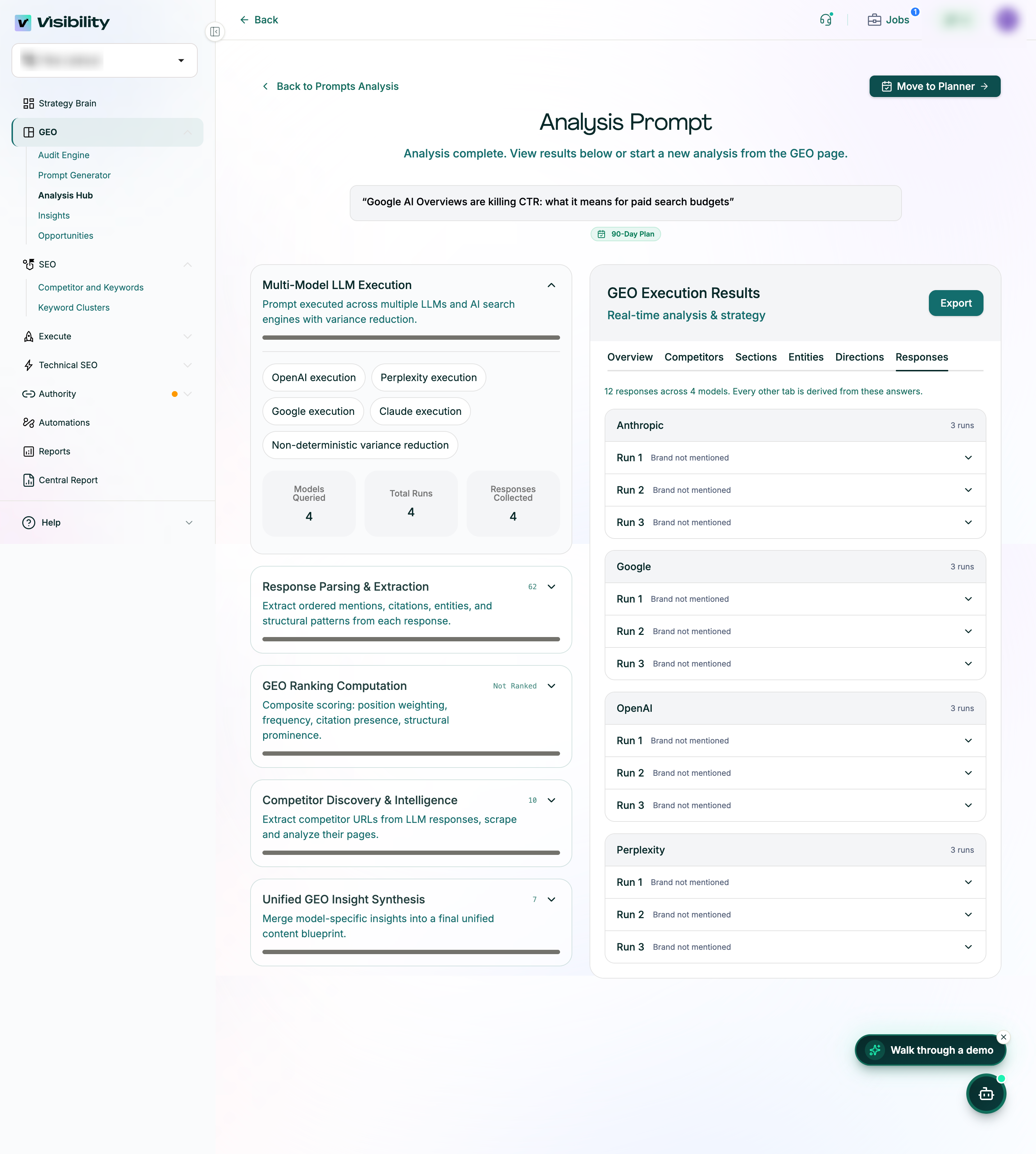
Pixis Visibility addresses both variances with the same mechanism. Each prompt runs 12 times, evenly distributed across ChatGPT, Perplexity, Claude, and Gemini, for a total of 3 runs per engine. The cross-engine spread addresses the 11% overlap problem, and the repeated runs within each engine address the self-inconsistency above, producing a stable average rather than a single draw.
- A prompt is entered once in the dashboard, and the platform handles execution across all four engines.
- Three runs per engine smooth out the run-to-run variance that makes single queries unreliable.
- Results aggregate into a Visibility Score, with per-engine details preserved beneath it.
That last point matters more than the headline number. An aggregate score is useful for tracking direction over time, but it can mask exactly the gaps this piece is about, since strong performance on two engines can carry a score while you are invisible on a third. The per-engine breakdown is where the actionable information lives.
What to Track, and Why Aggregates Hide Things
Per-engine reporting only helps if you are measuring the right things underneath it.
- Citation presence and density. How often you are cited, and how many sources the engine cites in total, which together give your real share of voice on that platform.
- Ordered mentions. Where your first mention falls, since earlier positions carry more weight with users.
- Sentiment. Whether a citation frames you favorably, neutrally, or otherwise.
- Response structure. How the engine organizes information in its answer, which tells you how to format content it can lift cleanly.
- Entity associations. Which topics and concepts does each engine connect to your brand, and where are those associations missing?
The academic work offers a useful anchor for what moves these numbers. The KDD study measured visibility with Position-Adjusted Word Count, which weights how much of your content appears in an answer and how prominently it is placed. Its top three interventions, adding citations, quotations, and statistics, each produced improvements in roughly the 30 to 40 percent range on that metric, and combining tactics beat any single one, with fluency optimization paired with statistics addition outperforming the best individual method by more than 5.5%. Notably, the study also found that the largest relative gains went to lower-ranked pages, with source citations lifting rank-five pages by over 115%, suggesting GEO gives challenger brands more room than traditional ranking does.
One caveat worth carrying: the paper's authors observed that effects measured on live engines were materially smaller than those in their controlled environment. Treat the percentages as directional evidence about which tactics work, not as forecasts of what you will see in production.
Building a Testing Protocol
A defensible protocol comes down to a few decisions made once and held consistently.
Start with a fixed prompt set covering your core topics, product categories, and the questions buyers actually ask, and keep the wording identical across engines. Comparison only means something when the input is controlled. Test all four major engines rather than the one your team uses personally, since audience usage rarely matches internal habits. Sample on a regular cadence, weekly for fast-moving categories, so you can separate a genuine shift from ordinary run-to-run variance. And record results automatically, because manual tracking across four engines and multiple runs introduces exactly the inconsistency the protocol exists to eliminate.
Turning Multi-Engine Data Into Strategy
The value of per-engine data is that it tells you what to do differently, not just where you stand.
Gaps become specific and addressable. Present in ChatGPT but absent in Perplexity points toward freshness and literal-phrasing alignment, given how differently the two retrieve. Weak in Claude points toward the depth of citation and structured argument. The fix follows from the engine's documented behavior rather than from a general instruction to make better content.
Sequencing becomes possible. Rather than optimizing everywhere at once, the data supports starting with the engine closest to the threshold, then extending to the others as authority accumulates. And a presence built across four engines is durable in a way a single-engine position is not, since no one index change can remove you from the answer entirely.
The domain guidance from the research is worth folding in here as well: statistics carry the most weight in technical, legal, and government-adjacent content, quotations in historical and cultural material, and a confident, evidence-backed register in argumentative content. Matching the tactic to the subject matter beats applying a single formula across an entire content library.