
The question isn't whether Ahrefs or Pixis Visibility is better. The question is which tool solves the problem you actually have: SEO research or AI search execution. Ahrefs combines large-scale SEO and AI-visibility research with AI-assisted content optimization. Pixis Visibility connects GEO analysis to a broader execution workflow spanning opportunity detection, briefs, drafts, review, publishing, and measurement. If you're researching Ahrefs alternatives or comparing Ahrefs competitors more broadly, this comparison breaks down what each platform actually does, where they differ, and which one fits your budget, workflow, and strategy, or whether you need both.
Executive Summary: Ahrefs vs. Pixis Visibility at a Glance
Ahrefs is a well-established SEO platform with a standalone AI Visibility Index product built on 470M+ search-backed prompts, plus limited AI prompt tracking bundled into its paid SEO plans. It provides broad intelligence, strong backlink data, and AI-assisted content optimization through AI Content Helper. Pixis Visibility is a dedicated GEO platform with 12-session prompt sampling across four AI engines, Strategy Brain, and an end-to-end content execution layer. The core distinction: Ahrefs combines research with content assistance inside its own editor, while Pixis Visibility connects that kind of analysis directly to a brief-to-published-page workflow.
A comprehensive comparison like this requires understanding the foundation of each platform. You must evaluate which layer of the marketing stack is missing from your current setup: is it the data, the content assistance, or a fully connected path from opportunity to published page? We outline the core strengths of Ahrefs and how they've evolved to include AI signals, then contrast that with our approach at Pixis Visibility, built from the ground up for Generative Engine Optimization.
Understanding Ahrefs: An Established SEO Platform with AI Visibility Tools
Ahrefs is a widely used SEO platform with one of the larger backlink indexes in the industry. Its core tools include Keywords Explorer, Site Audit, Rank Tracker, and Content Explorer, products that have defined SEO workflows for nearly a decade. Ahrefs' keyword gap analysis, part of Keywords Explorer, compares your site's keyword rankings against competitors to surface terms they rank for that you don't. The platform provides deep historical data and technical site auditing, and it's a common choice for SEO professionals working on link health and keyword rankings at scale.
To address AI search, Ahrefs offers two related but distinct products. A limited Custom Prompts allowance (5, 10, or 20 daily prompts depending on plan) is bundled free into paid Lite, Standard, and Advanced SEO subscriptions, letting you track specific buyer questions. Separately, the standalone AI Visibility Index draws on a large, continuously updated database of 470M+ search-backed prompts to show any brand's visibility across six platforms: Google AI Overviews, Google AI Mode, ChatGPT, Perplexity, Gemini, and Copilot. Ahrefs' broader Brand Radar API infrastructure also added Grok as a data source in April 2026 and Claude in July 2026, per Ahrefs' developer changelog, but neither currently appears in the public six-platform AI Visibility Index; Claude specifically remains available through Custom Prompts rather than the core index. This lets users track AI visibility metrics such as mentions, citations, estimated impressions, and AI Share of Voice.
Ahrefs has published large-scale analyses using Brand Radar data. In an updated analysis of 863K keyword SERPs and roughly 4 million AI Overview URLs, Ahrefs found that 37.9% of URLs cited in AI Overviews also appeared within the first 10 organic positions on the SERP for the same query. That's a partial overlap between traditional rankings and AI Overview citations, not proof that ranking causes citation, and it's worth noting that most cited URLs in that same analysis came from outside the first 10 blocks for the original query.
Ahrefs' backlink intelligence and keyword research are well-established strengths, built over roughly a decade of SEO tooling. Ahrefs frames AI as an extension of existing content visibility rather than a new marketing channel, which helps SEOs map AI signals onto familiar metrics. Beyond the AI Visibility Index itself, AI Content Helper adds genuine AI-assisted writing capability inside Ahrefs' own editor: rephrasing and expanding text, generating titles, and AI chat for feedback, alongside its optimization suggestions.
Understanding Pixis Visibility: A Dedicated GEO & AI Search Platform
Pixis Visibility is a platform purpose-built for Generative Engine Optimization rather than an AI layer added to an existing SEO suite. Its GEO methodology runs each prompt 12 times across four AI engines, ChatGPT, Perplexity, Gemini, and Claude, three runs per engine, to reduce variance; Google Search and AI Overview visibility are tracked separately, as part of the platform's SEO side, included on every plan. That SEO side includes its own keyword gap analysis, comparing your site's rankings against competitors to surface terms they rank for that you don't; see our guide to keyword gap analysis for how that process works and feeds into a content calendar. Running the same prompt multiple times reduces dependence on any single response and can provide a more stable directional picture than checking once, though model, geographic, and temporal variation still exist and aren't eliminated by repeated sampling. We monitor metrics including AI Share of Voice, Average Position, Top 3 Presence, Model Coverage, Citation Analysis, and Sentiment, plus section-level analysis of which parts of your content are reflected in, associated with, or relevant to a given cited AI response.
Our GEO Analysis Hub provides granular data that goes beyond simple mention counting, tracking entity and section-level analysis to help identify what a cited response appears to draw from in your content. This includes a GEO Opportunities framework that groups findings into distinct opportunity states, including untapped, losing, winning, and sentiment-risk categories, to help prioritize next steps. Strategy Brain personalizes recommendations using ICP, business model, sales motion, deal size, brand voice, priorities, and risk tolerance.
The execution layer is where we differ from a research-and-optimization tool like Ahrefs. We move from diagnosis to brief to draft to WordPress publishing with diff review and rollback, a closed-loop workflow designed to let teams publish content aimed at winning citations without switching systems partway through. Our managed Authority workflow identifies third-party sources appearing in relevant AI answers and supports off-site authority campaigns targeting those source categories; placement and any subsequent AI citation aren't guaranteed outcomes of the workflow, but it moves beyond monitoring into active outreach. Our pricing includes a free workspace entry point with 500 credits and no credit card required.
Core Philosophy: Research and Optimization vs. Connected GEO Execution
The fundamental shift in search is the move from optimizing for ranking on SERPs to optimizing for being recommended by AI engines. Ahrefs, rooted in SEO data infrastructure, extends into AI visibility through its AI Visibility Index. It supports AI-assisted writing through AI Content Helper, while its visibility tools provide response analysis, citation research, topic reporting, and cited-page data. What it doesn't publicly offer is the same integrated, closed-loop pipeline Pixis Visibility provides, opportunity detection flowing directly into a brief, a draft, review, and publishing, inside one connected system.
Pixis Visibility is built from the ground up for GEO, using prompt-level sampling, entity clarity, structural extractability, and off-site corroboration as core signals, mapped to actionable content briefs within that same connected workflow.
Feature Comparison: AI Visibility Metrics, Tracking & Engine Coverage
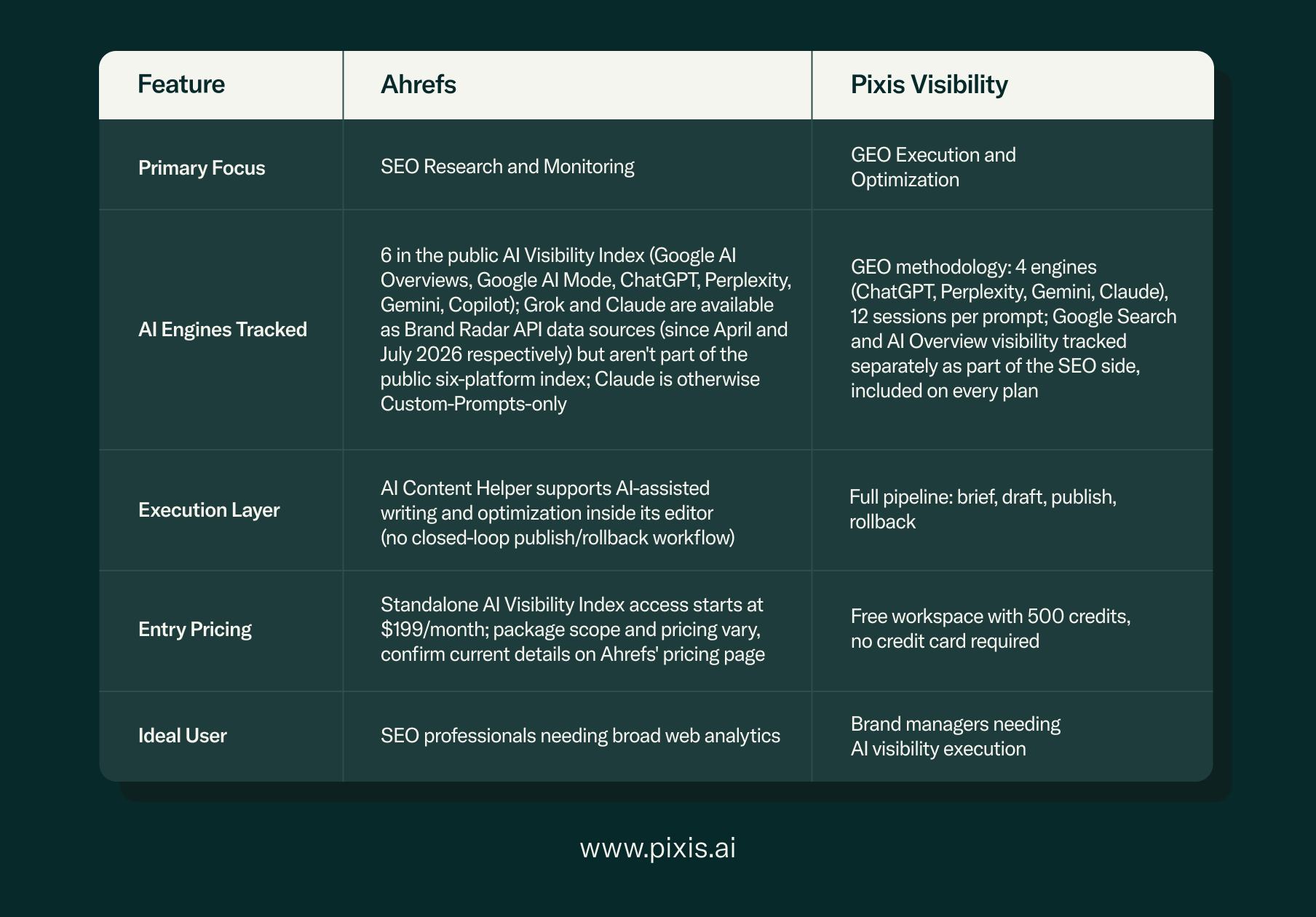
Ahrefs' public AI Visibility Index covers Google AI Overviews, Google AI Mode, ChatGPT, Perplexity, Gemini, and Copilot through its core search-backed dataset. Ahrefs' Brand Radar API also added Grok (April 2026) and Claude (July 2026) as data sources, though neither is part of the public six-platform index; Claude is otherwise available through custom prompts rather than that core dataset. This provides broad visibility across major consumer-facing AI, tracking mentions, citations, AI Share of Voice, and competitor AI benchmarking, with custom prompt tracking for businesses with unique keyword strategies.
Pixis Visibility's GEO methodology covers four engines, ChatGPT, Perplexity, Gemini, and Claude, running 12 sessions per prompt with variance reduction, which helps distinguish a recurring pattern from a one-off result; Google Search and AI Overview visibility are tracked separately, as part of the platform's SEO side. We also offer entity and section-level analysis to help identify what content is reflected in a cited response; Ahrefs' equivalent entity-level analysis isn't publicly documented in the same detail.
Granularity is another differentiator. Pixis offers Narrative Weakness tracking alongside exact AI response retention, so you can review whether the AI response reads as treating your content as a primary source or a supporting reference, an analysis we provide, not a claim about the model's internal reasoning. Ahrefs provides raw AI responses, mention and citation analysis, topic reporting, and cited-page data, including which pages were "found but not cited"; Pixis differentiates through its entity, section, and narrative-level analysis and how those specific findings feed directly into content execution.
Both platforms offer competitor AI visibility comparison; Pixis adds a Competitor Matrix with citation-level analysis, letting you see which competitor pages are consistently winning citations.
Feature Comparison: Actionability, Workflow & Content Execution
Ahrefs' AI Content Helper supports genuine AI-assisted writing: an "Ask AI" feature to rephrase, summarize, or expand selected text, AI-generated titles and descriptions, and an AI chat for brainstorming and feedback, alongside its topic-gap and optimization guidance. What it doesn't offer is the same integrated, closed-loop pipeline Pixis Visibility provides: GEO opportunity detection flowing directly into a brief, a draft, review, and WordPress publishing with rollback, all inside one connected workflow. Pixis Visibility offers 28 content formats, reusable templates, bulk generation, AI briefs, AI drafts, and a content calendar, so you can create a GEO opportunity, generate a brief, draft a page, and publish it to WordPress with diff review and rollback capabilities in one place.
Technical SEO remains a strength for Ahrefs via Site Audit. Pixis includes 8-module continuous monitoring, Internal Links, Sitemaps, Broken URLs, Images, Schema, Metadata, Site Vitals, and Robots.txt, rolled up into a single Technical Health score with a prioritized, running list of action items rather than a static audit snapshot. Recommendations go beyond flagging that a problem exists: for example, an unused-JavaScript finding names the specific script and page, estimates the kilobytes that aren't used on initial load, and suggests a fix (code-splitting, tree-shaking, or deferring the script), and a sitemap check can cross-reference Search Console impression data against what's actually declared in your sitemaps to surface pages search engines are already seeing that aren't listed. Site Vitals tracks Core Web Vitals-style metrics like Largest Contentful Paint at the page level. Reports can be exported, and analysis can be re-run on demand. We also offer an AI Assistant for querying your data and a central dashboard with GA4 and GSC integration for performance tracking.
On Authority: Ahrefs provides backlink intelligence for research, helping you find potential link-building targets. Pixis's managed Authority workflow identifies the third-party site behind an AI citation and supports off-site campaigns targeting that source, going beyond monitoring into active outreach, though placement and subsequent AI citation aren't guaranteed.
.Target Audience, Pricing & Total Cost of Ownership
Ahrefs' ideal users are SEO professionals, agencies, and teams needing broad web analytics, backlink intelligence, and keyword research at scale. If your team is focused on traditional link building and keyword research, Ahrefs fits that workflow well. Ahrefs offers a limited Starter plan at $29/month covering basic SEO tools; its full SEO plans begin with Lite at $129/month, scaling to Enterprise tiers.
Standalone AI Visibility Index access starts at $199/month; package scope and pricing vary, so confirm current details on Ahrefs' pricing page before quoting a specific figure.
Pixis Visibility's entry point includes a free workspace and 500 credits, no credit card required.
Teams running SEO research, AI visibility tracking, and content production as separate tools face more total cost and more workflow fragmentation than a consolidated setup, though the specific dollar difference depends on which tools and tiers are being compared. Pixis Visibility consolidates GEO analysis and content execution into one platform, moving teams from a detected citation gap to a brief, draft, review, and WordPress publication in a single operating flow.
Strengths and Weaknesses: A Balanced Assessment
- Ahrefs Strengths: Large, well-established backlink index, extensive keyword dataset, 470M+ search-backed AI prompt database, strong brand recognition, integrated Site Audit, genuine AI-assisted writing through AI Content Helper
- Ahrefs Weaknesses: Full AI Visibility Index access is sold separately, although paid SEO plans include limited custom-prompt tracking; no end-to-end GEO publishing and rollback pipeline; entity-level analysis isn't publicly documented in the same detail; no publicly documented Strategy Brain equivalent
- Pixis Visibility Strengths: Purpose-built for GEO with 12-session methodology, full content execution pipeline, Strategy Brain personalization, Authority workflow, free entry point
- Pixis Visibility Weaknesses: Smaller raw keyword and backlink dataset than Ahrefs, limited historical SEO data compared to Ahrefs' multi-year archives, newer platform with less brand recognition
We acknowledge vendor bias, as this comparison is authored by Pixis. Readers should verify claims independently and test both platforms before deciding. For teams primarily seeking SEO research and backlink intelligence, Ahrefs is a strong, well-established option. For teams operationalizing SEO and GEO improvement from diagnosis through execution, Pixis Visibility is purpose-built for that.
Pixis runs each tracked prompt three times across four models, producing 12 observations per prompt. Repeated sampling reduces dependence on any single response and can provide a more stable directional view, though it doesn't eliminate model, geographic, or temporal variability, and 12 observations shouldn't be read as establishing formal statistical reliability on its own. Separately, Princeton's peer-reviewed GEO research (Aggarwal et al., KDD 2024) found that specific content changes, adding citations, statistics, and quotations, can boost AI engine visibility by up to 40% under its benchmark conditions. That study demonstrates that content interventions can affect source visibility; it doesn't validate any commercial platform or any particular prompt-sampling methodology, including ours. We cite it here as context for why visibility in these systems is measurably improvable, not as validation of our specific approach.