
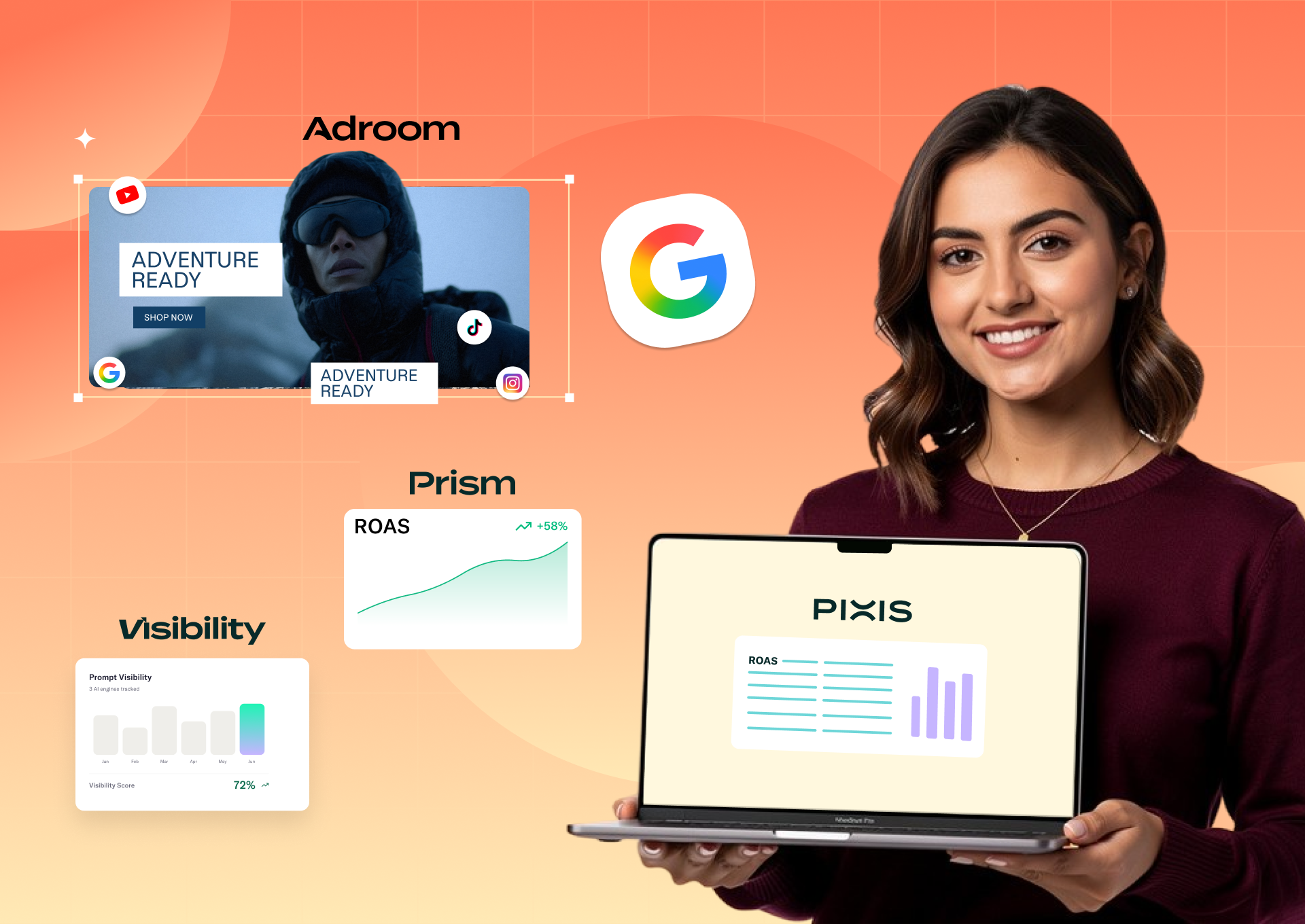
The gap between performance marketing teams that scale and those that plateau is no longer about budget or headcount. It is about how much of the analytical and operational work their tools handle autonomously, and how directly those tools connect data to action. In 2026, teams still running manual bid adjustments from static dashboards are not just slow. They are structurally disadvantaged against teams whose platforms monitor, diagnose, and optimise continuously in the background.
This blog covers the automated SEO software and marketing automation tools that drive measurable growth, how the Pixis ecosystem approaches this problem across paid and organic, and what to look for when evaluating platforms for your team.
Key Takeaways
- Legacy marketing automation tools report on what happened. The platforms that drive growth in 2026 analyse continuously, surface prioritised actions, and execute approved changes without a manual step for every adjustment.
- Prism is Pixis's paid media intelligence platform, trained on over three billion data points and built around Model Context Protocol (MCP). It connects to Meta, Google, and TikTok, monitors campaigns continuously, and executes optimisations agentically across platforms through a plain-English conversational interface.
- Creative generation and approval sit outside Prism's action-execution layer by design. Prism identifies creative fatigue and recommends refresh. AdRoom handles production. Brand and compliance decisions remain with the team.
- Pixis Visibility covers the organic side of the same problem: keyword gap analysis, AI citation tracking across four engines, technical SEO monitoring, content brief generation, AI drafting, and WordPress publishing, all inside one workflow.
- The most critical feature to evaluate in any automation platform is whether it tracks the impact of its own actions. Platforms that execute optimisations without closing the measurement loop make it impossible to assess whether the automation is actually working.
- Prism and Pixis Visibility are separate products within the Pixis ecosystem. Prism handles paid media intelligence. Pixis Visibility handles organic and GEO execution. Each operates independently and connects where the workflow calls for it.
The Problem with Legacy Marketing Automation Tools
Legacy platforms report on what happened. They tell you last week's ROAS, last month's keyword positions, and which campaigns are pacing behind plan. What they do not do is tell you what to do next, execute the adjustment, or connect the organic insight to the paid decision.
The practical consequence is a team that spends significant time in dashboards rather than acting on them. When your SEO data lives in one platform, your paid media metrics in another, and your creative performance in a third, the synthesis required to make a good optimisation decision falls entirely on the analyst. That synthesis takes time, and in performance marketing, the window between identifying an opportunity and capitalising on it is often shorter than the reporting cycle.
The mandate for 2026 is an active decision layer, not a better dashboard. Systems that analyse continuously, surface prioritised actions, and execute approved changes without requiring a manual step for every adjustment are the ones that produce compounding efficiency gains over time.
Prism: The AI-Powered Paid Media Intelligence Layer
Pixis Prism is an AI-powered campaign manager trained on over three billion performance data points. It connects to Meta, Google, and TikTok, monitors campaign performance continuously, surfaces prioritised recommendations through a conversational interface, and executes optimisations directly across ad platforms. The underlying architecture uses Model Context Protocol (MCP) as its core intelligence layer, synchronising real-time context from marketing, finance, and creative systems so that recommendations are specific to each team's account history and goals rather than generic.
The conversational interface is a meaningful operational shift. Instead of building reports and interpreting dashboards, teams ask Prism what happened in the last 24 hours, what the impact of a 25% budget increase would be, or which campaigns are showing creative fatigue. Prism pulls from live account data and returns a structured answer in plain English. That compression from question to actionable insight is where the time savings accumulate.
On execution, Prism operates agentically across paid platforms. It can adjust bids, reallocate budgets, and identify scaling opportunities directly. Creative generation and approval sit outside Prism's action-execution layer: Prism identifies creative fatigue and recommends refresh, but the creative production itself runs through AdRoom. This separation is deliberate. Brand and compliance decisions require human oversight, and Prism's model is designed to automate the decisions that produce recoverable errors while keeping humans in the loop on those that carry brand or compliance risk.
Scheduled Workflows extend Prism's monitoring into the background. Define the analysis prompts once, set a schedule, and Prism runs them automatically on whatever cadence the team needs, generating a structured conversation with the results each time. Teams using Scheduled Workflows report spending significantly less time on manual weekly reviews while catching performance shifts earlier.
Together with AdRoom for creative production and Pixis Visibility for organic and GEO execution, Prism sits in the paid media intelligence layer of the Pixis ecosystem. Each product operates independently and connects where the workflow calls for it.
Pixis Visibility: Automated SEO Software Built for Execution
What makes automated SEO software effective in 2026 is not keyword tracking speed. It is whether the platform connects what it finds directly to what the team publishes. Monitoring keyword positions is only useful if the path from gap to published content is short enough to act on.
Pixis Visibility tracks traditional Google search rankings and AI engine citations across ChatGPT, Perplexity, Gemini, and Claude. The dual-tracking matters because consumer search behaviour now spans both surfaces: users search Google for discovery and query AI engines for synthesised answers. A brand that ranks well on Google but does not appear in AI-generated responses is invisible at a critical part of the purchase journey.
The platform's execution pipeline closes the loop that most SEO tools leave open. A keyword gap or GEO citation gap becomes a content brief. The brief becomes an AI draft grounded in entity extraction and cross-model citation analysis. The draft is humanised, reviewed with a visual diff, and published to WordPress directly, with before/after impact tracking showing what changed in rankings and citation rates after publication. That pipeline runs inside one platform rather than across four disconnected tools.
Technical SEO monitoring runs continuously in the background across six modules: sitemaps, broken URLs, robots.txt, internal links, Core Web Vitals, and images. Issues are surfaced with severity rankings and actionable recommendations rather than raw data requiring interpretation.
For agencies managing multiple clients, Pixis Visibility supports multi-tenant workspaces with separate data, automations, and reporting per client. Automated intelligence pipelines deliver weekly SEO summaries, keyword gap reports, and content decay alerts directly to Slack or email, reducing the manual overhead of pulling and distributing reports across account teams.
Essential Features to Look for in 2026's Marketing Automation Platforms
Autonomous optimisation with human governance. The most effective platforms distinguish between decisions that can be safely automated and those that require sign-off. Bid adjustments, budget pacing corrections, and creative fatigue alerts are strong automation candidates. Brand decisions, compliance-sensitive changes, and major strategy shifts benefit from human review. Look for platforms that make this distinction explicitly rather than treating all automation as equally safe or equally risky.
Creative fatigue detection connected to production. Identifying that a creative is fatiguing is only half the capability. The platform should connect that signal to a production workflow that can refresh the asset. A platform that flags fatigue but requires a separate tool and separate team to act on it still creates the manual handoff problem it was meant to solve.
Continuous data validation. Automated decisions are only as reliable as the data they run on. Platforms that validate data freshness and flag anomalies before they propagate into campaign decisions protect teams from the compounding errors that automated systems can produce when acting on bad inputs.
Execution connected to measurement. The clearest sign of a mature automation platform is whether it tracks what its own actions produced. Platforms that execute optimisations without closing the loop on impact leave teams unable to assess whether the automation is adding value. Look for before/after tracking on automated changes as a baseline requirement.