
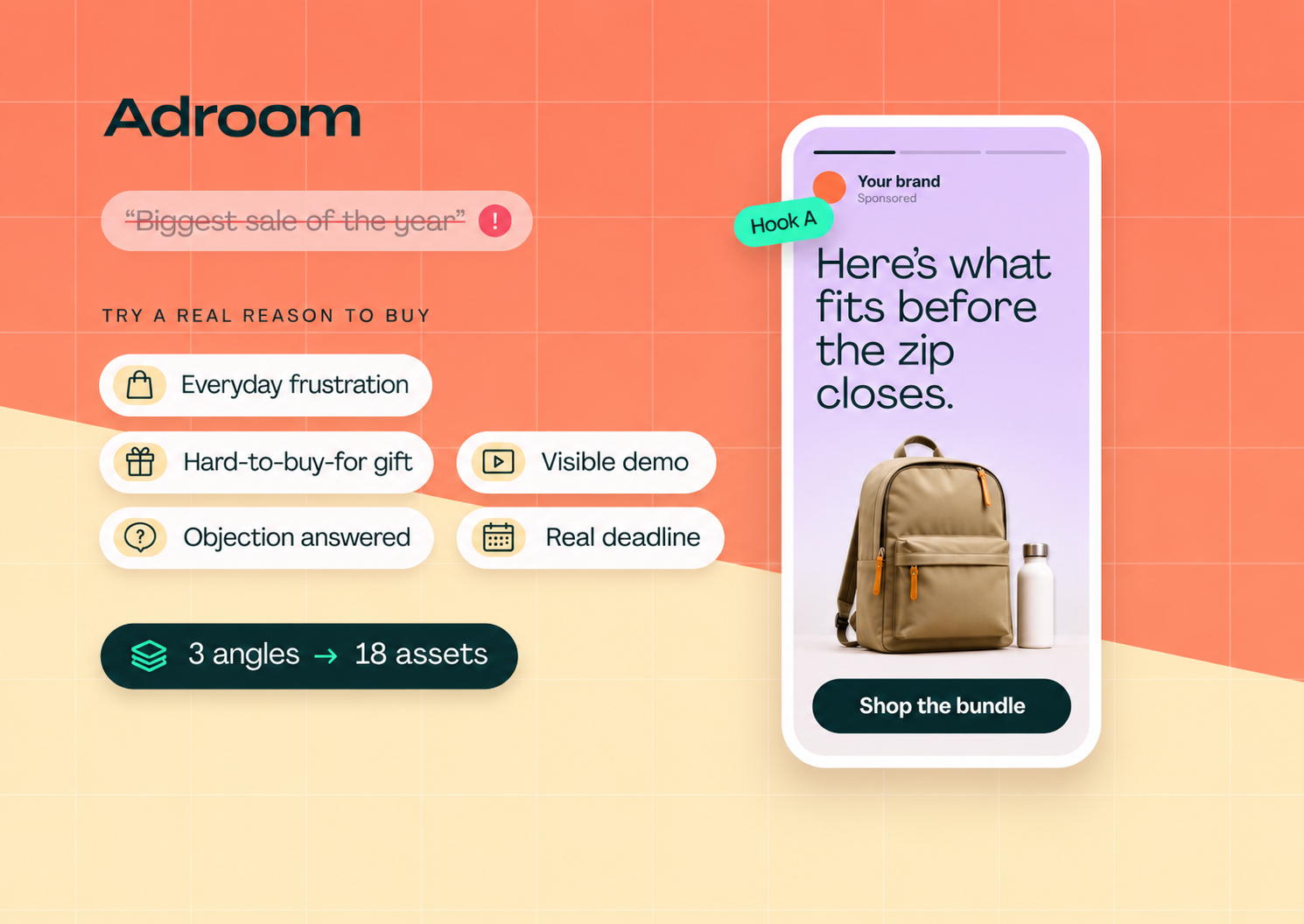
“Biggest sale of the year” tells a shopper something about your calendar. It tells them very little about why they should want the product.
That gap becomes obvious when you try selling something ordinary. A suitcase. A coffee grinder. A pair of boots. Put a discount badge on any of them and you have announced a promotion. Show the suitcase closing around a badly packed weekend, the grinder fitting beside a tiny kitchen sink, or the boots working with three outfits someone already owns, and you have started a buying argument.
The offer still matters. But it becomes more persuasive when it attaches to a reason the purchase belongs in someone's life.
For BFCM, the creative challenge is to find several of those reasons, give each one a convincing opening, and produce the versions your campaign can actually use. The examples below show how to do that without turning a promising angle into fifty interchangeable sale ads.
Key takeaways
- A hook combines the opening words and image or action. Changing the headline while leaving a generic sale visual untouched may leave the buying argument unchanged.
- Choose angles from real product questions, objections, use cases, and customer language. Treat unsupported ideas as hypotheses to investigate.
- Give each angle its own evidence. An attractive demonstration, compatibility claim, or customer quotation needs to be accurate and usable.
- Separate new concepts from executions and format adaptations when planning production. Eighteen files might represent only three ideas.
- Use Adroom to generate and adapt approved directions, with product fidelity, offer accuracy, and human review built into the workflow.
Before writing a hook, finish this sentence
“This product is worth considering because _____.”
If the answer is only “it is discounted,” you have an offer-led concept. That can be useful, particularly for someone who already wants the item. It does not have to carry the entire campaign.
Try completing the sentence with a customer need instead. The suitcase keeps a laptop accessible without unpacking everything. The grinder is suitable for someone making one cup at a time. The boots answer a genuine sizing concern with clear guidance.
Now identify the moment that would make that reason visible. A hook is the first expression of the argument: a line, a demonstration, a recognisable situation, or a combination. The body of the ad should deliver the explanation the opening promises, then connect it to the actual offer.
Keep that distinction in the brief. “Make it more emotional” leaves the production team guessing. “Show the recipient using the gift on an ordinary weekday” gives them a direction they can execute.
Eight BFCM hook angles worth developing
These are starting points for tests, not a ranking of proven winners. Each example assumes the product and offer can support the claim.
1. The everyday frustration: begin where the problem happens
Sample hook: “Your charger has its own pocket. Why is it still at the bottom of the bag?”
Open with someone searching through the bag, then show how the advertised product organizes the item. The frustration should be specific enough to recognize and small enough for the product to solve credibly.
This angle works as a brief when customer questions or reviews repeatedly describe the same inconvenience. For kitchenware, that might be awkward storage. For clothing, it could be an unclear fit decision. Avoid inflating a minor annoyance into a crisis just to make the opening more dramatic.
The ad's next job is proof. Show the pocket, closure, dimensions, or process that answers the problem, then introduce the sale. A relatable opening followed by an unrelated product montage leaves the argument unfinished.
Produce it with: An approved real-use demonstration or an accurately staged product scene. If you do not have footage of the function working, commission or obtain it before promising the result.
2. The recipient who is hard to buy for: make the gift decision easier
Sample hook: “For the friend whose coffee order needs its own paragraph.”
A useful gift angle identifies a person through a recognizable preference, then explains why the product suits them. It can be warmer and more memorable than another grid labeled “gifts for everyone.”
Show what makes the gift appropriate: the included items, the level of experience it suits, the available choices, or the presentation. For a coffee set, the proof might be a clear view of its contents and preparation requirements. It should not rely on a claim that every coffee enthusiast will love it.
Give the shopper enough information to decide whether the recipient fits. If the product requires separate equipment, say so. An appealing gift becomes a poor experience when an essential accessory is missing.
Produce it with: A recipient-specific opening, a product or unboxing sequence, and a landing page that explains suitability. Develop genuinely different recipient needs rather than swapping “friend” for “dad” in the same script.
3. The visible demonstration: let the product earn the opening
Sample hook: “Here is what fits before the zip closes.”
For a carry-on bag, start with the packing sequence. Keep the actual bag visible and show the contents clearly. The sale message can enter once the shopper understands what the product offers.
Demonstrations give the creative team a concrete assignment, but they also create an accuracy requirement. A bag must not become larger between shots. A generated accessory must not appear in a bundle that does not include it. Editing should not conceal the conditions needed to achieve the result.
Google's ABCD guidance for effective creative emphasizes attracting and sustaining attention alongside branding, connection, and direction. A product demonstration gives you material to build that sequence, provided the product and next action remain understandable.
Produce it with: Verified footage of the product in use. Use AI-assisted production around that evidence where appropriate, and review the finished sequence for continuity and fidelity.
4. The honest trade-off: help the right buyer choose
Sample hook: “No screen. No app. Just the grind setting you need.”
This is an illustrative opening for a simple grinder, not a claim about a particular product. Its appeal comes from making the product's scope clear. A simpler model can have a strong proposition without pretending to contain every feature in the category.
Explain who benefits from that trade-off and who may need something else. A compact version might suit a small kitchen but have less capacity. A basic kit might be easier to understand but offer fewer functions.
The honesty has to survive the whole ad. Do not lead with restraint and then make an unsupported “does everything” claim in the closing card. Keep the approved price and offer visible so the shopper can assess the actual exchange.
Produce it with: A feature-led opening and an accurate view of controls, size, or included parts. Competitor comparisons are optional; the product should be understandable on its own.
5. The complete setup: show what goes together
Sample hook: “The gift is the kit. The first attempt should not require another order.”
For a genuinely complete beginner kit, this can introduce a useful offer. Lay out the contents, show the first use, and explain why the components belong together. The hook fails if the customer still needs an undisclosed essential item.
A bundle should solve a real buying problem. Use customer-service questions, accessory purchases, and product knowledge to determine what is necessary. Adding slow-moving inventory to a box does not automatically make the bundle more helpful.
Check the commercial proposition too. A larger basket can cost the shopper more even if its unit economics are attractive. Explain what is included and let the customer judge its relevance rather than relying only on a large savings number.
Produce it with: Accurate packshots of every included item, a clear inventory of the set, and approved offer terms. If the set is not complete, use a narrower hook such as “Start with these three essentials” and disclose the additional requirements.
6. The objection answered: use the opening to resolve hesitation
Sample hook: “Measure this space before you choose your desk.”
This hook offers help with a decision instead of trying to rush past it. Open with a measurement, explain the relevant product dimension, and show the desk in a space that accurately represents its size.
The same approach can address sizing, compatibility, cleaning, assembly, or included accessories. Choose the objection from questions buyers actually ask. If the issue is returns, state the applicable policy rather than inventing a risk-free promise.
This angle can also improve the destination brief. Someone clicking to understand dimensions should find them easily on the page. The ad has created a specific expectation; the landing page needs to honor it.
Produce it with: An approved diagram, demonstration, or explanation tied to current specifications. Keep qualifications readable in every adaptation.
7. The customer detail: lead with something only use can reveal
Sample direction: Open with an authentic customer explaining a specific moment when the product was useful.
Use the customer's actual words with the required permission. A precise observation about a pocket, a cleaning routine, or an included accessory can be more informative than a generic superlative. It helps a prospective buyer imagine the product in use.
Do not write a testimonial, put it in quotation marks, and treat it as customer evidence. If no suitable quote exists, use a brand-authored demonstration or explanatory line instead. Likewise, generated people should not be presented as real customers reporting experiences they did not have.
Keep the scope of the statement intact. An individual account of a product's usefulness does not establish a universal performance claim.
Produce it with: Approved customer material and a product sequence that illustrates the actual detail. Creative style, customer endorsement, and factual substantiation are separate review questions.
8. The real deadline: explain what changes when the offer ends
Sample hook: “The bundle price ends Monday. Here is what is included.”
A deadline gives an already relevant offer a decision point. Make the date, time zone, eligibility, and current terms clear wherever they matter. This is different from adding a countdown to every concept because the campaign happens to run in November.
A deadline-led execution may be useful toward the close of your actual promotion. It should retain enough product context for someone encountering it for the first time. If the offer changes, replace the claim; if it ends, stop or update the relevant creative.
Avoid manufactured scarcity and unsupported superlatives. “Biggest sale” needs a defensible basis, just as “only three left” needs accurate stock information. Often the precise fact is a stronger line than the exaggeration.
Produce it with: A clear offer asset and approved expiry instructions, including an owner responsible for replacement. Keep the product explanation available alongside the deadline version.
Choose three angles before making thirty assets
A useful first selection answers three questions: can we support it, can we produce it, and can we learn from it?
For an illustrative coffee gift set, you might choose recipient suitability, a contents demonstration, and an objection about required equipment. Each explores a different reason to consider the same offer. If you cannot substantiate one of those directions, replace it before production begins.
Write the proof beside each angle. The recipient version needs a clear account of who the set suits. The demonstration needs accurate footage or imagery. The equipment objection needs a verified explanation of what the customer must already own.
Then check what the campaign can evaluate. A small account may not support many simultaneous creative tests. Production capacity is not a reason to launch more cells than the budget and purchase volume can inform. The variation-first creative production guide covers the broader production model; for BFCM, keep the initial batch connected to a small number of commercial questions.
Produce the approved directions with Adroom
Adroom supports image, video, and ad-copy generation, AI editing, shared libraries, and approval flows. Use those capabilities to turn a defined creative plan into reviewed assets. The plan should specify what changes across versions and what must stay fixed.
1. Assemble the material that keeps generation accurate
Prepare the current product references, brand assets, approved claims, offer terms, and destination. Include the actual variant and packaging to be advertised. A previous sale's image may be a useful composition reference while containing a price or product version that must not reappear.
Complete the Brand Kit and add the campaign-specific brief. Treat the kit as the brand foundation and the brief as the instructions for this particular offer and concept.
A practical brief could read:
Create a BFCM direction for the approved coffee gift set. The angle is recipient suitability for someone beginning to make coffee at home. Open on the included items and make the intended experience level clear. Use only the supplied product specifications and approved offer. Preserve the product, packaging, logo, and included quantities. Do not invent testimonials, ratings, performance claims, accessories, or scarcity. Produce distinct opening treatments for review while keeping the offer and product explanation consistent.
This is a suggested production brief, not a promise of a particular one-click workflow or output count. Review what the selected tools and generation options support.
2. Separate concept variation from format coverage
For an illustrative batch, three angles with two opening treatments create six executions. Adapting each approved execution into three required formats would produce eighteen files, but the batch still contains three underlying buying arguments.
That distinction should remain visible in the naming and reporting. Use a label such as gift-set_recipient_opening-A_vertical_v1, and retain the concept, opening, format, and revision as separate fields in the production record. Do not rely on filenames alone if the media team needs stable creative IDs for reporting.
Make the first review before expanding every execution. A weak argument in one format becomes a larger correction task when it has already been adapted into several others.
3. Adapt to the destination without losing the hook
For Google campaigns, Google Creative Coverage in Adroom supports preparation for Demand Gen and YouTube Video Reach. It checks available creative, identifies gaps, and supports adaptation and generation using the Brand Kit and brief. Generated videos receive ABCD evaluation before review and export.
Select the intended campaign requirements before deciding which adaptations to produce. The opening may need a new composition in a wider frame, or a shorter edit may need a different explanation to remain coherent. Keeping every source element visible is not the same as preserving a clear message.
Use the BFCM Google creative checklist for format and offer checks. The job here is to ensure that the buying argument survives those formats, including the product proof and CTA.
4. Approve the meaning as well as the appearance
Ask reviewers to check four things: whether the opening is understandable, whether the product evidence supports it, whether the offer is accurate, and whether the next action is clear.
Inspect the product itself, including controls, dimensions, attachments, colors, and packaging. Check text against the approved specifications and terms. Review the actual exported asset rather than assuming an earlier draft's approval covers a revised version.
Keep the revision loop small. Feedback such as “the opening promises beginner suitability, but the body never explains the required equipment” gives production a specific correction. “Needs more punch” leaves the underlying problem unresolved.
Test whether the angle sells the product, not just the opening
A surprising hook may attract viewers who never wanted the item. Read attention metrics alongside click behavior, landing-page performance, purchases, and acquisition economics.
Compare like with like where possible. If you want to understand the opening, keep the main explanation and offer consistent. If you change the bundle, audience, destination, and hook together, you are testing the package. That may be a valid business decision, but it cannot tell you which change caused the result.
Account for uneven delivery and conversion delay before declaring a winner. Where the platform and account support an appropriate experiment, use it; otherwise describe the findings as directional rather than causal. Choose the observation period and spending limits around the account's volume, rather than assuming every concept can be judged after the same number of hours.
Carry the learning back into the brief. If the equipment explanation produces commercially useful purchases, test another way to communicate that answer before commissioning a completely unrelated concept. If the recipient joke attracts clicks but misrepresents who the product suits, fix the proposition rather than making the joke louder.
The best BFCM batch leaves the team with more than assets. It explains which reasons to buy are earning their place. Explore Adroom to build those approved directions into a creative set your team can review, launch, and learn from.