

Generative copy and creative-variation features are now common across enterprise marketing platforms, so the question for buyers has moved from "can it generate?" to "can it decide, personalize, execute, and be governed?" But "enterprise AI marketing platform" is a wide category, and the biggest mistake a buyer can make is comparing tools before defining the job. A customer-data platform, a lifecycle-messaging engine, a paid-media optimizer, and a creative-generation system are all sold as "AI marketing platforms," and they are not substitutes for one another. Evaluating them against a single generic checklist produces a shortlist that looks reasonable and fits no one.
This is a working procurement guide. It takes you from defining the job and building the right peer set to testing vendors, calculating total cost, and scoring the final shortlist, with a clearly separated section at the end on where Pixis fits, so the framework stays neutral until you reach it.
Key takeaways
- Define the job before comparing tools. Most bad shortlists come from evaluating platforms against generic criteria rather than documented requirements, and against the wrong peer set: a CDP, a lifecycle engine, and a paid-media optimizer solve different jobs.
- "Agentic" is not all-or-nothing. What matters is which actions execute, on which channels, inside which guardrails, with what approval and audit, not whether a product "has agents."
- Test, do not watch. A demo shows the vendor's best case; a proof of concept on your own data and accounts shows what you will actually get.
- Procurement turns on the unglamorous parts: total cost of ownership, security posture, measurement and incrementality, implementation effort, and exit risk decide more deals than feature lists do.
Step 1: Define the job before evaluating the platform
Every platform looks strong against a vague need. Before you look at any vendors, write a short requirements brief so every vendor has the same target to hit.
Capture at least these, in writing:
- Primary use case: the one job the platform must do well above all others
- Channels in scope (paid social, search, programmatic, email, SMS, push, in-app, web, commerce, service)
- Markets and languages
- Monthly media spend and campaign volume, which drive pricing, and whether the tool operates at your scale
- Number of brands or business units sharing the platform, and whether they need isolation
- Data sources to connect, and which system is the source of truth
- Action permissions you will grant: recommend-only, execute-with-approval, or autonomous within guardrails
- Regulatory and privacy exposure in the market
- Existing tools to replace versus retain, and the cost of running both in parallel
- Internal implementation capacity, including engineering support for integrations
- Success metrics and the baseline you will measure against
The output is a one-page brief. Every later section is easier once it exists, because "what strong looks like" only means something relative to what you need to be strong.
Step 2: Decide which capabilities are mandatory, and which are optional
With the brief written, sort the capabilities into must-haves, nice-to-haves, and not relevant for your specific purchase. This is where buyers most often over-scope, treating every impressive capability as a requirement. A lifecycle-messaging buyer does not need paid-media bid execution; a paid-media buyer does not need a journey-orchestration canvas.
Two capabilities deserve explicit classification because they are frequently mis-scoped:
AI-search visibility is conditional, not universal. Monitoring how your brand appears in AI-generated answers matters a great deal for some buyers and not at all for others. Evaluate it as a core requirement when AI-assisted discovery materially affects your category, as our analysis of the AI buyer journey lays out, or when consolidating organic visibility with paid media and creative workflows is part of the platform brief. For a team buying a customer data platform, an email engine, or a service platform, the decision usually belongs in a separate decision.
Autonomous execution is a spectrum, not a checkbox. Decide in advance how much action authority you actually want to grant, since that constraint either eliminates or accelerates vendor onboarding faster than any feature.
Step 3: Compare like with like, not vendor against vendor
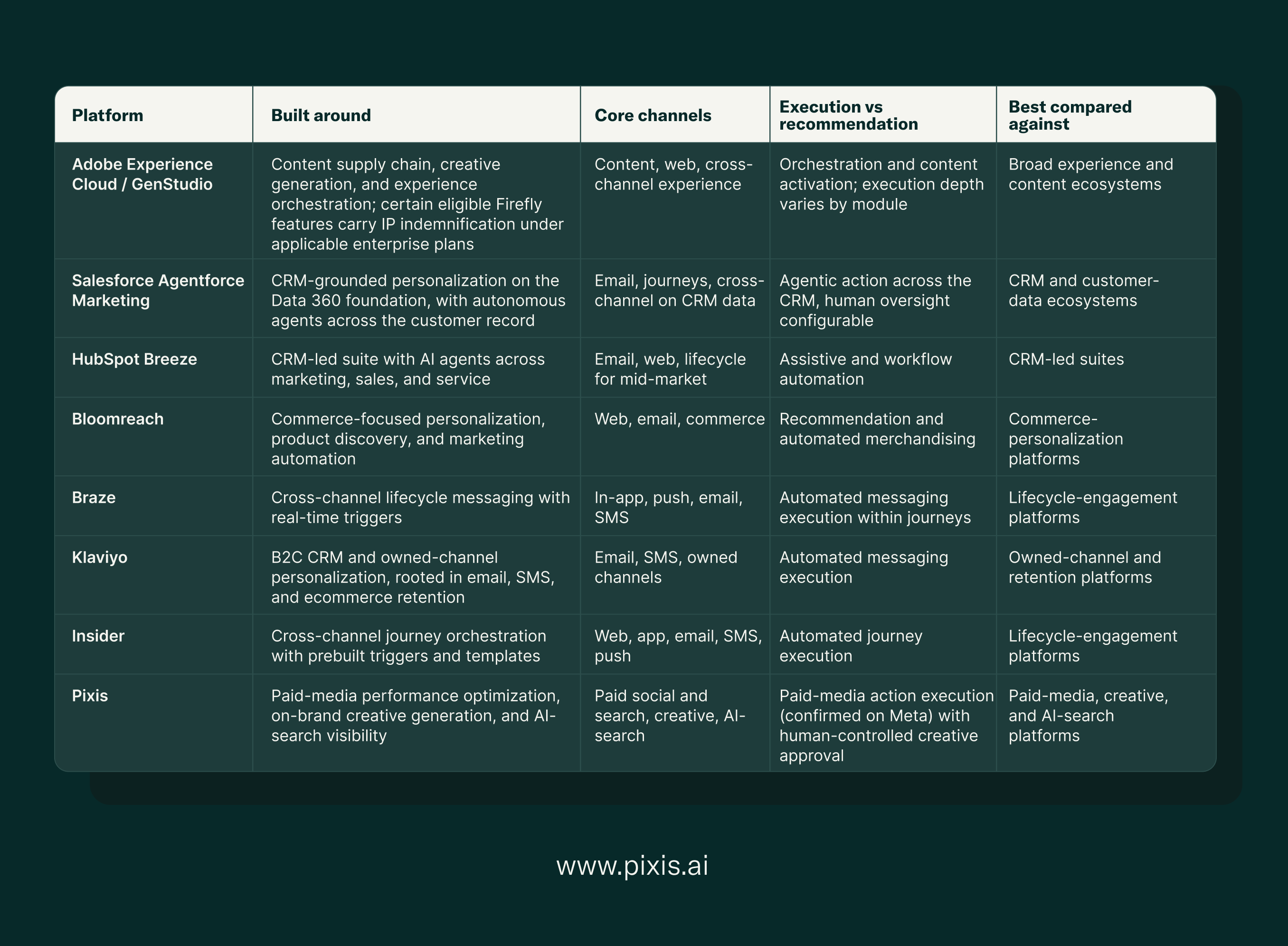
Enterprise platforms tend to be strongest in the category they grew out of, so match that origin to your primary need rather than expect one platform to lead everywhere. The table below maps where the best-known platforms are concentrated, with each row linked to the vendor's product page. The final column matters most: it names the peer set each platform is genuinely compared against, so you do not score a commerce-personalization tool against a paid-media optimizer as if they did the same job.
Step 5: Evaluate agentic execution and its boundaries
The single most useful question in this whole evaluation is not "does it have agents?" but "which decisions does it execute, on which channels, inside which guardrails, and with what approval and audit?" Agentic AI is a spectrum, and the useful platforms draw explicit lines.
Map each candidate against five distinctions:
- Recommendation versus autonomous execution: does it suggest and wait, or act within limits you set?
- Channel-specific support: execution is rarely uniform across Meta, Google, TikTok, programmatic, and email, so confirm per channel rather than accepting a blanket claim
- Guardrails: can you cap budget-change magnitude, set KPI thresholds, and constrain what an action may touch?
- Approval workflow: which actions require human sign-off, and can you tier that by risk?
- Auditability: is every action logged, attributed to an authorized profile, and reversible?
This is also where the platform-incentive problem lives: native platform automation optimizes for metrics the platform can measure and monetize, so an independent layer that validates recommendations against your own business goals is worth more than raw autonomy. For a deeper treatment, our guide to what to automate and what to keep human works through the boundary decision in detail.
Step 6: Evaluate measurement and incrementality
"Improves performance" means nothing without a defined method of measurement, and this is one of the weakest areas in most vendor pitches. A platform can raise platform-reported ROAS while the actual business outcome stays flat, because it optimizes toward the metric it can see. Ask each vendor to answer, with evidence:
- What is the baseline, and what is the counterfactual you are measured against?
- Does the platform support holdouts, geo-tests, or controlled experiments to isolate its effect?
- How does it separate platform optimization from market movement and seasonality?
- Which attribution model is used, and can recommendations be tied to incremental outcomes rather than last-click credit?
- Can the system distinguish correlation from causation in its own reported wins?
- Are model decisions logged against later results, so you can audit whether a recommendation actually helped?
A vendor that can only show platform-reported lift, with no holdout or incrementality method, is asking you to take the improvement on faith.
Step 7: Evaluate governance and compliance
Governance is where a buyer should ask for evidence rather than accept claims, and the relevant obligations are distinct rather than a single checklist. GDPR is an EU data-protection regulation; CCPA and CPRA set California privacy obligations; the EU AI Act is a risk-based law whose duties depend on your role and the system's classification; and ISO/IEC 42001 is a voluntary AI-management-system standard a vendor may be independently certified to, implement without certification, or merely claim alignment with. Buying a compliant or certified tool does not by itself make your whole AI operation compliant.
On the EU AI Act, get the current picture right, because much published advice is out of date. As of 2 August 2026, the Act is in general application, and the Article 50 transparency duties are live: they cover disclosure for certain direct AI interactions and machine-readable marking of covered AI-generated content, subject to the Act's scope and exceptions. The heavier high-risk (Annex III) obligations were deferred to 2 December 2027, and many ordinary marketing uses fall outside the high-risk categories, though classification depends on function and deployment. For most marketing platforms, then, the near-term question is Article 50 content-marketing and disclosure rather than high-risk conformity assessment. Confirm classification for your own deployment, and turn the rest of the section into evidence you request.
Evidence to request
- Data-processing agreement and current subprocessor list
- The vendor's AI-system classification for your use case, and the reasoning
- ISO/IEC 42001 certificate with scope, issuing body, and validity, if certification is claimed
- Data-retention policy, including any Zero Data Retention option for data sent to external model providers, and what telemetry or abuse-monitoring exceptions remain
- Account-level data isolation confirmation
- A sample audit log for AI-driven decisions
- The permission model and role definitions
- Human-approval workflow documentation for high-stakes actions
- Model-provider terms governing how your data is processed
- How AI-generated assets are marked where Article 50 transparency applies
Step 8: Evaluate security
Security is often the actual procurement blocker, and it needs its own scrutiny rather than being folded into general governance language. Enterprise security review typically covers:
- SOC 2 Type II and ISO 27001, with current reports
- SSO/SAML and SCIM provisioning
- Role-based access control and tenant isolation
- Encryption in transit and at rest, and customer-managed keys where required
- Data residency options by region
- Subprocessor list and breach-notification terms
- Penetration-testing cadence and summary results
- Business continuity and disaster recovery, with recovery-time and recovery-point objectives
- Logging and SIEM integration
Request the evidence, not the assurance. A vendor that cannot produce a current SOC 2 Type II report or a clear data-residency answer will take a slower path through your own security review, regardless of the product.
Step 9: Evaluate model reliability
For an AI platform specifically, evaluate the AI itself, not just the connectors around it. A platform can have excellent integrations and still make unreliable recommendations. Test for:
- Recommendation consistency across repeated runs on the same data
- Data freshness, and how stale an input can be before a recommendation is made on it
- Explainability and confidence indicators on recommendations
- Failure detection, fallback behavior, and human override
- Rollback of an executed action, and how quickly
- Brand-safety enforcement and prompt-injection exposure for any generative surface
- What happens when an underlying model changes, and how that is monitored
Step 10: Evaluate integration, cost, and vendor viability
Integration. Connector count alone is close to meaningless. What matters is read versus write support, available objects and fields, sync latency, backfills, error handling, regional availability, and who maintains each connector. As a public reference point, Twilio Segment advertises more than 550 activation destinations and more than 750 total catalog integrations, but treats those as different measures and weighs reliability over quantity.
Total cost of ownership. No enterprise buyer can shortlist responsibly without modeling the full cost, which is rarely just the license fee. Build a TCO view covering license structure, media-spend or percentage-of-spend fees, usage or credit limits, and overage pricing, model-inference charges, seats, implementation and integration fees, professional services, support tiers, contract length, and minimum commitments, the cost of running parallel tools during transition, and migration and training. Two platforms with similar list prices can differ severalfold once implementation and overages are included.
Vendor viability and exit risk. In a young AI-platform market, evaluate the company, not only the product: financial stability and customer concentration, support capacity and service levels, roadmap credibility, reference customers and implementation partners, and, critically, exit terms, data portability, export formats, ownership of generated assets and any fine-tuned models, and what happens if a feature is discontinued. Lock-in is a real cost, even when the product is good.
Step 11: Run a 30-day proof of concept
This is the step that separates a decision from a demo. A demo shows the vendor's best-prepared case; a proof of concept on your own data and accounts shows what you will actually get. Give every shortlisted vendor the same protocol and the same baseline, so the results are comparable. Because the categories are not substitutes, the test needs a common core plus a module matched to what you are actually buying.
The common core, for every vendor:
- Connect to your live environment and import a defined period of historical data
- Record every action taken, with timestamps and attribution
- Export the full data and decision history
- Demonstrate rollback of any executed action
- Report results against the agreed baseline, with the method stated
Then run the module that fits the category:
- Paid media: diagnose three known performance issues, then execute one approved bid, budget, or status change end-to-end
- Creative: produce and approve an asset from a fixed brief, through your brand and compliance workflow
- Lifecycle messaging: build and run one triggered customer journey
- CDP: resolve identities against a known set and activate one audience
- Commerce: generate and test one recommendation set
- AI search: run a fixed prompt portfolio and inspect brand mentions and citations
Score what actually happened, not what was promised. A vendor that cannot cleanly export its own decision history, or cannot demonstrate rollback, has told you something important. One caution on interpretation: use the 30-day window primarily to validate integration, workflow, controls, logging, export, rollback, and the quality of recommendations. Treat performance results as directional unless the test has the volume, duration, and experimental control to support a reliable conclusion, since low conversion volume, seasonality, long sales cycles, and retention outcomes can all outrun a 30-day window.
Step 12: Score with a weighted scorecard
Turn the evaluation into a single comparable view. Weights are buyer-specific and should come straight from your Step 1 brief: AI-search intelligence might carry 15% for one brand and 0% for another, and agentic execution might dominate for a paid-media team and barely register for a lifecycle buyer. Set the weights before you see the results, so the scorecard measures your requirement rather than your impression of the last demo.
The method is simple: assign each criterion below a weight that reflects your brief, with all weights summing to 100%, and a 1-to-5 score based on the evidence and the proof-of-concept result. Multiply weight by score, add the results, and the shortlist ranks itself. Score each on what you can actually verify:
- Core use-case capability, scored from documentation and the POC result. This usually carries the heaviest weight.
- Agentic execution and boundaries, scored from the workflow demonstration and the change you executed in the POC.
- Approval and audit controls, scored from a sample audit log.
- Measurement and incrementality, scored on whether the vendor showed a holdout or geo-test method rather than platform-reported lift alone.
- Creative production and brand control, scored from a brand-kit test.
- Integration reliability, scored from API documentation and the sync you ran in the POC.
- Governance and compliance, scored from the data-processing agreement, AI-system classification, and any ISO certificate.
- Security posture, scored from the SOC 2 Type II report and the data-residency answer.
- Model reliability is scored from the consistency and rollback tests.
- Total cost of ownership, scored against a full TCO model, not the license fee alone.
- Vendor viability and exit, scored from references and the exit and data portability terms.
One rule keeps the scorecard honest: a criterion with no evidence and no test result scores zero, not the benefit of the doubt.
What should make you reject a platform?
Some findings should end an evaluation regardless of how the rest of the scores: no current SOC 2 Type II or equivalent when your security review requires it; no way to export your own data and decision history; no rollback for executed actions; execution claims that collapse under the proof of concept; or contract terms that leave generated assets or fine-tuned models with the vendor when you need them. And where measurable performance improvement is central to the purchase, reject vendors that claim lift without an agreed counterfactual, holdout, or credible incrementality method. Any one of these is a reason to stop, not a point to negotiate down in weighting.
Where Pixis fits in this framework
Pixis sits in the paid-media, creative, and AI-search corner of this market. It is best compared with platforms solving those jobs, not with CDPs or lifecycle-messaging engines.
Across the framework, Pixis spans three connected products. Prism analyzes campaign performance across Meta, Google, and TikTok. Its public documentation confirms approved action execution on Meta, running under designated permissions with a full audit trail; confirm current execution support for Google, TikTok, and each action type during your evaluation, since the capability is expanding. Targeting surfaces as recommendations, and creative approval stays human-controlled by design. Adroom generates on-brand creative on demand through governed approval workflows. Pixis Visibility handles AI-search and SEO monitoring and execution, which matters for the conditional AI-search pillar when discovery in AI answers affects your category. Creative production and approval sit outside Prism's action layer, keeping brand and compliance decisions under human control. As with any multi-product suite, confirm in your own proof of concept exactly which data and steps pass automatically and where a person stays in the loop.
If that corner of the framework is where your evaluation lands, you can book a demo to run your current workflow against Prism, Adroom, and Pixis Visibility and define the metrics to measure together.
FAQs
What counts as an enterprise AI marketing platform?
It is a broad category rather than a single product type. It spans customer-data platforms, journey and lifecycle orchestration, email and messaging, paid-media management, creative production, marketing analytics and attribution, commerce personalization, and increasingly AI-search visibility. Because these solve different jobs, the first task in any evaluation is deciding which of them you are actually buying, then comparing vendors within that peer set rather than across the whole category.
Does the EU AI Act apply to a marketing platform?
Usually, through its transparency duties rather than the high-risk regime. As of 2 August 2026, the Act is in general application, and Article 50 imposes transparency duties on specified providers and deployers, including disclosure for certain direct AI interactions and machine-readable marking of covered AI-generated content, subject to the Act's scope and exceptions. The high-risk obligations were deferred to December 2027. Many ordinary marketing uses may fall outside the high-risk categories, but classification depends on the system's function and deployment, so confirm it for your specific case and ask vendors how they handle content marking and disclosure.
How do we test a platform rather than just watch a demo?
Run the same proof of concept across every shortlisted vendor: a common core (connect a live environment, import historical data, log every action, export the decision history, and demonstrate rollback, all against an agreed baseline) plus a module matched to the category you are buying, whether that is executing a paid-media change, producing and approving a creative asset, running a triggered journey, activating a CDP audience, or inspecting AI-search mentions. Score what happened, not what was promised, and treat performance results as directional unless the test has enough volume and control to support a firm conclusion.