
An AI answer says your software does not support an integration you launched six months ago. Another describes your support as slow, citing complaints your customer success team is still receiving. Both sound negative. Only one can be addressed by correcting outdated information.
That distinction should guide how you find and fix negative brand sentiment in AI answers. Before changing website copy or contacting a publisher, establish what the answer claims, whether it is true, and what a buyer could misunderstand. A product limitation, an obsolete policy, and an invented allegation require different responses.
For content, brand, and customer experience teams, the practical challenge is deciding where to act. This guide explains how to collect useful evidence, investigate cited sources, assign the right response, and track what changes across AI platforms.
Key Takeaways
- Negative sentiment and factual inaccuracy are separate findings. Accurate criticism may require a business change rather than a content correction.
- Compare answers within consistent prompt groups. Questions about drawbacks will naturally produce different responses from neutral brand questions.
- Inspect cited pages, but do not treat citations as a complete record of what influenced an answer.
- Track sentiment, factual accuracy, and brand appearance separately. Report results for the prompts you tested rather than treating them as market-wide measurements.
- Pixis Visibility can help teams monitor brand representation, sentiment, citations, and competitors. People still need to verify claims and decide what action is justified.
What Counts as Negative Brand Sentiment in AI Answers?
Negative brand sentiment is unfavorable language or evaluation directed at your brand in an AI-generated response. It might concern pricing, reliability, customer support, compatibility, or suitability for a particular buyer.
The object being analyzed matters. A response can praise one company and criticize another. It can also describe a strength and a limitation of the same product. An overall answer-level label may miss what is being said about your brand specifically.
Sentiment analysis helps classify the tone of those statements. Verifying them is a separate task. A negative answer can be accurate, while a glowing recommendation can contain false claims.
Consider an answer that says a product is expensive for a small team. If its pricing and intended audience support that assessment, more positive copy will not make the criticism incorrect. The useful response may be to explain which customers benefit from the product and what the price includes.
Likewise, a neutral description is not a reputation failure. An answer does not need to repeat your preferred messaging to serve the buyer well.
Why Monitor Negative AI Mentions Across Platforms?
A buyer researching a product may encounter an AI-generated comparison before visiting the vendor's website. An inaccurate statement about availability, pricing, or capabilities could influence that assessment. Monitoring helps you discover these statements and decide whether they need attention; it does not, by itself, establish their effect on revenue.
There is evidence that sentiment differs between platforms. In its analysis of brand mentions across apparel, electronics, and education, BrightEdge reported negative sentiment in 2.3% of Google AI Overviews brand mentions and 1.6% of ChatGPT brand mentions. That is a difference of 0.7 percentage points, or approximately 44% in relative terms.
These figures describe BrightEdge's dataset, not a universal benchmark for every brand. The study also found that the direction of the difference varied by industry. Its practical value is the reminder to test across platforms and query types rather than assuming one engine's results represent the rest.
Your own baseline should come from questions relevant to your products, buyers, and market. There is no universal percentage of positive answers that defines a healthy brand.
Step 1: Build a Prompt Set That Does Not Predetermine the Result
An audit built entirely around “Why is [Brand] bad?” will generate an unbalanced picture. Include several kinds of questions and keep their results separate.
Start with neutral brand questions such as “What does [Brand] offer?” These help you check whether the answer gets your category, capabilities, and basic facts right. Then add purchase questions, such as “Is [Brand] suitable for a team of ten?”, to see how the answer handles fit, pricing, and relevant trade-offs.
Comparison prompts should specify a use case. Asking “How do [Brand] and [Competitor] compare for [use case]?” lets you assess whether the answer uses accurate information and equivalent criteria for both companies.
Include questions about support and reliability, such as “What should buyers know about [Brand]'s customer support?” Look for specific claims, the evidence cited, and whether that evidence is current.
Finally, ask explicitly about limitations. “What are the limitations of [Brand]?” can reveal outdated or poorly contextualized criticism. Keep these results separate from neutral questions, since the prompt itself asks the system to identify drawbacks.
Use sales questions, support tickets, customer interviews, and relevant search queries to inform the set. Treat these as indicators of buyer concerns, not proof that people enter identical questions into AI assistants.
Test the appropriate platforms for your market, such as ChatGPT, Gemini, Claude, Perplexity, and Google AI Overviews. Record when an AI Overview does not appear rather than labeling that result neutral.
Repeat prompts in fresh conversations and keep language, location, and personalization settings comparable where possible. Record whether web search was used and the model version when visible. Start with a manageable set you can review consistently, then expand where you find recurring issues.
For the broader process of identifying citation gaps, Pixis's GEO execution guide covers the work that precedes this deeper assessment of negative mentions.
Step 2: Record the Claim Before Assigning a Sentiment Label
Preserve the full answer before summarizing it. A negative sentence can mean something different when read alongside the qualification that follows it.
For each observation, record:
- The exact prompt, engine, date, and relevant testing settings.
- The full response and a screenshot where useful.
- The specific statement about your brand.
- Any cited URLs and the passages that appear relevant.
- The topic, such as pricing, support, reliability, or compatibility.
- A brand-specific sentiment label: positive, neutral, negative, or mixed.
- A separate accuracy assessment: supported, outdated, contradicted by evidence, or unresolved.
Maintain a reference sheet with current pricing, product specifications, service policies, release notes, and other evidence. Where possible, include independent documentation as well as owned pages. Marketing language alone is not sufficient proof of a disputed capability or performance claim.
Do not classify an omitted strength as negative sentiment automatically. First ask whether the question called for that information. A short response cannot include every differentiator.
Step 3: Investigate What Supports the Negative Statement
Open each relevant citation and check whether it supports the claim the answer makes. There are several possible findings: the page is accurate, the page is outdated, the answer misreads it, or the citation does not support the statement at all.
Look for dates and scope. A complaint about a discontinued product may be presented as a limitation of the current range. A feature available only on an enterprise plan may be described as available to everyone. A review of another company with a similar name may be attributed to yours.
When no supporting citation is visible, record that limitation. Answers can draw on retrieved material, information learned during training, and conversation context. A visible source list does not reveal every influence on generation.
Recurring citations can help prioritize which pages to investigate. They do not prove that changing those pages will change the answer. Equally, a negative review is not a candidate for removal simply because it is unfavorable. Requests to publishers should identify a specific factual error or material update and provide evidence.
Step 4: Match the Response to the Finding
The response should follow the evidence rather than the sentiment score.
When criticism accurately describes a current problem, assign it to the relevant product, support, or operations owner. Explain the limitation clearly while the team works on it, and track both progress on the business issue and recurring customer feedback. Rewriting the description alone will not resolve the cause.
Outdated information calls for a different response. Update current owned pages and send relevant publishers a specific correction request with supporting evidence. Record which pages changed, which publishers responded, and whether later AI answers continue to repeat the old information.
For an unsupported or demonstrably false statement, document what contradicts it. Publish accessible evidence where appropriate and submit feedback through the platform's available channels. Keep a record of those reports and monitor whether the claim recurs.
Subjective assessments of price or suitability require context. Explain the intended audience, what the price includes, and the trade-offs involved. Track whether later answers describe those trade-offs accurately rather than treating an unfavorable opinion as a factual error.
If an answer confuses your company or product with another, clarify names, descriptions, and relationships across current pages and profiles. Subsequent checks should focus on whether that specific confusion persists.
Keep factual information consistent across pricing pages, help documentation, product pages, and relevant third-party profiles. Preserve historical context in dated announcements instead of rewriting the past to match the present.
Where structured data is appropriate, make sure it matches visible page content. Google's guidance for AI features states that no special schema is required for AI Overviews or AI Mode. Structured data should describe the page accurately; it is not a guaranteed sentiment fix.
Useful content answers the concern directly. If buyers misunderstand cancellation terms, publish the terms clearly. If an integration is limited to particular plans, make that condition easy to find. General praise about your brand will not resolve a specific question.
A Worked Example: An Integration AI Says You Do Not Offer
The following example is hypothetical.
A software company finds repeated answers saying it lacks a native CRM integration. Its release notes and current documentation show that the integration launched six months earlier, although it is available only on two paid plans.
The team checks the citations. Two review pages predate the launch. Another page discusses the free plan, where the limitation remains accurate.
That distinction changes the response. Asking all three publishers to remove the criticism would be inappropriate. The team instead:
- Updates its integration and pricing pages to state availability, supported plans, and setup requirements clearly.
- Sends the two outdated review publishers the release notes and a specific correction request.
- Checks that its own free-plan description still explains the limitation accurately.
- Repeats the original prompts, including separate questions about free and paid plans.
The desired outcome is a correct explanation of availability. An answer saying the free plan lacks the integration remains accurate even if a sentiment classifier labels it negative.
If later answers improve, record the change without assuming the content edits alone caused it. Retrieval systems, models, and other sources may have changed during the same period.
Step 5: Measure Recurrence and Response Progress
Keep sentiment and factual accuracy separate in reporting. Otherwise, a legitimate limitation and an invented allegation become indistinguishable in a single negative score.
A practical scorecard can include:
- Negative-answer rate: Responses classified as negative toward your brand divided by responses mentioning it, reported by engine and prompt group. State how mixed answers are handled.
- Verified factual-error rate: Responses describing your brand that contain at least one verified error, divided by all responses describing it.
- Issue recurrence: How often a specific claim appears within the same eligible prompt set across repeated checks.
- Response progress: Time to triage, time to update owned information, publisher correction status, and date of the last observed recurrence.
Report raw counts beside percentages. A finding in two of ten responses is easier to interpret when the denominator is visible. Mark measures with no eligible observations as not applicable.
These are measurements of your audit sample. They do not reveal how many buyers saw a statement or how much revenue it affected. Repeated testing helps assess consistency, but sampling frequency alone does not establish statistical confidence.
Choose a monitoring cadence that fits the issue. An active incident may warrant daily review; a stable product description may need less frequent checks. Set internal response targets for actions your team controls rather than promising a same-day correction inside an external AI system.
For competitor comparisons, use equivalent prompts and the same scoring rules. Pixis's project-management software analysis provides a category-specific example of examining AI recommendations. Keep recommendation visibility separate from whether a description is favorable or factually correct.
How Pixis Visibility Supports the Investigation
Pixis Visibility helps teams track brand representation across AI engines, with sentiment and citation data, competitor monitoring, and custom prompts. Teams can use those observations to identify recurring concerns and decide which answers warrant closer review.
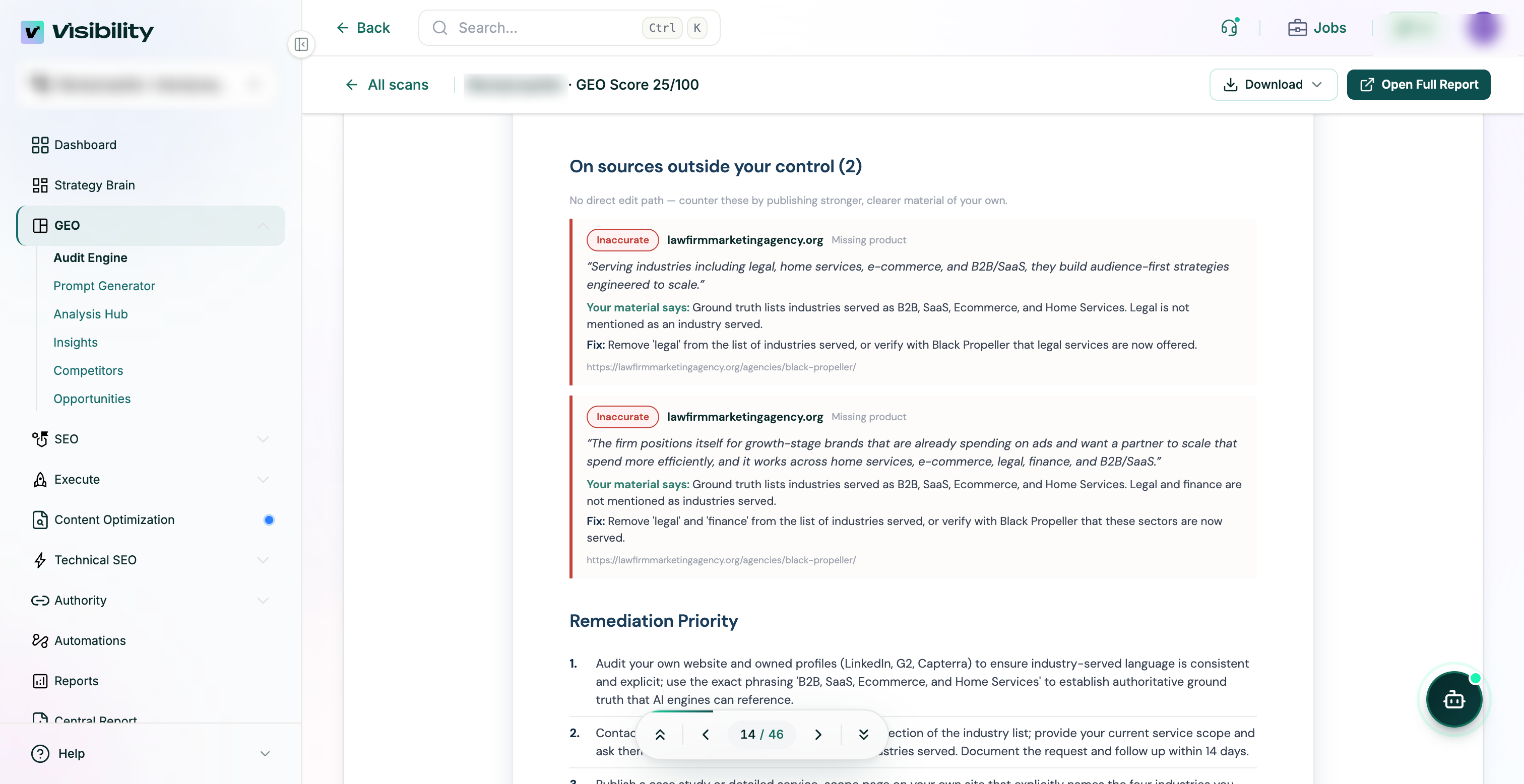
For example, a team monitoring support-related prompts can examine unfavorable descriptions, inspect available citations, and compare observations over time. Its next step is to check those claims against support policies, customer feedback, and documented service performance.
The platform supplies monitoring evidence. The team establishes whether a claim is wrong, whether a customer problem needs attention, and which page or publisher to contact. A sentiment label alone cannot make those decisions, and no monitoring tool can guarantee that an external engine will adopt a correction.
Turn Negative Mentions Into Specific Decisions
Start with a small set of buyer questions and investigate the statements that recur. Give each issue an owner, supporting evidence, a next action, and a review date.
Some findings will lead to clearer content. Others will require a publisher correction, a product improvement, or an honest explanation of a limitation. That is what makes sentiment monitoring useful: it gives teams a concrete reason to investigate what buyers may be hearing.
Explore Pixis Visibility to monitor how AI describes your brand, or book a demo to discuss your monitoring needs.