
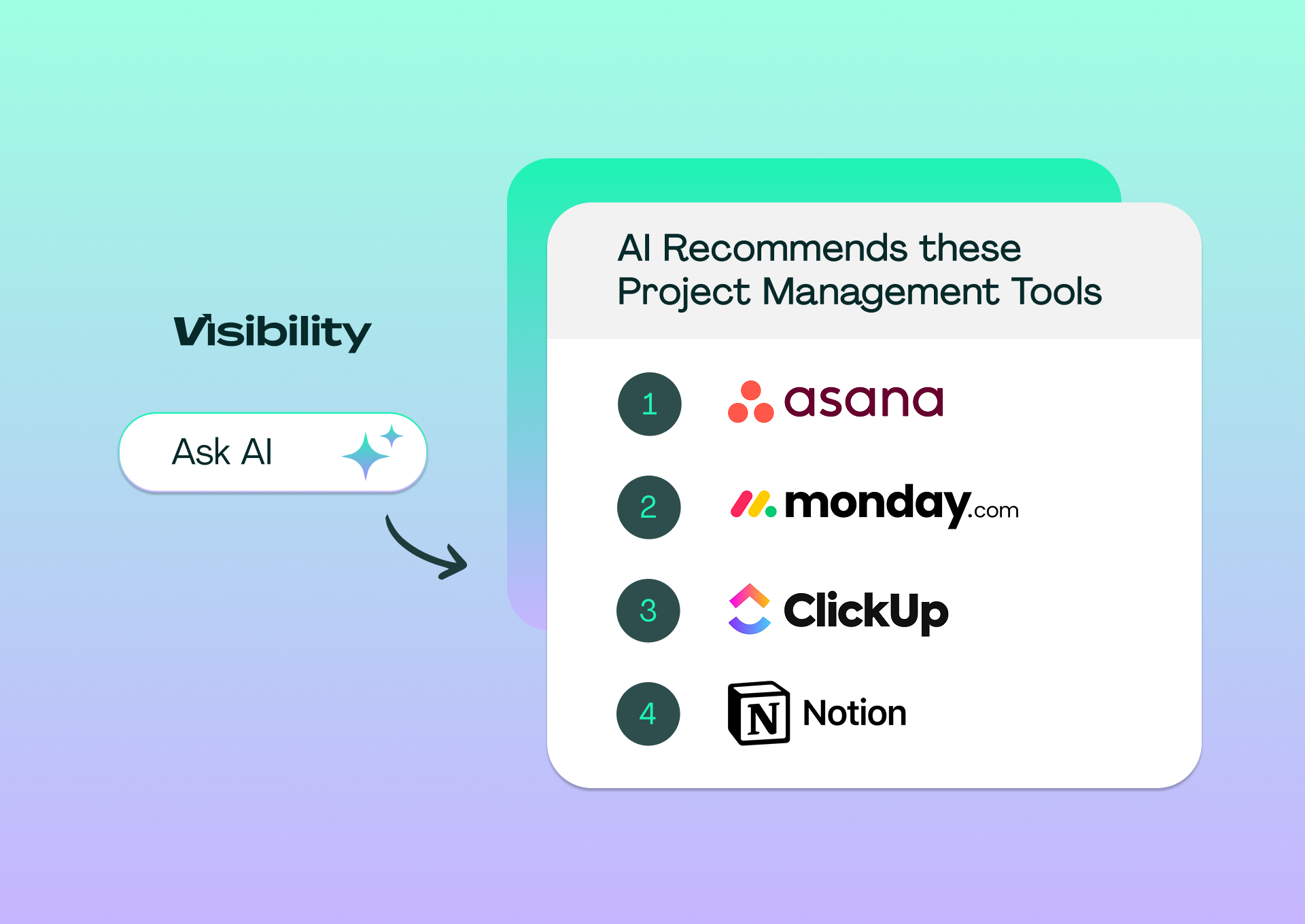
AI engines are quietly re-sorting the project management software market into five distinct visibility battlegrounds, each moving at its own speed. Audit data across Asana, monday.com, and Celoxis shows why strong products vanish from AI answers, and what actually fixes it.
For two decades, a software buyer with a question typed it into Google, skimmed a page of blue links, and clicked through to a few. That journey is quietly breaking apart. A growing share of buyers now open ChatGPT, Gemini, Perplexity, or Claude and ask, in plain language, "what's the best project management software for my team," and the model answers with a short, confident shortlist. Three or four names, a reason for each, no page two. Gartner predicted that traditional search engine volume would drop 25% by 2026 as AI chatbots absorb queries that once went to search, and buying behavior in this category suggests the shift is well underway.
For a category as crowded and heavily researched as project management software, this is more than a channel change. The entire market is being re-sorted, and the data shows the re-sorting is happening unevenly, at different speeds, in different parts of the category, with very different rules for who wins.
Key takeaways
- Project management software is five AI-visibility markets stacked on top of each other, at very different stages of maturity. Only one of them, vendor comparison, is even close to being decided.
- Generative engine audits of Asana, monday.com, and Celoxis (50 buyer prompts per brand, 200 AI responses each across four engines) found that the presence of the answer varies enormously: Asana appeared in just over half of responses, monday.com in roughly a third, and Celoxis in about one in five.
- Rank barely varies once a brand is named. All three landed in the same 2.7 to 2.8 average position band, with 77% to 79% of mentions in the top three. Getting into the answer at all is the differentiating variable, not where you sit inside it.
- The gap stems from EEAT and structured-data signals on each brand's site, rather than from product quality or brand awareness. Asana scored 43/100 on EEAT and monday.com 36/100, with missing author bios and thin schema coverage dragging both down.
- The losses are invisible to standard analytics. When an AI engine substitutes a competitor into an answer, no click, session, or impression is recorded anywhere.
- Four upstream segments (procurement, AI-powered work management, collaboration, and education) remain unclaimed. The brands that publish the clearest reference content there will shape the default answers before the segments consolidate.
The category is actually several markets, not one
Treat "AI visibility in project management software" as a single competition, and you will misread it. Break down what buyers are actually asking AI engines, and the category splits into distinct markets at very different stages of maturity.
Software selection and vendor comparison. Prompts like "best PM software for a 50-person team," "Asana vs monday.com," "Wrike pricing compared to Smartsheet." This segment is saturated. The same names recur across nearly every AI answer: ClickUp, Monday.com, Asana, Jira, Smartsheet, Wrike, Microsoft Project, Trello, Celoxis, Zoho Projects, Basecamp, Notion, Teamwork, pulled from a concentrated set of trusted sources including Gartner, G2, Capterra, Forbes Advisor, and TechRadar. High competition, high AI consensus, low remaining upside.
Procurement and evaluation workflows. Prompts about how buying committees should structure a purchase decision: "how to run a PM software evaluation," "RFP template for work management platforms," "questions to ask project management, vendors." No consolidated ownership exists yet. Multiple vendors surface across answers, but none have become the default reference that the engines return to.
AI-powered work management and workflow automation. Prompts like "agentic work management," "AI teammates for project delivery," and "intelligent project planning tools." This is the fastest-growing prompt category in the space, and the least settled. Engines recognize the segment exists; they do not yet agree on how to define it, which vendors anchor it, or which sources best describe it.
Cross-functional collaboration and work coordination. Prompts around team alignment, work visibility, and project communication. Sourcing here is fragmented, with no dominant framing and no single publisher owning the topic.
Project management education. Prompts like "what is a work management platform," "project governance explained," "waterfall vs agile vs hybrid." This segment has the lowest competition and weakest source ownership of any part of the category, and it is growing fastest, as more buyers use AI to build understanding before they ever reach a comparison prompt.
The throughline: the market is moving from tool-centric prompts ("which software should I buy") toward workflow-centric ones ("how should teams coordinate, automate, govern, and optimize work"). The comparison segment is mature and largely decided. Everything upstream of it is still being written, and the education segment matters disproportionately because it shapes the mental model a buyer carries into subsequent prompts. A buyer who learns the category's vocabulary from one brand's explainer tends to evaluate every vendor through that brand's framing.
The sources that shape the answers
Source ownership explains why the comparison segment is so hard to break into. A concentrated ecosystem exerts disproportionate influence on how AI engines construct project management software answers: analyst research such as the Gartner Magic Quadrant and Gartner Peer Insights, review platforms including G2, Capterra, Software Advice, and TrustRadius, and editorial publications like Forbes Advisor, TechRadar, PCMag, Project-Management.com, and The Digital Project Manager. These sources appear repeatedly as foundational references across rankings and evaluation frameworks, which is exactly why a new entrant can rank well on paper and still struggle to break into the market.
In the four open segments: procurement, AI-powered work management, collaboration, and education, no equivalent ecosystem has consolidated yet. That absence is precisely what makes them open. There is no incumbent reference to displace, only a category waiting for someone to become it.
Even inside the "decided" segment, the data tells a different story
Here is what makes this more than a theoretical framework. Generative engine audits were run on three platforms squarely inside the mature comparison segment: Asana, monday.com, and Celoxis. Each audit covered 50 buyer prompts per brand across OpenAI, Gemini, Perplexity, and Claude, for a total of 200 AI responses per brand. Repeated runs across multiple engines matter here because AI answers are non-deterministic; the same prompt can return a different shortlist on a different day, so single-session checks produce noise rather than signal. The pattern only becomes reliable at volume.
If the comparison segment were really as consolidated as the source-ownership data suggests, quality and consensus should track together cleanly. They don't.
Asana appeared in just over half of all AI answers in its space and led its competitive set on share of voice. Monday.com showed up in roughly a third of responses. Celoxis, a capable and well-regarded enterprise tool, appeared in only about one in five cases and lost to Smartsheet in 38 instances where a buyer asked a direct comparison question and Celoxis wasn't named. Each of those 38 moments represents a qualified buyer who asked a question Celoxis could credibly answer, and heard a competitor's name instead.
Yet the average position, when a brand was named, barely moved between them. All three landed in roughly the same 2.7 to 2.8 range, with 77% to 79% of mentions in the top three. When AI engines name a credible vendor, they rank it well, almost regardless of which vendor it is. The differentiator was whether the brand showed up in the answer at all, and rank had almost nothing to do with it.
That distinction matters for how the whole category should be read. "Saturated" and "high AI consensus" describe agreement on who's good, and say nothing about agreement on who gets mentioned. The real variance shows up at two specific funnel moments.
Top-of-funnel, unbranded prompts. These are the "what tools exist for this" questions asked before a shortlist forms. Visibility here fell sharply down the set: 39% for Asana, 15% for monday.com, and just 7% for Celoxis. Miss this stage, and you are not on the mental list by the time the buyer reaches a comparison prompt. The shortlist an AI engine produces at this moment often becomes the buyer's entire consideration set; there is no page two to rescue a brand the model left out.
Generic comparison prompts. "X vs Y" and "best tool for [use case]" questions. Every brand scored close to perfect when a buyer already knew their name and asked about them directly. The gap opens entirely in the moments before a name is chosen: Asana held 44% share here, monday.com 34%, Celoxis 28%. That gap is invisible to standard web analytics, since no click or session is recorded when an AI engine silently substitutes a competitor into the answer instead. A marketing team watching organic traffic and branded search volume can look perfectly healthy while losing a growing share of buyers it never knew existed.
What actually explains the gap, and why it applies to the whole category
The audits point to a consistent driver, and it is neither product quality nor brand awareness. The driver is the set of trust and structure signals AI engines can actually read off a brand's own site, commonly grouped under EEAT (Experience, Expertise, Authoritativeness, Trustworthiness), the framework Google itself uses to describe helpful, reliable, people-first content. Generative engines lean on the same class of signals when deciding which sources to retrieve and cite: named authors with visible credentials, claims supported by external citations, structured data that tells a machine what a page is and who wrote it, and content that states answers plainly enough to be lifted into a response.
The audit numbers make the gap concrete. Asana scored 43/100 on EEAT and monday.com scored 36/100, both held back by missing author bios, thin external citation, and sparse structured data. Monday.com was fully crawlable by every major AI crawler (100/100) with strong internal linking (100/100), yet used just 5 of 18 recommended schema types, averaged 732 words per page, and had zero author bios across its 50 sampled pages. A site can be perfectly accessible to AI crawlers and still give them nothing that establishes why its pages deserve citation. Crawlability gets an engine in the door; trust signals decide whether it quotes you.
None of this is exotic. It is ordinary publishing hygiene, and exactly what generative engines use to decide whether a source is worth citing. The foundational academic work on the discipline, the Princeton GEO study presented at ACM KDD 2024, tested content modifications across thousands of queries and found that adding relevant statistics improved a source's visibility in AI answers by roughly 41%, and adding quotations from credible sources by around 28%. Precise, attributed claims earn citations that generalizations do not. For a closer look at the retrieval mechanics behind this, see our breakdown of how AI engines read the internet to build answers, and our guide to why schema markup still matters for SEO and GEO.
This is the throughline connecting the mature segment to the open ones. In the comparison segment, weak EEAT signals explain why strong, well-regarded products like Celoxis are skipped in unbranded prompts despite ranking well when named. In procurement, AI work management, collaboration, and education, where no source ecosystem has consolidated yet, the same signals will determine who becomes the default reference AI engine while the category is still being defined.
The mechanism does not change; only the stakes do. Getting it right in an unsettled segment does more than win a citation. It can define the answer for years, as Gartner and G2 effectively became permanent fixtures in the comparison segment.
Two clocks are running, and they favor different moves
In the comparison segment (Asana, monday.com, Celoxis, and peers), the fix is narrow and mechanical: close the EEAT and structured-data gaps to stop leaking unbranded, top-of-funnel moments to competitors who show up more often for comparable quality. In practice, that means adding named author bios with real credentials to every substantive page, expanding schema coverage beyond the handful of default types most sites deploy, citing external sources so claims can be verified, and restructuring key pages so the answer to a buyer's question appears near the top rather than after eight paragraphs of buildup. This is a defensive move. It protects a position in a market that is already largely determined, with a real but bounded ceiling on the visibility it can add.
In procurement, AI-powered work management, collaboration, and education, the opportunity looks like open-field SEO in its earliest years: no dominant source ecosystem, no standardized answer structure, rapidly growing prompt volume. A brand that publishes the clearest procurement framework, the clearest definition of agentic work management, or the clearest plain-language explainer of what a work management platform even is does more than win a citation. It shapes what the "settled" answer looks like once these segments mature, as the comparison segment already does. The offensive playbook favors definitional content: canonical explainers, named frameworks, original data, and glossary-grade clarity, published with the same EEAT hygiene the defensive fix requires.
The two moves also demand different measurements. Defensive work is scored by the presence in unbranded and comparison prompts against a known competitive set. Offensive work is scored by whether an engine adopts your definition, your framework name, or your framing when a buyer asks an open question nobody owns yet. Each engine weighs sources differently, too; our comparison of how ChatGPT, Perplexity, and Gemini handle sources explains why a strategy tuned to one platform leaves the others on the table.
The disciplines involved sit at the intersection of traditional search and AI citation, and the distinction is worth understanding before committing budget. Our guide to what separates GEO from SEO, and what still applies to both, maps where each one operates.
The industry-level takeaway
- Project management software is transitioning from a mature software-comparison ecosystem into a broader work-management ecosystem: a largely decided comparison market (where Asana, monday.com, ClickUp, Jira, and Celoxis already compete on citation share) sitting on top of four still-unwritten ones covering procurement, AI orchestration, collaboration, and education.
- The same underlying signal, brand trust, and structural readability to AI engines, determines who wins in both.
- Even inside the most consolidated segment of the category, genuinely strong products (Celoxis being the clearest example) are being left out of a meaningful share of AI answers for reasons that have nothing to do with product quality and everything to do with content and markup choices well within a marketing team's control.
- The brands that treated search optimization seriously in their first years captured an advantage that competitors spent a decade trying to claw back. The same window is open now for AI visibility, specifically because the majority of the category is not measuring it yet, in either the segment that has already been decided or the ones that have not.
- The next visibility wins in this category will come from owning workflow, procurement, AI orchestration, collaboration, and education conversations, while comparison prompts grow ever more saturated and difficult to influence.
Measuring it is the starting point. Pixis Visibility runs this exact analysis continuously, tracking citation share, share of voice, and source patterns across ChatGPT, Perplexity, Gemini, and Claude with repeated sessions per prompt, then converting each visibility gap into a brief a content team can act on. The audit data in this piece came from the same methodology, so the signal is reliable enough to build a strategy on rather than a one-off snapshot. For teams comparing approaches, our review of the best AI visibility platforms for marketing teams covers where monitoring-only tools stop, and execution platforms begin.