
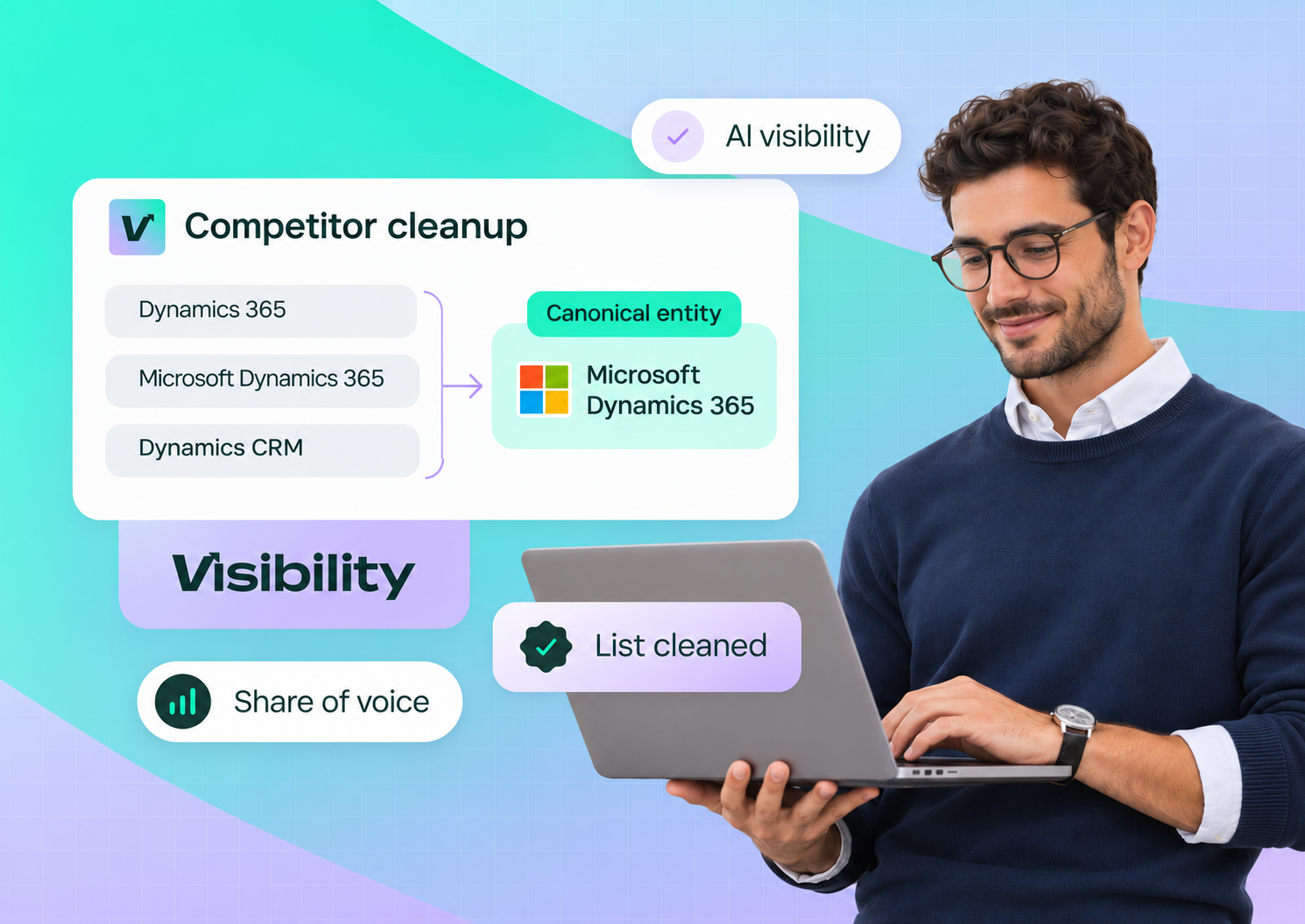
Your AI visibility report lists twelve competitors, and three of them are the same company. One row says "Microsoft Dynamics 365", another says "Dynamics CRM", and a third just says "Dynamics 365". Each one looks small. Together they are one of your biggest rivals.
This happens because AI models do not name companies consistently. The same engine can use a short name in one answer, a legal name in the next and a legacy product name in a third. When every spelling becomes its own row, one competitor's mentions are split across the report and every share of voice figure is wrong.
The fix is not a find-and-replace. Some variants should be merged and some should stay separate, because a government edition or an industry-specific product is a different purchase from the base product. The rule that decides it is the buying decision, not the corporate structure.
This guide explains how to build a mapping sheet, which folding rules to apply, how to re-baseline share of voice, and how to keep the list clean as models change.
Key takeaways
- Group competitors by buying decision, not by corporate structure: one row per product a buyer would choose between.
- Fold case variants, hosting labels and edition or tier labels into the base product, and keep products with their own pricing page, data model or vertical market as separate rows.
- Every alias needs a documented basis in a real AI answer, so keep the original answer text next to each mapping.
- Re-baseline share of voice after every cleanup and tell stakeholders before the numbers move, so the shift is not read as a performance change.
- Pixis Visibility shows the actual AI answer for each prompt, separates tracked competitors from discovered ones and merges duplicate names automatically with an undo; the final folding decisions stay with your team.
Why the same company shows up more than once
A surface form is any string a model uses to name a competitor. The variety is larger than most teams expect. One published analysis of entity folding audited a single CRM-tools corpus and found 205 surface forms that mapped to just 96 products.
The variation compounds across engines. ChatGPT, Perplexity, Gemini and Claude each have their own naming habits, and repeated runs of the same prompt on one engine can produce different forms. A list that was clean last quarter will not stay clean on its own.
The cost shows up in every comparison. If a rival is split across three rows, each row looks minor, the rival's true share is understated, and you may rank yourself above a competitor that actually leads. The opposite error, merging two genuinely different products, hides a competitor that buyers actually evaluate.
Build a mapping sheet before you change any report
Start with evidence, not with the competitor list. The mapping sheet is the record of every folding decision, and it is what lets someone else check your work later.
Collect three things:
- Your current competitor list, with whatever grouping or tags it uses today.
- The AI answers behind each visibility report. You need the actual answer text per prompt across the engines you track, not only the aggregate scores.
- A spreadsheet with one row per surface form, the canonical name you assign it, the answer it came from and the rule you applied.
Then scan every answer for names that refer to the same company. Record each surface form exactly as the model wrote it, including capitalization and qualifiers. Preserve the original answer text beside the mapping so the classification can be checked against the source.
Apply folding rules by buying decision
The same study grouped its 205 surface forms into 96 canonical products using nine rules, labeled R0 to R8. They work well as a checklist, because each one asks a specific question about a surface form.
- R0, case variants: fold.
- R1, slash alternatives: fold.
- R2, parenthetical qualifiers: fold unless they name a vertical product.
- R3, hosting qualifiers such as "Cloud" or "On-Premise": fold.
- R4, edition and tier qualifiers: fold.
- R5, corporate prefixes: fold.
- R6, sub-brand and legacy names: fold unless sold separately.
- R7, vertical products: keep separate.
- R8, trailing category words: fold.
The separation test behind every rule is the same: could a buyer choose this variant instead of the base product as a different purchase? A hosting label describes deployment, so it folds. A government edition or a health-industry product targets a different buyer with its own pricing, so it stays as its own row.
Parent company or product name
Pick one canonical name per buying decision and use the name the market uses when it compares options. If buyers ask for the product, track the product. If they compare parent brands, track the parent.
Keeping both as separate rows splits one rival's mentions across two entries. Overwriting the product name with the parent name causes the opposite problem when the parent sells several products buyers compare separately. Record the parent in the mapping sheet as metadata, not as the reporting unit.
Sub-brands and vertical products
A sub-brand that buyers evaluate as an alternative to the parent product needs its own row, whoever owns it. Folding it removes the signal that tells you whether models recommend your product against it.
The same applies to vertical products. If you sell into healthcare and a rival has a dedicated healthcare edition, merging that edition into the base product hides exactly the comparison you care about.
Aliases need evidence
Do not add every word in a company name as an alias. Each alias should match a surface form a model actually used in an answer you can point to. Aliases that never appeared create phantom matches and inflate counts.
A worked example from the CRM study
In the study's corpus of 132 AI answers, the largest Dynamics 365 row, "Microsoft Dynamics 365", held 25 answers. Eleven sibling rows, down to "standard Dynamics 365" with a single answer, held the rest.
Before folding, those 28 answers were spread across 12 rows, each counted as a distinct competitor. After folding the variants into one canonical entity, the corrected board credits Dynamics 365 with 28 of 132 answers in a single row.
The change in one row looks small. Repeated across every competitor with naming variants, it changes the shape of the whole report: fewer rows, higher counts per row and a share of voice split that matches how buyers actually choose.
Re-baseline share of voice after the cleanup
Cleaning the list changes the denominator, so every share of voice figure moves even though the underlying answers have not changed. That is expected, and it needs to be explained before anyone sees the new numbers.
Re-baseline after every entity cleanup, after adding or removing a tracked competitor, and after any acquisition or rebrand that changes how models name a rival. Keep the old and new baselines side by side for one reporting period so the shift is visible and attributable.
The cleanup affects more than share of voice. Mention rate, average position, citation rate and top-3 presence all depend on correct entity counts. An illustrative case: a brand named in 240 of 1,200 answers has a 20% mention rate, but that figure is meaningless if the same brand was counted under two names. For how share of voice is calculated and where it misleads, see attributed share of voice in AI search.
Check the cleaned list against the raw answers
Run a before-and-after comparison with the old and new lists side by side. The cleaned list should show fewer rows with higher counts per row. Two patterns signal a mistake:
- A row's count drops after folding. A surface form was probably assigned to the wrong canonical entity.
- A genuine competitor disappears. It may have been merged into another entity by mistake.
Both errors send you back to the answer text. Pull a sample of answers, apply the nine rules in order, and confirm every surface form in the sample has a mapping. Add any missing mapping before the cleaned list goes into live reports.
Check the result across engines, not only on one. Naming habits differ by model, so a list that looks clean on one engine can still split a rival on another. For why single-engine checks mislead, see multi-engine testing for GEO.
Keep the list clean as models change
New surface forms appear as models update. Treat the mapping sheet as the single source of truth and route every newly discovered name through it before it earns a row in your tracked list.
A quarterly review is enough for most teams. Compare discovered competitors against the mapping sheet, decide which ones deserve tracking, and rerun the comparison on a fresh set of prompts to confirm the cleaned list still holds.
Your AI competitor set can differ from the rivals your sales team meets in deals. A name that keeps appearing in AI answers deserves a decision either way.
Where Pixis Visibility fits
The cleanup starts with evidence, and the evidence is the answer text. Pixis Visibility shows the actual AI answer for each prompt across ChatGPT, Perplexity, Gemini and Claude, so you can see exactly how each model named each competitor.
Its competitor matrix separates the competitors you track, up to 20, from competitors discovered in answers that you have not added yet. That split gives you a natural review queue: discovered names go through your mapping sheet before they become tracked rows. Brand mentions, average position, citation rate, share of voice and top-3 presence are tracked alongside, so you can see how the cleanup changes each metric. After each GEO run, it also reviews the competitor list automatically, merging two names of one company into one column and hiding your own brands and names that are not companies, and you can undo any correction or merge names yourself.
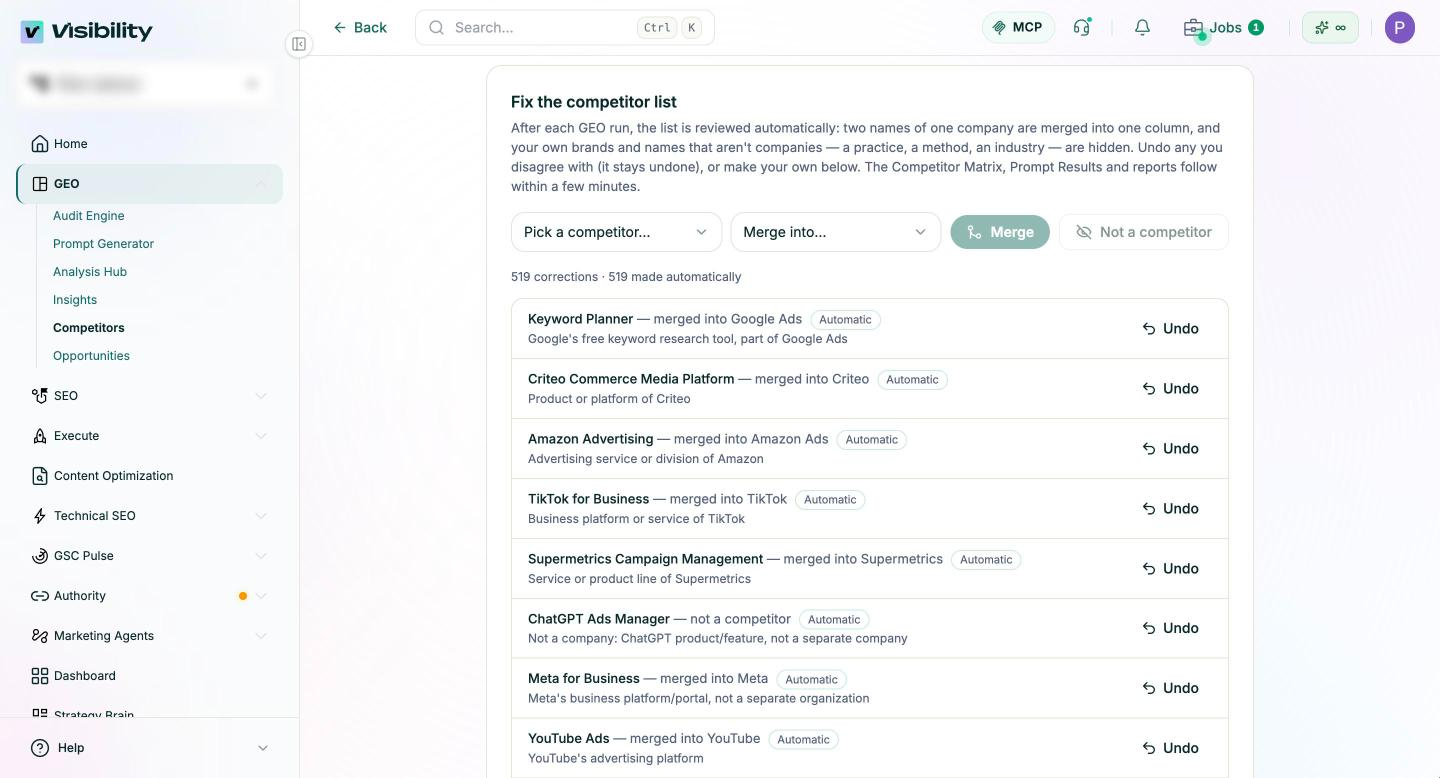
A scheduled GEO audit with share of voice by funnel stage lets you compare periods before and after a cleanup, and export the result as a PDF or PowerPoint for stakeholders.
What stays with your team is the judgment: checking the automatic merges, deciding which variants are the same purchase, which vertical products deserve their own row, and when to re-baseline.
Start with your three largest competitors
You do not need to clean the whole list at once. Take your three largest competitors, pull every answer that mentions them, and build the mapping sheet for those names first. That usually exposes most of the naming patterns in your category.
Then apply the nine rules, re-baseline, and brief stakeholders on why the numbers moved. Extend the sheet to the rest of the list once the method is agreed.
Get started with Pixis Visibility to review the actual AI answers behind your competitor list and track share of voice against a clean set of rivals.
FAQs
What does re-baselining share of voice mean?
It means recalculating share of voice against the cleaned competitor set and treating that result as the new starting point. Because the denominator changes, every percentage shifts even though no answer changed. Report the old and new baselines side by side for one period, and re-baseline again after any acquisition, rebrand or change to the tracked list.
What is the difference between tracked and discovered competitors?
Tracked competitors are the names you actively monitor and report on. Discovered competitors are names that appear in AI answers but have not been added to your tracked list. Review discovered names against your mapping sheet before promoting them, so a new spelling of an existing rival does not become a duplicate row.
Should a sub-brand be its own competitor row?
Yes, if buyers evaluate it as a separate purchase from the parent product. Ownership does not matter; the buying decision does. If the sub-brand is only a legacy name or a marketing label for the same product, fold it into the base product and record the decision in the mapping sheet.