

AI-written content often gives readers the same problem it gives search: another page repeating what is already available. The sentences are fluent. The article covers the topic. But there is little in it that makes the page worth choosing.
We rebuilt how Pixis Visibility writes around one rule from an agency client's style guide: generic, inflated statements must never replace specific facts.
I think that rule gets closer to the problem than a list of words to avoid. An article can lose every obvious AI phrase and still have nothing useful to say. The work is to preserve the information that makes it worth reading.
We put that approach to work on two sites in our group. On pixis.ai, 24 of 26 published pieces were picked up by AI engines. At Black Propeller, 20 of 21 articles were cited in AI answers, and 12 held the first answer position in our tracking.
Here is how we built the process, and what we observed after publishing.
Key Takeaways
- Start with a specific point of view. Give the writer an argument grounded in your experience before generating the brief.
- Research before drafting. Attach sources to facts, and keep unsupported figures and quotes out of the article.
- Separate writing from evaluation. Pixis Visibility uses an independent judge, revision passes, and a final style check before human approval.
- Edit for information, not just tone. Replace generic claims with the specific capability, finding, or example the reader needs.
- Measure against the questions the content answers. In our reporting, AI engines picked up 24 of 26 Pixis pieces and cited 20 of 21 Black Propeller articles. Broader search gains accompanied publishing, content revisions, and technical SEO work.
What the fault looks like on the page
The failure is easy to miss during a quick read. A sentence that should explain a capability becomes a general claim about efficiency. A passage that needs evidence instead tells you why the topic is important.
“A robust platform to streamline your workflow” is a good example. It tells you neither what the platform does nor how it changes the work. Replacing “robust” with a less inflated adjective leaves the same empty sentence.
These are some of the patterns we check:
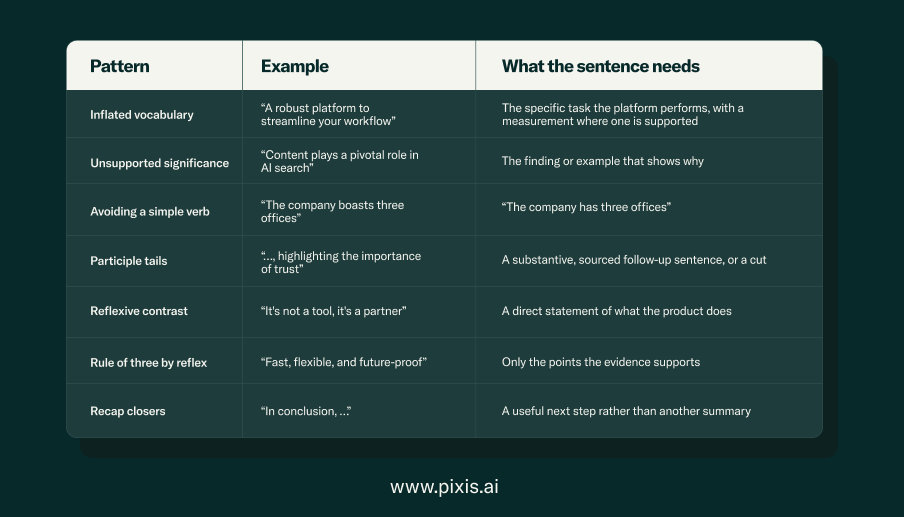
None of these problems is solved by swapping a word. My test is whether the edit restores information. Find the fact the sentence avoided, or delete it.
Our house rules track more than 80 writing patterns, and we update the list as models change. These are editorial checks, not a test of whether a human or a model wrote the sentence.
Your brand kit sits on top of those house rules. You can add your own voice, terminology, and writing preferences. Where they differ from the house style, your brand kit takes precedence.
Every piece starts with your take
Before a brief is generated, Visibility asks for your point of view on the topic. Upload a document, add a link, or type it in. The brief is built around that input.
This is where I would spend time before asking for a draft. What has your work taught you that the existing articles leave out? Perhaps a common recommendation breaks down in a situation your team encounters regularly. Explaining that exception gives the writer something more useful to develop than another version of the standard advice.
Research supplies the evidence. Your take determines the argument the article will make with it.
How the platform writes a page
No single model writes and approves its own work. Each draft moves through research and writing, followed by an independent judge and a style check. The sequence makes the work easier to inspect before an editor approves it.
1. The brief starts from a gap.
Visibility identifies prompts where competitors are cited and your brand is missing, alongside keyword opportunities in search. It builds the outline around that gap and your take. Our house style uses sentence-case headings and leaves out automatic recap sections.
2. Research comes before writing.
The research step gathers statistics, definitions, examples, and named sources from the live web. Every fact carries the URL it came from. Material the research step cannot verify is dropped before it reaches the writer.
3. The writer works from the sourced facts.
The writer is instructed not to introduce a figure or quote that is absent from the research. If the evidence is thin, the draft must work within that limit. A section does not become more useful because a plausible statistic fills the space.
4. Every link is fetched.
The workflow removes links that fail to load or are identified as competitor destinations. Each paragraph holds no more than two links. Fetching checks the destination; the judge's claim review checks whether the research supports what the draft says.
5. A separate judge scores the draft.
The judge evaluates nine weighted categories, with brand voice and factual accuracy accounting for 20% each. It checks claims against the research. The passing threshold is 8.0 out of 10, with no critical issue left open.
6. Failing sections are revised and scored again.
The loop runs for up to three passes and retains the highest-scoring version for review. The score helps identify work that needs attention; it is an internal quality measure, not a forecast of rankings or citations.
7. The house style runs last.
Code handles the formatting rules. A final pass then rebuilds each flagged sentence around a fact or cuts it. This brings the draft back to the rule we started with: specific information should survive the writing process.
8. A person can step in throughout.
You can edit the brief before drafting, refine a single section, or send the article back with feedback. Nothing gets published until you approve it.
The checks give the editor a more developed draft to work with. They also make the process visible: the evidence is attached, the evaluation is separate, and the person approving the page can intervene.
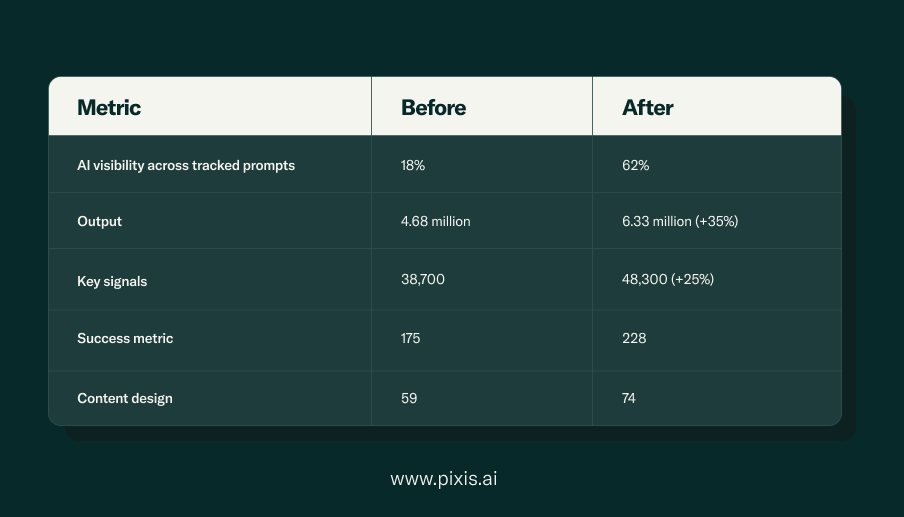
The work began with high-intent prompts where Pixis was missing. Visibility recommended content to address each gap, and we built templates for the formats the team needed, including how-to guides and comparison pages.
After publishing, we ran the target prompts again. That kept the measurement tied to the question each article had been written to answer.
Technical work ran alongside publishing. Using the platform's technical SEO module, the team addressed schema markup, internal linking, robots.txt, page consolidation, and metadata.
The site-wide search gains reflect that combined program. They should not be attributed to the 26 articles alone, or to any single writing rule.
Case study: Black Propeller
At Black Propeller, the opportunity included a substantial existing blog. The paid media agency is part of the Pixis group, and we applied the same process to its May prompt set while revising the library already on the site.
Twenty of 21 articles were cited in AI answers. The team also reported 11 leads attributed to AI search. Alongside those results, site-wide search performance changed as follows:
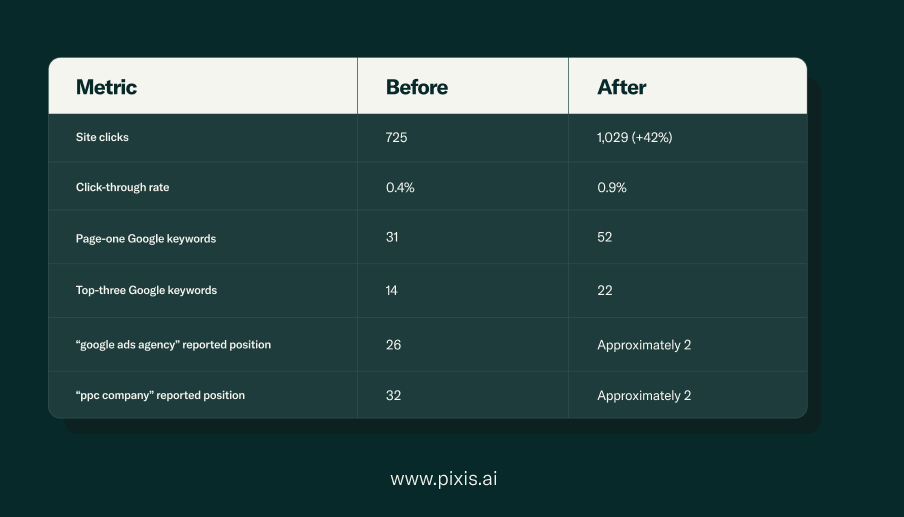
Two articles reached Google's first position and appeared in AI Overviews in our checks: “10 signs you need help with Google Ads” and “Google Ads vs Smart Campaigns vs AI Max.” Branded clicks rose 58%.
The agency's site needed more restructuring than ours, so new publishing was only part of the work.
We organized the existing library. The blog was grouped into five topic clusters: Google Ads and PPC; paid social; home services; SEO and GEO; and conversion and measurement. Internal links connected pillar content to relevant service pages.
We revised existing articles. The team kept useful material that already ranked and reworked other sections against the platform's recommendations. Revised guides on Pinterest ads, keyword match types, ChatGPT ads, and Meta Ads Manager appeared on Google's first page in our reporting.
We filled the remaining gaps. The platform generated prompt opportunities, new articles were written to address them, and the prompts were run again after publication. Technical fixes continued across the site in parallel.
The Black Propeller case study covers the broader program. As with Pixis, the table reports site-wide search results, while the citation count describes the article set. These are observations from our reporting, and positions can vary by query and search conditions.