You ask ChatGPT the question your article was written to answer. It cites a competitor. You read both pages side by side and the problem is obvious: your answer is there, but it is buried in the third paragraph of a section that opens with background and never states the point plainly.
The rest of the article is fine. Rewriting all of it would take a day, risk breaking what already ranks, and probably flatten the parts that work.
AI systems quote passages, not whole pages, so one vague section can cost a citation even when the page around it is strong. A targeted fix to that passage is often the right move. The risk is in the edges: a patch that reads well on its own can repeat a point, change a definition or break the flow of the article.
This guide covers how to find the weak passage, how to rewrite it answer-first, how to keep the edit small, and how to check the result.
Key takeaways
- Use three signals to find the weak passage: Search Console queries with impressions but few clicks, AI answers that cite a competitor for your target prompt, and sections that are hard to read.
- Rewrite answer-first: put the direct answer in the first sentence under the heading, then add the evidence, example or definition that makes it self-contained.
- Keep the edit inside one section. If more than half of that section's text needs to change, plan a deliberate section rewrite instead of a patch.
- Read the whole article after the edit and check every number, date, name and qualifier against the original.
- Pixis Visibility shows the actual AI answer for each tracked prompt and a competitor matrix, so you can see which pages win the citation before and after your fix.
Confirm that a patch is the right fix
A passage-level fix works when the article's premise still holds and the problem sits in one place. If the topic has moved on, two sections overlap, or an idea is introduced twice, a patch will not help. That is a structural problem and calls for a broader refresh. For deciding between the two, see how to keep stale drafts from eroding content quality.
Google's guidance on traffic drops makes a similar distinction. A small drop in position is often not worth acting on, especially on content that is still performing. A larger, sustained drop deserves a closer look at the page.
You need three things: Search Console access for the page, access to at least one AI assistant (ChatGPT, Perplexity, Gemini or Claude), and the published URL. You do not need a full content audit.
Step 1: Find the weak passage
Three signals point to the passage that needs work. Use at least two before you decide.
Signal 1: Queries with impressions but few clicks
In the Search Console Performance report, filter to the page and sort queries by impressions. Look for queries with healthy impressions and low CTR, and for queries whose impressions have dropped over a long window. Those queries describe what searchers expected to find; the gap usually sits in one section. For pulling question-shaped queries out of Search Console, see how to find AI queries in Google Search Console.
Signal 2: AI answers that cite someone else
Type the target question into one or more AI assistants and read which sources they cite. If a competitor's passage appears where yours should, compare the two. The competitor's version usually states the answer earlier, names the subject more clearly or includes a specific fact yours lacks.
Signal 3: Sections that are hard to extract
Read the candidate section as if it were the only thing a reader saw. A passage that an AI system struggles to quote usually has one of three problems:
- The answer does not sit directly beneath the relevant heading.
- The central entity is not named consistently, so pronouns carry the meaning.
- The claims depend on context from earlier paragraphs and stop being true when lifted out.
A readability checker can help flag sections where sentence length or reading level spikes, but your own read is the better test.
Step 2: Describe the problem before you rewrite
Write down what is wrong in one or two sentences before you change anything. "Make this better" gives an editor or an AI model nothing to work with and tends to produce generic prose. Name the problem:
- "The main claim is in the last sentence. Move it to the first."
- "This repeats the previous section. Keep only what is new."
- "The term is defined differently here than in the introduction. Use the introduction's definition."
If you use an AI model for the draft, give it that description plus constraints: the length, the claims that must stay, and the qualifiers that must not be dropped.
Step 3: Rewrite answer-first
Lead with a one-sentence direct answer or definition. Follow with the evidence that makes it self-contained: a specific fact, an example, a short list or a small table. The goal is a short paragraph a reader, or a model, can lift and quote without needing the rest of the page.
An illustrative example. Original: "Email open rates have been declining in recent years." Rewrite: "Email open rates fell 12 percent year over year in 2024, driven by privacy changes and inbox saturation." The figure here is illustrative; in a real rewrite, use a number you can source and link. The point is the shape: a specific claim first, then the reason.
Concrete, attributable material tends to give AI systems clearer passages to quote than vague prose. Research on generative engine optimization by Aggarwal and colleagues found that adding citations, quotations and statistics were among the most effective changes they tested, and the gains were somewhat smaller when they repeated the tests on Perplexity, a live engine. Treat that as directional, not a guarantee. For prompts that help build passages like this, see five prompts for building content worth citing in AI answers.
Step 4: Keep the edit small
Use one rule for scope: the edit stays inside one section, and if more than half of that section's text has to change, stop patching. At that point you are rewriting the section, and it deserves a deliberate rewrite with its own outline rather than a series of fixes.
Smaller is usually better. The more of the original that survives, the less risk you take with rankings the page already has and the less chance of drifting from the article's voice.
Step 5: Check the seams and read the whole article
Read the sentence before and after the new passage. If the transition is abrupt, adjust it. If the passage no longer sounds like the rest of the piece, restore your phrasing.
Then read the complete article. Local improvements can create problems elsewhere: an explanation now repeated in two places, a term used two ways, a later section that refers to something you removed.
Watch the qualifiers
Words that limit a claim, such as "may," "some," "up to," "in this study" and "among respondents," can look expendable to a rewriting tool. They are often what keeps the sentence true. After any AI-assisted edit, check every number, date, name and qualifier against the original. For tools that help AI-assisted edits keep a human voice, see the best tools for content humanization.
Add something of your own
Google's January 2025 update to its Search Quality Rater Guidelines tells raters the Lowest rating can apply when almost all of a page's main content is copied or paraphrased with little effort, originality or added value. A rewrite that only rephrases does nothing for you. Add your own number, example or analysis to the passage.
How long it takes
A light refresh of a whole article, which includes rewriting a weak passage, updating statistics and refreshing dates, typically takes 60 to 90 minutes and can recover 15 to 25 percent of lost traffic while deeper refreshes are queued, according to Stanetskyi's content decay analysis.
A single-passage fix is a smaller piece of that work, so it takes less time. Do not borrow the recovery figure for it: that number describes a full light refresh, and a one-passage change may move results more or less depending on how much of the page's traffic depends on that section.
Check whether the fix worked
Keep two kinds of outcome separate. A clearer, better-supported passage is an editorial improvement you can inspect immediately. Whether AI systems and Google reward it is something you have to observe over time.
- AI answers: re-run the target prompt in the same assistants and note whether your page is now cited, and whether it replaced a competitor.
- Search Console: compare clicks, impressions, CTR and position for the page's queries over matched periods before and after the edit.
- Timing: give it time. If a core update rolls out in the meantime, Google's guidance on core updates recommends waiting at least a full week after it finishes before you analyze performance.
Where Pixis Visibility fits
The slow parts of this process are finding the passage and checking the result across several AI assistants, prompt by prompt.
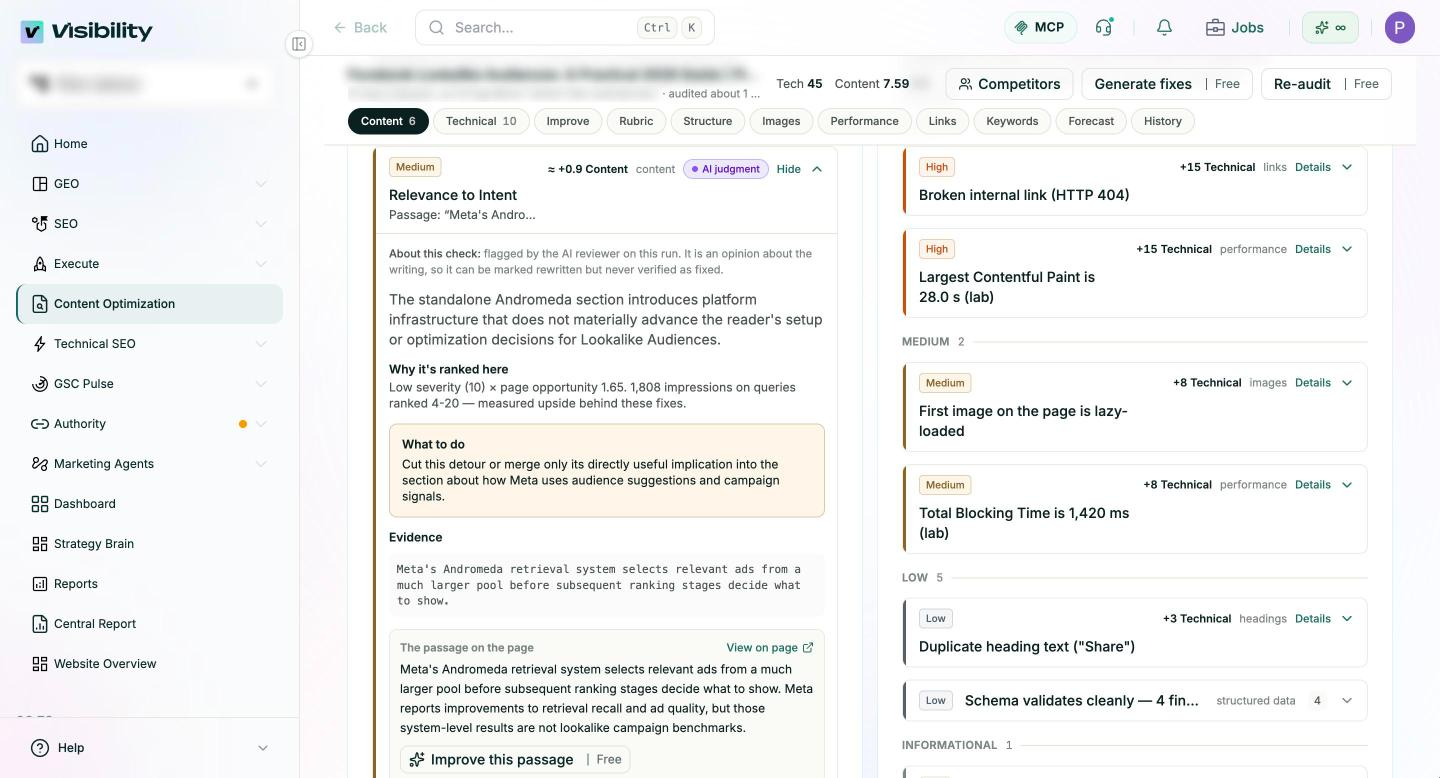
Pixis Visibility tracks your brand's mentions, citation rate, average position, share of voice and top-3 presence across ChatGPT, Perplexity, Gemini and Claude for prompt sets you build or auto-generate. It shows the actual AI answer for each prompt, and its competitor matrix shows which competitors are cited and how often. That turns signal 2 into a list you can work through and makes the before-and-after check repeatable. Its page optimization audits also flag individual passages, show each one as it reads on the page with why it was flagged and what to change, and offer to improve just that passage. The Google Search Console connection shows before-and-after content impact per page and per query once the edit is live.
Choosing the passage, writing the answer-first version and checking the qualifiers stay with an editor. The tool tells you where the citation went; the fix is still writing.
Fix one passage this week
Pick one page that ranks but is not cited for its main question. Run the three signals, write down the problem, and rewrite the passage answer-first within a single section. Read the full article, check the qualifiers, and publish.
Then re-run the prompt and watch Search Console over the following weeks. When the result is clear, move to the next weak passage on the list.
Get started with Pixis Visibility to see which competitor wins the AI citation for each prompt and whether your rewritten passage takes it back.
FAQs
How do I find which passage is weak?
Combine three signals. In Search Console, look for queries with impressions but low CTR. In AI assistants, check which sources are cited for your target question. Then read the candidate section on its own: if the answer is buried, the subject is unclear or the claims depend on earlier paragraphs, that is the passage to fix.
Will AI rewriting tools flatten my voice?
They can, especially with vague prompts. Describe the specific problem, set constraints such as length and which claims must stay, and compare the result with the surrounding text. Restore your own phrasing wherever the rewrite sounds generic.
When should I rewrite the whole article instead?
When the problem is structural: the premise has changed, sections overlap, or more than half of several sections needs new text. A passage-level fix cannot solve those, and a series of patches usually makes the article harder to read.