
Content strategy in 2026 has two jobs. The first is the one it has always had: producing content that ranks in Google search and earns organic traffic. The second is new: producing content that AI engines like ChatGPT, Perplexity, and Gemini cite when generating answers for buyers who never click a blue link.
These two jobs are not at odds. The content depth that earns Google rankings also earns AI citations. The difference is in how deliberately you optimise for each, and whether your platform connects the intelligence from both surfaces to what your content team actually produces.
Pixis Visibility is built for both pipelines. This guide covers the content types that move the needle across traditional SEO and GEO, and maps each one to the specific Visibility capabilities that support its production and measurement.
Key Takeaways
- Content over 3,000 words earns 3.5x more backlinks than shorter content according to 2026 data from DemandSage and PressWhizz, but length is only valuable when it reflects genuine topic coverage, not padding.
- SEO, GEO, and AEO now operate as three distinct disciplines with different optimisation targets. The content types that win across all three share one characteristic: they cover a topic with enough depth and structural clarity that both search engines and AI models can extract useful information from them.
- Pillar and cluster architecture is the most reliable structural approach for building topical authority, which is the foundation of both Google rankings and AI citation.
- Interactive content (calculators, tools, quizzes) and original research are the two content types most likely to earn high-quality backlinks organically. Both require more investment upfront but compound over time.
- Pixis Visibility connects GEO citation data, keyword gap intelligence, and technical SEO monitoring directly to content brief generation and publishing across 27 supported content types, so every piece of content is grounded in what the platform's analysis shows is actually needed.
- The weakest point in most content strategies is not ideation or production. It is the gap between identifying what to create and publishing it. Pixis Visibility closes that gap inside one workflow, now with a Templates feature in the Content section that lets teams generate content quickly, save templates, and reuse them across briefs rather than starting from scratch each time.
What Makes Content Work for SEO and GEO in 2026
Search engines now evaluate content on intent match, topic depth, and authority signals. A page that ranks well demonstrates it is the most useful resource for a specific query, not simply the one with the most keyword mentions. Google's quality evaluation framework considers Experience, Expertise, Authoritativeness, and Trustworthiness as the characteristics of high-quality content, though these are not direct ranking metrics but principles reflected in how content is evaluated.
AI engines add a layer to this. As research from the Pixis blog on AI citation signals confirms, 82% of links cited by AI come from earned media sources: journalistic coverage and third-party references. AI retrieval systems also favour content that has been recently updated, uses clear entity relationships, and provides structured, extractable answers. Content that performs well in traditional search for depth reasons tends to perform well in AI citation for the same reasons.
The practical implication is that diversifying content formats is not just about covering user preferences. Each format serves a different function in building the topical authority that earns both traditional rankings and AI citations.
Long-Form Guides and Comprehensive Articles
Long-form content earns backlinks at a significantly higher rate than shorter content. 2026 data from DemandSage and PressWhizz puts content over 3,000 words at 3.5x more backlinks than shorter articles, while Digital Applied's 2026 blogging data shows 2,000+ word pieces earn 77% more backlinks than short-form content. The mechanism is straightforward: comprehensive guides are more likely to be cited as a reference because they actually cover a topic rather than touching on it.
The caveat matters: length is only valuable as a proxy for depth. A 4,000-word guide padded with repetition earns fewer backlinks than a tight 2,200-word guide that genuinely answers every relevant question on a topic. The goal is coverage, not word count.
Pixis Visibility supports long-form production at the brief level. The GEO Analysis Hub extracts the entities, content sections, and structural patterns that AI models associate with authoritative content on a given topic. That intelligence feeds directly into the content brief, so writers know exactly what to cover rather than guessing from keyword lists alone.
Whitepapers and e-books serve a specific function in B2B contexts: they establish depth of expertise on complex topics while capturing leads. They work best for subjects too complex for a standard blog post, where the investment in comprehensive coverage justifies a gated download.
Pillar Pages and Topic Clusters
Pillar and cluster architecture is the most reliable structural approach for building topical authority at scale. A pillar page covers a broad topic comprehensively. Cluster pages go deep on specific sub-topics and link back to the pillar. The internal linking structure signals to search engines that the site covers a subject from multiple angles, which is what topical authority requires.
The depth signals that drive AI citation work on the same logic. A cluster of ten genuinely comprehensive, interlinked pieces on a topic builds citation authority that compounds over time. AI models develop increasing confidence about who the authority on a topic is, and that confidence, once established through consistent depth signals, is not easily displaced by a competitor publishing more posts.
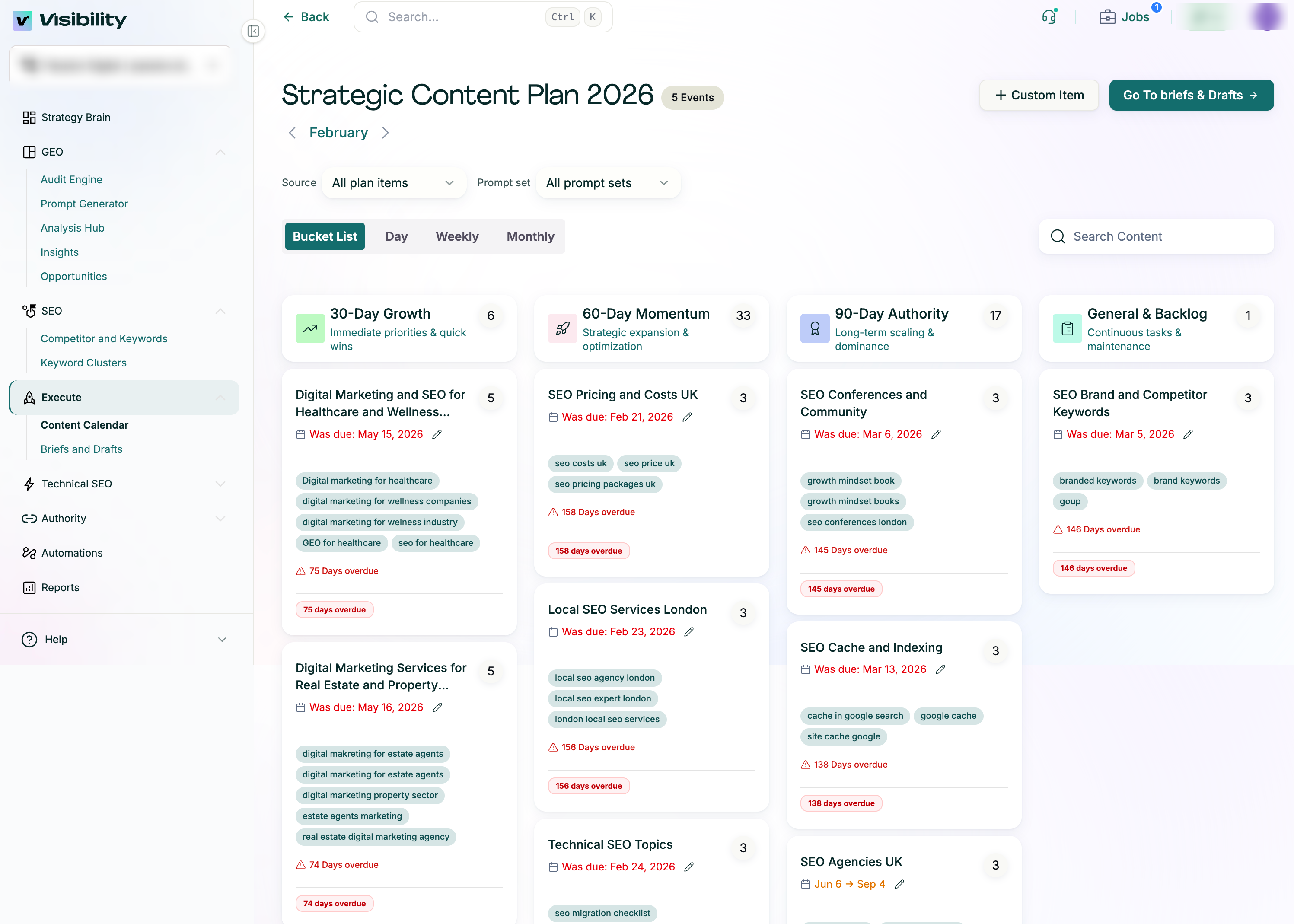
Pixis Visibility maps this directly. Keyword clusters are intent-tagged, scored for potential, and mapped to a 30/60/90-day content roadmap in the Execute tab. Each cluster identifies which pieces are missing, which need refreshing, and which are the highest priority based on keyword gap data and GEO citation analysis. The pillar-cluster structure is built into the workflow rather than having to be planned separately.
Blog Posts: Evergreen vs Timely
Blogs serve two distinct functions. Evergreen content answers questions that do not change, targeting search queries that will be relevant for years. Timely content covers current events and trends, capturing traffic when interest peaks before declining. Both have a place in a content strategy, but they require different investment levels.
Evergreen pieces deliver better long-term ROI because they continue earning traffic and citations without ongoing maintenance. The trade-off is that they require more upfront research and depth to outperform existing content on established topics.
Pixis Visibility's Content Refresh Planner automation identifies pages with decaying performance: falling rankings, dropping clicks, or declining CTR. This surfaces which evergreen pieces need updating before rankings are lost, which is a more efficient use of editorial resource than creating new content when existing content could be improved.
Internal linking is where most blogs lose value. Good internal links pass authority from cluster pages to pillar pages and keep users on site longer. Pixis Visibility's Internal Links module surfaces orphan pages, link equity distribution, and linking opportunities that manual audits routinely miss.
Video Content
Video earns high dwell time, which is a meaningful ranking signal. Tutorial queries in particular are heavily influenced by video results, and YouTube functions as a search engine in its own right. The case for video in a content strategy is real, but it requires the same treatment as any other format: clear intent match, descriptive metadata, and transcripts that make the content crawlable.
Repurposing video into supporting formats multiplies the production value. A long video can generate a blog post, a series of social clips, and pull quotes for other content. This approach makes video production more efficient rather than treating each piece as a standalone investment.
For brands tracking GEO visibility, video content on YouTube that ranks for relevant queries contributes to the entity signals that AI models use. A brand with strong YouTube presence on topics relevant to its product category is building authority signals that show up in generative answers, not just video search results.
Interactive Content: Calculators and Tools
Interactive tools are among the most effective link magnets available. A well-designed ROI calculator or diagnostic tool solves a real problem for users, which is exactly the criterion other sites use when deciding whether to link to something. The link earns itself.
Interactive content also generates zero-party data directly from users. Unlike inferred audience data, someone interacting with a calculator is explicitly revealing their context, which makes the data more useful for segmentation and personalisation.
Building a calculator or tool requires more investment than a blog post, but the return compounds over time. A tool that earns 50 organic backlinks in its first year continues earning authority from those links for as long as it is maintained. The upfront cost is amortised across a much longer return window than a blog post.
Visual Content: Infographics and Data Visualisations
Infographics work when they make complex data easy to understand in a way that text cannot. They are shareable, often rank in image search, and earn backlinks when other sites reference the data they present. The condition is that the underlying data is either original or presented in a significantly more useful way than existing resources.
Charts and graphs embedded within long-form content serve a different function: they increase credibility and engagement. A research-backed article with clear data visualisations signals that claims are supported by evidence, which is both a trust signal for readers and an authority signal for search engines.
Optimising visual content for search requires descriptive file names, meaningful alt text, and where possible, schema markup that tells search engines what the image represents. These steps are consistently skipped and consistently matter.
How-To Guides and FAQs
How-to guides target informational intent at its most specific: a user who knows what they want to accomplish and is looking for the steps to do it. These queries are prime candidates for featured snippets because Google identifies them as having a clear, structured answer.
FAQs serve a similar function for question-based queries. The combination of direct answers and FAQ schema markup increases the likelihood of appearing in rich results. For GEO specifically, direct answers in FAQ format are among the most citation-friendly content structures. How each AI engine cites content varies, but structured, extractable answers are consistently rewarded across ChatGPT, Perplexity, and Gemini.
Pixis Visibility's GEO Analysis Hub identifies which entities and answer structures AI models associate with a given topic, which directly informs how FAQs and how-to sections should be structured within a piece of content.
Original Research and Data Studies
Original research is the most reliable way to earn high-quality backlinks organically. When a brand publishes proprietary data, it becomes a citable source. Other content creators, journalists, and bloggers who write about the same topic have a reason to reference the research rather than finding data elsewhere.
94% of online content has zero external backlinks according to Backlinko's 2026 analysis. Original research is one of the few content investments that consistently breaks out of this pattern because it provides something genuinely unique that cannot be replicated.Presenting research effectively matters as much as the data itself. Clear charts, a well-structured press release, and proactive outreach to journalists and industry publications maximise the reach of the initial publication. A piece of original research that earns 30 high-quality backlinks in its first month provides more lasting SEO value than 30 blog posts earning one backlink each.
Product Pages
Product pages target transactional intent: users who are already in buying mode and searching for specific products or features. They require a different treatment from editorial content: detailed specifications, high-quality imagery, customer reviews that provide social proof, and clear calls to action.
Product page SEO frequently suffers from thin content, duplicate descriptions across variants, and poor internal linking from editorial content to commercial pages. Each of these is a fixable problem. Pixis Visibility's Technical SEO module identifies broken internal links, missing metadata, and page-level issues that affect how product pages are crawled and indexed.
How Pixis Visibility Connects Content Strategy to Execution
The gap in most content strategies is not knowing what to create. It is the distance between identifying what to create and having published, optimised content live on the site. Pixis Visibility is built to close that gap.
The workflow runs from keyword gap analysis and GEO citation intelligence through to content brief generation, AI drafting, humanisation, and WordPress publishing inside one platform. The full pipeline from insight to live article removes the handoffs and tool switching that slow most content operations down.
Specific platform capabilities map to each content type covered in this guide:
For long-form and pillar content: The GEO Analysis Hub extracts entity coverage, section consensus, and competitor citation patterns that brief writers need to produce comprehensive, citation-worthy content rather than guessing at what depth looks like.
For keyword clusters and topic mapping: The Competitor and Keyword Intelligence module identifies every keyword competitors are ranking for that you are not, scored by opportunity and mapped to a content roadmap. Keyword clusters are intent-tagged and built into the 30/60/90-day content calendar automatically.
For evergreen content maintenance: The Content Refresh Planner automation identifies pages with declining performance and surfaces them for update before rankings are lost, running on a scheduled cadence rather than requiring manual monitoring.
For technical health: Six continuous monitoring modules covering sitemaps, broken URLs, robots.txt, internal links, Core Web Vitals, and images ensure the technical foundation supports the content strategy built on top of it.
For GEO citation tracking: The GEO Analysis Hub runs 12 sessions per prompt across ChatGPT, Perplexity, Gemini, and Claude with variance reduction, producing statistically reliable citation data that informs which topics and content structures are earning AI citations versus which are being overlooked.
The 27 Content Types Pixis Visibility Supports
When generating a brief in Pixis Visibility's Execute tab, the platform does not produce a generic article structure. Under Content Format, the AI Brief generator gives you a choice across 27 distinct content types, each with its own structural defaults, entity coverage requirements, and GEO optimisation signals. Set to Auto, the AI picks the strongest format for the topic from the list. Or you can specify the format yourself.
The full list of supported content types:
How-To Guide, Beginner Guide, Listicle, FAQ Article, Comparison Article, Best Of / Top Picks, Product Review, Product Roundup, Buyer's Guide, Case Study, Problem-Solution Article, Industry Trends Article, News and Updates, Expert Roundup, Thought Leadership Article, Myth-Busting Article, Checklist, Resource List, Glossary Article, Data-Driven Research Post, Tutorial, Seasonal Content, Local Guide, Interview, Behind-the-Scenes / Company Story, Infographic Blog, and Ultimate Guide / Pillar Content.
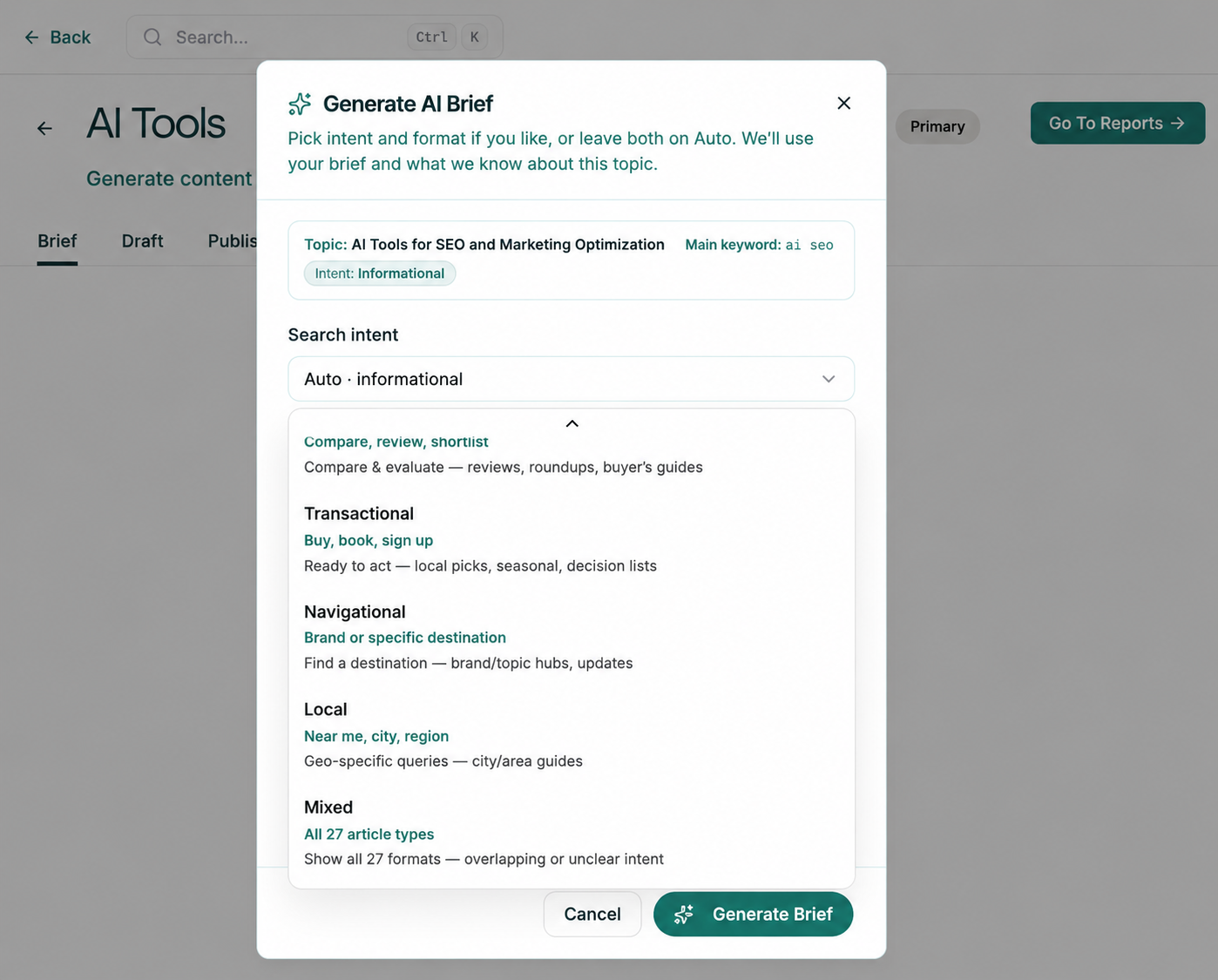
The practical value is in the specificity. A brief for a Comparison Article is structured differently from a brief for a Buyer's Guide, which is structured differently again from a Data-Driven Research Post. Each format carries different reader intent, different content hierarchy, and different GEO citation signals. When Pixis Visibility's GEO Analysis Hub identifies a gap, it does not just tell you to create more content on a topic. It recommends which of these 27 formats is most likely to close the gap based on what AI engines are currently citing for that prompt and what competitors are using to earn those citations.
The Auto setting in the Content Format dropdown means teams can move from gap to brief without needing to make that format decision manually every time. For teams who have strong opinions on format, the full list is available to override the recommendation at any point in the workflow.
Templates: Generate, Save, and Reuse
Pixis Visibility has shipped a new Templates feature in the Content section. Teams can now generate content using a template, save it, and reuse it across future briefs rather than rebuilding the structure from scratch each time.
This matters practically for content teams running at volume. The overhead of setting up a new brief, establishing the structure, specifying the format, and configuring the SEO and GEO parameters for each piece adds up across a high-volume content calendar. Templates remove that overhead for repeatable content types: a product page template, a comparison article template, a topical FAQ cluster template each get configured once and are available for every future brief of that type.
For agencies managing multiple clients inside Pixis Visibility, Templates also support the creation of client-specific brief structures that reflect each brand's voice, formatting preferences, and content conventions. Save once, apply across every new brief for that client.
Measuring What Matters
Organic traffic and keyword rankings remain the baseline metrics for SEO performance. They tell you whether the strategy is producing visibility. What they do not tell you is whether that visibility is producing the right outcomes.
Engagement metrics add the next layer. Dwell time and bounce rate indicate whether users find the content useful after arriving. High bounce rates on content that ranks well often signal an intent mismatch: the page is ranking for a query it does not actually answer.
Conversion rate connects the content strategy to revenue. Tracking which content pieces contribute to lead generation, demo requests, or purchases ties editorial investment to commercial outcomes and makes the case for continued resource allocation.
Pixis Visibility adds two forward-looking metrics: AI Citation Rate, which tracks how often your brand is cited in AI-generated answers across tracked engines, and keyword opportunity scoring, which helps prioritise which gaps to close first for maximum impact. The Reports module connects content publish events to before-and-after SEO performance changes, creating a direct line between what was published and what changed in traffic and rankings.