

A keyword gap analysis works by comparing your site's rankings against competitors' to surface exact search terms you're leaving on the table. Rather than brainstorming topics from scratch, you start from what's already proven to rank somewhere else, then filter that raw list down to the handful of terms actually worth pursuing based on volume, difficulty, and intent. The payoff shows up in two places: a shorter path from research to a content calendar, and a clearer read on which of your existing pages are quietly underperforming against competitors rather than simply missing.
This guide covers the full process end-to-end. That means identifying the right competitor set (which is often not the same as your obvious business rivals), choosing tools that fit your budget and workflow, filtering a raw keyword export down to something usable, and mapping the survivors to a specific content decision, whether that's a new page, a refresh, or a topic cluster. It closes with how to measure whether any of it worked, and where keyword gap analysis stops, and content gap analysis should take over.
Key Takeaways
- Run keyword gap analysis on a consistent cadence. A large share of web pages get zero organic traffic, and most of that comes down to targeting the wrong terms.
- Differentiate between keyword and content gap analysis to avoid strategy conflicts and make the most of limited production time.
- Prioritize keywords by search volume, difficulty, and intent instead of targeting every gap you find.
- Connect research to publishing so a validated keyword list doesn't stall before it reaches a content calendar.
- Track rankings, organic traffic, conversions, and AI citation rates together, since visibility now spans both channels.
What is Keyword Gap Analysis?
Keyword gap analysis is the SEO technique of comparing a website's keyword rankings against its competitors to find valuable missing search terms. It surfaces keywords your target audience actively searches for but cannot find on your site, and it replaces guesswork with evidence, giving your content team a list of terms to pursue based on real search demand rather than internal assumptions.
This differs from content gap analysis in an important way. Keyword gap analysis focuses on specific search queries competitors rank for, while content gap analysis identifies broader topic coverage gaps. You need both to build authority, but they serve different purposes. Keyword gap analysis tells you which exact terms to target; content gap analysis tells you which subjects to cover comprehensively. A page can cover a topic well and still miss the particular phrasing your audience searches for, and keyword gap analysis surfaces that phrasing gap directly.
Dedicated tools let you compare your site's keyword profile against several competitors at once, surfacing traffic share, keyword difficulty, search intent, and data recency. Some extend the comparison beyond Google rankings to include AI search monitoring across engines such as ChatGPT, Perplexity, and Gemini, flagging high-value placement opportunities and generating content briefs to close gaps in AI search visibility. Pixis Visibility combines traditional keyword gap analysis with AI search citation tracking in a connected workflow, worth a look if you're evaluating platforms for that specific combination.
Why Perform a Keyword Gap Analysis?
Keyword gap analysis works because it replaces guesswork with evidence of what already ranks somewhere else. Your actual return depends on your competitive landscape, domain authority, content quality, and how fast you act on findings, but the scale of the underlying problem is well documented: a study of nearly 14 billion webpages found that the large majority receive no organic search traffic from Google at all, largely because they target the wrong terms or ignore what competitors are already winning with. Gap analysis addresses this directly by showing you exactly which terms are driving traffic elsewhere, so you can evaluate whether they fit your strategy.
Instead of publishing content and hoping it ranks, you start with a validated list of terms with proven demand and manageable competition, often keywords with moderate volume and low difficulty that competitors have overlooked. That gives you an entry point to build momentum that compounds over time, and it shifts your content team from reactive publishing to proactive targeting.
AI engines are also reshaping how users discover brands, and being cited in AI-generated answers increasingly matters alongside traditional ranking. Brands that monitor their presence across AI-generated answers and traditional search results can catch keyword opportunities that competitors haven't addressed in either channel. Our AI visibility checker guide covers how to check and improve that side of visibility specifically.
How to Conduct a Keyword Gap Analysis: Step-by-Step
Identifying Your True SEO Competitors
The strongest keyword gap analysis starts with an accurate competitor list, which is often different from your obvious business rivals. Start by finding both direct business competitors and indirect search competitors who rank for your target queries. Direct rivals sell the same products but might not dominate organic search, while indirect competitors answer customer questions effectively and capture traffic you could be earning. Analyze SERPs for your core keywords, search for the terms you want to rank for, and note which domains consistently appear in the top results. You may find that a niche blog or comparison site outranks the brands you consider your closest competitors, often because they've covered content formats and keyword angles your direct rivals have missed entirely.
Shift your focus to search competitors if direct business rivals don't have a strong organic presence. The SERP tells you who is actually winning the attention of users right now, and that's more useful than your internal competitive map. Many platforms let you compare multiple domains at once, grouping keywords into categories such as Missing (competitors rank, you don't), Weak (you rank, but lower than competitors), and Untapped. This makes spotting your most immediate opportunities straightforward and gives you a structured way to prioritize which gaps to address first.
For brands extending keyword research into broader audience acquisition, the same organic keyword data can inform paid targeting on Meta Ads and Google Ads. Keywords with high commercial intent identified through gap analysis often translate well into paid search, giving you a head start on terms your competitors have already validated through organic performance.
Choosing and Using Keyword Gap Analysis Tools
Dedicated gap-analysis tools vary widely in approach, and the right one depends on your budget, how fresh the data is, and how deep the feature set goes. Some offer dedicated side-by-side domain comparison built specifically for this workflow. Others fold gap reporting into a broader competitive research suite. Free options like Google Keyword Planner offer basic manual analysis but lack the speed and breadth of purpose-built tools. When evaluating platforms, prioritize data freshness, how many competitors you can compare simultaneously, and whether the tool integrates gap analysis with content planning. Our AI visibility platform comparison breaks down how several of these tools stack up if you're weighing options.
Modern platforms also automate parts of the research process, grouping competitor terms into semantic clusters and applying initial filters for volume and difficulty. This speeds up manual sorting considerably, though you still need to validate relevance, intent, and business fit before committing resources to any term.
Pixis Visibility, for example, populates a 30/60/90-day content calendar directly from keyword gaps and AI search opportunities, with a generated brief for each item. That can reduce the handoffs between research, planning, and drafting, though how much time it actually saves depends on your existing process and team structure.
Finding and Filtering Keyword Opportunities
Once you've pulled the Missing and Weak keyword lists from your tool, the real work is filtering aggressively before acting on any of it. A raw export can contain thousands of keywords, and targeting all of them dilutes your focus. Start by removing branded keywords that belong to competitors, since these aren't realistic targets, then remove terms with no real connection to your product or audience even if competitors rank for them.
From there, apply three filters:
- Keyword difficulty. If your site is relatively new, terms with a difficulty score over 50 usually aren't worth pursuing yet. Focus on the 0 to 50 range for faster, more realistic wins, and revisit higher-difficulty terms as your domain builds authority.
- Search volume. Set a minimum threshold, commonly 50 to 100 monthly searches, to avoid terms that won't move the traffic needle. Low-volume terms can still be worth targeting when intent is highly specific or conversion value is high, so weigh volume alongside context rather than as a hard cutoff.
- Search intent. Most tools categorize keywords as informational, commercial, transactional, or navigational. Match this against the content format you can realistically produce. A transactional query you can only answer with a blog post is a mismatch worth skipping or reformatting for.
A high-volume keyword with impossible difficulty wastes resources. A low-difficulty keyword with no volume produces no traffic. A keyword with strong volume and manageable difficulty but mismatched intent drives visitors who leave without converting. Getting this balance right is what makes a keyword list actually move your traffic.
Translating Gaps into Content Strategy
Once you've prioritized keywords, the next step is mapping each one to a specific content action based on what already exists on your site:
- No corresponding page exists. Create new content targeting that term.
- A page already ranks weakly. Refresh and optimize it rather than starting from scratch. Updating an existing page with better on-page SEO, up-to-date information, and stronger internal linking often yields faster results than creating a new page.
- You have partial coverage of a broader topic. Build a topic cluster around it to strengthen thematic authority.
Match the content format to search intent: informational queries call for blog posts or guides, commercial queries suit comparison pages, and transactional queries need optimized product or landing pages. For a breakdown of which content types work best for different keyword intents, see our guide to SEO content types.
Platforms that combine gap analysis with content planning typically intent-tag and score keyword clusters, then map them to a 30/60/90-day roadmap, flagging which pieces are missing, which need refreshing, and which are highest priority. For teams managing multiple content types or channels, this kind of integrated planning can cut the overhead that often delays production after research wraps up.
For long-form and pillar content specifically, look for tools that extract entity coverage, section consensus, and competitor citation patterns, since that intelligence tells writers exactly what to cover instead of working from a bare keyword list. If your gap analysis surfaces terms tied to emerging search behavior, our guide to getting cited by ChatGPT covers how the same keyword data can inform an AI citation strategy alongside traditional content.
Measuring Success and Ongoing Optimization
Track rankings, organic traffic, and conversions to validate that your strategy is working. A reasonable cadence is a full analysis quarterly, with monthly check-ins in fast-moving markets. Use Google Search Console to monitor which queries drive impressions and clicks, and Google Analytics to track how organic visitors behave once they land on your site. Together, these tools help you spot new gaps before competitors fill them and identify pages that need refreshing to hold their positions.
The operational problem most content teams face isn't a shortage of keyword ideas. It's the friction between research and publication. A keyword gap analysis only creates value once it leads to published, optimized content, so the workflow connecting research to execution matters as much as the research itself. Whatever tools you use, the goal is the same: minimize the gap between finding a keyword opportunity and publishing content that targets it.
Beyond traditional rankings, it's increasingly worth tracking AI citation rate, meaning how often your brand is cited in AI-generated answers across major engines, alongside conventional keyword opportunity scoring. Our breakdown of GEO versus SEO metrics covers how to weigh the two together. Traditional rankings and AI citation data give you a fuller picture of your search visibility and show which content investments are actually producing returns.
Keyword Gap Analysis vs. Content Gap Analysis
Keyword gap analysis identifies missing search terms; content gap analysis identifies missing topics; and most SEO programs need both.
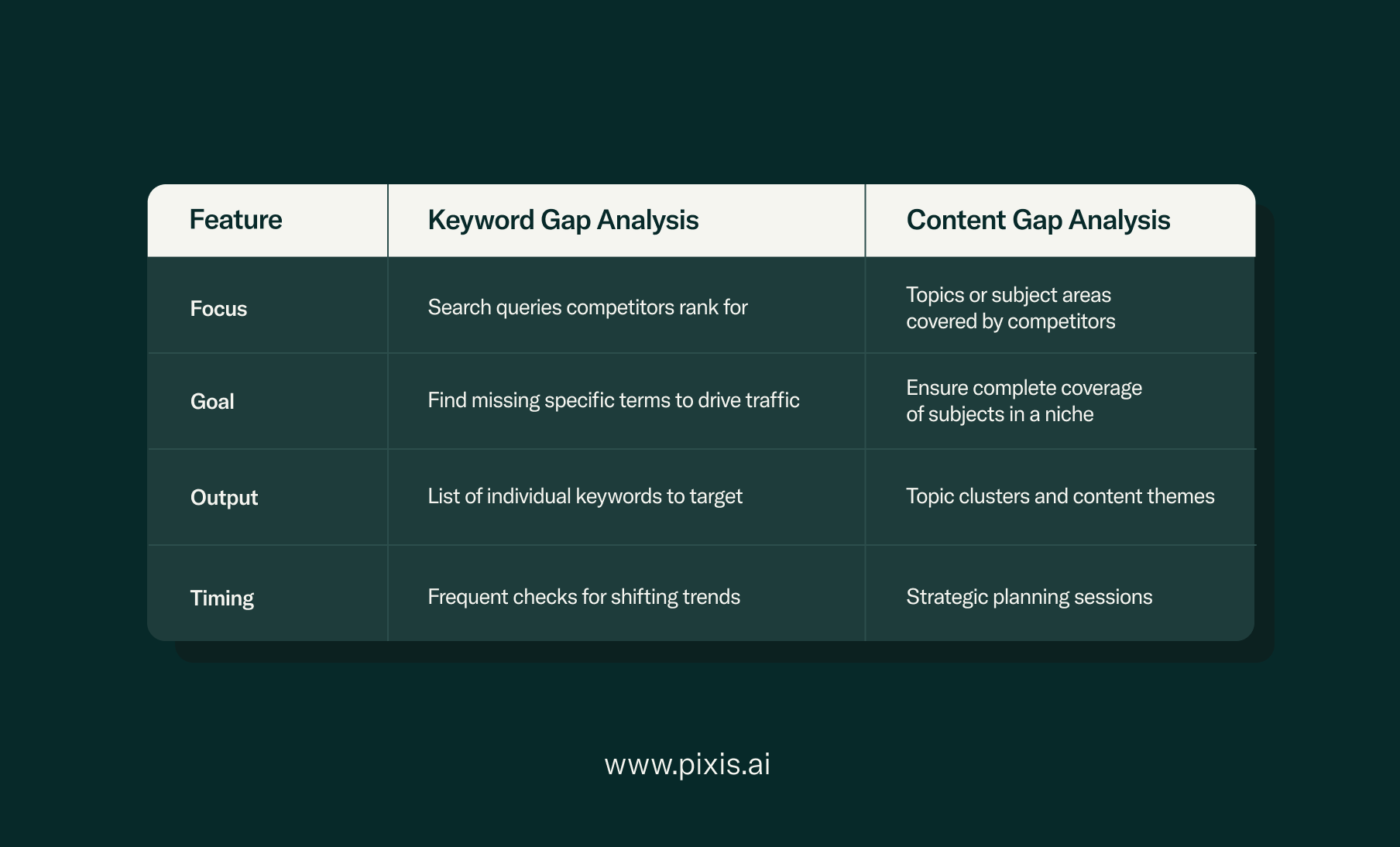
Start with keyword gap analysis when you need specific terms that can produce traffic gains within the next 30 to 90 days. Use content gap analysis when you're planning a quarter or more ahead and need to determine which subject areas your site should cover to build long-term topical authority. If a competitor ranks for "AI ad optimization tools" and you don't, keyword gap analysis flags that exact query for immediate targeting. If that same competitor has an entire hub of content around AI advertising strategy, content gap analysis tells you to build a comparable cluster. Run keyword gap analysis first to find your quickest wins, then layer content gap analysis on top so those wins sit within a broader topic structure.
Closing keyword gaps comes down to running a repeatable process and acting on it quickly, not treating it as a one-time audit. The brands that see the best results treat gap analysis as an ongoing practice. They revisit their competitor set and refresh keyword lists on a set cadence, then adjust the content calendar based on the data.
If you're ready to put this into practice, start with a small competitor set and a focused keyword list rather than trying to analyze everything at once. The FAQs below cover the most common practical questions on cadence, tooling, and targeting.