
A traditional content calendar assumes the search environment will sit still. It maps a quarter of topics, assigns the writers, and locks the schedule until the next planning cycle. That assumption held when rankings moved slowly. It holds far less now that generative engines re-synthesize their answers continuously, and the queries people ask shift week to week. A brand that planned its quarter three months ago can miss a surge in new prompts simply because its process has no way to pivot before the next review. This guide is a practical approach to building a calendar that stays fixed enough to plan against and loose enough to change when the data changes, using Pixis Visibility to see the shifts as they happen.
Key Takeaways
- Generative search moves faster than a quarterly plan: models re-synthesize answers and shift citations continuously, so a locked calendar is out of step soon after it is set.
- The planning input shifts from keyword research to prompt intelligence and answer-gap analysis, which surfaces the queries where competitors are cited and you are not.
- Structure the calendar in rolling 30, 60, and 90-day cycles and leave 20 to 30 percent open for emergent topics, so editing on the fly is built in rather than aspirational.
- The speed from detecting a gap to publishing against it is an advantage. Real-time monitoring, mobile access, and direct-to-CMS publishing collapse that distance to near the same day.
- Measure AI share of voice, citation frequency, and brand sentiment, not traditional traffic estimates, since those describe your actual presence inside the generated answer.
Understanding Generative Engine Optimization (GEO)
Generative Engine Optimization differs from traditional search work in what it targets. Traditional SEO aims for a page-one ranking on a specific keyword, using backlinks and on-page signals to earn it. GEO aims to be part of the synthesized answer itself, cited inside the model's response. AI search engines assemble those answers by pulling from many sources at once, which changes what content planning has to optimize for: semantic clarity, context, and specific user intent rather than a static keyword list. If your brand is absent from the synthesized answer, you are absent from that query, regardless of where you rank on the traditional results page.
The planning input that replaces keyword research is prompt intelligence paired with answer-gap analysis. Instead of starting from search-volume tables, you identify the specific prompts where a model gives a thorough answer but does not cite you, while it does cite competitors. Mapping that prompt landscape shows you the emerging, high-value queries where you are missing from the conversation, which is exactly the information a production schedule should be built around. When you know what users are actually asking the models, you can fill those gaps deliberately rather than guessing at topics.
- GEO targets inclusion in the synthesized answer, not a blue link on the results page.
- AI search engines synthesize across many sources to produce conversational answers, so semantic clarity and intent matter more than keyword density.
- Prompt intelligence surfaces the emerging queries where your brand is missing from citations.
- Answer-gap analysis pinpoints where a model answers thoroughly but does not cite you.
- Content has to stay crawlable and free of paywalls or render-blocking so crawlers can read and index it.
Why Static Calendars Fail in the AI Search Era
A static calendar assumes a fixed keyword set and a stable environment, and generative search offers neither. Models retrain and shift their citation behavior on new data, so a rigid schedule can quickly become out of step after it is finalized. When a model's underlying data changes, a query that drove traffic last month can quiet down this month, and a plan with no slack cannot respond. Google's own guidance has leaned toward rewarding non-commodity, expert-led content over the mass-produced articles that quota-driven calendars tend to generate, which further penalizes plans built around hitting a publishing count rather than answering real demand.
The cost of rigidity is speed. A team deep into a quarterly campaign can miss a sudden rise in new prompts because its process cannot turn fast enough to address them. Editing on the fly is less an agility perk and more a baseline requirement for holding visibility, because the brand that publishes against a new prompt within hours captures the citations the slower competitor forfeits.
Technical prerequisites get missed in static planning too. Content blocked in robots.txt, hidden behind login walls, or dependent on client-side rendering can read beautifully to a person and remain invisible to a crawler. One tactic worth calibrating here is llms.txt: Google has said on the record that Search does not use it, and its 2026 AI-features guidance names llms.txt among tactics that do not help, so it is not the shortcut some planners treat it as. The durable technical work is more basic, making sure content is server-side rendered, crawlable, and unwalled, and a dynamic calendar accounts for that before drafting rather than after publishing.
How Pixis Visibility Empowers Dynamic Content Calendars
Pixis Visibility closes the gap between spotting a shift and acting on it. The platform monitors generative engines continuously, so when your citation rate slips or a competitor's coverage jumps on a prompt you care about, you see it as it happens rather than in a report weeks later. That lets a team edit a content brief the moment a high-value prompt starts trending, instead of waiting for the next planning cycle to notice.
The prompt-mapping layer shows where your brand is missing from generated responses across your category, and answer gaps surface as they form rather than in a monthly summary. That continuous read is what turns the calendar from a document into a working instrument: you can reallocate production toward the queries that are live now, and you are answering questions people are currently typing rather than ones you guessed at a quarter ago.
Two capabilities make the loop fast enough to matter, and they work together. Visibility now runs the full workflow on mobile, so generating prompts, running prompt analysis, and creating content are not tethered to a desk when a shift lands mid-week. And direct-to-CMS publishing pushes an approved draft to your live site without waiting on a developer queue, which is usually where the hours between "we should update this" and "it's live" disappear. Between them, the distance from detecting a gap to publishing against it collapses to something close to same-day.
Key Features of Pixis Visibility for GEO Content Management
The features below map onto the calendar workflow rather than standing alone, which is the point: each one feeds the next. That end-to-end coverage is also what separates a tool that only reports on visibility from one that carries you from gap to published page, a distinction our rundown of the best AI visibility platforms in 2026 covers in depth.
- Prompt mapping curates and tracks the high-value prompts that drive AI citations for your brand and category, replacing keyword research as the planning input.
- Answer-gap analysis finds the queries where competitors are cited and you are not, so production targets a specific opening rather than a broad topic.
- Search visibility tracking monitors citation frequency and brand sentiment in real time across the major engines, so you see how a piece performs once it is live and indexed.
- Competitor Matrix benchmarks your AI share of voice against rivals, now including relative share of voice measured against your top competitor, so you know exactly who you are trying to outpublish on which clusters.
- Strategy Brain accepts URLs directly into its Knowledge Base, pulling source content in without manual copy-paste, and workflow automation carries a brief through to a published draft.
Prompt mapping is the foundation, because it grounds the whole calendar in verified demand rather than internal assumptions. Answer-gap analysis then turns that map into targets: the specific queries where a competitor holds the citation, and you have a clear opening to take it. Search visibility tracking closes the loop by showing how each published piece actually performs in generative answers once it is indexed, which is the feedback that tells you where to double down and where to move on.
Two recent additions deepen the workflow. Analysis Hub now surfaces the exact responses each model returned, so you can read what ChatGPT or Gemini actually said about a prompt instead of inferring it, and its Page Analysis covers every competitor page rather than a sample. On the SEO side, Keyword Tracking lets you follow keywords on the cadence that fits the topic, weekly, every fifteen days, or monthly, so fast-moving clusters get watched closely without over-monitoring stable ones.
The content tooling has also loosened up. You can now build a template by uploading a file and letting the system extract its structure, in addition to the blank, pre-saved, and from-URL options. You can also attach reference images to a draft so generated visuals carry a specific avatar or visual identity throughout the piece. For teams that want one view across everything, the new Central Report pulls SEO competitor analysis, keyword gaps, GEO coverage by model, the content pipeline, and Technical SEO into a single report where you choose which sections appear.
Structuring Your Adaptable GEO Content Calendar
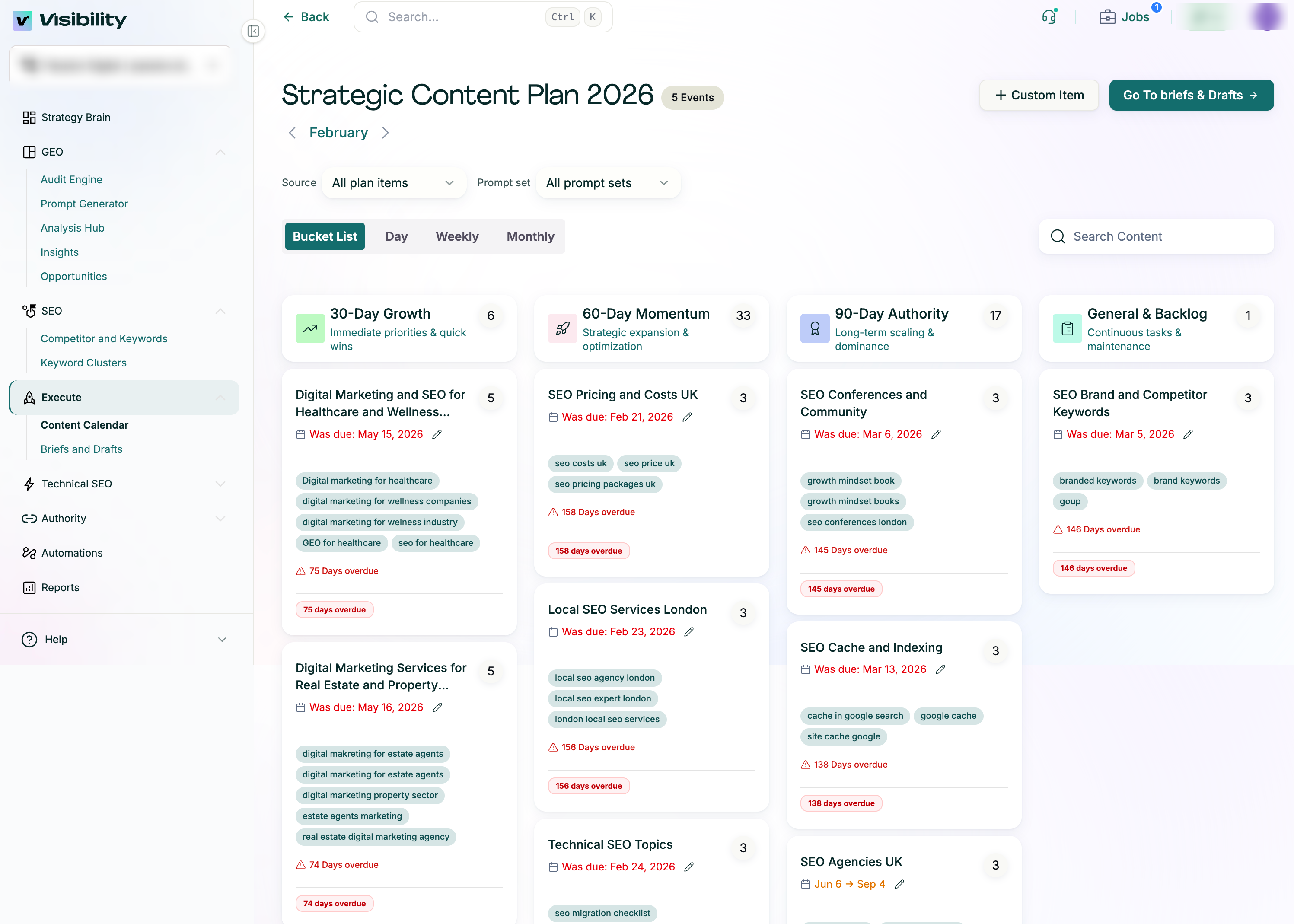
A calendar that can flex still needs a spine. Each row should carry the prompt it targets, the primary engine focus, the content type, the internal owner, the production status, and the expected impact, so every piece has a defined purpose tied to a measurable outcome rather than a date on a grid. That structure is what lets the plan stay legible even as individual rows change.
Plan on rolling 30-, 60-, and 90-day cycles rather than a fixed annual block, so you can review often and adjust based on live data. The first thirty days are for audit and baseline: run a GEO audit to capture where your citation rates and sentiment currently stand. Days 31 to 60 are for restructuring toward citability, rewriting content into groundable chunks with clear stats and named sources. Days 61 to 90 shift to measuring and scaling, tracking citation frequency and share of voice month over month, and iterating on what moves. And leave real slack across the whole thing: keeping 20 to 30 percent of the calendar open for emergent topics makes on-the-fly editing possible rather than aspirational. Without that buffer, every new opportunity forces something else off the plan; with it, you can move on a trend the day you detect it.
This gives you a roadmap you can staff and budget against across the quarter while keeping the freedom to redirect within it. The stability of the phased plan and the agility of a newsroom are not in tension here; the phases hold the long arc while the open buffer absorbs the day-to-day shifts.
Measuring and Iterating on Your GEO Content Strategy
Measure against the metrics that describe generative visibility, not traditional traffic estimates. The ones that matter are AI share of voice, citation frequency, and brand sentiment across the major engines, because they describe your actual presence inside the generated answer rather than a projected click. They tell you whether your content is being cited by the models your customers are asking, which is the thing traditional traffic numbers cannot see.
The iteration loop is short by design: a data insight prompts a calendar edit, which drives a content update, which you then re-measure to confirm the effect. Run that loop weekly and the calendar stays current regardless of how the algorithms move underneath it. What keeps the loop fast is a connected pipeline rather than a set of disconnected tools passing exports back and forth, as our guide to replacing five disconnected SEO tools with one connected pipeline argues. Real-time performance data is what makes the loop honest, since you are adjusting based on what actually happened in the generative results rather than a hunch, shifting resources toward prompts that draw citations and away from those that fall flat.
A chart showing citation frequency and share of voice trending upward across a six-month tracking period.
Sustained gains come from consistent refinement rather than a single push. A calendar that responds to the market compounds its visibility over months; one that ignores real-time data tends to flatline. That is the practical case for building the editable-on-the-fly calendar this guide describes: agility, applied consistently, is what moves share of voice.
Frequently Asked Questions about GEO Content Calendars
What is the ideal frequency for updating a GEO content calendar?
Weekly reviews are a sensible baseline, because models update and new prompts emerge fast enough that a monthly cadence misses spikes. The goal is to catch the moment a scheduled topic needs an edit to capture rising interest before it fades. Pixis Visibility supplies the real-time data that flags when a calendar topic needs an immediate update or a swap for a more relevant subject.
How does Pixis Visibility handle new AI models like Perplexity or Gemini?
Visibility tracks citation frequency and sentiment across the major generative engines together, and integrates new engines into its tracking as they become relevant. That coverage keeps your calendar useful regardless of which model currently dominates your audience's usage, without requiring you to rebuild dashboards for each new release.
Can I integrate Pixis with my existing CMS to speed up publishing?
Yes. Visibility supports workflow automation that takes a brief through to a published draft and pushes approved content directly to your CMS. That integration removes the developer-queue delay between deciding to update a page and the update going live, so you can keep your existing approval process while acting on real-time data.
How is GEO different from traditional SEO content planning?
Traditional planning centers on keyword rankings and backlink volume. GEO planning centers on semantic entities and prompt intelligence, aiming to be cited by models as a trusted source rather than ranking on a crowded results page. It asks you to target specific user intent and the entities a model associates with your category, which legacy keyword tools were not built to surface.
What metrics should I track to measure GEO success?
The core set is AI share of voice, citation frequency, and brand sentiment across the major models. Visibility dashboards visualize these so you can see how a published piece performs in generative answers and identify when a topic needs an edit to hold its position. Together, they give a clear read on your influence inside the generated response, which is the outcome GEO content is actually working toward.
Start Building Your Dynamic GEO Content Calendar Today
Capturing share in generative search starts with the ability to act on what the models are doing right now, and that requires both the data and a calendar built to move on it. If you want to see how the real-time prompt data and editing workflow come together, explore Pixis Visibility and try it against your own category.
The search landscape keeps moving. The point of an editable calendar is to move with it rather than re-plan around it every quarter.