
A growing share of your buyers' research now happens entirely inside a chat window, and the AI search category itself is moving fast enough that a strategy built six months ago is already out of date. Zero-click search has reached roughly 60 percent of all Google queries in 2026, and on top of that shift, AI search platforms sent 1.13 billion referral visits to websites in June 2025 alone, a 357 percent increase year over year, with ChatGPT accounting for 78 percent of that traffic. AI search engines now handle an estimated 12 to 18 percent of English-language informational queries as of early 2026, up from under 2 percent a year earlier.
What makes this different from a normal SEO shift is that "AI search" isn't one channel. ChatGPT, Perplexity, Gemini, Claude, and Google AI Overviews each retrieve from different source pools, weight different signals, and cite brands at wildly different rates, sometimes by a factor of more than 40x for the same query. Generative Engine Optimization (GEO) is the discipline of structuring your content, your technical infrastructure, and your off-site presence so that these systems treat your brand as a source worth citing, and this guide breaks down what that actually requires, what's changed in the last few months, and what it means specifically if you're a performance marketer or an agency managing this across multiple client accounts.
Key Takeaways
- GEO is the practice of structuring your content and infrastructure so AI engines such as ChatGPT, Perplexity, Gemini, and Claude cite you directly inside their answers. A 2024 Princeton/KDD study found that applying GEO techniques can lift a source's visibility by up to 40 percent in generative engine responses.
- The platforms are not interchangeable. A 2026 study of 34,234 AI responses found ChatGPT cited brands in just 0.59 percent of answers versus 13.05 percent for Perplexity, a roughly 46x gap, and a separate 90-day, 300,000-citation study found Claude gave brands the highest owned-citation share while ChatGPT was consistently the lowest across every brand tested.
- Zero-click search has reached roughly 60 percent of all Google queries in 2026, and AI Overviews now appear on close to half of all searches, so a citation inside an AI answer carries as much weight as a page-one ranking once did.
- AI-referred traffic converts at roughly 4 to 5 times the rate of standard organic search traffic across multiple 2025-2026 studies, which is why performance teams are starting to budget for GEO the way they budget for paid channels.
- For agencies, GEO is becoming a reportable line item: clients increasingly ask why a competitor shows up in a ChatGPT answer and they don't, and "we don't track that yet" is no longer an acceptable answer.
- Pixis Visibility runs a 12-session GEO Analysis Hub across ChatGPT, Perplexity, Gemini, and Claude and turns each visibility gap it finds directly into a content brief, an AI-assisted draft, and a published page, which is the only way this scales across more than one or two accounts.
What is Generative Engine Optimization (GEO)?
Generative Engine Optimization is the strategic process of structuring and presenting content so that AI-powered search engines and answer engines cite your brand as a reliable source. Unlike traditional SEO, which targets human searchers via keyword matching, GEO targets Large Language Models to secure direct answers and citations within synthesized, conversational responses. This includes platforms like Google AI Overviews, Perplexity, Gemini, Claude, and ChatGPT Search.
What GEO Actually Encompasses
GEO gets described most often as "writing content that AI likes," and that framing undersells it badly. A 2024 study out of Princeton and Georgia Tech found that applying GEO techniques can lift a source's visibility in generative engine responses by up to 40 percent, but that lift only shows up when the underlying work covers more than content. GEO is closer to a small operating model with four interlocking parts, and most of the brands that show up consistently in AI answers are doing all four, not just the content piece.
Content architecture. This is the part most guides focus on: structuring pages so a retrieval system can extract a direct, attributable answer early, with the supporting depth to back it up. Section 5 covers this in detail.
Technical accessibility. AI crawlers are not the same as Googlebot, they don't behave the same way by default, and a site that's perfectly crawlable for Google can be effectively invisible to ChatGPT's or Perplexity's retrieval systems if robots.txt, schema, and crawl budget aren't configured for them specifically. Section 6 covers this.
Off-site authority and earned media. Roughly 82 percent of links cited by AI engines come from earned media (journalism, third-party reviews, independent blogs) rather than brand-owned pages. This means your PR and analyst-relations work is now part of your GEO strategy, not adjacent to it. A brand that only talks about itself, on its own site, is structurally disadvantaged regardless of how well-written that content is.
Ongoing measurement and iteration. Because AI engines retrieve from indexes that update continuously, and because the same prompt can return different sources on different runs, GEO isn't a project with an end date. It's a monitoring loop: audit, identify gaps, fix or create content, re-check, and repeat. Section 9 and Section 10 cover what that loop looks like in practice.If you're only doing the first of these four, you'll see inconsistent results and won't be able to explain why. If you're doing all four, the platform-by-platform breakdown in the next two sections is what tells you where to focus first.
GEO vs. SEO vs. AEO: How the Three Disciplines Differ
Three disciplines now shape where you show up in search: SEO, GEO, and AEO. They aren't competing strategies, and you don't choose one over the others. SEO is the infrastructure layer everything else depends on. AI crawlers still rely on the same sitemaps, robots.txt files, site speed, and internal linking that traditional search crawlers have used for years, so if your technical SEO foundation is weak, your GEO and AEO efforts are built on top of it anyway.
GEO and AEO are closer cousins, and the distinction between them is about what happens after an AI engine decides to use your content. GEO is about earning the citation in the first place: getting your page selected as one of the sources an AI engine draws from. AEO is about what happens once a user's query maps directly onto your content: featured snippets, "People Also Ask" boxes, voice search results, and direct chatbot answers where your content becomes the answer itself, not just one of several cited sources.
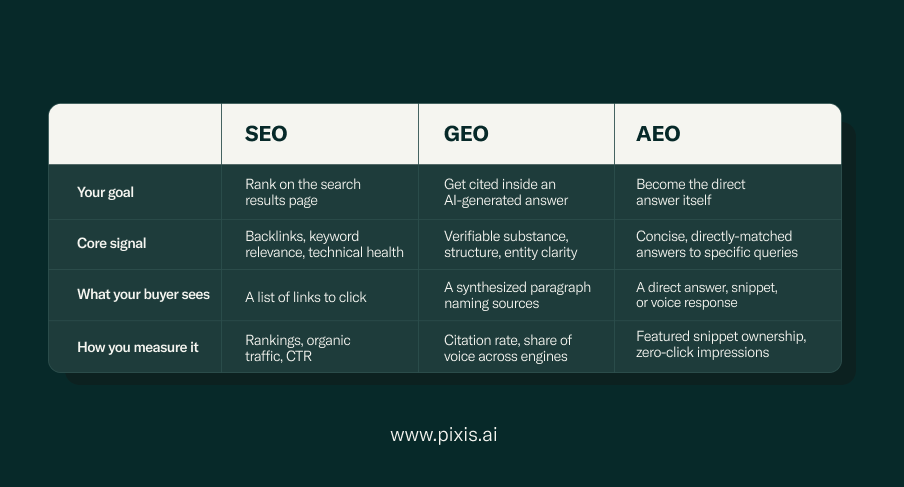
A useful way to hold all three together: SEO determines whether an AI crawler can find and trust your page at all. GEO determines whether that page gets pulled into the answer. AEO determines whether your page becomes the answer. You can have strong SEO and weak GEO at the same time, ranking well on Google while being functionally invisible inside ChatGPT and Perplexity for the same topic. The next section shows you exactly how invisible, and to which engines specifically.
Live Example: How the Same Brand Gets Cited Differently Across Engines
This is the part of GEO that surprises most teams the first time they see it. The assumption is usually that AI engines are roughly interchangeable: get cited once, and you're "visible in AI search." The data says otherwise, and the gap is large enough to change how you prioritize.
A 2026 study analyzing 34,234 AI responses found that ChatGPT cited brands in just 0.59 percent of answers, while Perplexity cited brands in 13.05 percent, a roughly 46x difference for what's broadly the same category of query. Grok came in higher still, at around 27 percent. Separately, Slate HQ tracked the same content from six B2B SaaS brands across ChatGPT, Perplexity, Gemini, Claude, Google AI Overviews, and Google AI Mode for 90 days and over 300,000 citations. Claude gave brands the highest owned-citation share at 9.1 percent, Perplexity gave them 6.8 percent, and ChatGPT was consistently the lowest across every single brand in the study. The researchers described the per-platform citation profiles as looking "like different brands."
Here's what that means in practice, platform by platform:
ChatGPT. Lowest brand-citation rate of the major engines, but the highest absolute traffic volume (78 percent of all AI referral traffic in June 2025). About 31 percent of ChatGPT queries trigger a live web search at all; the rest are answered from training data or prior context. ChatGPT leans on Bing's index and domain authority, so if your domain authority is thin, you're fighting an uphill battle here even with excellent content.
Perplexity. Highest brand-citation rate of the major engines (13.05 percent) and the platform most sensitive to source mix changes. Through most of 2025, Reddit was Perplexity's single largest source, accounting for 6.6 percent of total citations and nearly 47 percent of its top-10 share. After Reddit sued Perplexity over scraping in October 2025, Perplexity's Reddit citations dropped roughly 86 percent almost overnight, and YouTube partially filled the gap, now sitting at around 16 percent of Perplexity's top-10 share. If you were building a Perplexity-specific strategy around Reddit presence a year ago, that strategy needs to be rebuilt around video and other sources now. Perplexity also has the highest share of .edu and international ccTLD sources of any major engine, with strong concentration in institutional, medical, and academic publishers.
Claude. Highest owned-citation share in the Slate HQ study, consistent with Claude's weighting toward factual density, source attribution, and argument coherence across a full page rather than keyword-matched snippets.
Google AI Overviews. Pulls from Gemini plus the same E-E-A-T and ranking signals that have shaped organic search for years. An Ahrefs analysis of 863,000 keywords found that only about 38 percent of pages cited in AI Overviews also rank in the top 10 organic results for the same query, meaning roughly 62 percent of citations come from outside the top 10, so your organic rank and your AI Overview presence are correlated, not identical.
The takeaway isn't "pick one platform." It's that a single citation-rate number, blended across engines, hides where your actual gap is. If 89 percent of the citation landscape is invisible to you because you're only checking one engine, you don't know whether you have a content problem, a Perplexity-specific source-mix problem, or a ChatGPT domain-authority problem, and each of those has a different fix. See how ChatGPT, Perplexity, and Gemini each select and cite sources differently for the per-engine tactics that follow from this.
The Four Pillars of an Effective GEO Strategy
A working GEO strategy rests on four pillars, and if you skip any one of them, it tends to show up as a citation gap that's hard to diagnose without checking all four.
Answer-first content structure. Generative engines favor content where the core answer to a likely query appears early, in a form the retrieval pipeline can extract cleanly: clear headings, a direct answer near the top, FAQ sections that mirror how your buyers actually phrase questions to an AI, and bulleted summaries of key facts. Research analyzing roughly 3 million ChatGPT responses found that close to 44 percent of all citations are pulled from the first 30 percent of a page (the "ski ramp" pattern), and a separate 2025 study found that content with a clear "answer capsule" near the top sees a citation rate roughly 40 percent higher than content without one. Section 5 shows you exactly how to write one.
Verifiable substance and depth. Generic claims like "industry-leading" or "comprehensive solution" don't get cited because they aren't verifiable. What does get cited is content with specific data, named studies, dates, and direct quotations the AI can attribute to you. Volume isn't the goal; a retrieval model rewards the page that demonstrates the deepest, most specific understanding of a topic, not the brand with the most pages on it. See why content depth, not volume, drives AI citation for what those depth signals look like in practice.
Authority signals beyond your own domain. AI engines are built to avoid amplifying misinformation, so they look for corroboration. If your claims about your own product only appear on your own site, that's a weaker signal than if the same claims are echoed in independent coverage, and roughly 82 percent of links cited by AI engines come from earned media rather than brand-owned pages.
The technical foundation. None of the above matters if AI crawlers can't access your content in the first place. Section 6 covers which bots to allow, how to structure your schema markup, and what an llms.txt file actually does.
Writing for Citation: The Answer Capsule Format
An "answer capsule" is a short, self-contained block, usually 40 to 80 words, placed within the first few hundred words of your page, that directly and completely answers the query the page targets. It's the single highest-leverage formatting change you can make, given how much citation weight the opening of a page carries.
A good answer capsule has three properties:
- It states the answer first, not last. Don't build up to the answer through three paragraphs of context. Lead with the conclusion, then support it.
- It's extractable as a standalone unit. An AI model should be able to lift the capsule out of your page and drop it into a response without needing the surrounding paragraphs to make sense. No pronouns referring to something three paragraphs up, no "as discussed above."
- It contains at least one specific, attributable fact. A number, a date, a named source, or a defined term. "GEO can lift visibility by up to 40 percent (Princeton/KDD 2024)" is citable. "GEO can significantly improve your visibility" is not.
Here's the difference in practice. A weak opening for a page targeting "what is generative engine optimization":
In today's digital landscape, businesses need to think carefully about how they show up across every channel, including the rapidly growing world of AI-powered search, which is changing how consumers find information online.
A capsule that does the job:
Generative Engine Optimization (GEO) is the practice of structuring content so AI systems like ChatGPT, Perplexity, Gemini, and Claude cite it when answering user questions. A 2024 Princeton/KDD study found GEO techniques can increase a source's visibility in AI-generated answers by up to 40 percent.
The second version answers the implied query in the first sentence, names the specific engines, and attributes a specific number to a specific source. That's the standard to write every H2 section opener toward, not just your introduction.
The Technical Layer: robots.txt, Schema, and llms.txt
This is the part of GEO that has nothing to do with writing, and it's where most teams have an invisible problem they've never checked.
robots.txt and AI crawlers. AI crawlers behave differently from Googlebot. Googlebot is permissive by default: if your robots.txt doesn't mention it, Googlebot assumes it's allowed to crawl. Several major AI crawlers behave the opposite way; if you don't explicitly allow them, some configurations treat that as a denial. A robots.txt that only addresses User-agent: * can leave you invisible to AI engines without you realizing it.
The crawlers fall into two categories: training crawlers, which feed your content into a model's future training data, and retrieval (search-time) crawlers, which fetch your content live to answer a specific user query right now. For citation purposes, the retrieval crawlers are the ones that matter; you can decide separately whether to also allow training crawlers.
A reasonable starting configuration:
# Allow AI search and retrieval crawlers (these drive citations)
User-agent: OAI-SearchBot
Allow: /
User-agent: ChatGPT-User
Allow: /
User-agent: ClaudeBot
Allow: /
User-agent: PerplexityBot
Allow: /
# Decide separately on training crawlers
# (these don't affect whether you're cited in real-time answers)
User-agent: GPTBot
Allow: /
User-agent: Google-Extended
Allow: /
User-agent: CCBot
Disallow: /
A few specifics worth knowing:
- Google-Extended controls whether Google can use your content to train Gemini and other generative models. It does not affect Googlebot's crawling or your traditional Google Search ranking, which is the detail most teams get wrong.
- OpenAI operates multiple distinct crawlers: GPTBot is the training crawler, while OAI-SearchBot and ChatGPT-User are involved in live search and user-initiated fetches. Anthropic similarly distinguishes ClaudeBot from user-initiated fetchers.
- If you see Claude-Web or anthropic-ai in older robots.txt examples, those are deprecated user-agent strings. Leaving old rules for them in place does no harm, but they're not the active agents to configure for.
- Audit your server logs periodically. If a crawler consumes significant bandwidth and never shows up in your citation tracking, that's a candidate to disallow.
Schema markup. Structured data, implemented as JSON-LD, gives AI systems an explicit, machine-readable map of your page instead of forcing them to infer everything from prose. The schema types that matter most for GEO are Article (or BlogPosting), FAQPage, Organization, Product, and HowTo where relevant. Microsoft has confirmed Bing Copilot uses schema markup to understand page content, and Google has indicated structured data gives content an advantage in AI-influenced results, though neither has published the full mechanics of how schema affects citation specifically. Changes typically take four to eight weeks to be reflected, since crawlers need time to re-index. This look at how schema markup actually fits into AI search is a useful reality check on what's confirmed versus assumed.
llms.txt. A simple markdown file at yourdomain.com/llms.txt that gives AI systems a short, direct summary of your brand: an H1 with your brand name, a one-line blockquote description (the line models lean on most to describe your identity), optional context paragraphs, and H2 sections linking to your most important pages. It's a low-cost addition, a few hours of work, and does no harm even where it isn't yet consumed, but it's a description and sitemap-like summary, not an access-control mechanism, and it doesn't override your robots.txt. This implementation guide for llms.txt covers the format in full, including how to track whether it's making a measurable difference over a 30-to-90-day window.
What GEO Means for Performance Marketers
If you run paid media, GEO probably feels adjacent to your job until you look at the numbers, and then it looks like a budget conversation.
AI referral is now a trackable, attributable channel, and it converts better than most of what you're already running. Visitors referred from ChatGPT, Perplexity, or AI Overviews convert at roughly 4 to 5 times the rate of standard organic search visitors across multiple 2025-2026 studies, with one B2B benchmark spanning over 300 companies finding AI-referred visitors converting at roughly 14 percent against 2.8 percent for Google organic. See why AI search traffic converts at 4 to 5x the rate of organic search for the underlying datasets. In GA4, this traffic shows up under source/medium values like chatgpt.com / referral and perplexity.ai / referral, and it's worth a dedicated segment in your reporting rather than getting folded into "referral" generally.
The attribution gap runs in your favor, which means your real numbers are better than your dashboard shows. A buyer who sees your brand recommended in ChatGPT and then searches your brand name on Google gets attributed to branded organic, not to AI. If branded search volume is climbing and your AI citation tracking shows growing presence on the prompts that map to that brand search, that's a real signal even though GA4 won't connect the two for you.
Citation share of voice is the new competitive metric, and it behaves differently from paid share of voice. In paid search, you can buy your way to a higher share of voice on a given keyword. In GEO, you can't; citation depends on what the retrieval system already trusts, which means the lead time to build it is longer, but the result is also harder for a competitor to displace quickly once you have it. If you're used to thinking in campaign-length timeframes, GEO investments need to be framed and reported on a longer cycle, with citation rate and branded search lift as the leading indicators rather than immediate conversions.
Your landing pages are now also retrieval candidates. If a campaign landing page is well-structured, with a clear answer near the top and specific, attributable claims, it can itself become a source an AI engine cites, not just a destination for paid clicks. The answer-capsule format in Section 5 isn't just a blog-content recommendation; it applies to any page you'd want an AI system to be able to extract and cite.
What GEO Means for Agencies
If you manage content or search across multiple client accounts, the platform-level variance in Section 3 is the part that should change how you scope GEO work, because it makes "we did a GEO audit" a much smaller claim than it sounds.
A single-platform check isn't an audit anymore. Given that ChatGPT, Perplexity, Claude, Gemini, and Google AI Overviews can show citation-rate differences of 40x or more for the same brand and the same query set, an audit that checks one engine tells a client about one-fifth of their actual visibility picture, at best. The Slate HQ finding that the same brand's per-platform citation profile can look like "a different brand" on each engine is the practical argument for why a real audit has to be multi-engine and multi-session from the start, not a one-platform spot check that gets expanded later if the client asks.
This doesn't scale manually past one or two accounts. Running a prompt set by hand across four or five engines, multiple times each for statistical reliability, for every client, every month, is not a workflow an agency team can sustain alongside everything else on a content calendar. This is the practical reason GEO tooling exists: not because the underlying task is conceptually hard, but because doing it consistently across an account list requires automation, and the agencies that try to do it manually tend to do it once and then quietly stop.
Client reporting needs a translation layer. "Your citation rate on Perplexity went from 4 percent to 9 percent" is meaningful to you and meaningless to most clients on its own. The translation that tends to land is connecting citation rate movement to branded search volume and, where trackable, AI-referred conversions, the same way you'd connect a paid campaign's impression share to its conversion volume. Clients understand "more people are finding you through AI tools and converting at a higher rate when they do" even when they don't have a frame of reference for "citation share of voice."
The competitive framing creates urgency that a generic SEO audit doesn't. Showing a client the specific prompt where a named competitor appears in a ChatGPT or Perplexity answer and they don't is a different conversation than a ranking report, because it's concrete, it's something the client can verify themselves in thirty seconds by typing the prompt in, and it maps directly onto a sale the client can picture losing. That concreteness is also why this needs to be handled carefully: an audit that surfaces a gap creates an expectation that someone will work the gap, which is the case for treating GEO as an ongoing retainer line item rather than a one-time deliverable.
Measuring GEO Performance: Metrics That Matter
Your existing SEO dashboards weren't built to answer "did my brand get mentioned in an AI-generated answer today," so GEO measurement requires a different set of metrics layered on top of the ones you already track.
Citation rate across engines, tracked separately per engine. Section 3 is the reason this can't be a blended number. For a defined set of prompts relevant to your category, track how often you appear, get named, or get linked, broken out by ChatGPT, Perplexity, Gemini, and Claude individually. Because generative engines are non-deterministic, a single check per prompt is closer to a snapshot than a trend; multi-session sampling (running the same prompt many times across each engine) gives you a far more reliable signal.
Branded search volume as a leading indicator. If your branded search volume is rising and you cross-reference it against your AI citation tracking, that's often a sign of growing AI visibility before your direct referral numbers move at all, for the attribution-gap reasons covered in Section 7.
Time from gap to published fix. How long does it take your team to go from identifying a citation gap to publishing content that addresses it. In a channel where engines update what they retrieve from on a rolling basis, a gap identified in a quarterly audit and fixed three months later has already cost you months of citations to whichever competitor filled that gap instead. Run an AI search visibility audit in 15 minutes is a reasonable starting point if you haven't measured this baseline yet.
A Practical GEO Workflow: From Audit to Published Content
You don't need a full content rebuild to start a GEO program. You need to find out where you currently stand, and the workflow from there is largely the same one you already use for paid campaigns: audit, prioritize, brief, produce, measure, repeat.
Step 1: Audit, per engine, not blended. Run a set of prompts that reflect how your real buyers would research your category, across ChatGPT, Perplexity, Gemini, and Claude separately, and record whether you appear, what you're credited for, and which competitors show up instead. Run the questions your buyers actually ask, like "best [category] for [use case]" or "[your category] vs [alternative]," not just your brand name.
Step 2: Separate content gaps from technical gaps. The two produce the same symptom (you don't appear) but need different fixes. If AI crawlers can't access or correctly parse your site, per Section 6, publishing more content won't move your citation rates. Fix the technical foundation first.
Step 3: Build the brief around a canonical prompt. A strong GEO content brief states, near the top, the exact prompt the piece needs to answer, the format the AI is likely to want (a numbered list, a comparison table, a step-by-step process), the specific claim the piece should be cited for, and the data or sources that back that claim. This is the same brief format referenced in Section 4, built around the canonical prompt and structured so the answer lands within the first third of the page.
Step 4: Write the answer capsule first, then build out from it. Using the format from Section 5, draft your opening capsule before you write the rest of the piece. If you can't write a tight 40-to-80-word answer to your canonical prompt before drafting the body, the piece is usually trying to cover too much.
Step 5: Publish, then track the before-and-after, per engine. Once your piece is live, the same prompts from Step 1 become your tracking set. Re-running them on a 30 to 60 day cadence, separately per engine, shows you whether the citation gap actually closed, and whether it closed on the engine you built for.
How Pixis Visibility Supports Your GEO Program
Pixis Visibility is the execution layer for the workflow above, and it's built specifically around the multi-engine, multi-session problem that sections above describe. It's a unified SEO and GEO platform, separate from Pixis Prism (which handles paid media intelligence across Meta, Google, and TikTok), and it connects visibility data directly to content production rather than stopping at reporting.
At the center of the platform is the GEO Analysis Hub, which runs 12 sessions per prompt across ChatGPT, Perplexity, Gemini, and Claude, the same four engines where Section 3 shows citation rates can vary by 40x or more for the same brand. Multi-session sampling per engine is what turns a noisy, non-deterministic signal into a citation pattern you can act on with confidence, and it's the part of the workflow that doesn't scale manually, which matters most if you're running this across more than one account.
When the Analysis Hub identifies a gap, for example, a competitor being cited more often than you on Perplexity for a category-relevant prompt while you're ahead on ChatGPT for the same prompt, Pixis Visibility extracts the entities, content sections, and structural patterns the AI engines are actually citing, and generates a content brief grounded in that data. From there, your brief becomes an AI-assisted draft, the draft goes through human review, and the piece publishes directly to your CMS. See which content types Pixis Visibility supports and how for how this maps onto pillar pages, comparison content, and cluster architecture.
Because Pixis Visibility maintains separate keyword-driven (SEO) and prompt-driven (GEO) content calendars with independent briefs and measurement, you can see the distinct contribution of content built for Google rankings versus content built for AI citation, rather than one blended number that obscures both, the same blending problem that makes single-platform GEO audits misleading in the first place.