
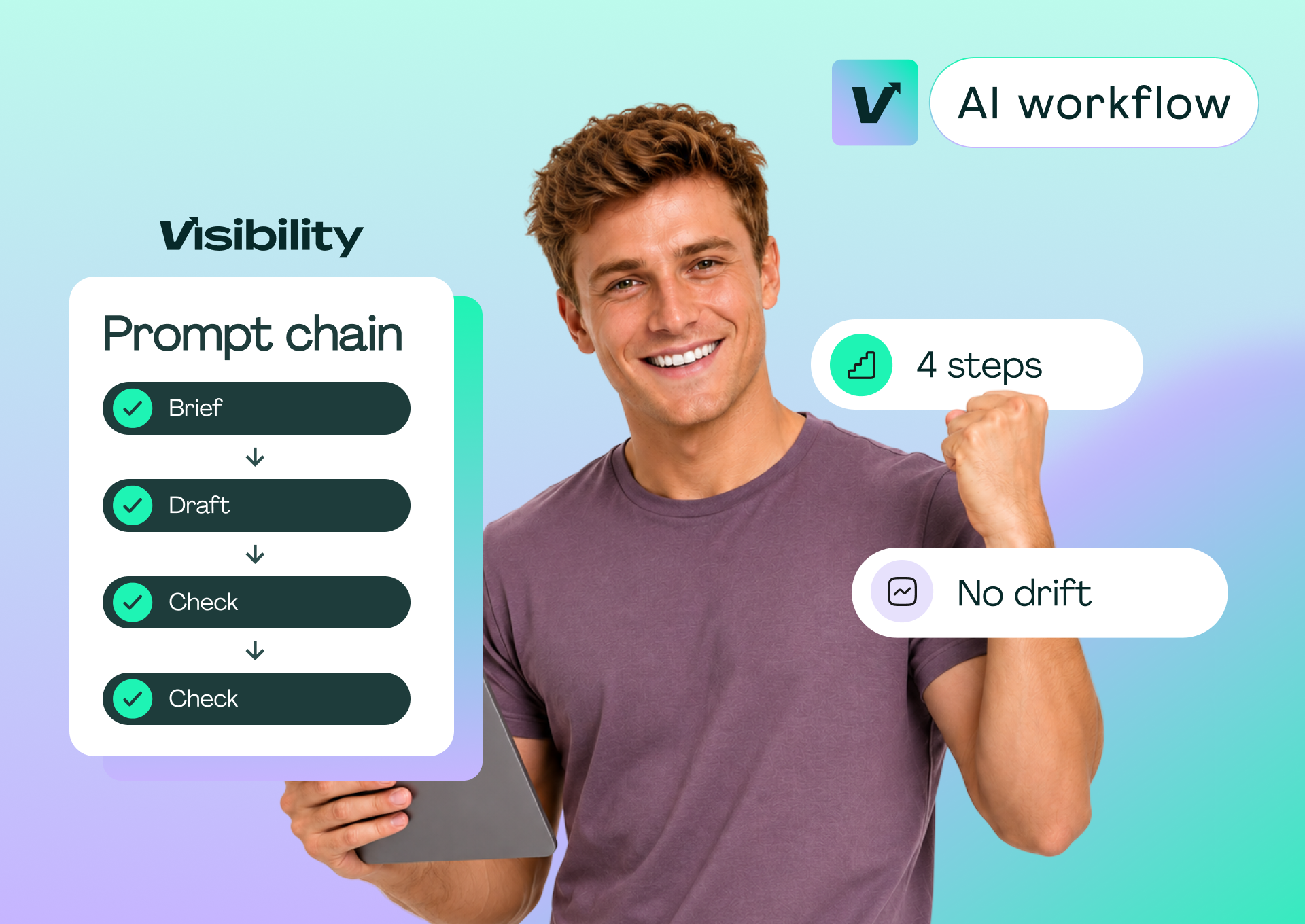
Consumer brands face a relentless operational challenge: generating dozens of on-brand ad variants while simultaneously responding to live performance signals across Meta, Google, and TikTok. A single prompt can address several of these requirements at once, but the resulting output becomes harder to inspect, validate, and improve as the task grows more complex. Prompt chaining is one workflow pattern that can help structure this process by breaking a complex task into smaller, interconnected steps; when connected to the necessary data and tools, each stage can be evaluated independently. By chaining prompts together, teams create a multi-step workflow in which separate model calls handle different parts of a task that requires sequential logic, such as research, drafting, and editing. Prompt chaining gives developers a structured way to guide each stage of a workflow rather than hoping a single prompt gets everything right.
Key Takeaways
- Prompt chaining passes selected output from one model call into a later call, letting a complex task be divided into smaller stages that can each be inspected and tested.
- It can improve observability and control, but it doesn't inherently guarantee better accuracy or fewer hallucinations; an uncaught error at one step can propagate through every step after it.
- Structured outputs, validation, tracing, retries, and human review are what reduce the risk of a bad intermediate result compounding, not chaining by itself.
- Multiple calls typically add latency and can increase cost; model routing to cheaper models for simpler steps, caching, and selective retries are what change that economics, not the act of chaining.
- A predefined workflow differs from an agent because a developer controls the workflow's path in advance; the model's outputs within that path can still vary between runs.
- Chains work best when a task decomposes cleanly into stages that can each be evaluated on their own.
What Is Prompt Chaining?
Prompt chaining is a workflow pattern in which selected output from one model call is passed into a subsequent call, allowing a task to be divided into smaller stages. Instead of asking a model to do everything in a single call, you decompose the task into focused steps and pass the relevant intermediate results forward, not necessarily the entire preceding output. For tasks that can be divided into clear subtasks, chaining can make outputs easier to inspect and control than a single, monolithic prompt. Anthropic's guidance on building effective AI systems frames the core tradeoff plainly: the goal of chaining is to trade latency for higher accuracy by making each individual model call an easier task, not to guarantee better output in every case. Whether chaining actually improves final quality compared to a well-constructed single prompt has to be tested for the specific workflow; it isn't automatic.
The process starts by providing the model with an initial prompt, which is usually a question or statement describing the desired output. After processing, the model generates its first output, and that output is passed directly to the next prompt in the chain. This is the minimum sequential pattern: each step receives the prior step's result and performs its own focused task. Separately, teams can add optional evaluation and feedback loops on top of this pattern. A human reviewer or an automated system can check intermediate output against criteria such as accuracy and brand compliance, then feed corrections into the next prompt. These verification checkpoints are a control layer, not a requirement of basic chaining. The distinction matters: sequential chaining moves output forward by default, while evaluation loops add an extra gate only where the task demands it.
Think of this as an assembly line where each station performs one focused task and passes its work to the next station. For example, a contract-review assistant might extract clauses, classify them against predefined criteria, propose revisions, and prepare a summary for qualified human review, splitting the task into four separate calls: extract, classify, rewrite, and summarize. Each step has a narrower focus, making its output easier to evaluate against criteria defined for that stage.
How Does Prompt Chaining Work?
The mechanism behind prompt chaining is a sequential flow where a complex problem is broken into sub-tasks. Each sub-task is handled by a dedicated prompt, with intermediate outputs passed forward to the next stage. This relies heavily on task decomposition: instead of one giant prompt, the system splits the job into distinct phases. Structured-output features and schema validation, such as requiring JSON in a defined shape, can catch malformed handoffs before they reach the next step. Merely asking a model to respond in JSON doesn't guarantee compliance or factual correctness on its own; actual schema validation at each hop is what catches formatting issues, and a well-formed JSON object can still contain incorrect values that only content-level validation would catch.
Consider the flow as: input, then step 1 prompt, then intermediate output, then step 2 prompt, then final output. A useful architectural pattern is "plan, execute, then verify," with checkpoints that allow intermediate outputs to be inspected before the workflow continues. Developers can inspect and adjust each step independently, enabling isolated debugging and potentially cheaper retries when valid intermediate results can be reused. In McKinsey's 2025 State of AI survey, 23% of respondents said their organizations were scaling at least one agentic AI system somewhere in the enterprise. That's a real and useful signal of growing multi-step AI adoption, though McKinsey's survey doesn't isolate prompt chaining specifically as the technique behind those deployments; treat the connection as directional context, not a measured share.
A prompt registry helps teams version and manage prompt definitions, while tracing records what happened at each step; workflow state should be managed separately so each stage receives only the data it needs. If something goes wrong, tracing lets you identify exactly which hop failed. Validation tests whether outputs are acceptable as input for the next step. This is how teams handle complex multi-step tasks that may be difficult to manage or evaluate reliably within a single prompt, such as multi-step data extraction, analysis, and content generation. The combination of schemas, validation, and tracing makes the surrounding workflow more observable, debuggable, and easier to optimize, even though the model's internal behavior at each step remains partly opaque.
Key Benefits of Prompt Chaining
Prompt chaining can improve control by giving each model call a narrower task. In some workflows, that improves accuracy or reduces irrelevant output compared to a monolithic request. These benefits aren't automatic, though: an incorrect intermediate result can just as easily contaminate every later step, which is exactly why evaluation and validation at each hop matter. Enhanced control is a more reliable benefit than accuracy alone: developers can inspect and adjust each step independently, enabling isolated debugging and retries that may cost less than rerunning the full workflow, provided earlier outputs can be retained safely.
Cost is more nuanced than it first appears. Prompt chaining can increase per-run cost because it introduces additional calls and may process more tokens overall; actual cost depends on the models used, token volume, caching, retries, and how much context is passed between steps, so a short chain built on smaller models could still cost less than one large call on a bigger model. Costs can sometimes be reduced by routing simpler steps to cheaper models, caching repeated context, or retrying only failed stages, rather than by chaining itself. In many enterprise workflows, the stronger justification for chaining is greater control and observability rather than guaranteed cost reduction. The ability to handle complex multi-step tasks that may be difficult to manage or evaluate reliably within a single prompt is a genuine benefit, enabling automation that would otherwise require manual handoffs between steps.
Types and Techniques of Prompt Chaining
Prompt chains can be organized in several practical ways; the categories below are common design patterns rather than a single universally standardized taxonomy. Sequential chaining breaks complex tasks into linear, step-by-step prompts, useful for tasks like summarizing long text in sections. Conditional chaining uses if-then logic to shape outputs, so future steps depend on prior results. For example, if step 1 classifies a ticket as "urgent," step 2 routes it to a specific agent queue; otherwise, it goes to general support. This routing logic makes the chain adaptive without requiring human intervention at each junction.
Iterative (or looping) chains reuse the same step across multiple items, which suits batch operations such as processing several datasets that require the same sequence of transformations. Interactive chaining incorporates user feedback into a chain to respond to outputs in real time, with users having free-flowing conversations with the model, adding new information and ideas to continuously shape outputs. This provides flexibility for creative tasks such as brainstorming or iterative copywriting.
Verification gates can catch some errors before they propagate, provided the checks are appropriate and sufficiently reliable to catch the specific failure mode they're meant to. Building these into workflow engines helps maintain data integrity before proceeding to the next stage. The type of chaining selected depends on the predictability of the task and how much human intervention is needed at specific nodes.
Practical Examples and Use Cases
In content creation, marketing teams can iteratively generate blog posts and ad copy using chained prompts to refine drafts toward brand voice, length, and tone. A chain gives specific control at each stage: one prompt generates a first draft, the next applies brand-voice and length checks, and a third formats the output for the target channel. This makes it easier to apply the same quality checks to every variation.
Pixis Visibility follows a comparable staged workflow for SEO and GEO content: it can turn an identified visibility gap into a data-grounded content brief (built around the specific prompt and citation pattern the gap was found in), support an AI-assisted draft and human review, and publish the approved piece to a connected CMS. That's a genuinely staged, generate-then-validate process, though it's worth being precise about what that establishes: the workflow resembles the chaining pattern described in this guide, but Pixis hasn't published the underlying technical architecture, so similarity to a chained workflow isn't the same as confirmation that it's implemented as one. What is documented is the outcome: teams can develop content informed by the entities, sections, and structural patterns that AI engines are already citing from competing sources, which is a more defensible framing than promising that any specific asset will be cited. See how Pixis Visibility's GEO Analysis Hub connects visibility gaps to published content for the full workflow.
In customer support, a chain classifies an incoming ticket, extracts entities, and drafts a reply in three structured steps. Entity extraction can make required details easier to check, and a validation step can flag missing or ambiguous fields before the reply is sent. In software development, developers generate code, then chain prompts to optimize it, check it against standards, and debug it, which can support code review and catch issues earlier, though the resulting code still needs appropriate testing and human review before shipping.
Another use case is ad creative production. Teams create initial design concepts, then refine them based on technical feasibility and market research. Chained AI workflows can generate creative variants, apply brand checks, and use performance signals to guide the next iteration, but these validation and optimization stages are explicit workflow steps that teams configure and monitor, not an automatic outcome of chaining itself. Adroom supports the creative-production stage; a separately configured chain, built and maintained by the team using it, could add validation or routing around Adroom's outputs, but that surrounding architecture shouldn't be presented as an inherent Adroom feature unless product documentation confirms it.
Prompt chaining can support parts of a creative-automation workflow when the production process can be divided into defined, testable stages. Data extraction and analysis is another common pattern: extract, then reason, then format, useful for processing unstructured documents. For marketing operations, this can reduce some of the manual handoffs in repetitive processing tasks once the workflow is properly implemented and monitored.
How to Design and Implement Prompt Chains
To get started, first decompose the task. Identify discrete sub-tasks that can each be handled by a single focused prompt rather than writing one prompt that tries to do everything at once. Then write clear instructions for each prompt: specify the exact input format, expected output format, and constraints, since each prompt needs to know precisely what it will receive and what it should produce.
Enforce structured outputs next. Using JSON or a similar format between steps makes state transfer more predictable and machine-readable, and schema validation at each hop catches formatting issues before they reach the next prompt, though it won't catch every factual error inside an otherwise well-formed response. Implement error handling and verification gates: validate each intermediate output before passing it forward, since this is where hallucinations and formatting errors get caught before they compound.
Test iteratively. Start with a simple two-step chain, evaluate each step, then add complexity. Errors compound faster than intuition suggests: in a simplified example where four steps each succeed independently 95% of the time and every step must succeed for the chain to succeed, end-to-end success works out to roughly 81%. Real workflows can perform better or worse than that simplified figure, since errors aren't always independent between steps, and validation or retries can recover some failures before they propagate, but the underlying point holds: evaluating every step, not just the final answer, matters. Finally, manage context and state deliberately: pass only the fields the next prompt actually needs, to reduce unnecessary tokens and confusion, and use a prompt registry and tracing to make every hop visible and debuggable.
Building a prompt library once a prompt is crafted simplifies future prompt creation. Define the objective clearly before building a chain, select a model that fits that objective, and map out sequences and subtasks carefully. Complexity should be divided into different prompts, each with a narrow scope, rather than loaded into one initial prompt.
Prompt Chaining vs. Related Concepts
It's worth distinguishing prompt chaining from chain-of-thought (CoT) prompting. CoT prompting encourages intermediate reasoning within a single model interaction; prompt chaining divides the workflow across multiple separate model calls and passes selected outputs between them. The distinction is about workflow structure, not necessarily whether a model exposes its internal reasoning, since some newer reasoning systems don't surface that reasoning in the same way earlier models did.
Prompt chaining and AI agents are also distinct, and Anthropic's own framing draws this line clearly: workflows (which include chaining) are systems where the LLM and tools are orchestrated through developer-defined code paths, while agents are systems where the model dynamically directs its own process and tool use. A workflow's execution path is generally easier to inspect and evaluate because a person defined it in advance; that doesn't mean the model's outputs within that path are deterministic, they can still vary between runs. A practical rule of thumb: start with a chain. If the next step depends on the previous result, add conditional routing. Add tool use specifically when the workflow needs external data or must perform an action through an API or another system, for example, if step 1 identifies a product name, step 2 might call a tool to look up its current price before drafting ad copy. If the required sequence is too variable to define sensibly in advance, an agent may be more suitable, provided the additional autonomy is justified by the task and properly controlled, since agents also add their own cost, security, and evaluation overhead compared to a fixed chain.
Prompt chaining and retrieval-augmented generation (RAG) can also be combined: chaining can incorporate RAG as one step, retrieve relevant documents, then pass them to a reasoning step, then format the answer, letting each stage focus on a single job. Compared to zero-shot, few-shot, and fine-tuning, chaining's advantage is narrower than a blanket claim of superiority: for tasks that decompose cleanly, chaining tends to offer clearer structure and easier debugging, but whether it beats a well-constructed single prompt on final output quality depends on the specific task and has to be tested, not assumed.
Challenges, Limitations, and Security in Prompt Chaining
Increased latency is a real trade-off from making multiple API calls, which may affect real-time applications. Error compounding is a related, critical issue: in the same simplified example above, a 95% per-step success rate across four required steps works out to roughly 81% end-to-end, assuming independent, uncorrected errors. Step 3 inherits step 2's hallucination if nothing catches it first. Evaluating intermediate steps creates opportunities to catch an error before it propagates, although evaluation doesn't guarantee detection; a weak or poorly designed check can still let a bad result through. Schemas should be defined up front to prevent bad handoffs where one step emits a field, the next step doesn't expect.
Debugging complexity increases with more steps; identifying where a chain fails requires tracing and logging at each hop. Security risks also arise: prompt injection attacks can propagate across steps, and sensitive data in intermediate outputs may be exposed if not handled carefully. Input validation, output sanitization, verification gates, and schema enforcement all reduce this risk without eliminating it. A fuller security posture also includes least-privilege tool permissions (so a given step can only access what it actually needs), a clear separation between trusted instructions and untrusted content pulled in from external sources, confirmation steps before any consequential or irreversible action, data minimization in what gets passed between steps, allowlisted destinations for any external calls, and ongoing monitoring with a real incident-handling process rather than a one-time security review.
Governance for scaled deployment includes permissions that ensure agents and chains access only the data they need, audit trails that log every action, and human-in-the-loop controls for decisions with real consequences. There are also scenarios where chaining isn't the right tool: single prompts may suffice for simple tasks, and highly variable tasks may be better served by an agent. The right trade-off between complexity and control depends on the risk profile of the specific use case.
Frequently Asked Questions About Prompt Chaining
What is prompt chaining in simple terms?
Prompt chaining is a workflow pattern in which selected output from one model call is passed into a subsequent call, allowing a complex task to be divided into smaller stages. This can make the workflow easier to inspect, test, and control, but it does not guarantee greater accuracy or eliminate hallucinations.
How is prompt chaining different from chain-of-thought prompting?
Prompt chaining orchestrates multiple external LLM calls in sequence, each with a narrow focus. Chain-of-thought prompting, by contrast, asks a single model to reason through intermediate steps within one prompt before producing a final answer. Chaining tends to suit workflows that need external verification or genuinely distinct processing stages between calls.
What are the main types of prompt chaining?
Common patterns include sequential chaining for linear step-by-step tasks, conditional chaining for if-then logic based on prior output, iterative (looping) chains for repeating a step across multiple items, and interactive chaining for incorporating real-time human feedback. These are practical design categories rather than a single fixed standard, and the type that fits depends on whether the task needs rigid structure or dynamic human input.
What are the biggest challenges of prompt chaining?
Key challenges include added latency from multiple API calls, error compounding across steps, more complex debugging, and the need for real governance rather than ad hoc checks. A modest per-step error rate can compound significantly over a longer chain, which is why step-by-step evaluation matters more than checking only the final output. If a specific step errors out, the chain should return a structured error, retry on parse failures, or route the case for human review rather than passing bad output forward.
How do I get started with prompt chaining?
Start by decomposing your task into discrete steps, write clear instructions for each prompt, enforce structured outputs like JSON between steps, implement error handling and verification gates, and test iteratively. Begin with a simple two-step chain before adding complexity, and confirm each new addition actually improves the outcome rather than just adding steps.
Conclusion
Prompt chaining works best when you know your task, can define its steps, and can validate each one. Start with a simple two-step chain, measure where errors appear, and add complexity only once the earlier steps are stable. For advertising teams, the same principles apply to creative workflows: generate variants, apply brand checks, and use performance signals to guide the next iteration, with human review built into the checkpoints that matter most.
A guide like this is only useful if people can find it through the search and AI surfaces they use. Pixis Visibility measures where a brand appears across ChatGPT, Perplexity, Gemini, and Claude, while visibility in Google Search and AI Overview is tracked through the platform's search-focused capabilities. It connects identified gaps to data-grounded briefs, AI-assisted drafting, human review, and CMS publishing. This gives teams a structured way to measure visibility and address content gaps, without implying that publication guarantees future citations.
If you want to see how these workflows connect to real campaign performance, this guide to AI-powered user acquisition on Meta Ads and Google Ads walks through the practical steps. For teams already running campaigns, detecting and preventing ad fatigue with iterative creative workflows is a natural next step.