
Replacing Ahrefs starts with a harder question than which subscription costs less: which parts of your SEO work can you afford to lose?
A tool might cover keyword research without reproducing the backlink reports your team relies on. Another might track more keywords but refresh them less often than you need. And an AI visibility dashboard only adds value if it measures the questions, markets and answer engines your buyers actually use.
This guide compares seven alternatives against those decisions. Pixis Visibility comes first for teams connecting SEO and AI search analysis with content execution. Semrush and SE Ranking deserve a closer look for broad SEO workflows, while Moz Pro, SpyFu, Mangools and Google Search Console address more specific needs.
Disclosure: Pixis Visibility is our product. This guide draws on public vendor documentation, rather than a hands-on accuracy benchmark across all seven tools. The order reflects the use cases described below. Prices are in US dollars where stated; vendor pages may display a different local currency. Billing terms, taxes, promotions and usage limits can change.
Key takeaways
- Choose an Ahrefs alternative around the reports and workflows you need to preserve, including backlink research, keyword gaps, audits and ranking history.
- Pixis Visibility connects SEO and AI visibility findings with briefs, drafts and publishing. Its Free plan includes 850 starting credits; ongoing usage consumes credits.
- AI visibility is available from several vendors in this list. Compare included allowances and bundles before assuming it requires a separate subscription.
- SE Ranking is worth evaluating for daily keyword tracking. SpyFu is a focused option for competitor SEO and PPC research.
- Google Search Console is a useful free foundation for your own site, but it cannot replace competitor research.
What are you replacing in Ahrefs?
Ahrefs combines keyword discovery, backlink research, site audits and rank tracking. Its current pricing page lists Lite at $129 a month, with one user, 750 tracked keywords and weekly ranking updates. Two additional users can be added at $40 each per month, making a three-user Lite setup $209 a month before tax.
That is a useful comparison baseline, but $129 is not Ahrefs’ lowest price. It also offers a $29 Starter plan and Ahrefs Free for verified websites, with different capabilities and limits.
AI search is already part of the product range, too. Lite includes 150 AI prompt checks per month. Brand Radar AI, which supports broader research across Ahrefs’ AI-answer database, starts at $199 a month. Ahrefs also lists custom prompt packages from $50 a month for 2,500 checks, with overage charges. One prompt checked on one platform in one location uses one check. These allowances and database-research products serve different needs.
Before choosing a replacement, write down what you actually use:
- Which competitor and backlink reports inform decisions?
- How many keywords, countries and devices do you track?
- How much historical data do you need to keep?
- How many people need access?
- Do you need analysis, content production or both?
The best alternative is the one that meets those requirements at a sustainable total cost.
Ahrefs alternatives at a glance
Use this shortlist to identify which tools merit a replacement trial. Prices below refer to monthly billing unless explicitly stated otherwise. The entry price does not imply equivalent coverage, users or usage across vendors.
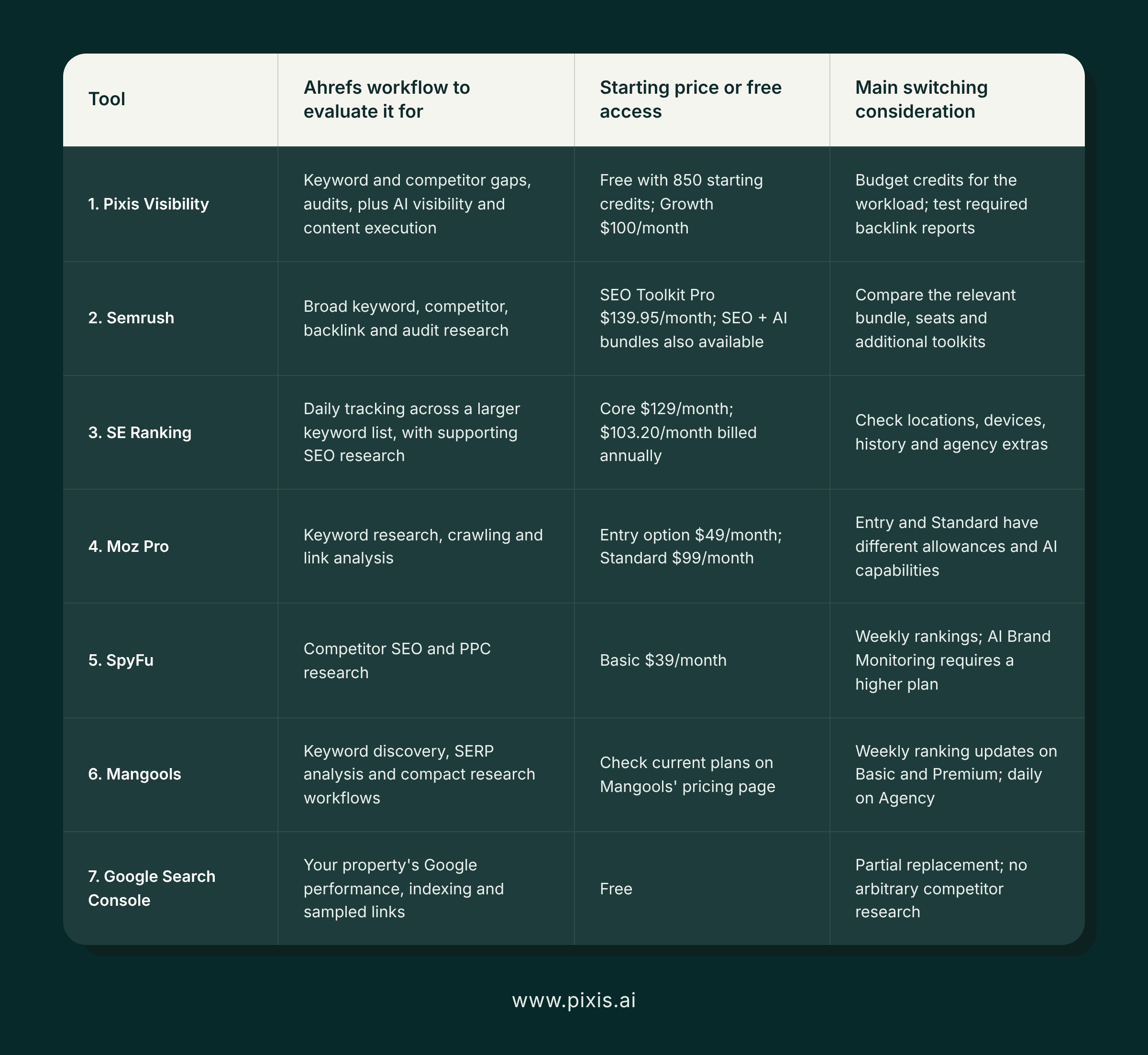
Vendor sources and detailed limits are linked in each profile below. Ahrefs Lite remains the comparison baseline at $129/month, rather than a claim that every alternative reproduces all its features.
The 7 best Ahrefs alternatives
1. Pixis Visibility: for connecting search analysis with content execution
An SEO report can show that a competitor owns a useful keyword. An AI visibility report can show that an assistant recommends that competitor. The next decision is what to improve, which page should own the topic and how to get the work published.
Pixis Visibility brings that work into a connected workflow. It combines keyword tracking, competitive analysis, keyword gaps and clustering with technical audits and AI search analysis across ChatGPT, Gemini, Perplexity and Claude.
Strategy Brain captures the audience, business context, objectives and brand voice used to guide content work. Teams can move from an identified opportunity to a brief and draft, then review and publish through the WordPress workflow. Google Search Console data helps connect that work with search performance.
The practical advantage is continuity. A content team can investigate a missing topic, decide whether to update an existing page or create a new one, and develop the content with the same strategic context.
That does not make every gap a publishing assignment. Some gaps belong to irrelevant competitors, overlap existing content or require stronger evidence before a page is useful. Editorial judgment remains part of the process.
Pricing: The Free plan includes 850 starting credits, access to SEO, GEO, Technical and Execute, and tracking across all four supported engines. No credit card is required. Growth costs $100 a month for 1,000 monthly credits, with automations and scheduled reports. Premium costs $400 a month for 5,000 monthly credits. Enterprise pricing is custom.
Before switching: Model the credits required for your actual audit, prompt analysis and content workload. If backlink investigation is central to your work, test the reports you need before retiring a dedicated research tool.
For the detailed two-product decision, read our Ahrefs vs. Pixis Visibility comparison.
2. Semrush: for a broad SEO research suite
Semrush belongs on the shortlist when replacing Ahrefs means preserving several research functions together. Its SEO Toolkit covers keyword research, competitor analysis, backlink analysis, position tracking and site auditing.
It also offers adjacent marketing products, although those should not be assumed to come with every subscription.
Pricing: Semrush’s SEO Toolkit documentation lists Pro at $139.95 a month. Compare that with the current SEO and AI search plans if you need both.
Importantly, AI visibility is not available only as a separate add-on. Semrush One bundles the SEO and AI Visibility toolkits in one subscription.
Before switching: Price the bundle you would actually use, including users and any additional toolkits. Then check whether it reproduces your recurring competitor, link and reporting tasks.
If Semrush is already on your shortlist, our Semrush alternatives guide explores that separate buying decision.
3. SE Ranking: for daily tracking across larger keyword lists
SE Ranking is a strong candidate when rank tracking is the main reason you pay for Ahrefs. Its entry plan combines daily keyword tracking with keyword, competitor and backlink research, plus website and on-page audits.
Pricing: The Core plan costs $129 a month, or $103.20 per month with annual billing. It includes 10 projects, one manager seat, 2,000 keywords tracked daily and 250,000 audit pages per month.
The current plan also includes AI visibility tracking with 25 prompts daily across five AI engines. A 14-day trial is available without a credit card.
That gives Core more tracked keywords and a faster standard refresh cadence than the Ahrefs Lite baseline discussed above. It does not establish that either vendor has more accurate data.
Before switching: Load the same priority keywords, locations and devices into a trial. Check reporting, historical requirements and how the AI prompt allowance is counted. Agencies should also confirm which client access and white-label capabilities require additional purchase.
4. Moz Pro: for a focused SEO toolkit with familiar authority metrics
Moz Pro is worth considering when your needs center on keyword research, site crawling and link analysis. Its Domain Authority and Page Authority metrics can also be useful where existing reports already use them.
Treat those metrics as comparative vendor scores, rather than Google ranking factors.
Pricing: Moz lists an entry-level option at $49 a month for an individual managing one website. Standard costs $99 a month, or approximately $79 per month with annual billing, according to its pricing page.
Standard includes one user, three tracked sites and 300 tracked keywords. It also includes an AI visibility dashboard and 150 tracked prompts, updated weekly, across GPT, Gemini and Google AI Mode.
Before switching: Check the plan that covers your required sites, keywords and AI models. The $49 entry price should not be presented as the price for all Standard features, and a modest keyword allowance can become restrictive as your reporting grows.
5. SpyFu: for competitor research across SEO and PPC
SpyFu is particularly relevant when organic research sits alongside paid search work. Its competitor keyword and advertising research can help teams investigate which topics and campaigns deserve attention.
Its current offer also includes site audits, so a replacement trial can cover technical checks alongside competitor research.
Pricing: SpyFu Basic costs $39 a month, or $29 per month billed annually. It includes one user, 5,000 weekly tracked keyword rankings and 50,000 crawl pages per month.
AI Brand Monitoring is excluded from Basic. Pro + AI includes it and is advertised at $59 for the first month, followed by $119 a month. The introductory price should not be used as the ongoing cost.
Before switching: Check the keyword and advertising data for your target market, plus export limits and the reports your team uses. Weekly rank tracking will not meet a requirement for daily updates.
6. Mangools: for a compact keyword and SERP research workflow
Mangools brings together KWFinder for keyword research, SERPChecker for search results analysis, SERPWatcher for rankings, LinkMiner for backlinks and SiteProfiler for domain analysis.
Its current SEO + AI plans also include AI Search Watcher Pro, bringing AI search monitoring into the package.
According to Mangools’ plan documentation, Basic includes 200 tracked keywords, Premium 700 and Agency 1,500. Ranking updates are weekly on Basic and Premium, and daily on Agency. The SEO + AI plans include 500 AI Search Watcher prompts and unlimited monitors.
Pricing: Use the current Mangools pricing page for the applicable currency and billing term. Prices depend on country and billing term; the annual view shows a monthly equivalent alongside the amount charged yearly.
Before switching: Distinguish the SEO + AI bundle from a standalone AI Search Watcher subscription. The latter includes much smaller SEO allowances. Also check whether the plan’s lookup limits and ranking frequency fit your workload.
7. Google Search Console: for free first-party search data
Google Search Console should remain part of your measurement setup whichever paid platform you choose. It reports Google search clicks, impressions, queries and average position for properties you can access, alongside indexing and technical information.
It also has a Links report. The limitation is that it provides a sample of links associated with your property, rather than a database for investigating arbitrary competitors.
Pricing: Free.
Before switching: Search Console is a partial replacement. It will not reproduce competitor keyword discovery, competitor backlink analysis or controlled keyword tracking by location and device. Its average position metric also should not be treated as interchangeable with a rank tracker’s result.
Choose it as the baseline for understanding your own site, then add paid research where a specific decision requires it.
Which free Ahrefs alternatives are useful?
“Free” can describe a permanently available tool, a limited account, a trial or starting credits. Those distinctions matter when planning ongoing work.
Google Search Console provides a continuing foundation for your own Google search data. Ahrefs Free offers limited research and auditing for verified websites. Pixis Visibility provides 850 starting credits to explore search analysis and content workflows.
A useful free setup begins with one question, such as why an important page is losing impressions. Check its queries and indexing in Search Console, investigate the page itself, and use the relevant research or audit allowance to narrow the cause.
Avoid building a stack simply because every tool has a free entry point. Add a tool when it answers something your existing setup cannot.
For crawl, performance and technical checks, see our guide to free SEO audit and website checker tools.
Beyond ChatGPT: preserve the AI coverage you need
If AI search is one reason for leaving Ahrefs, include it in the replacement trial. Use the same buyer questions across your priority engines, inspect actual responses and citations, and check whether the allowance counts unique prompts or individual checks. Confirm refresh frequency before budgeting recurring runs.
A few answers cannot establish category-wide visibility. For a dedicated AI-first platform shortlist, use our AI visibility tools comparison. Here, the decision remains whether a tool covers the Ahrefs work you need to replace.
Test the replacement before canceling Ahrefs
A short parallel evaluation is more useful than comparing feature checkmarks.
Reproduce a real research task. Choose a recent competitor analysis or backlink investigation. Confirm that the alternative provides enough evidence to reach a useful decision, including the exports you need.
Track a representative keyword set. Include branded and nonbranded terms, priority markets and different page types. Check locations, devices, refresh cadence and reporting.
Audit an important section of your site. Compare actionable findings. A larger issue count is not automatically a better audit.
Complete one content assignment. If content execution is part of the purchase, move an opportunity through the brief, draft, review and publishing process. Assess factual accuracy and editorial effort.
Price the whole workload. Include users, sites, credits, prompt checks, reports and integrations. Export required historical records before ending the old subscription.
A replacement can cover your main workflow while a specialist tool remains useful for occasional research. The decision should follow the work.