

Your English pages sound like you. The German version, run through a translation tool and lightly edited, sounds like a careful stranger. It is grammatically correct, it uses the English keywords in German, and local buyers do not search for any of them.
Multilingual content fails in two ways at once. It loses the voice that makes your brand recognizable, and it misses what people in that market actually type into Google or ask an AI assistant. Fixing one without the other still leaves a weak page.
AI search raises the stakes. ChatGPT, Perplexity, Gemini and Claude each pick their own sources, and a page that ranks in one market is not guaranteed a citation there. Each language needs its own research, its own review and its own measurement.
This guide covers how to scope markets, build a voice guide that survives translation, research and draft per market, set the technical base, and measure each language separately.
Key takeaways
- Localize rather than translate. Rebuild keywords, prompts, hooks and examples for each market instead of converting the English page word for word.
- Write the voice guide before the first localized draft, and give the same guide to every writer, translator and AI tool. Without it, each language drifts in its own direction.
- Scope by locale, not by language. de-DE and es-MX need their own keyword lists, reviewers and baselines, and so do US and UK English.
- Put every draft through a native reviewer and log their corrections back into the voice guide, so the system improves each cycle.
- Measure rankings and AI visibility per language. Pixis Visibility can track prompt sets per market and hold your brand book, voice settings and terminology rules; native review stays human.
Translation is not localization
Translation moves words. Localization moves meaning: language, cultural references, pricing, currency, regulatory context and search behavior. A translated page reads like a tourist with a phrasebook, technically correct and culturally flat.
Keywords show the gap most clearly. The terms that drive traffic in English rarely survive a word-for-word swap into German or Spanish, because local buyers use different words, different intent markers and different questions.
AI search adds a second layer. A page that ranks in traditional search is not guaranteed a citation in an AI answer, and a page that does not rank can still be cited. Localized pages need the same things English pages need for GEO: clear entities, direct answers, specific facts and formatting that is easy to quote. For the overlap and the differences, see GEO vs SEO: what is actually different and what still applies.
Scope by locale before you write anything
Take an illustrative example: a US B2B SaaS company expanding into Germany and Mexico. That is two locales (de-DE and es-MX), two native reviewers and two baselines, not "German and Spanish".
The locale matters because one language can serve very different markets. US and UK English differ in spelling, vocabulary and idiom, and the same is true of European and Latin American Spanish or of Portuguese in Brazil and Portugal.
Before the first draft, confirm you have:
- A target market list with regional variants specified
- Keyword research and AI engine access for each market, so you can run local queries and prompts yourself
- One native reviewer per locale
- A CMS that supports separate URLs per locale and hreflang
- A baseline for each market: Google Search Console data and a record of current AI visibility
1. Build a voice guide that travels
The voice guide is what keeps a German page and a Mexican page sounding like the same company. Write it before any localized drafting starts, and make it specific enough that a translator or an AI tool can apply it without guessing.
A portable voice guide includes:
- Principles, each with a short do and don't example (for instance, "direct, not blunt").
- A terminology glossary listing product names and terms that are never translated, plus the approved local equivalent for terms that are.
- Per-market notes on formality, such as whether German copy uses "Sie" or "du", and how claims should be phrased under local regulations.
- Words to avoid in each language, including literal translations that read as awkward or misleading.
Give the same guide to every writer, translator and AI tool. For how much brand context AI drafting actually needs, see how much brand context does AI content need.
2. Research keywords in each market
Build a fresh keyword list in the local language rather than translating the English one. Search volumes and intent differ by country, and the best local term is often not the literal translation.
In the illustrative example, the German list ends up with 95 keywords and the Mexican Spanish list with 80, both built from local research. If a list came out of a translation tool, rebuild it.
3. Research AI prompts in each market
Ask ChatGPT, Perplexity, Gemini and Claude the questions local buyers would ask, in the local language. Record each answer and the sources it cites.
Engines differ in how they choose sources, so test more than one; multi-engine testing for GEO explains why. For a method to find the questions worth tracking, see AI prompt research.
4. Draft for the market, not from the English page
Rebuild the hook around a local pain point, fold local keywords into natural sentences, and replace examples with local ones. In the illustrative example, the German page leads with a compliance angle and the Mexican page leads with price transparency.
Apply the voice guide while drafting, not afterward. Fixing voice at the end usually means rewriting the page.
5. Review with native speakers and feed corrections back
An AI draft can be fluent and still wrong for the market. Errors that survive to publication also become part of what AI engines learn about your brand in that language.
Ask each native reviewer to check three things: meaning, voice against the guide, and local search fit. Log every correction that reflects a pattern, such as a recurring mistranslation or a tone issue, back into the voice guide. Over a few cycles, the guide absorbs the reviewers' knowledge and drafts need fewer fixes.
6. Set the technical base
Publish one URL per locale, add hreflang annotations that point at every version, and list them in your sitemap. Google's Search Central documentation on localized versions covers the markup rules.
In the illustrative example, the de-DE and es-MX pages each carry bidirectional hreflang pairs. Validate every pair before publishing, because a missing or one-way annotation leaves search engines guessing which page serves which market.
Measure each language separately
Few teams measure AI search at all. A McKinsey survey of about 30 CMOs at large consumer brands found that just 16% systematically track AI search performance. Measuring per language puts you further ahead, and it is the only way to see which market is actually working.
Run a monthly check for each locale:
- Rankings and gaps. Review Search Console and keyword positions per market. A flat German profile next to a healthy Mexican one points to a Germany-specific problem, not a site-wide one.
- AI visibility. Run the same local-language prompt set each month and record mentions, citations and position. In the illustrative example, the company tracks 50 prompts per language.
- Voice consistency. Have a native reader score a sample of published pages against the voice guide.
If a market stays flat after two cycles, read the actual AI answers before rewriting anything. The usual cause is that the pages answer questions local buyers are not asking.
Where localization goes wrong
- Translating the keyword list. The result misses what local buyers type.
- Skipping native review. Fluent is not the same as right.
- Treating one language as one market. Scope by locale.
- Broken or missing hreflang. Validate every pair.
- Measuring only English. Pages in other languages look invisible when nobody tracks them.
Where Pixis Visibility fits
Two parts of this workflow repeat every month in every market: keeping drafts on-voice and measuring AI visibility per language.
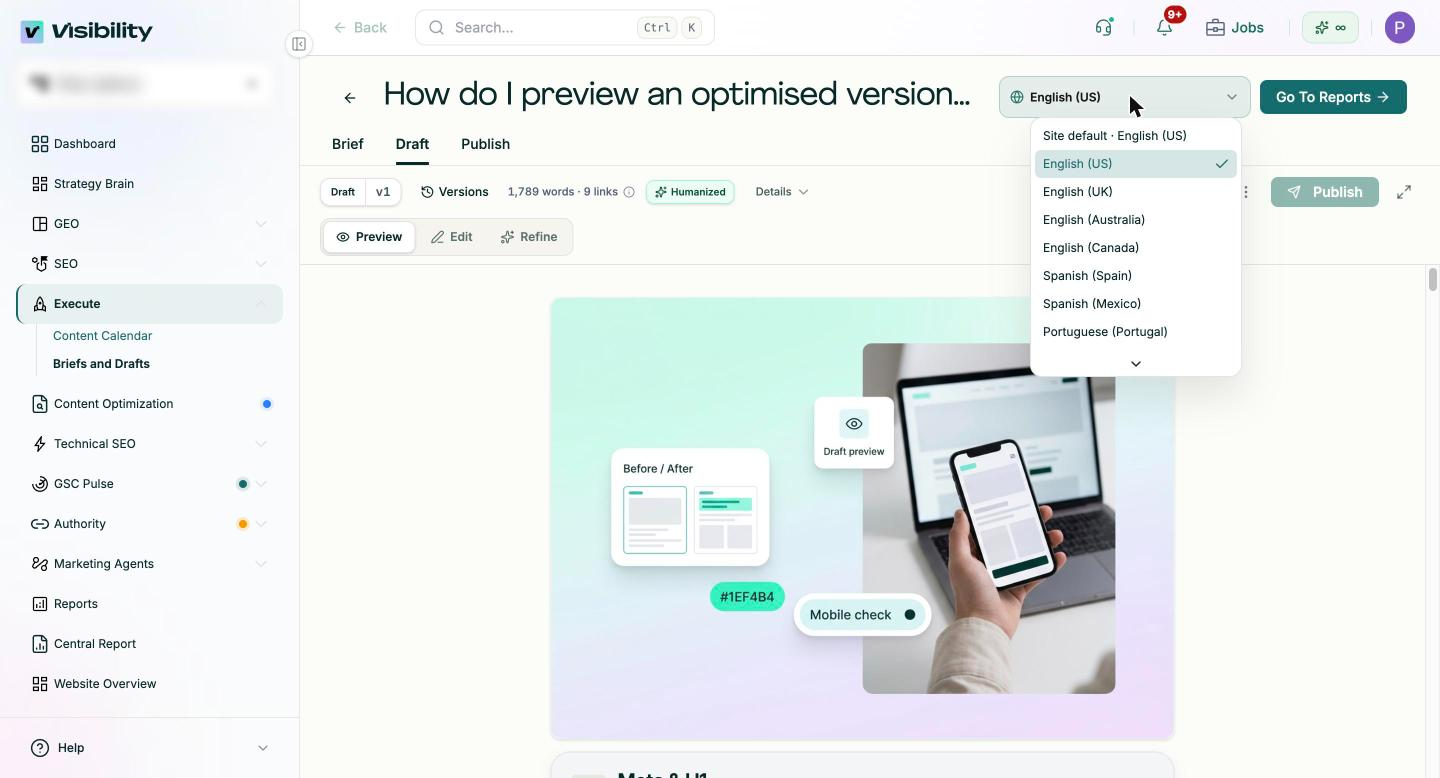
Pixis Visibility's Strategy Brain holds your brand book, voice settings such as reading level and claim sensitivity, and must-include and never-mention terms, so drafts and briefs start from the same rules your voice guide sets out. Its content tools produce plans, briefs and drafts in that brand voice, and each draft has a language setting with regional variants, such as English (UK), Spanish (Spain) or Spanish (Mexico), so a market's draft starts in the right language.
For measurement, you can build or auto-generate a prompt set for each market and track brand mentions, average position, citation rate, share of voice and top-3 presence across ChatGPT, Perplexity, Gemini and Claude, with the actual AI answer shown for each prompt. The Google Search Console connection and keyword gap analysis cover the search side.
What stays with your team: local keyword research decisions, native review, hreflang implementation and the judgment about what each market needs to hear.
Start with one market and a baseline
Pick the market you are most likely to win and build its voice guide notes, keyword list and prompt set first. Record the baseline for rankings and AI visibility before you publish a single localized page.
Then localize a small set of pages, run them through native review, and compare the next month's numbers against the baseline. Add the second market only once the first has a working loop.
Get started with Pixis Visibility to track AI visibility per market and keep every localized draft on-brand.
FAQs
What is the difference between localization and transcreation?
Localization adapts content to a market: keywords, examples, formats and references. Transcreation is the writing inside that, rebuilding the hook and copy so the page reads as if a native copywriter wrote it while keeping the brand voice. Transcreation briefs often ask for several options plus a recommendation rather than one rendering.
Do I need separate pages for GEO and SEO in each language?
No. One well-structured page per locale can serve both. The difference between a page that ranks and one that also gets cited is usually entity clarity and specific facts, not separate copy.
Should AI prompts be written in the local language?
Yes. Write them the way local buyers actually ask, in their language and register. An English prompt about the German market tells you little about what German buyers see.