

A client asks whether you "do GEO". Your manager wants someone on the team to own AI search. A recruiter lists "GEO certification" as nice to have. The obvious move is to find a course, pass the assessment and add a badge to your profile.
The problem is that there is no universal certification for generative engine optimization. Programs come from course providers, software vendors and training companies, under names such as AI SEO, AEO and GEO, with very different depth. A certificate shows you finished a course. It does not show that you can move a brand's visibility in AI answers.
What does show that is a measured result: the same set of buyer prompts, run before and after your changes, on a site you can edit.
This guide covers what certificates can and cannot prove, what to know first, a six-week practice plan, how to read the results honestly, and how to choose a course if you still want one.
Key takeaways
- No single official GEO certification exists; programs vary widely, so treat any certificate as evidence of study, not of skill.
- The strongest proof is a portfolio of before-and-after results on a fixed prompt set, measured on a site you control.
- A practical self-study plan takes about six weeks at a few hours a week: sources and prompts, measurement and content, technical access and re-measurement.
- The original GEO research is the best starting point for methods; read it before any course summary of it.
- Separate citations from mentions, and expect run-to-run variation before you call a change a result.
- Pixis Visibility tracks mentions, citation rate, share of voice and average position across four AI engines, which gives you the baseline and re-measurement for the portfolio.
What GEO certifications can and cannot prove
A certificate is useful in narrow ways. It can give you a structured syllabus, deadlines and a shared vocabulary with colleagues. Some programs include assessed practical work, which is worth more than a multiple-choice test.
What a certificate cannot show is the thing a client or employer actually needs: that you can find the prompts that matter, diagnose why a brand is missing from answers, change something, and measure the effect.
So the question to ask is not "which certification is official?" but "what evidence will convince the person I am trying to convince?" For most people, that is a short case study with real numbers.
What to know before you start
GEO builds on SEO rather than replacing it. If the term is new, start with what generative engine optimization is. If your SEO fundamentals are rusty, the comparison of what differs between GEO and SEO covers what still applies.
Before week one, have these in place:
- A site you can edit, with access to its analytics and Google Search Console. A section of your company site or a personal project both work.
- SEO fundamentals: how crawlers reach pages, how content is indexed, and how internal links and structure work.
- A way to measure AI answers, either a tracking tool or a disciplined spreadsheet where you record each prompt, engine, date and answer.
- A few hours a week for six weeks, with the practice project running alongside.
Then read the source. The paper that named the field, GEO: Generative Engine Optimization, published at KDD 2024, defines the problem, proposes visibility metrics and tests specific content methods. Reading it first means you can judge course material against the original rather than against someone's summary.
A six-week practice plan
Each two-week block has a focus, a concrete output and a way to know it worked. Run every step on your own site so every number is real.
Weeks 1 and 2: how engines choose sources, and which prompts matter
- Study source selection. Learn how generative engines retrieve pages and synthesize answers from several sources. You know this worked when you can explain, for one query in your category, why the engine cited the sources it did.
- Build a prompt set. Write 30 to 50 questions real buyers ask, in their own words. Ask sales and customer teams what people type into ChatGPT before choosing a provider. For a method, see how to find buyer questions worth answering.
Keyword lists are a weak substitute. They miss the conversational phrasing that AI answers respond to.
Weeks 3 and 4: baseline, then content for citation
- Baseline the prompt set. Run every prompt on the engines you care about and record whether your brand is mentioned, whether your pages are cited, where you appear in the answer and which competitors appear. Do not change anything until this is saved.
- Improve the pages you want cited. The GEO paper tested methods such as adding citations to credible sources, quotations and statistics, and found that these generally helped while keyword stuffing did not. Apply them to a small set of pages so you can attribute the effect.
Weeks 5 and 6: technical access and re-measurement
- Fix technical access. Check robots.txt, sitemaps and schema on the pages you changed, so AI crawlers can reach them. You know this worked when a crawl of those pages returns clean.
- Re-measure. Run the same prompt set on the same engines and compare every metric with the baseline. This is the first before-and-after pair in your portfolio.
Doing technical access last in the plan is deliberate for learning purposes, but on a live project check it first. Content changes on pages crawlers cannot reach will not show up in any answer.
An illustrative before-and-after
Suppose a marketer runs this plan on a 20-page B2B site with a 40-prompt set. At baseline, the brand is mentioned in answers to 13 of the 40 prompts, or about 32 percent. Over weeks four and five, they add cited statistics to six pages and fix schema.
At re-measurement, the brand appears in answers to 19 of the 40 prompts, about 47 percent: a gain of roughly 15 points. These numbers are illustrative, not a benchmark.
What makes the result credible is the method, not the size of the gain. The same prompts, the same engines and recorded dates on both sides mean anyone can check the comparison.
Read the results honestly
AI answers vary from run to run, so a single re-measurement can mislead. Run each prompt more than once, or across several days, before you claim a change.
Separate two outcomes when you read the answers:
- A citation means the engine linked or named your page as a source.
- A mention means your brand appeared in the answer, with or without a link.
Both matter, but they move for different reasons, and a case study that blurs them is easy to challenge.
If the numbers do not move, check three things in order: technical access, then prompt set quality, then content depth. The GEO paper reports visibility improvements of up to 40 percent on its benchmark for the best methods. Treat that as evidence the methods can work, not as a target for your site.
For a quick structured check beyond your own prompt set, see how to audit your AI search visibility in 15 minutes.
Choosing a course if you still want one
A course can still be worth it, especially for structure. Before you enroll, check four things:
- Practical work: does the program require you to measure a real site, or only to pass a quiz?
- Sources: does the syllabus cite the original research and official documentation, or only the provider's own material?
- Measurement: does it teach a repeatable method for baselining and re-measuring prompts?
- Vendor neutrality: if a software vendor runs it, is the method usable without their product?
A program that passes all four complements the practice plan. One that fails them adds a badge, not a skill.
Where Pixis Visibility fits
The repetitive part of this plan is running the same prompts across several engines, recording the answers and comparing them weeks later. Pixis Visibility does that tracking across ChatGPT, Perplexity, Gemini and Claude, using prompt sets you write or auto-generate.
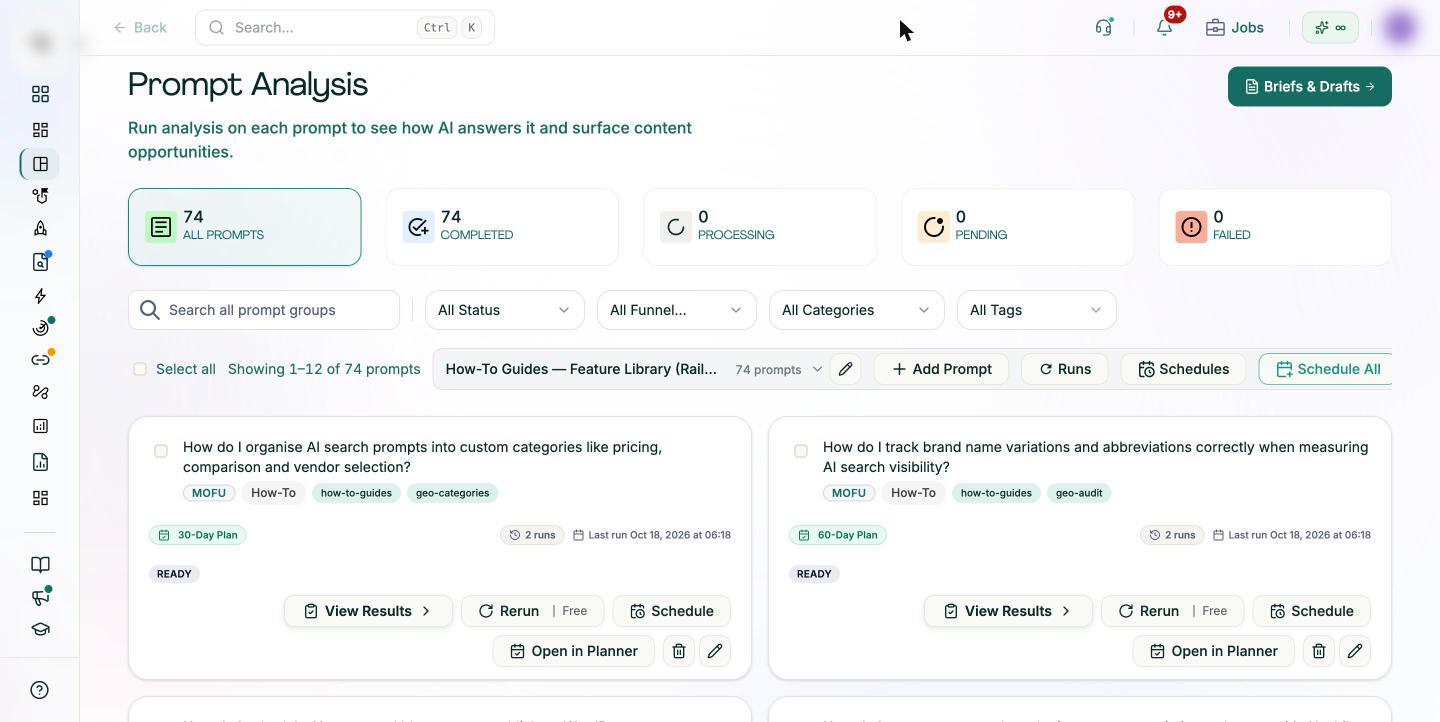
For each prompt, it records brand mentions, average position, citation rate, share of voice and top-3 presence, and shows the actual AI answer so you can check citations against mentions yourself. A competitor matrix covers up to 20 tracked competitors.
A GEO audit adds a GEO score, share of voice by funnel stage and a maturity stage. Audits can be scheduled and compared over time, and exported as PDF or PowerPoint, which makes them a practical appendix for a portfolio case study.
What stays with you is the part a course cannot teach by itself: choosing the prompts, deciding what to change, and explaining why the numbers moved.
Turn the practice project into a case study
Record the baseline this week, before you change anything. That number is the starting point for every before-and-after pair you will show.
After week six, write a one-page case study: the prompt set, the engines, the dates, what you changed, the results and what you would do next. Keep the raw answers so anyone can check the comparison.
Get started with Pixis Visibility to baseline your first prompt set across four AI engines and measure the before-and-after for your GEO portfolio.
FAQs
Is there an official GEO certification?
No. Certificates come from individual course providers, software companies and training organizations, under different names and with different standards. None is recognized across the industry the way some analytics or ads certifications are.
How long does it take to learn GEO?
With SEO fundamentals in place, about six weeks at a few hours a week is enough to complete one measured practice project. Becoming good at it takes repeated projects across different sites and categories.
Do I need a certificate to work on GEO?
No. The methods are public and anyone with a site and a way to measure AI answers can apply them. A certificate can support a job application, but a measured case study usually carries more weight.
What should I learn before GEO?
SEO fundamentals: crawling, indexing, site structure and content quality. The AI-specific parts, such as how engines choose sources and how to measure visibility in answers, are easiest to learn through the practice project itself.