
Generative Engine Optimization gets discussed mostly as a content and authority problem, which it largely is, but none of that work reaches an AI engine if the technical layer underneath it is broken. A model cannot cite a page it cannot crawl, cannot parse a page it cannot render, and cannot trust a page whose structured data contradicts what is on screen. Technical SEO for GEO is the set of backend conditions that must be met before any content-level tactics matter. This guide covers the ones that actually move AI visibility: getting the right crawlers in, making content machine-readable through schema and structure, and measuring whether any of it is landing, with attention to the one distinction most technical GEO advice gets wrong.
Two-line summary: AI engines can only cite content they can crawl, parse, and trust, so technical SEO is the precondition for every GEO tactic. This covers crawlability for retrieval bots specifically, schema, extractable structure, and measurement.
Key Takeaways
- Not all AI crawlers do the same job. Training crawlers feed model training; retrieval crawlers decide AI citations. Getting these confused is the most common technical GEO mistake, and it changes which bots you actually need to allow.
- Crawlability and clean indexation are the precondition for everything else, because a page a bot cannot access cannot be cited, no matter how good it is.
- Structured data reduces ambiguity for machines, but only when it stays synchronized with the visible page. Stale or exaggerated schema lowers trust rather than raising it.
- Answer-first structure, a direct answer up top, question-shaped headings, clean semantic HTML, is what makes content extractable into a generated answer.
- Technical GEO is a monitoring discipline, not a one-time setup, since crawl access, schema validity, and rendering all drift over time.
Understanding Technical GEO
Technical GEO is the backend layer of Generative Engine Optimization: the crawlability, indexation, structured data, performance, and structure that determine whether an AI engine can find your content, read it correctly, and cite it. Traditional technical SEO aimed at the same infrastructure for a different end, ranking a page in a list of links. Technical GEO points to the infrastructure at a new outcome: being extracted and cited inside a synthesized answer.
The practical difference is what the machine does with your page. For a ranking, a crawler needs to index the page and assess its relevance. For a citation, an engine needs to parse the page, pull a specific fact or passage out of it, and be confident enough in that fact to attribute it to you in an answer it generates. That raises the bar on clarity and structure. A page can rank perfectly well while being hard for a model to extract cleanly, and closing that gap is most of what technical GEO does.
The relationship to content strategy is straightforward: technical GEO does not make weak content citable, but weak technical foundations make strong content invisible. It is the precondition, not the whole job.
Crawlability: Get the Right Bots In
Crawlability is the first gate, because a bot that cannot reach a page cannot cite it. The basics are familiar from traditional SEO: a robots.txt that does not accidentally block important crawlers, valid XML sitemaps submitted to the major search consoles, and core content that is not trapped behind JavaScript a bot will not execute. Many hosting platforms and CMS templates block AI crawlers by default, so the first audit step is confirming you have not inadvertently shut out the bots you want.
Here is the distinction that most technical GEO advice misses, and it is the one that matters most: AI crawlers do two fundamentally different jobs, and only one of them affects citations.
- Training crawlers collect content to train future models. GPTBot (OpenAI), ClaudeBot (Anthropic), Google-Extended (a control token for Gemini training), and CCBot (Common Crawl) are in this group. Blocking them keeps your content out of model training datasets. It does not remove you from AI answers, and allowing them does not, on its own, get you cited. Google's own documentation is explicit on this point, noting that Google-Extended is for product improvement and does not affect Search rankings, a separate function from Googlebot.
- Retrieval crawlers index and fetch pages to build the live answers an engine generates. OAI-SearchBot (OpenAI's search indexer), Claude-SearchBot (Anthropic's retrieval bot), PerplexityBot, and Bingbot are the ones that decide AI citations. These are the bots to prioritize allowing if visibility is the goal. OpenAI's own crawler documentation makes the separation explicit: a site can allow OAI-SearchBot to appear in ChatGPT search results while disallowing GPTBot to stay out of training, because each control is independent.
The consequence is real and easy to get wrong. A team that blocks GPTBot and ClaudeBot for intellectual-property reasons, a legitimate choice, has done nothing to their citation eligibility, because those are training bots. A team that accidentally blocks OAI-SearchBot or PerplexityBot with an overly broad rule has removed itself from AI answers while believing its content is open. The user-triggered fetchers (ChatGPT-User, Claude-User, Perplexity-User) matter too, since blocking them breaks the moment a real person asks an assistant about your page. The decision is per-category, not global: you can allow retrieval and block training, or the reverse, but you have to know which bot does which job to make that call.
Bing deserves specific attention, because several generative surfaces draw on or are influenced by the Bing index, so Bingbot indexation feeds AI visibility beyond Microsoft's own products. Submitting through Bing Webmaster Tools and using the IndexNow protocol to signal fresh or updated content can lead to faster discovery. For the exact rules, our guide on robots.txt for AI crawlers covers which agents to allow and how to avoid blocking the ones that carry your citations.
Structured Data: Reduce Ambiguity for Machines
Structured data provides an engine with explicit, machine-readable signals about what a page contains, reducing the guesswork in extracting an accurate answer. JSON-LD, a Schema.org vocabulary supported by major engines, is the format to use, since it is easier to maintain and less fragile than microdata woven into the HTML. Defining your entities, relationships, and page purpose in schema turns a page from prose that a model has to interpret into a set of facts it can read directly.
The schema types that carry the most weight map to the content type:
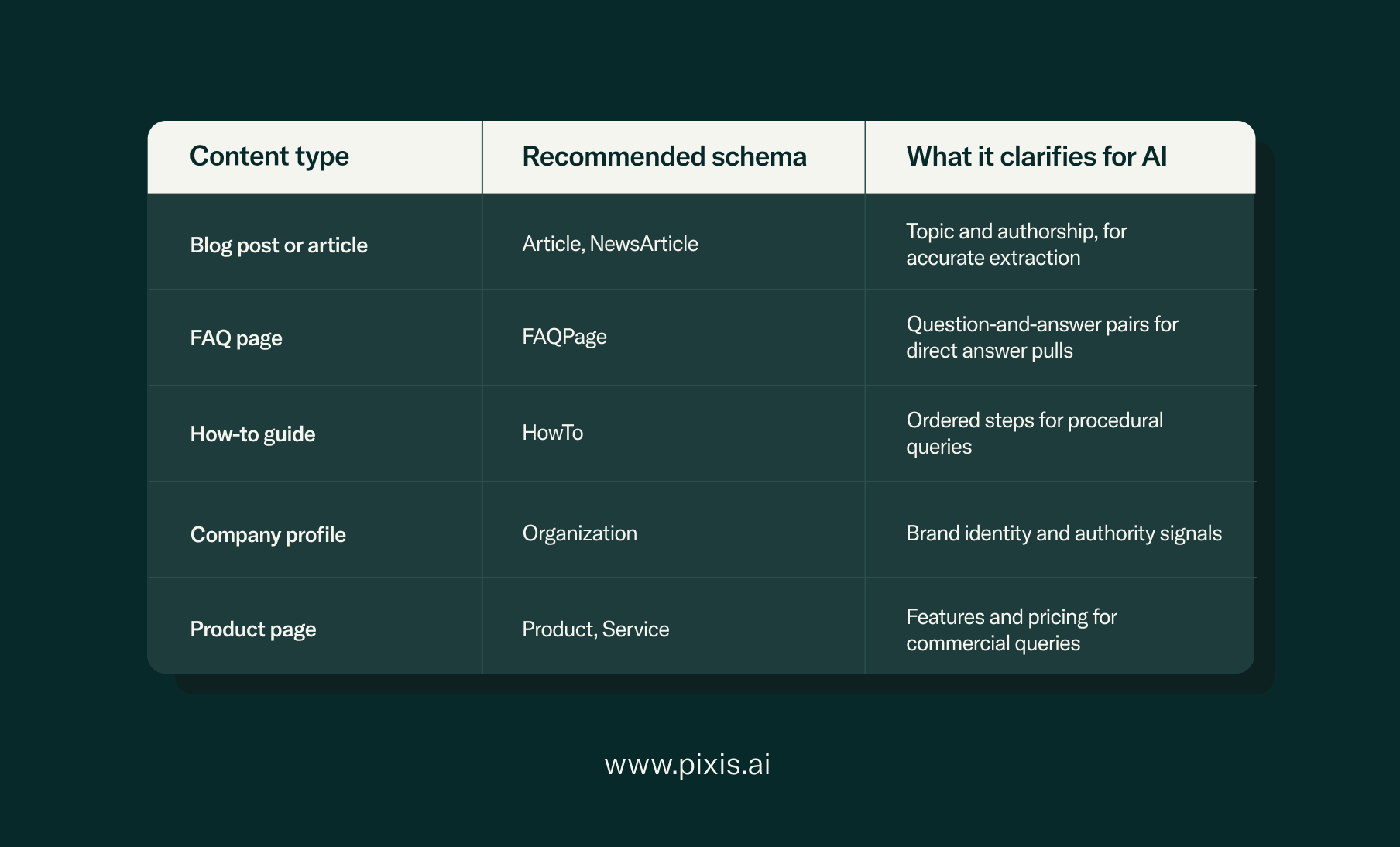
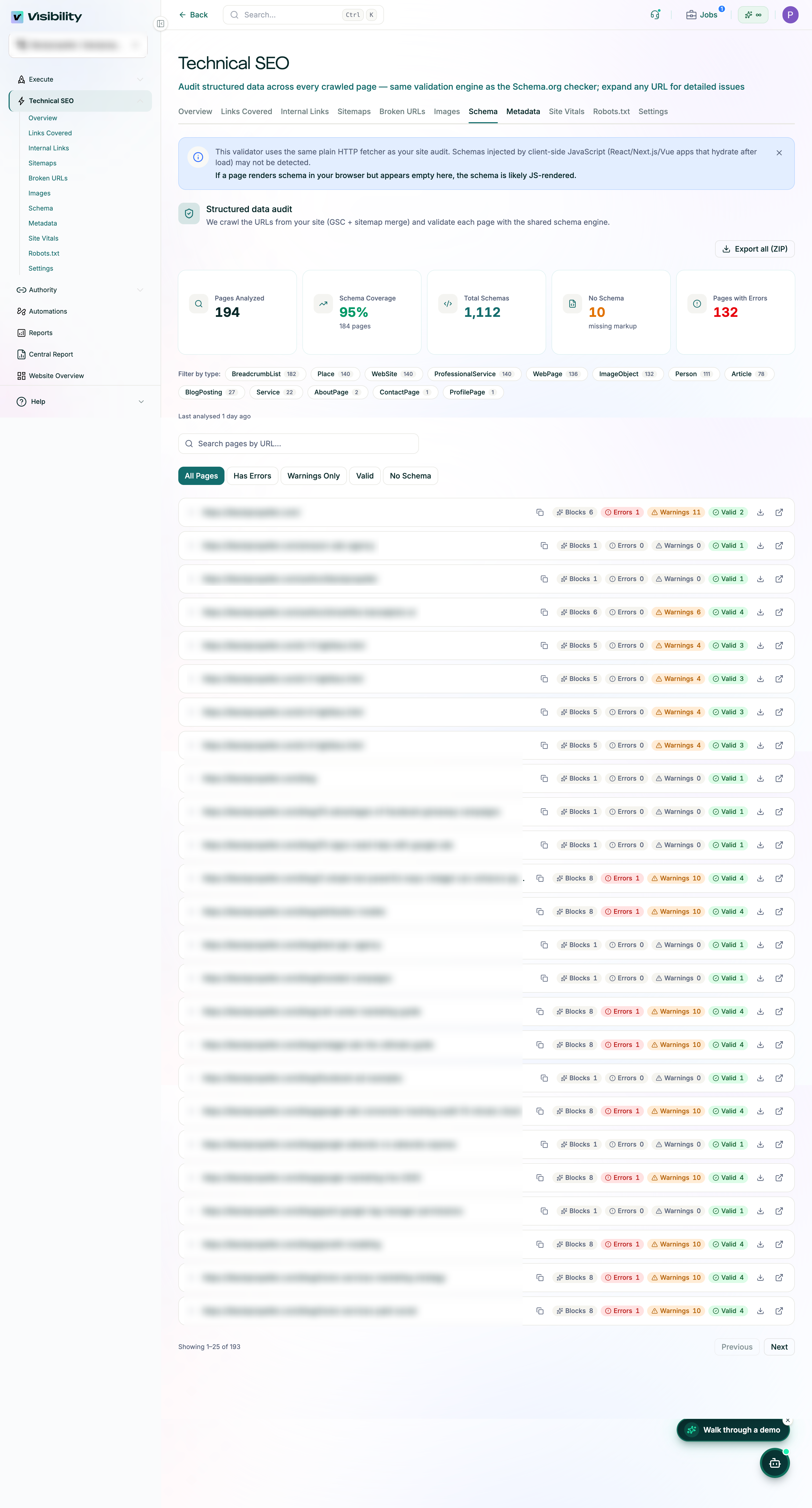
The rule that governs it all: the schema has to match the visible page. Structured data that claims something the page does not show, stale prices, a rating that no longer applies, an author who is not credited, reads as a mismatch, and mismatches lower an engine's trust rather than raising it. Keep the markup synchronized with what is actually on screen, and treat it as something to validate on a schedule rather than as something to set once. Our deeper walkthrough on schema markup for SEO and GEO covers implementation specifics for a technical team.
Structure Content So a Machine Can Extract It
An engine building an answer wants to pull a clean, self-contained fact out of your page. Content structured for that extraction gets cited; content that buries its answer in dense prose does not, however good the prose is.
The most effective pattern is answer-first, sometimes called Bottom Line Up Front: state the direct answer to the page's core question in the opening, then expand with the supporting detail and context beneath it. This lets an engine lift the core fact immediately while human readers still get the depth they expect. The rest follows from making the page's logical structure explicit to a parser:
- Use a clean heading hierarchy (one H1, then nested H2s and H3s) so the document outline is unambiguous.
- Phrase headings as the questions buyers actually ask, since those match the queries an engine is resolving.
- Keep paragraphs short, roughly two to three sentences, which improves both human scanning and machine parsing.
- Define key terms and product specifics explicitly rather than assuming context.
- Use tables and lists for comparisons and specs, which are far easier to parse than the same data in prose.
- Use semantic HTML correctly so each element's purpose is clear to a machine, not just visually implied.
The through-line is that a predictable, well-labeled structure serves both the human reader and the extracting machine. There is no trade-off to manage here: the formatting that makes a page scannable is largely the same as the formatting that makes it extractable.
E-E-A-T Signals a Model Can Verify
Experience, expertise, authoritativeness, and trustworthiness are the signals engines weigh when deciding whether to rely on a source, and in a citation context, they influence whether you get named over a competitor. The technical side of building them is concrete: credited authors with real bios, transparent sourcing, visible editorial standards, secure HTTPS, clear organizational identity, and verifiable contact information. These are the markers a machine can actually check.
The practical point is that trust signals work when they are visible in the page structure, not buried in a footer. An engine assessing credibility scans for authorship, ownership, and sourcing; a page missing those reads as lower confidence than one that clearly surfaces them. This is where technical hygiene and content credibility meet, and neither substitutes for the other.
Site Performance and Core Web Vitals
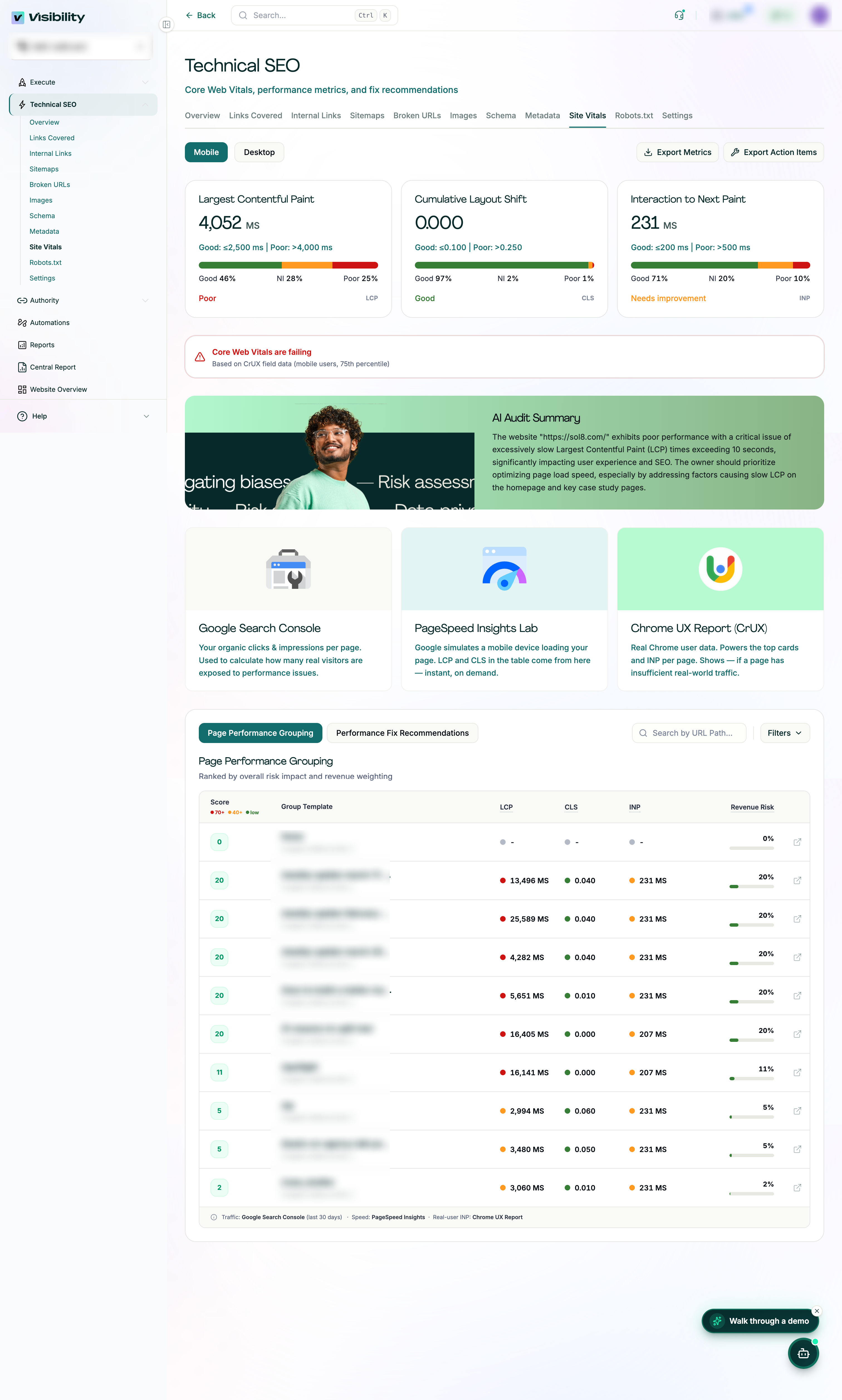
Performance matters to crawlers for the same reason it matters to users: a slow, unstable page is harder and more expensive to process, and a crawler under resource constraints may index it incompletely or deprioritize it. The three Core Web Vitals, with Google's "good" thresholds, are:
- LCP (Largest Contentful Paint) measures loading, how quickly the main content renders. Good is under 2.5 seconds.
- INP (Interaction to Next Paint) measures responsiveness to user input, and replaced First Input Delay as a Core Web Vital in 2024. Good is under 200 milliseconds.
- CLS (Cumulative Layout Shift) measures visual stability, whether elements jump during load. Good is under 0.1.
The improvements that move these are the familiar ones: performance budgets, image optimization, sensible caching, and server-side rendering, where it helps, particularly since content dependent on client-side JavaScript is exactly what a non-rendering crawler misses. Fast, stable pages are easier for a bot to process fully, which supports more complete indexing and, downstream, better citation eligibility.
Measuring Technical GEO
The metrics that tell you whether the technical work is landing differ from traditional traffic numbers, and they need to be monitored on a regular cadence. The useful set: referral traffic arriving from generative engines, brand mentions, and citation frequency in AI answers, indexed-page counts, and general crawl health.
The tools that cover this groundwork work together rather than individually:
- Google Search Console for indexing status, Core Web Vitals, and structured-data errors, the traditional-search foundation that still underpins AI eligibility.
- Bing Webmaster Tools for indexation and URL submission in the Bing ecosystem that several generative surfaces draw on.
- GA4 for identifying referral traffic and landing-page behavior originating from conversational tools.
- Server log analysis for seeing which AI crawlers are actually visiting, how often, and whether retrieval bots are reaching your key pages, which is the ground truth no third-party estimate replaces.
Reading these together, at a minimum on a monthly audit, confirms that the technical changes are producing the intended result and surfaces regressions before they cost visibility. Pixis Visibility consolidates the AI-answer side of this, tracking citation frequency and brand mentions across engines, so the citation picture sits alongside the crawl-and-index signals rather than being pieced together manually.
Common Pitfalls
Technical GEO drifts out of true if it is treated as a one-time setup, so a few recurring failures are worth watching for.
- Blocking the wrong bots. Either shutting out retrieval crawlers by accident with a broad rule, or blocking training bots and assuming that protected citations. Know which is which before you edit robots.txt.
- Schema that has gone stale. Markup that no longer matches the visible page, which lowers trust. Validate on a schedule.
- JavaScript-dependent content. Critical text or product data that only appears after client-side execution, invisible to bots that do not render.
- Broken canonical tags and messy internal linking. Both confuse crawlers about which pages matter and how they relate.
- Neglected freshness. Key pages left unupdated, signaling to engines that the content is not actively maintained.
The best practice underneath all of these is the same: treat the technical layer as a living system that gets audited, not a project that gets finished. Crawl access changes when a platform updates its defaults, schema breaks when a template changes, and rendering regresses when a new script ships. Monthly validation of robots.txt, structured data, rendering, internal links, Core Web Vitals, and content freshness is what keeps the foundation solid enough for the content and authority work to pay off.