
A page can be technically sound, rank well, and still make its answer unnecessarily difficult to find. The definition arrives after four paragraphs of context. The heading says “Overview” instead of naming the question. The company is described three different ways on the same page. A useful claim appears, but there is no source attached to it.
None of those problems makes the content wrong. They make it harder to reuse.
That is the part of the search problem Answer Engine Optimization, or AEO, is designed to solve. AEO makes a page’s answer easier for a search or answer system to identify, extract, and present accurately. It applies to featured snippets, People Also Ask results, voice responses, knowledge panels, and answer-led experiences where the user may receive the information before visiting a website.
The distinction I want to make early is this: AEO does not make weak content authoritative. It makes a good answer easier to locate and understand. The work still depends on SEO fundamentals, credible sourcing, and a page worth surfacing in the first place.
Two-line summary: AEO is the practice of making a page’s answer clear, extractable, and easy to attribute. It builds on SEO, overlaps with GEO, and works best when structure supports substance rather than trying to replace it.
Key Takeaways
- AEO makes a page’s answer easier for search and answer systems to identify, extract, and present accurately.
- It builds on SEO rather than replacing it. Crawlability, useful content, credible sourcing, and clear authorship still do the foundational work.
- Pixis distinguishes AEO from GEO by the surface being optimized. AEO focuses on direct-answer experiences, while GEO focuses on inclusion in synthesized generative responses.
- Answer-first writing, descriptive headings, consistent entities, and verifiable claims matter more than hitting a fixed word count.
- Structured data can describe a page more clearly, but Google does not require special schema for AI Overviews or AI Mode.
- AEO performance should be evaluated through answer presence, accuracy, citations, search visibility, referral traffic, and downstream outcomes rather than clicks alone.
What Is Answer Engine Optimization?
Answer Engine Optimization is the practice of structuring content so search and answer systems can identify and present a clear response to a user’s question.
In practical terms, that means removing the work a system would otherwise have to do to understand your page. The answer sits directly beneath the relevant heading. The central entity is named consistently. Claims carry enough context to remain true when extracted from the surrounding paragraph. Sources are visible. The technical setup allows the content to be crawled and rendered.
The common mistake is to reduce AEO to short paragraphs. Brevity helps only when the short answer is also complete. “It depends” is concise, but it is not useful until the page explains what it depends on. A 40-word definition can be perfectly extractable. So can a four-step process or a small comparison table. The format should follow the question.
Here is the simplest test I use: if the paragraph were lifted from the page and shown on its own, would it still answer the question accurately?
If the answer is no, the page may need more context inside the passage, not more words before it.
Where Does AEO Show Up?
AEO matters wherever a system selects a bounded answer instead of returning only a list of pages.
- Featured snippets extract a paragraph, list, or table and place it prominently in the search results.
- People Also Ask results answer related questions inside expandable panels.
- Knowledge panels assemble factual information about a recognized entity.
- Voice responses read a selected answer aloud.
- AI Overviews synthesize information from multiple sources into a generated response.
Google AI Overviews complicates the neat taxonomy because it behaves like an answer surface and a generative system at the same time. It can use the concise, extractable passages associated with AEO, but it also needs enough authority and corroboration to synthesize an answer across sources. In practice, that means AEO and GEO often meet on the same page even when the terms describe different parts of the work.
The scale makes the distinction worth understanding. Google reported in May 2026 that AI Overviews had passed 2.5 billion monthly users and AI Mode had surpassed one billion. Those numbers establish reach. They do not mean every query produces an AI response, or that one optimization tactic works across every surface. Google’s I/O 2026 announcement provides the reported usage figures.
AEO, SEO, and GEO Are Related, but They Are Not the Same Job
The vocabulary around AI search is still forming, and different companies draw these boundaries differently. Pixis uses a practical distinction based on what the work is trying to achieve.
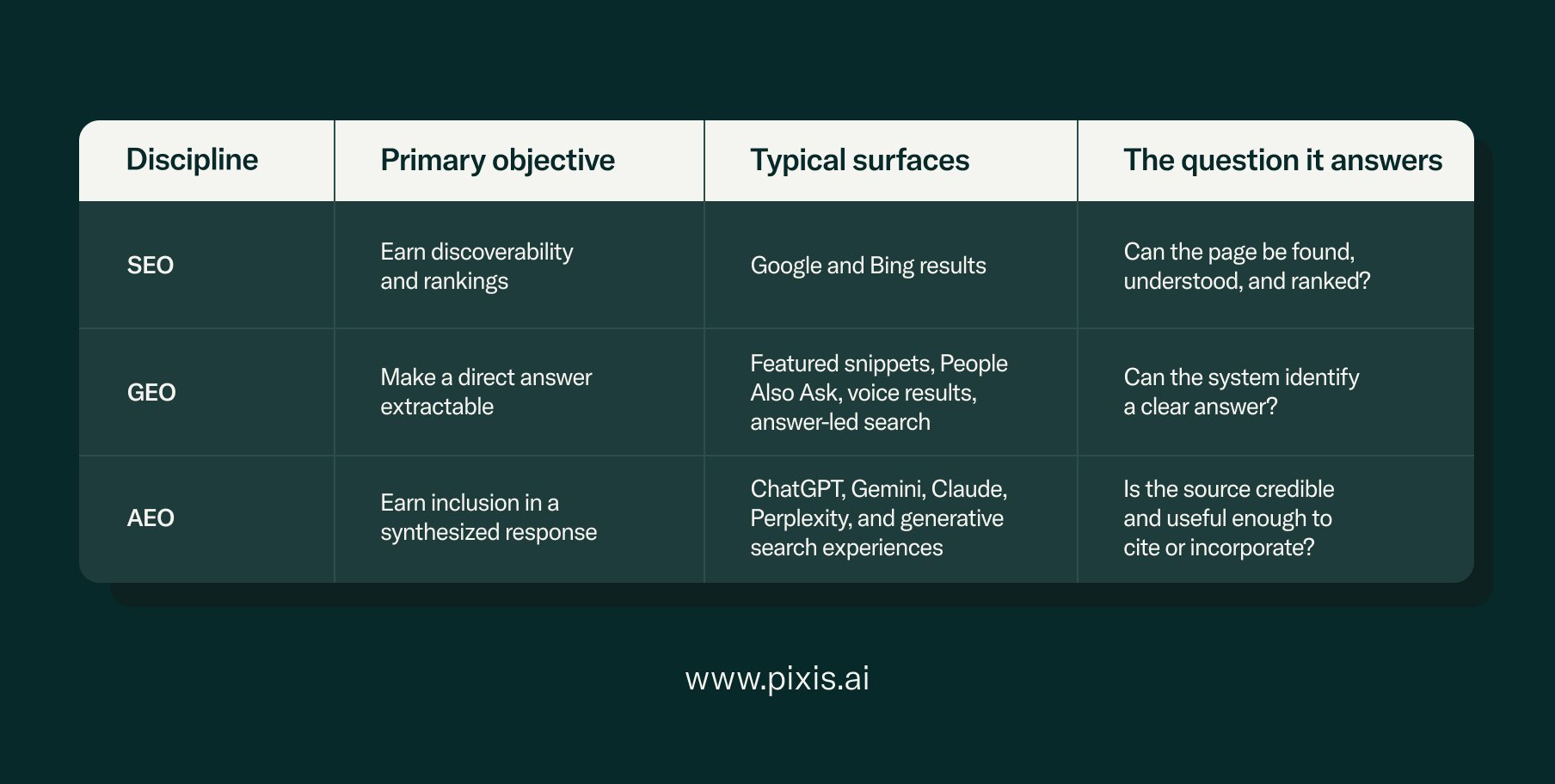
The overlap is real. A page that cannot be crawled is poorly positioned for all three. A clearly written definition can support a featured snippet and an AI citation. External authority can strengthen traditional rankings and generative visibility.
But treating the three as interchangeable creates a bad strategy. Answer-first writing does not repair technical SEO. Schema does not manufacture authority. A page-one ranking does not guarantee that a generative engine will cite the page.
A useful way to hold them together is as a sequence. SEO makes the page available and understandable. AEO makes the answer easy to locate. GEO strengthens the case for using that answer inside a synthesized response.
For the full comparison, read SEO, GEO, and AEO: What They Are, How They Differ, and Why Your Search Strategy Needs All Three. The narrower boundary is covered in AEO vs. GEO: Key Differences in AI Search Visibility.
What Makes an Answer Extractable?
There is no single template that works for every question. There is, however, a pattern I keep returning to: name the question, answer it immediately, and then earn the reader’s trust with the detail that follows.
Put the answer before the runway
Consider a page answering, “What is incrementality in marketing?”
The version that makes the reader wait:
Marketing measurement has changed considerably as customer journeys have become more complicated and privacy restrictions have affected the data available to advertisers. This has caused many teams to reconsider the frameworks they use to evaluate campaigns.
The version that does the job:
Incrementality measures the outcomes caused by a marketing activity beyond what would have happened without it. It separates additional conversions or revenue from results that would have occurred anyway.
The second version does not remove the context. It puts the definition before it. The page can now explain lift testing, control groups, limitations, and examples without making the reader search for the answer they came for.
Make the heading carry information
“How does AEO differ from SEO?” tells the reader what the section will resolve. “Key differences” asks them to infer it.
This sounds minor until it happens across a 3,000-word guide. Descriptive headings create a visible map of the questions the page answers. They help readers scan, support a logical document hierarchy, and give retrieval systems clearer boundaries between sections.
A table of contents can reflect that structure, but the links themselves are not the lever. The hierarchy underneath them is. Our article on whether a table of contents helps SEO and AI citations explains why the distinction matters.
Keep the entity stable
Content teams often vary names because repetition feels inelegant. A product becomes “Pixis Visibility,” then “Visibility,” then “our platform,” then “the solution.” A person can usually follow that shift. A system connecting entities across pages has more room to get it wrong.
Define the entity clearly on first use, then use shortened references only where the relationship remains obvious. Apply the same discipline across product pages, author bios, directories, profiles, and third-party descriptions. The goal is not mechanical repetition. It is a consistent answer to the question, “What exactly is this?”
Write claims that survive extraction
A claim can be technically accurate inside a paragraph and misleading once the paragraph disappears.
“AI search reduces clicks by 60%” is a good example of a sentence that travels badly. Which AI surface? Which market? Which query set? Compared with what period? If those qualifications determine whether the claim is true, they belong close enough to travel with it.
Primary sources help for the same reason. A reader should be able to move from a number to the research, documentation, or announcement behind it. AEO is not an excuse to strip evidence out of the answer. It is a reason to place the evidence more deliberately.
Structured Data Helps Describe the Page. It Does Not Guarantee the Answer.
Schema is one of the first tactics that appears in most AEO checklists because it feels satisfyingly concrete. Add the markup, validate it, move on.
The reality is less magical and more useful. Structured data gives search engines explicit information about the entities and attributes on a page. It can make eligible content available for supported rich-result formats. It does not guarantee a featured result, and it is not a special switch for AI visibility.
Google says websites do not need additional schema or special machine-readable files to appear in AI Overviews or AI Mode. Its guidance is to keep using appropriate structured data as part of normal SEO, without treating markup as a separate generative-search requirement. See Google’s guidance for AI features and websites.
Use the type that accurately describes the visible page:
- Article may suit a news, sports, or blog article.
- Organization can clarify official company information and identifiers.
- Product can describe eligible product details such as price and availability.
- LocalBusiness can represent a physical business and its details.
- Other supported types should be used only when the page genuinely matches them.
Do not add FAQ markup to every article simply because the page contains questions. Do not use HowTo or Speakable as generic AEO tactics. Google’s Speakable implementation remains a beta intended for topical news responses on supported Google Assistant experiences, not a universal voice-search method. Google documents those limits here.
The rule is boring, which is usually a sign that it is durable: use structured data to describe the page truthfully.
AEO Measurement Has to Extend Beyond the Click
Clicks still matter. The mistake is treating them as the only evidence that an answer influenced someone.
An answer can introduce a brand, establish a definition, or narrow a buyer’s shortlist without producing an immediate visit. At the same time, a citation with no downstream value is not automatically a business win. AEO measurement needs both visibility and outcome signals.
Track:
- Presence in answer-led results for the questions that matter
- Featured snippet and People Also Ask visibility
- Brand mentions and citations in relevant AI responses
- Accuracy and sentiment of those mentions
- Search impressions and click-through rate
- Referral traffic from answer and generative platforms
- Assisted conversions and the quality of referred visitors
- Share of voice relative to named competitors
Use the metric that belongs to the surface. A featured snippet can be monitored through search tools and manual SERP checks. Generative visibility needs repeated testing because responses change between runs. One favorable ChatGPT answer proves that the brand appeared once. It does not establish a stable presence.
If you need a starting process, How to Audit Your AI Search Visibility in 15 Minutes lays out the prompts, observations, and competitor checks worth recording.
The AEO Workflow I Would Actually Use
The easiest way to make AEO unmanageable is to turn it into another universal checklist applied to every page. Not every page needs an FAQ. Not every paragraph needs to be a definition. Not every topic belongs in a 3,000-word guide.
I would work in this order.
1. Start with a real question
Use search data, customer calls, support tickets, sales conversations, and on-site search to identify what people need to understand before they can evaluate the category or make a decision.
The question has to matter to the buyer, not just fit a keyword tool.
2. Decide which page should own the answer
Match the question to the right format. It may belong on a product page, a service page, a glossary entry, a comparison, a tutorial, or a larger guide.
This step prevents a common content failure: five pages that answer the same question with slightly different titles, none of which is clearly authoritative.
3. Write the smallest complete answer
Place it directly beneath the relevant heading. Define the subject, resolve the question, and preserve the qualifications that keep the statement accurate.
Then expand. Not before.
4. Build the evidence around it
Link to primary sources. Add original data, a worked example, or practitioner experience where it genuinely helps. Confirm that the author and organization behind the content are easy to identify.
5. Check whether a crawler can reach the answer
The page should be indexable. Its important content should be available in accessible HTML. The heading hierarchy should make sense. Related pages should be connected through internal links.
AEO cannot provide an answer that the system cannot retrieve.
6. Measure the gap, then diagnose it
If the page remains absent, the answer is not always “write more.” The problem may be structure, weak authority, poor technical access, stale information, an unclear entity, or a competing source that simply answers the question better.
Diagnose that problem before creating another page.
Where Pixis Visibility Fits
The manual version of this work starts with a spreadsheet. List the important questions, run them across search and AI surfaces, record which brands appear, capture the cited sources, and repeat the exercise often enough to separate a pattern from a lucky result.
That process is useful. It also becomes difficult to sustain across hundreds of prompts, several competitors, and multiple markets.
Pixis Visibility connects traditional search intelligence with repeated analysis across ChatGPT, Gemini, Claude, and Perplexity. It helps teams see where a brand appears, which competitors are being selected instead, and which prompts or topics point to a content gap. That gap can then move into a brief and draft within the same workflow. Google search visibility sits alongside the generative-analysis layer, so the two programs do not have to be managed as unrelated systems.
The platform does not remove the decision at the work's center. A gap may need a new page, an update, stronger entity information, better sourcing, or third-party corroboration. The useful part is that the gap ends with a specific next action rather than remaining a number on a dashboard.
For the generative side of the discipline, read What Is Generative Engine Optimization?. You can also explore Pixis Visibility directly.
Frequently Asked Questions About AEO
What does AEO mean in marketing?
AEO stands for Answer Engine Optimization. It is the practice of making a page’s answer easy for search and answer systems to identify, extract, and present accurately.
Is AEO replacing SEO?
No. AEO depends on SEO foundations such as crawlability, indexability, authority, and useful content. It adds a stronger focus on direct-answer structure, entity clarity, and passages that remain accurate when extracted.
Are AEO and GEO the same?
The industry uses the terms inconsistently, and the practices overlap. Pixis uses AEO for direct-answer optimization and GEO for inclusion in synthesized generative responses. Google treats work aimed at its own generative search features as part of SEO rather than requiring a separate technical discipline.
Does schema guarantee an AI citation or featured snippet?
No. Applicable structured data can help search engines understand a page and make it eligible for supported search features. It does not guarantee a result or citation, and Google does not require special schema for AI Overviews or AI Mode.
How long does AEO take to work?
There is no standard timeline. Results depend on crawl and indexing cycles, competition, the site’s existing authority, the quality of the answer, and the type of surface being measured. Repeated observation is more useful than promising a fixed number of weeks.
AEO Is What Happens When Good Content Stops Making the Reader Work for the Answer
AEO is not a schema trick, a fixed paragraph length, or permission to flatten every complicated subject into a sound bite.
It is the discipline of noticing where a good answer has been made harder to use than it needs to be. Put the conclusion before the runway. Name the entity clearly. Keep the evidence close to the claim. Build the page on sound SEO. Measure whether the answer is present and accurate, not just whether it earned a click.
Do that well and the page becomes more useful to the reader first. Its usefulness to answer systems follows from the same work.