
Ranking on Google used to be the clearest sign that your content was working.
Not anymore.
A page can rank well and still be invisible in the places where buyers now get their answers. Search results are no longer limited to blue links. They include featured snippets, voice responses, AI Overviews, chatbot answers, and generative recommendations that summarize information before a user ever clicks.
That shift has made AEO and GEO impossible to ignore, but also easy to confuse.
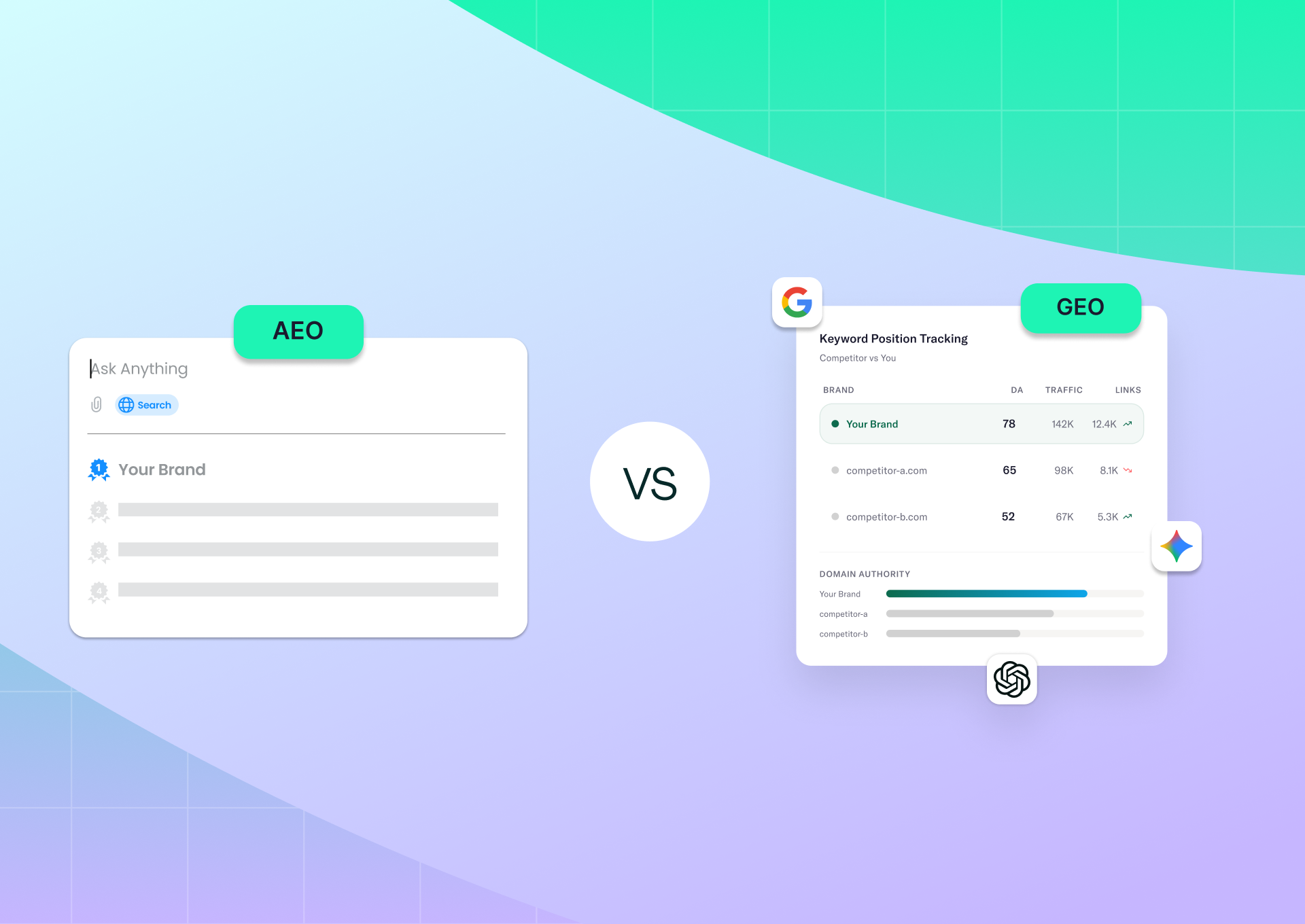
AEO helps your content become the direct answer. It is built for search experiences that extract concise, structured responses, like snippets, answer boxes, and voice search.
GEO helps your content become a trusted source for AI-generated answers. It is built for systems that interpret, synthesize, compare, and cite information across multiple sources.
The difference matters because the optimization work is not the same.
AEO rewards clarity, structure, and direct answer formatting. GEO rewards depth, credibility, context, entity strength, and citation-worthy authority. Both depend on SEO fundamentals, but they serve different moments in the search journey. This guide explains how AEO and GEO differ, where they overlap, and how to build a content strategy that works across both. It also looks at how measurement needs to evolve when visibility is no longer limited to rankings, clicks, and traffic.
The goal is not just to rank.
It is to become the answer engines extract and the source AI systems trust.
Key Takeaways
- AEO and GEO are connected, but they solve different visibility problems.
- AEO helps content win direct answers in search results like featured snippets, People Also Ask, and voice search.
- GEO helps brands get cited inside AI-generated answers across tools like Google AI Overviews, ChatGPT, Perplexity, Claude, and Copilot.
- AEO rewards concise, extractable answers; GEO rewards depth, entity richness, trust signals, and citation readiness.
- SEO remains the foundation for both, but rankings and clicks are no longer the only measures of search success.
- The strongest search strategy now combines SEO, AEO, and GEO so brands can rank, answer, and be cited.
AEO vs GEO: The Bottom Line
Here is the short version. AEO is built around answer delivery in search results. GEO is built around AI citation and synthesis in generative responses. Both depend on SEO fundamentals like crawlability and topical authority, but the optimization tactics diverge from there. AEO prioritizes concise, extractable answers. GEO prioritizes depth, entity richness, and trust signals. The modern search ecosystem rewards a hybrid approach rather than a choice between the two. Pixis Visibility helps teams track AI search presence, citations, and opportunities across engines, which gives content teams the data to work both disciplines from one place.
What Is Answer Engine Optimization (AEO)?
Answer Engine Optimization is the practice of structuring content to appear in direct answer features. These features include featured snippets, People Also Ask boxes, knowledge panels, and voice search answers. The goal is to satisfy a query directly within the search interface, often without the user clicking through to your site. That shifts the focus from driving clicks to building authority and visibility at the moment of the query. Search engines like Google and Bing, along with voice assistants like Alexa, Siri, and Google Assistant, rely on these formats to deliver immediate answers.
AEO rewards a specific content structure. Questions need clear, concise answers placed where an engine can extract them. Question-based headings help search engines identify the relevant section, and short answer blocks near the top of each section increase the likelihood of extraction. Matching the language of the query and answering it in the first sentence or two signals that your content is the most direct resource available. When you optimize for AEO, you are making your content the easiest correct answer for the engine to lift.
The AEO surfaces worth structuring for include:
- Featured snippets, the answer box at the top of search results that provides a direct response.
- People Also Ask, the expandable list of related questions that appears in results.
- Knowledge panels, the information box that surfaces for recognized entities.
- Voice search answers, the spoken response provided by digital assistants.
- Direct answer boxes, the specialized results for queries like weather, currency, or sports scores.
A note on schema: FAQPage and HowTo markup used to earn dedicated rich results in Google Search, but Google retired HowTo rich results in 2023 and FAQ rich results in May 2026. Both schema types remain valid and still help machines parse question-and-answer content, so they retain value for AI comprehension, but they no longer produce a visible SERP feature. Structure your AEO content around clear question-led headings and direct answers rather than around schema as a snippet lever, a shift we cover in more depth in our look at whether schema markup still matters.
What Is Generative Engine Optimization (GEO)?
Generative Engine Optimization is the practice of structuring content for generative AI systems including Google AI Overviews, ChatGPT, Perplexity, Claude, and Copilot. The goal is to make content discoverable, understandable, and citeable by AI models. Traditional search returns a list of links. Generative AI synthesizes information into a new response, which means your content has to be robust enough to be trusted as a source inside that synthesis. The shift is from earning a ranking to earning a citation.
GEO rewards entity-rich, comprehensive, and trustworthy content. AI models need context to understand how concepts relate, so they look for clear definitions, use cases, and supporting evidence. E-E-A-T signals carry real weight here: named authorship, source transparency, and expert review build the credibility a model looks for before citing a source, part of the trust ecosystem that decides which brands get cited. Content that lacks depth or authority gets skipped in favor of a more established reference. GEO is about ensuring your brand is the reference point an AI engine reaches for when it generates an answer.
The generative engines that GEO targets include:
- Google AI Overviews, the AI-generated summary at the top of search results, powered by Gemini.
- ChatGPT, the OpenAI model that generates text responses and cites sources in its search mode.
- Perplexity, the AI search engine that retrieves and cites sources on every query.
- Claude, the Anthropic assistant used for research and complex reasoning.
Key Differences Between AEO and GEO
The distinction matters most when you are allocating resources. AEO is about answering a specific query directly inside a traditional search interface. GEO is about being included and cited inside an AI-generated response. The tactics follow from that. AEO relies on extractable structure and brevity. GEO relies on depth, entity coverage, and citation readiness. Google AI Overviews sits between the two and rewards a blend of both.
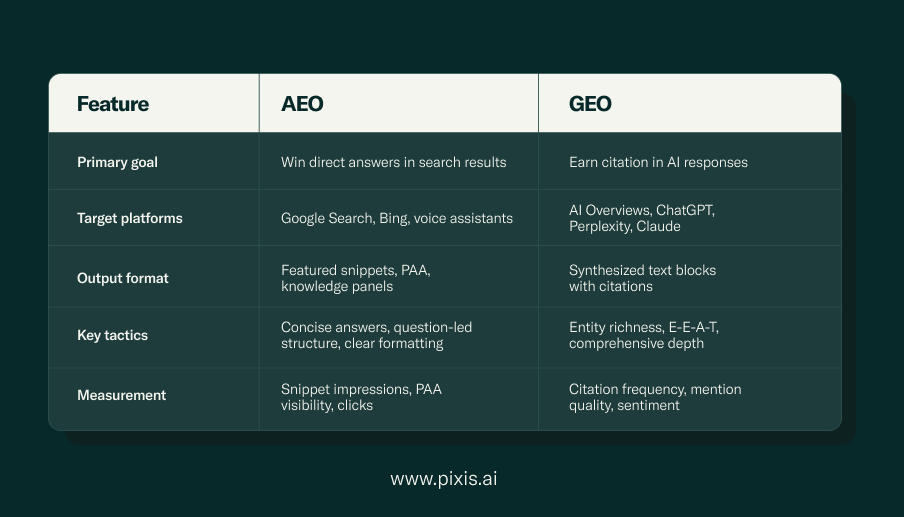
The table shows the operational split. AEO is tactical and page-specific: you can optimize a single page for a snippet. GEO is strategic and holistic: you optimize an entire site, and its surrounding authority, for citation. That difference shapes how you plan a content calendar. AEO drives visibility to specific landing pages. GEO builds brand authority across the web that AI engines draw on. Both belong in a complete 2026 search strategy.
How AEO and GEO Work Together
AEO and GEO complement each other rather than compete. They share a foundation in SEO, where clear structure, strong definitions, and credible sources help both. A page optimized for snippets is usually easier for an AI to parse, and a page optimized for AI citation usually carries the depth a snippet needs. The fundamentals that support both include crawlability, topical authority, and internal linking, so you do not have to choose one discipline over the other.
A single content strategy can serve classic rankings, direct answers, and AI citation surfaces at once. Building content with both AEO and GEO in mind captures the user who wants a quick answer and the user who wants a comprehensive AI summary. That integrated approach is also more durable. Content built on genuine depth and clear structure holds up better across algorithm changes than content built to chase a single feature.
How to Optimize for AEO
Optimizing for AEO starts with clarity and structure. Lead each section with a question-led H2 that matches real user intent, then place a short, direct answer near the top so an engine can extract it cleanly. Concise definitions, lists, tables, and step-by-step formatting all support extraction. Match the query language in your content, and answer the question in one or two sentences before expanding into detail. That directness signals authority to the engine and improves the experience for anyone scanning results.
Practical moves that support AEO:
- Use headings that mirror the questions your audience actually searches.
- Write a direct answer within the first 100 words of each section.
- Keep question-and-answer content clean and well-structured so engines and AI systems can parse it.
- Use bullet points and numbered lists where they aid scanning.
- Phrase content in natural language to support voice search.
How to Optimize for GEO: Leveraging Pixis Visibility
Optimizing for GEO is about trust and comprehensiveness. Make content easy for generative AI to parse, trust, and cite, which in practice means leading with direct answers and structuring pages the way AI engines actually retrieve them. Cover entities, definitions, relationships, and use cases thoroughly, because models need that context to place your brand in the broader category. Reinforce E-E-A-T through named authorship, source transparency, and expert review, which together build the credibility required for citation.
Pixis Visibility connects GEO insight to execution. Its GEO Analysis Hub runs your prompts across ChatGPT, Perplexity, Gemini, and Claude, then reports citation position, AI market share, and the sources each engine cites for prompts in your category. That data does not stop at a dashboard. It feeds content brief generation in the Execute tab, so a citation gap becomes a brief, a draft, and a published page inside one workflow. Without visibility into where your brand appears in AI answers, you are optimizing blind. With it, you can prioritize the gaps that matter and track whether the content you publish closes them.
Practical moves that support GEO:
- Create in-depth content that covers a topic comprehensively rather than thinly.
- Establish clear authorship and expert credentials on the page.
- Define your brand and products consistently across owned and third-party properties.
- Monitor brand mentions across AI platforms on a regular cadence.
- Use Pixis Visibility to track citation frequency, position, and sentiment across engines.
How to Measure AEO and GEO Performance
Measurement is where the two diverge most. AEO maps onto familiar metrics: snippet impressions, People Also Ask visibility, and clicks from direct answer surfaces, all trackable with traditional analytics. GEO needs a different layer. AI Overview visibility, citation frequency, mention quality, and sentiment are not captured by standard tools, so you need visibility tracking built for AI engines. Following branded prompts and topic clusters over time is what reveals the trend.
The Pixis Visibility dashboard surfaces AI search presence and citation patterns so teams can act on gaps as they appear. You can see which prompts trigger AI citations and which leave you absent, which informs the next quarter of content. It shows where to double down on what is working and where competitors are gaining ground. In a landscape where AI citation has no native reporting, that measurement layer is what makes the channel accountable, and it is where a tool that only monitors falls short of one that also executes.
The Future of Search: SEO, AEO, and GEO Integration
SEO remains the foundation that both AEO and GEO are built on. Search is becoming more answer-led and AI-mediated, and users increasingly expect immediate value over a list of links. The practical implication is that teams need one content strategy serving classic rankings, direct answers, and AI citation surfaces together, rather than treating each as a separate project. SEO is not a discipline you graduate from; it is the bedrock the other two stand on.
Pixis Visibility helps brands own their AI search presence across engines, which is less about ranking higher and more about being the source an AI engine trusts. As models grow more selective, competition for citation will intensify, and the brands investing in visibility and trust now are the ones positioned to be cited later. Search is becoming a conversation rather than a query, and a strategy that integrates SEO, AEO, and GEO is how you stay present in it.