
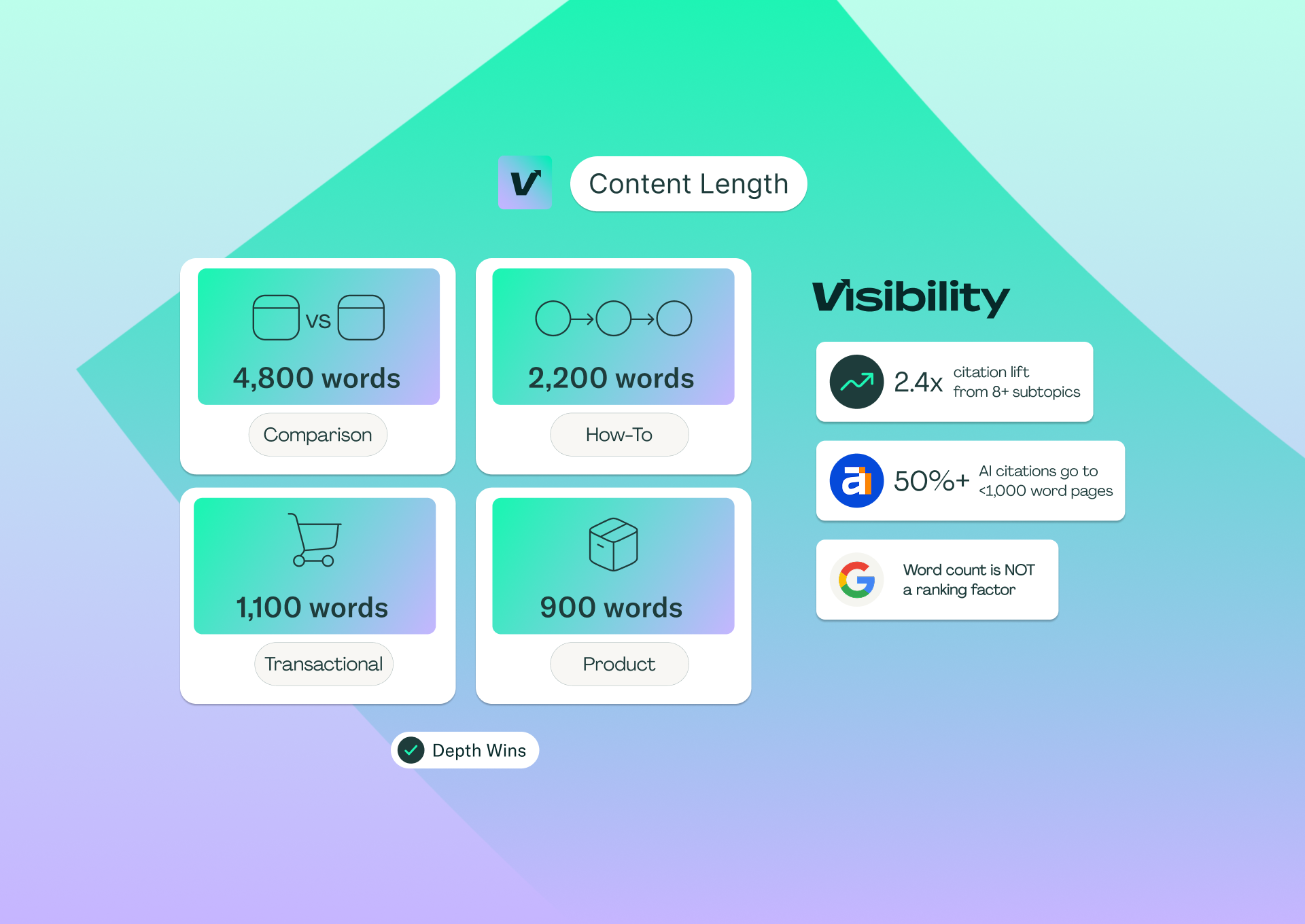
Google has said it directly, more than once: word count is not a ranking factor. John Mueller and Danny Sullivan have both stated it plainly through Search Central, which means the entire premise of "what is the ideal length" is built on a signal Google says it does not use. And the AI-citation data points the same way. When Ahrefs analyzed 174,000 pages cited in AI Overviews, the correlation between length and citation was 0.04, statistically indistinguishable from zero. So the useful question is not how long a page should be. It is how completely it answers the thing a person actually asked, which is a question about depth, and length is only ever a byproduct of that. This guide covers what the real evidence shows about content length across both traditional search and AI answers, and how to scope a piece to the depth its query demands rather than a number someone invented.
Two-line summary: Word count is not a ranking factor and shows near-zero correlation with AI citations; topical completeness aligned with search intent is what drives both. This covers how to scope content by depth rather than length, backed by verified data.
Key Takeaways
- Google has stated word count is not a ranking factor, and Ahrefs found a near-zero (0.04) correlation between length and AI-Overview citation, so length is not the lever.
- Depth and length are different things. A short page can be complete, and a long page can be shallow; what matters is whether the reader has to search again.
- Search intent sets the range. Transactional and product pages want concision; comparison and pillar content genuinely needs more room, but the driver is coverage, not word count.
- For AI citations specifically, structure and topical completeness matter far more than length: over half of AI-Overview citations go to pages under 1,000 words.
- Scope each piece by analyzing what the winning pages actually cover and where they leave gaps, not by applying a universal target.
Depth Is the Real Variable, Not Length
The most useful distinction in this whole debate is between depth and length, because teams collapse them and then optimize the wrong one. Depth is how completely a piece addresses a user's need, including the secondary questions and adjacent concerns they have not thought to ask yet. Length is just the word count attached to that effort. They correlate, but they are not the same, and the gap between them is where content strategy goes wrong.
A long page can be shallow if it restates the same points in different words, and a short page can be deep if it answers precisely and completely. The practical test cuts straight through the word-count question: after reading your page, does the user need to search again? If yes, it was not deep enough, at any length. If they stop looking, you have won the interaction regardless of whether it took 700 words or 2,700. This is also why padding backfires. Inflating a comprehensive 1,200-word answer to 3,000 words signals quality problems to readers and evaluators alike, since the added words carry no new information.
The reason longer content often appears to rank better is correlation, not cause. Comprehensive coverage tends to require more words, and comprehensiveness drives the satisfaction, links, and authority that actually move rankings. The length comes along for the ride; it is not doing the work. Google's own guidance says as much: focus on the user, not the word count, and there is no minimum length for ranking well.
What Traditional Search Actually Rewards
Even though length is not a direct factor, it correlates with topical authority, which is why the right move is to analyze the pages already winning for your specific query rather than apply a blanket rule. Content length across top-ranking pages varies widely by query type, and that variation is the whole point: a single universal target is useless because different intents require different depths.
The pattern that holds across the credible analyses is intent-driven, not number-driven. Transactional and navigational queries want speed and concision, often well under 1,000 words, because the user is ready to act and extra prose is friction. Product pages sit low too, where specifications and a clear value proposition matter more than essays, roughly a few hundred words for spec-driven ecommerce and somewhat more for feature-rich software pages. Informational guides and comparison content genuinely need more room, commonly in the 1,500 to 2,500-word range, because they have more ground to cover fairly. Pillar pages that anchor a topic cluster run longer still. But notice what determines each of these: the completeness the intent demands, with the word count falling out of that, not the other way around.
A few supporting principles matter regardless of length. Keyword integration should read naturally rather than hit a density quota, since stuffing to reach a length hurts the experience. Internal links should connect related topics logically so crawlers understand your site's hierarchy even when page lengths vary. And external links to authoritative sources reinforce credibility by showing the work behind your claims. None of these depend on word count; they depend on the content being genuinely useful.
What AI Search Rewards Is Structure, Not Volume
AI engines process content differently from traditional crawlers: they look for structured information, clear headings, and self-contained, extractable answers. Raw length does almost nothing for citation, and the data on this is unusually clean.
Ahrefs analyzed 174,000 pages cited in AI Overviews and found a near-zero correlation of 0.04 between word count and citations, with the average cited page running 1,282 words, only slightly above the organic average and far below the 3,000-plus figures many briefs still prescribe. More striking, over half of those citations, 53.4%, go to pages under 1,000 words. You do not need a long guide to be cited; you need a clearly structured answer to the specific question being asked.
What does matter for AI retrieval is completeness and structure within the page. Passage indexing lets an engine cite a specific section rather than a whole page, which means a single well-organized page can answer several query variants at once, if each section is self-contained and directly responsive to a distinct question. That is where the depth pays off: not in total length, but in how many real questions the page answers cleanly, each under a heading an engine can extract. Adding concrete evidence helps too, since sections carrying statistics, named sources, and specific examples are easier for an engine to lift and trust than unstructured prose. The move is to make every section a clean, cited answer to a real question, not to make the page longer.
The practical implication runs counter to the usual instinct. Inflating word count with repetition shows no citation benefit and can actively hurt, because low information density is exactly what an engine discounts. Pack meaning into every paragraph, structure each section as a direct answer, and let the page be as long as genuine coverage requires and no longer. This is the same lesson that applies to how much brand context AI content actually needs: the answer is measured in density, not length. On the structural side, our guide on how to get cited by ChatGPT covers the formatting and answer-first patterns that AI engines extract most reliably, and the technical foundations for GEO cover the indexing conditions your content needs to be retrievable at all.
Scoping Length by Format and Intent
Since intent sets the range, it helps to think in formats rather than a single target. Long-form educational guides need enough room to cover prerequisites and steps without rushing, commonly a couple of thousand words, with examples or visuals that aid comprehension. Pillar pages that anchor a cluster run longer because they map an entire topic landscape and link outward to supporting articles. Standard blog posts work best when kept tight and focused on a single angle, high on scannability, rather than trying to define a whole category. Product and landing pages stay lean, leading with specifications and value rather than prose. FAQ entries are deliberately short, with a direct answer per question, which also makes them clean targets for snippet and AI extraction. And original research earns its length by showing methodology and data in full, which is what makes it a source others cite.
The through-line across all of these is the same: the format's job determines its natural depth, and the word count follows. None of these are targets to hit; they are the ranges that tend to emerge when you cover each format's actual job well.
The Factors That Actually Decide Length
Three things override any generic average, because they focus on the specific query rather than a category benchmark. Search intent is the primary constraint, since it defines how much a complete answer requires, exhaustive for a complex informational query, minimal for a navigational one. E-E-A-T requires enough space to demonstrate genuine expertise through credentials, sourcing, and named authorship, because thin content struggles to establish trust even with strong links. And topical authority demands breadth across the subject, covering adjacent questions and subtopics that both semantic search and AI retrieval reward, rather than targeting a single keyword in isolation.
Because these vary so much by query, benchmarking against the specific pages ranking for your exact term beats applying a portfolio-wide rule every time. And because the mechanisms underneath, engagement, trust, coverage, shift faster than any fixed-length rule could keep up with, a data-driven read of your actual competitive set will always beat a template.
How to Decide Length in Practice
The workflow that replaces guessing is straightforward. Start by analyzing the top few ranking pages for your target query to see the depth and structure already winning, then look specifically for the gaps they leave, the subquestions that none of them answer well. The goal is not to cover everything they cover plus more, which just produces more of the same; it is to cover what users actually need that no one has answered cleanly yet. That gap is where a new page earns its place.
From there, structure for both readers and extraction: clear headings, logical paragraph breaks, and self-contained sections improve human dwell time and give AI engines the clean passages they cite. Treat the page as iterative rather than finished at publish, reviewing performance periodically and deepening coverage where the data shows gaps, since intent and competition both shift. This is the same discipline behind refreshing decaying pages before rankings are lost, where a substantive update to a page you already have equity in beats writing something new from scratch. And where you use AI to draft, reserve the evidence selection, examples, and editorial judgment for a person, because that is the layer that carries the authority both readers and engines reward. This is the work Pixis Visibility is built to support: it surfaces the entities, subtopics, and structural patterns that competitors use to earn citations, and the specific coverage gaps in your own library, so a content brief is scoped to what the evidence shows works rather than to a round number.