
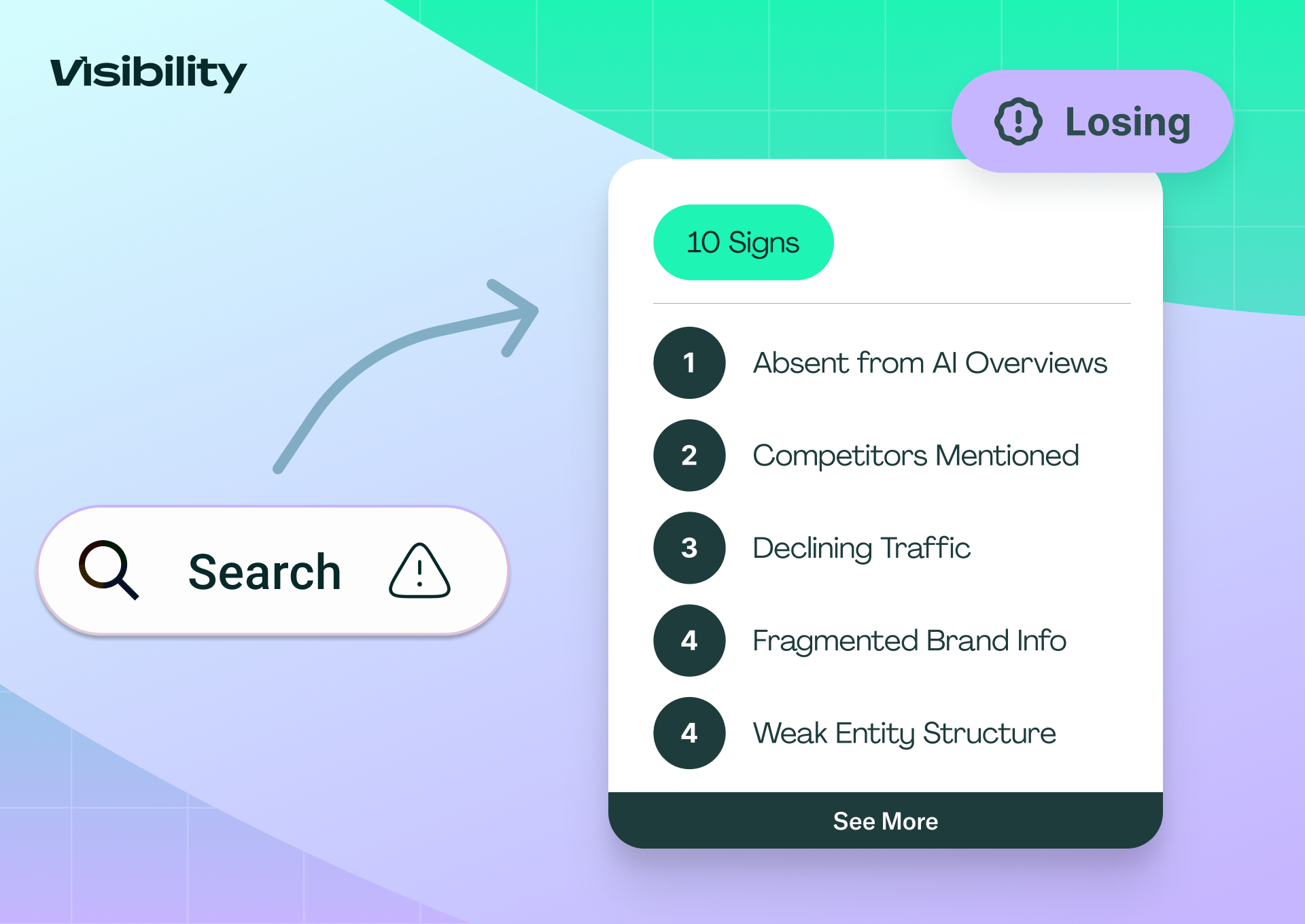
Your customers are still searching. They are simply getting their answers without arriving at your site, because AI Overviews and conversational tools now synthesize a response on the results page and resolve the query there. Strong traditional rankings no longer guarantee you are part of that answer, which means a brand can hold its positions while demand is intercepted upstream of the click. The difficult part is that this loss is quiet: it does not show up as a ranking drop, so a team watching only the rankings can miss it entirely. This guide covers ten measurable signs it is happening to you, how to confirm it in your own data, and where to start closing the gap.
AI search intercepts demand before the click, so traditional rankings can hold while traffic and citations quietly erode. This blog covers ten diagnostic signs, how to confirm the loss in Search Console and GA4, and the GEO fixes that reclaim visibility.
Key Takeaways
- The loss is upstream of the click and invisible to rank tracking, so the diagnostic signal is a widening gap between impressions and clicks on informational queries.
- AI visibility is volatile by design. Independent research finds only about 30% of brands that appear in one AI answer reappear in the next response to the same query, which makes single spot-checks unreliable.
- The strongest signals are entity clarity, consistent brand data across the web, and off-site citations, not keyword density.
- Confirming the loss takes Search Console and GA4, plus repeated manual prompt testing across the major engines, since one test is a snapshot of a moving target.
- Recovery starts with your highest-demand pages and your Google Business Profile, not a wholesale content rewrite.
Understanding GEO and AI Search Visibility
Generative Engine Optimization is the practice of structuring your content so AI systems can understand your brand, trust it, and cite it, rather than optimizing solely for a ranked position in a list of links. In practice, that means clearer entity signals, a more logical site structure, and accurate structured data. It is worth being precise about what that structured data does and does not do: Google's own documentation states that structured data helps Search understand a page's content but does not guarantee rich results or ranking improvements. It is a clarity layer, not a lever.
Two honest caveats belong here, because the field is full of overclaiming. First, "GEO" is widely used across the industry, but Google does not publish an official GEO standard, so anyone describing a fixed rulebook is describing a convention, not a specification. Second, AI features draw on Google's standard indexing and quality systems, so a page's eligibility for use still depends on the same fundamentals that govern ordinary search. GEO emphasizes entity authority and consistency; it does not replace the fundamentals underneath. For a fuller treatment of where GEO and SEO diverge and what still carries over, the short version is that the SEO foundation stays load-bearing while GEO layers citation-readiness on top.
1. Your Brand Is Absent From AI Overviews
If your business does not appear in AI-generated answers for the queries that matter most in your category, that absence is the clearest signal of all, and ranking well organically does not rule it out. AI systems assemble answers from sources they treat as trustworthy, and a brand missing from that set is entirely absent from the buyer's consideration.
The complication is volatility. AI visibility is not stable the way a ranking is: the AirOps and Kevin Indig 2026 State of AI Search analysis found that only about 30% of brands appearing in one AI answer show up again in the very next response to the same query, and just 20% persist across five consecutive runs. A single check that happens to include you proves little. Testing your presence repeatedly, across your core topics and over time, is the only way to read your true position.
2. AI Names Your Competitors, Not You
AI citations shape which brands a buyer even considers, well before any click. When a model consistently surfaces rivals for the exact services you offer and omits you, that points to weak entity recognition: the underlying knowledge graph does not associate your brand with the category strongly enough to include it.
Checking this is a matter of systematic comparison rather than a one-off query. Run the questions your customers would actually ask across ChatGPT, Gemini, Perplexity, and Claude, note who gets named, and track whether that changes over time. Because each engine retrieves and weights sources differently enough to behave like a separate discovery channel, a competitor dominating one engine tells you little about the others, which is why the comparison has to span all four. If competitors appear reliably while you do not, the gap is in your entity signals, not your luck on a given day.
3. Organic Traffic Falls While Rankings Hold
The signature that catches teams off guard is high, stable rankings paired with declining organic traffic. It happens because more searches now resolve without a click: the user reads the AI summary and never needs the page. Informational, top-of-funnel queries are hit hardest, since those are exactly the questions a synthesized answer handles completely.
The magnitude is well documented. Seer Interactive's analysis found that organic click-through rate on informational queries dropped by roughly 61% when an AI Overview is present, and zero-click rates on AI-Overview queries now run into the low-80s. The practical tell in your own account is a widening gap between impressions and clicks, concentrated on informational query types. That divergence distinguishes AI interception from an ordinary ranking decline, in which impressions would fall alongside clicks rather than holding steady.
4. Your Brand Data Is Fragmented Across the Web
AI systems build an entity profile for your business from how you present yourself across your site, Google Business Profile, directories, and social accounts. Inconsistency across these weakens the model's confidence that it knows who you are. Mismatched names, addresses, phone numbers, or service descriptions create exactly the ambiguity a model resolves by favoring a competitor with cleaner data.
Google's documentation on AI features notes that pages can appear in Search and be used by AI features, but eligibility is determined by its normal indexing and quality systems, which reward consistency and clarity. The fix is unglamorous: audit your brand signals across every touchpoint and make them match precisely, down to formatting.
5. Your Content Lacks Entity Clarity and Depth
AI systems favor content that defines its entities clearly and covers a topic with genuine depth over content optimized mainly for keyword coverage. If your pages are thin on structure, weak on schema, and loosely organized, a model has a harder time extracting and citing them with confidence.
Structured data is the translation layer that reduces that ambiguity. Google defines it as a standardized format for describing a page's content, and Search can use it to enable specific result features, though, again, it does not guarantee ranking gains. Used well, it removes doubt about what your business does and which entities your content covers, which is precisely the clarity a generative system needs to quote you accurately. Our deeper look at whether schema still matters for SEO and GEO covers which schema types carry the most weight for citation.
6. Weak Engagement on Informational Pages
When AI answers satisfy a question in the interface, the pages that used to serve that question show the effect: high impressions, low click-through, and shorter time on page for how-to and what-is content. That pattern is a direct footprint of interception on informational journeys.
Reading it requires the right instrument. GA4 is built around event-based measurement, so it reports engaged sessions and interactions rather than raw pageviews, which makes it well-suited to spotting pages that draw impressions but no longer hold attention. Separate your informational pages (how, what, why) from your commercial ones (best, buy, price) when you look, because AI tends to intercept the informational side first, and blending them hides the signal.
7. Your Google Business Profile Is Incomplete
For local and location-based brands, the Google Business Profile is a primary source AI systems consult when making geographic recommendations. An incomplete or stale profile gives a model too little to verify, and an unverifiable business tends not to get recommended.
Google's documentation explains that business information from the profile can appear across Search and Maps, which makes it a direct visibility layer for local discovery, exactly the discovery increasingly mediated by AI-assisted flows. Keeping categories, services, reviews, photos, and hours current is what lets a local model recommend you with confidence rather than defaulting to a competitor whose profile is complete.
8. Thin Off-Site Citations and Mentions
AI models gauge authority partly through the network of external sources that reference you. A brand with few mentions, links, or reviews on reputable industry sites and directories reads as less authoritative than a rival with a dense, credible footprint, regardless of how good the product actually is.
Building that footprint is ongoing work, and monitoring it should be routine rather than occasional. The pattern worth watching for across your data is the recurring one in this guide: stable rankings, falling click-through, and steady or rising impressions on informational queries. That combination is consistent with zero-click interception rather than a ranking loss, and it is the fingerprint to confirm before you invest in fixes.
9. AI Systems Cannot Crawl or Index Your Site
Content that a crawler cannot reach, render, or index is invisible to the systems that build AI answers, no matter how good it is. Crawlability, clean indexation, and render-friendly technology are prerequisites, not refinements.
Google's Search Essentials guidance is direct that solid fundamentals remain the basis for discovery, making content accessible to crawlers and avoiding blocked resources that prevent indexing. Search Console's page indexing and URL inspection tools let you verify whether a given page is actually indexed and eligible to appear, which is the precondition for both classic search visibility and any AI reuse of the page. If a model cannot crawl you, it cannot cite you, and the most sophisticated content strategy fails at that first gate.
10. You Are Not Monitoring AI Visibility at All
Without a deliberate way to track your presence in AI answers, you cannot see any of the nine signs above until they show up as lost revenue, and by then, the gap has widened. You cannot fix what you do not measure, and given the volatility documented earlier, measurement here means repeated testing rather than a single audit.
A workable monitoring stack does not have to be elaborate. Search Console for the impressions-versus-clicks picture, GA4 for engagement patterns, repeated manual prompt testing across the major engines, and periodic schema and indexing checks cover most of the ground. A short diagnostic phase, on the order of one to four weeks, is usually enough to establish a baseline you can measure future movement against, and our walkthrough on auditing your AI search visibility in fifteen minutes gives you a no-paid-tools starting point.
How to Confirm and Diagnose the Loss
Before investing in fixes, confirm the diagnosis in your own data. The sequence:
- Run structured prompt tests across the major AI tools to see whether your brand is cited for your core services, and repeat them, since one run is a snapshot of a moving target.
- Compare the last 90 days against the previous 90 in Search Console, isolating queries where impressions grew, but clicks dropped.
- Cross-check GA4 landing pages against Search Console to confirm a traffic drop is coming from lower clicks rather than lower rankings.
- Verify your most important pages are indexed and eligible to appear using the URL inspection tool.
That last distinction is the crux: a drop driven by falling clicks against steady impressions and rankings is AI interception, while a drop accompanied by falling rankings is a classic SEO problem with a different fix. Pixis Visibility runs the repeated multi-engine prompt testing and competitor comparison this diagnosis depends on, and pairs it with the Search Console and indexing signals, so the assessment comes from consolidated data rather than a manual patchwork.
Reclaiming Your AI Search Visibility
Recovery follows from the diagnosis rather than a generic checklist, and it starts where demand is highest rather than everywhere at once.
Strengthen entity authority first by making your core business information consistent across every platform a model might read, since that consistency is what lets the knowledge graph resolve you into one confident entity. Deploy accurate structured data on your priority pages to remove ambiguity about what you do. Write content that answers real questions directly, with clear formatting and explicit entity definitions, so a model can extract and quote it cleanly. Complete and maintain your Google Business Profile so local systems can verify you. These moves reinforce each other: consistent data makes citations more credible, and credible citations strengthen the entity, so working them together compounds faster than tackling any one alone.
On timelines, honesty serves you better than a promise. Diagnostic signal is available quickly through manual prompt tests and Search Console checks. Actual visibility change depends on indexing, content quality, and how often the AI systems recrawl and re-evaluate sources, and Google publishes no fixed timeline for any of it. Concentrating early effort on high-priority pages and profiles yields the fastest, defensible wins. Pixis Visibility helps prioritize which gaps to close first by ranking them against measured citation and competitor data, which keeps the work focused on the fixes most likely to move your position rather than the longest possible to-do list.